Peace

Various aspects of and approaches to this “essentially contested” concept.

And various ways of thinking across cultures.

Stuff here is both theoretical and practical – with an emphasis on the former.

We thought that a slightly blurred image of a sunset – the far horizon – could illustrate these endeavours.

The moment we think we know exactly what peace is, it isn’t.

It’s a never-ending process … exploration.

But peace is not just the absence of war and other types of violence.

It is something essential and substantial in and of itself.

Category

Year

Author / Contributor

Region

Sort by

Showing 1-10 of 892 stories

Soldier-in-the-Vietnam-War
John Scales Avery TFF Associate July 14, 2021 I would like to announce the publication of a book which discusses the reasons why the institution of war continues to threaten human civilization and the biosphere, and the steps that might be taken to rid the world of war. The book may be downloaded and circulated free of charge from the following link: A new freely downloadable book Albert Einstein’s letter to Sigmund Freud “Why War?” – the title of this book, was also the title of a famous letter written to Sigmund Freud by Albert Einstein. In 1931, the International Institute for Intellectual Cooperation invited Albert Einstein to enter correspondence with a prominent person of his own choosing on a subject of importance to society. The Institute planned to publish a collection of such dialogues. Einstein accepted at once, and decided to write to Sigmund Freud to ask his opinion about...
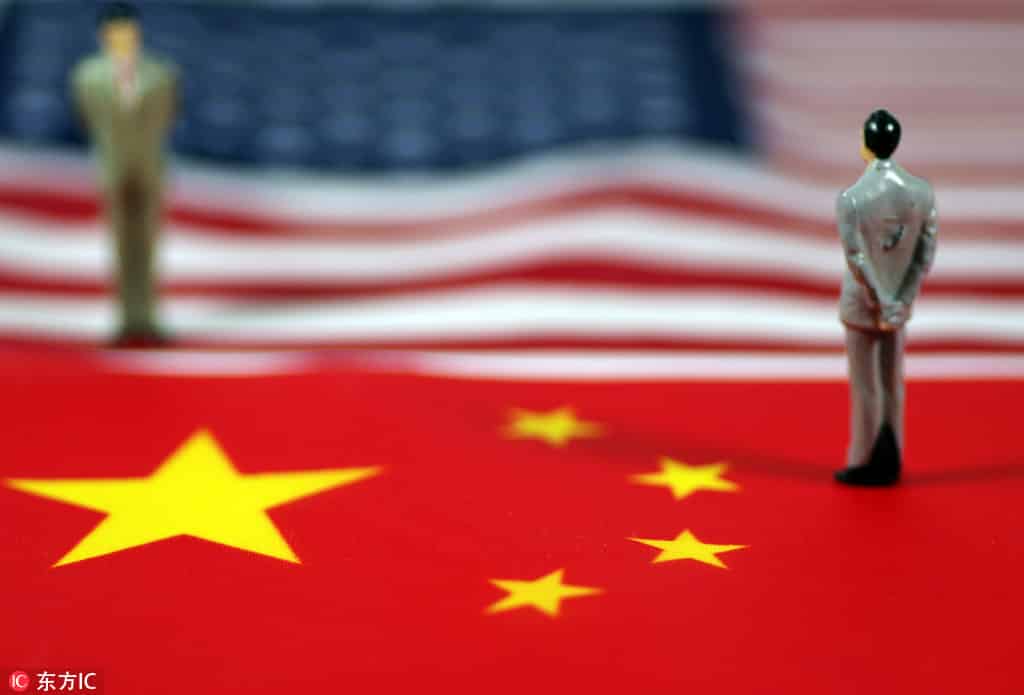
Beijing-has-continually-sought-to-defuse-the-tensions-and-avert-the-new-Cold-War-that-many-are-predicting
Quincy Institute July 1st, 2021 WASHINGTON — In response to the Senate Foreign Relations Committee’s recent vote to advance the Strategic Competition Act of 2021 (SCA), and reports that it will receive a Senate floor vote this week, 66 organizations said: Originally posted on the Quincy Institute’s website on May 17, 2021 here “We, the undersigned organizations that represent millions of people across the United States, are deeply concerned about the growing Cold War mentality driving the U.S. approach to China. Although our organizations may have different mandates or ideological persuasions, we know that the new Cold War with China currently being pushed in Washington does not serve the millions of people demanding change across this country nor the billions of people affected by U.S. foreign policy abroad, and will instead lead to further insecurity and division.  Worryingly, both political parties are increasingly latching onto a dangerously short-sighted worldview that presents China as the...
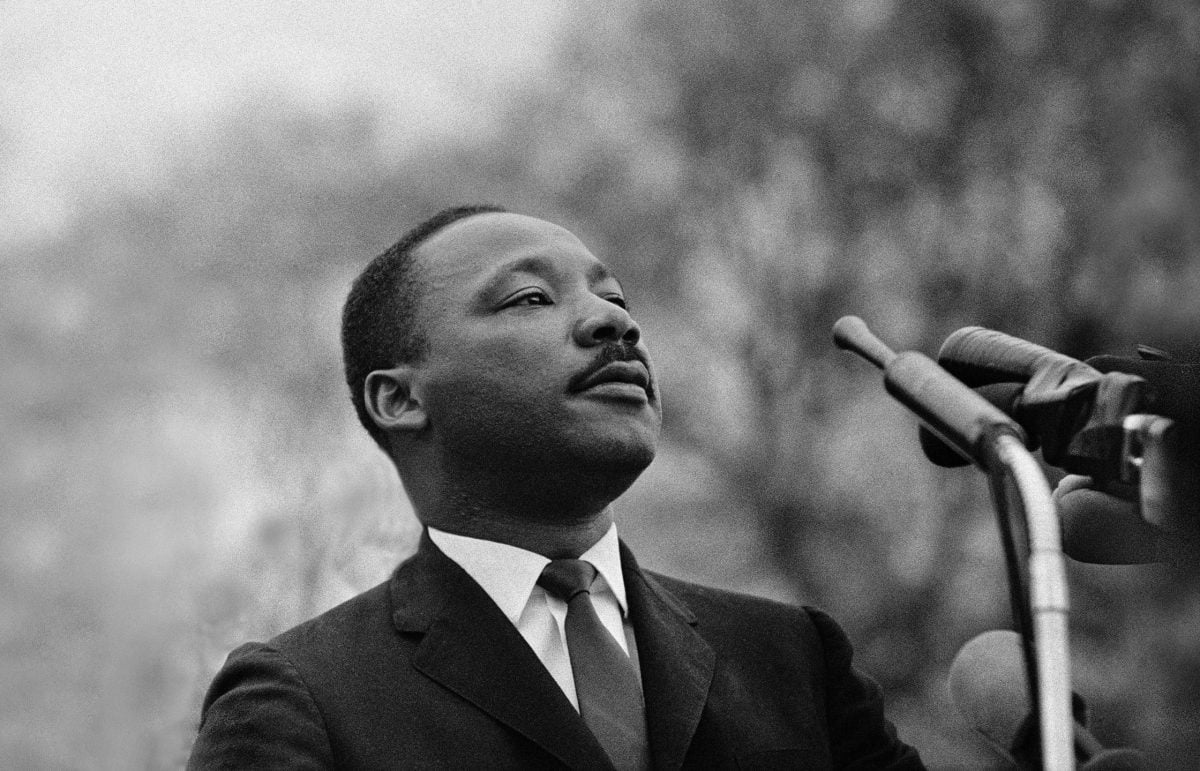
MLK
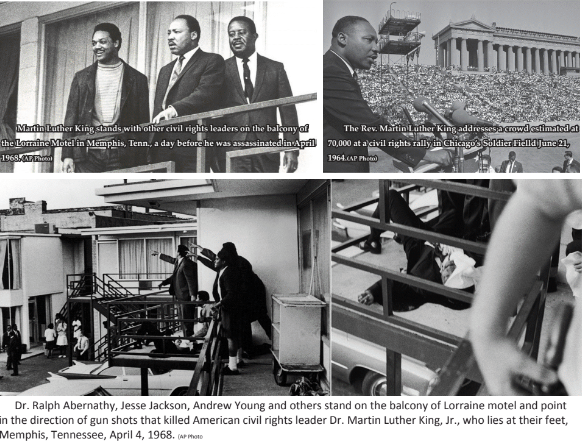
Photo: Martin Luther King. [bswise / CC BY-NC-ND 2.0] Jeff Cohen and Norman Solomon June 29, 2021 The MLK tributes are sure to pour on the anniversary of the civil rights hero’s death, but don’t expect them to acknowledge his anti-militarist ideals. The anniversary of his assassination always brings a flood of tributes to Martin Luther King Jr., and this Sunday will surely be no exception. But those tributes — including from countless organizations calling themselves progressive — are routinely evasive about the anti-militarist ideals that King passionately expressed during the final year of his life. You could call it evasion by omission. The standard liberal canon waxes fondly nostalgic about King’s “I have a dream” speech in 1963 and his efforts against racial segregation. But in memory lane, the Dr. King who lived his last year is persona non grata. Originally published April 21. 2021 at scheerpost.com The pattern is positively Orwellian....
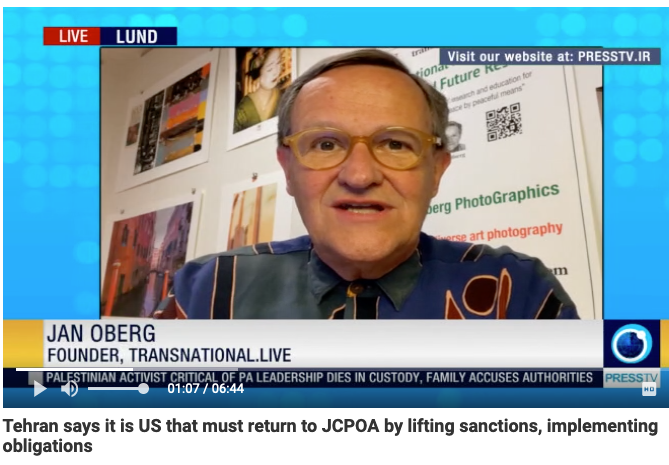
presstv
Comment On June 26, I gave this comment to Iran’s PressTV concerning the drawn-out negotiations in Vienna. The US under Trump left the nuclear agreement – the JCPOA – unilaterally and all it has to do is, simply, to rejoin it unilaterally. It cannot have a legitimate role standing outside shouting in its demands on Iran. Iran’s position is clear and fair: lift the sanctions, stick to the JCPOA and Iran will immediately get back into full compliance. Indeed, what could there to talk about? – Oberg asks. Here is the link to the interview. NOTEIncidentally, I found out a couple of days later that what I say above is also what official China says (July 1, 2021).
peaceprints
Lea Suter, TFF Associate June 21, 2021 Lea Suter, founder of “PeacePrints – Following the Footprints of Peacebuilders” for Peace Reporting on Post-Conflict Countries, Switzerland – and new TFF Associate. Lea has been working in the area of international relations since 2011. First, for the UN, later for a think tank on foreign policy and currently she is the Secretary-General of the UN Association in Switzerland. Originally from Switzerland, she lived in Russia and volunteered in humanitarian projects in Mongolia and Colombia. In 2017, she founded “PeacePrints – Following the Footprints of Peacebuilders” – a blog for which she travels as peace reporter to post-conflict countries to report about outstanding individuals committed to bringing a positive change. Here Lea speaks about her work and how important it is that we know, follow, learn from and honour those millions of fellow citizens around the world who cross borders, reach out and...
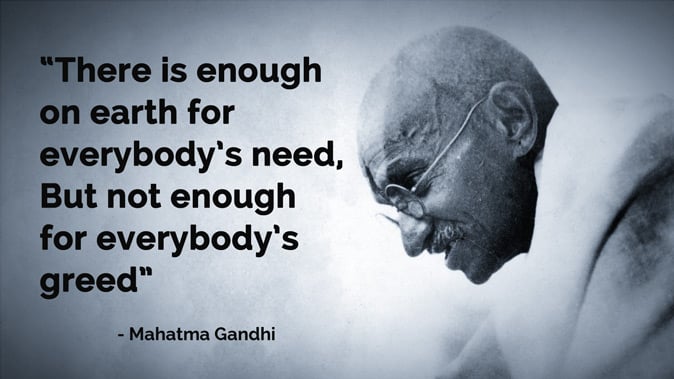
Mahatma-gandhiquote
 Raghav Kaushik May 19, 2021 Gandhi is not well-known for his views on the environment. Indeed, in his vast output, there is little explicit mention of the environment. Yet, in Gandhi’s views, one finds a lot that is relevant to environmentalism. Like most great thinkers, Gandhi’s views are flawed; however we learn a lot by studying his views critically. Let us begin by examining Gandhi’s views on materialism and consumerism. In his lecture on economic and moral progress delivered in 1916, he offers one of the most searing critiques of materialism: “This land of ours was once, we are told, the abode of the gods. It is not possible to conceive gods inhabiting a land which is made hideous by the smoke and the din of mill chimneys and factories and whose roadways are traversed by rushing engines dragging numerous cars crowded with men mostly who know not what they...
gandhi
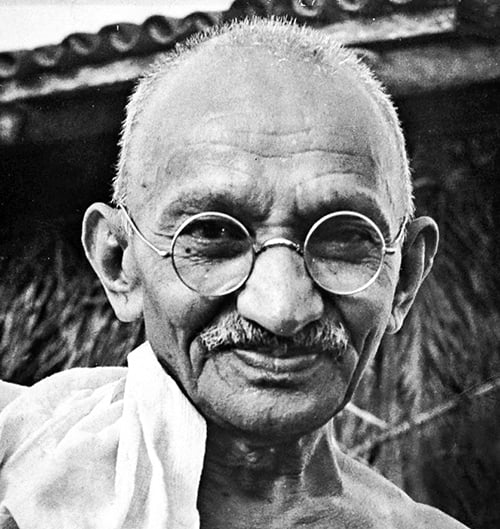
 People’s Union For Civil Liberties May 16, 2021 On 30th January, 2021, we marked the 73rd anniversary of the very date when Mahatma Gandhi was assassinated by someone who did not share his vision of an inclusive and plural India. The PUCL – People’s Union for Civil Liberties – would like to mark this important date by remembering the values which Gandhiji stood for which are under threat today. We want to remember a Gandhiji which the current establishment would rather forget, namely someone who was deeply committed to the ideal of ‘political freedom’ which was not just ‘freedom from the British’ but a commitment to fundamental values and principles. For Gandhiji, “Civil liberties consistent with the observance of non-violence are the first step towards Swaraj. It is the breath of political and social life. It is the foundation of freedom. There is no room there for dilution or compromise....
peopletopeople
First version – to be revised I was recently asked by Abhishek Bhaya at CGTN – China Global Television Network, see Wikipedia here and the network itself here with about 150 million followers across the globe – whether, as a peace researcher, I had any ideas what decision-makers in both the West and in China could do to avoid the worst possible scenario – given the present confrontation, or Cold War-like atmosphere. It’s the first time in a very long time that any media asked me a question about peace – that discourse has disappeared or been disappeared. In preparing my answer, I wrote this: It seems pretty unlikely that the US under Biden/Blinken should come to its senses quickly, if at all. Policy documents, statement and budget laws point in the direction of a well-planned long-term Cold War-like campaign against anything China – 7-8 standard negative stories, perhaps some...
peace-force
William Astore May 6, 2021 Introduction to the article Once upon a time, the Europeans had the copyright on naming lengthy wars: the Hundred Years’ War, the Eighty Years’ War, the Thirty Years’ War. I suspect, however, that it’s past time for the U.S. to enter that competition. After all, soon after we arrive at September 11, 2021, barring a genuine surprise, this country will have been fighting its twenty-first-century wars unsuccessfully for two decades. In other words, the conflict launched as the Global War on Terror in the days after the 9/11 attacks (the one that then-Secretary of Defense Donald Rumsfeld imagined targeting terror networks in up to 60 countries) has never either faintly succeeded or ended. It’s only spread to ever newer realms of death and disaster in distant lands (while bouncing back on this country in ever stranger ways), even as trillions and trillions of taxpayer dollars went down the drain. Shouldn’t the increasingly riven citizens of...
FreeComposition_1_1200_100dpi
En kritisk analys av en rapport från Newlines Institute och Raoul Wallenberg Center Gordon Dumoulin, Jan Oberg och Thore Vestby Transnationella Stiftelsen för Freds- och Framtidsforskning, TFF, Lund, Sverige TFF@transnational.org • The Transnational • Ph +46 (0) 738 525200 Översättning av engelska utgåvan: Rolf Nilsson Den 5. maj, 2021 Den 8 mars 2021 publicerade Newlines Institute for Strategy and Policy i Washington en rapport, The Uyghur Genocide: An Examination of China’s Breaches of the 1948 Genocide Convention i samarbete med Raoul Wallenberg Centre for Human Rights i Montreal. Den säger att ”Denna rapport är den första oberoende experttillämpningen av folkmordskonventionen från 1948 för den pågående behandlingen av uigurerna i Kina. Det genomfördes av Newlines Institute for Strategy and Policy, i samarbete med Raoul Wallenberg Center for Human Rights, som svar på framväxande redogörelser för allvarliga och systematiska grymheter i Xinjiang-provinsen, särskilt riktade mot uigurerna, en etnisk minoritet, för att fastställa...
BaldwinMead
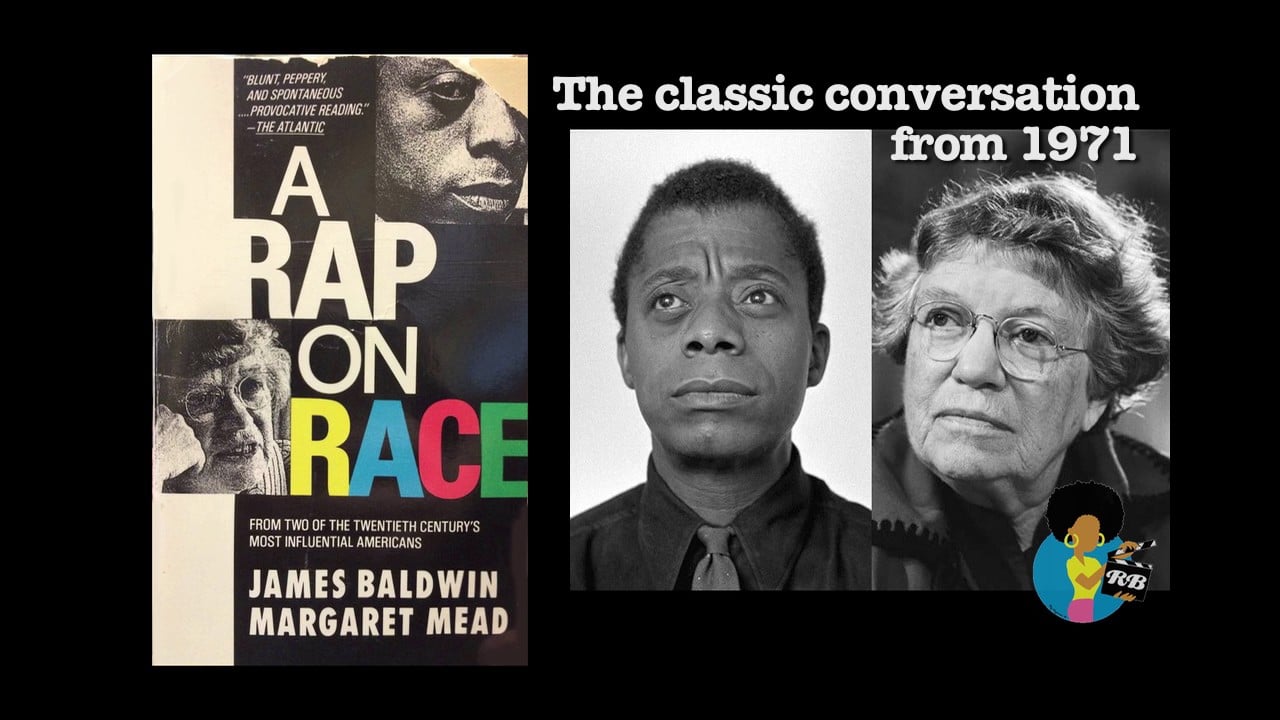
“We’ve got to be as clear-headed about human beings as possible because we are still each other’s only hope.” Maria Popova April 23, 2020 NOTE: This is the first installment in a multi-part series covering Mead and Baldwin’s historic conversation. Part 2 focuses on identity, race, and the immigrant experience; part 3 on changing one’s destiny; part 4 on reimagining democracy for a post-consumerist culture. On the evening of August 25, 1970, Margaret Mead (December 16, 1901–November 15, 1978) and James Baldwin (August 2, 1924–December 1, 1987) sat together on a stage in New York City for a remarkable public conversation about such enduring concerns as identity, power and privilege, race and gender, beauty, religion, justice, and the relationship between the intellect and the imagination. By that point, Baldwin, forty-six and living in Paris, was arguably the world’s most famous living poet, and an enormously influential voice in the civil rights dialogue; Mead, who was about to turn seventy, had become...
MLK50
Edward Curtin April 13, 2021 “I don’t believe in death without resurrection. If they kill me, I will rise again in the Salvadorian people…”  – Archbishop Oscar Romero, martyred, 24 March 1980 Whether we are aware of it or not, we live by stories. We live by others’ stories while we tell our lives by how we live.  Our actions tell our stories. Then when we die, others tell our stories as they wish. This is the spiritual thread that links the meanings of our lives.  It is the way we pass over to other lives and return to our own. But without truth, we end up in the wrong place, living the wrong stories. And don’t the stories of certain special people inspire us to carry on their legacies because their spirits are far stronger than death? Their courage contagious? Their witness the triumph of life over death? Love over hate? Don’t they challenge...
Categories

Year

Author / Contributor

Region