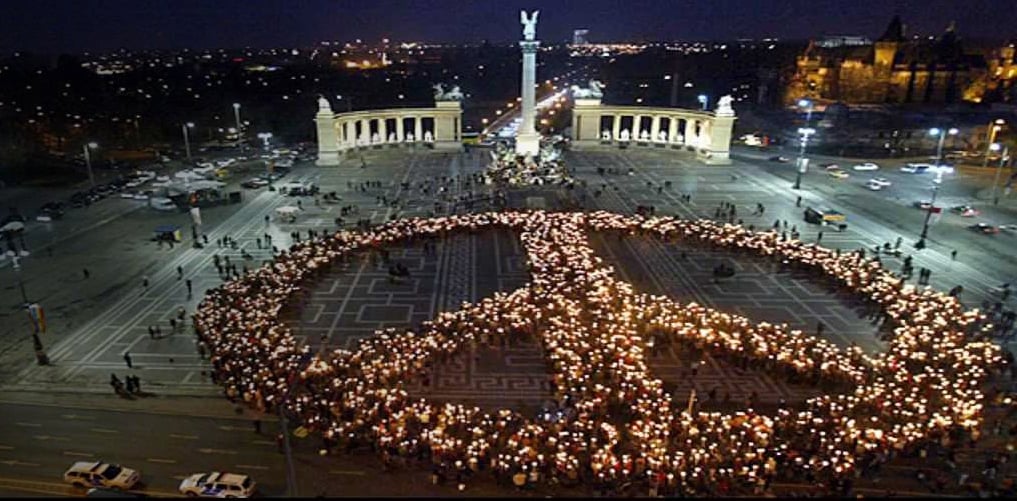
The addiction to militarism spells the end of the US as we know it

, the US taxpayers are paying US $ 32 million. That is now close to US$ 5000 billion in total!

Add to that the tragedy of the absurd: from Vietnam to Syria, 1955 till today or 64 years, there is no documentable evidence that all of its wars, interventions, occupations, meddlings, regime changes have been anything but failures.

There is no evidence either that today’s world is a better place than it would have been without these wars, alliances, deterrence and confrontational policies.

But there is plenty of hard evidence that the United States of America is in relative decline as a world power. Plenty of facts to show that others – who spend much less on their military and have no Empire – are growing and destined to surpass the US on fundamental indicators in just a few years.

As the largest military machine in human history, it has lost wars in small countries, lost the battles for local people’s hearts and lost the media wars too. On its way to these – predictable – fiascos, it has systematically violated international law, including UN Charter norms, and thrown out every moral criterion.

It has lacked exit strategies, left countries and cultures worse than when it entered. It has – thereby – caused most of the terrorism problem it maintains that it must fight worldwide since 9/11: It’s now a perfect perpetuum mobile to hell.

Militarism has ended the US where it is today: one of the most hated and least trusted major actors.

The peace that was promised the American people and humanity at each increase of the costs turned out – every single time – to be false. There was always a need for more, more, and more, always a new enemy or an old enemy doing new bad things.

eople believed it because they were told to fear, told that their fear would only go away if the military got more.

In summary, the diagnosis should be pretty obvious: Uncontrollable addiction. Denial. Delusion. It is not healthy. It is a life-threatening disease for which the patient should seek help.

Various aspects of these costs are calculated on a still-counting basis by the Massachusetts-based National Priorities Project of the Institute for Policy Studies and the Cost of War Project at Brown University. (No, this is not a Russian/Putin propaganda operation).

You should browse these two sites if you are interested in the issues as such and if you are tired of being told that all the rest of the world are bad guys while the U.S. seeks only peace.

You simply do not seek peace with these priorities:

And, as The Guardian correctly points out, “A budget shows our values more clearly than any tweet, campaign speech, or political slogan”.

As you can see, pure defence (the Pentagon budget) takes 57% of the FY 2020 discretionary Trump budget. Add to that Homeland Security 4% and Veterans Affairs 7%.

Add to that what is not here, namely interest on war debt. Every hour, taxpayers in the US are paying $ 10.05 million on that since 2001. And add some of Energy’s work related to nuclear weapons etc. – and we are talking about a country that spends at least 70% of its national budget on militarism… US$ 34 million per hour…

Depending on which research institute you rely on and what budget items you include in the concept of “military expenditures”, the US alone stands for 45 to 55% of the world’s total military (“defence”) expenditures.

And, still, it feels threatened all the time, pointing constantly at this or that enemy – be it Iran, North Korea, Russia, China – all de facto dwarfs when compared with the U.S.

Now, money is of course not the only and perhaps not the most important measure of the costs of militarism. Here’s the human toll:


Isn’t it heart-breaking? The facts are available. Why don’t you hear about them? Why don’t they make top stories anywhere?

Militarism is a major, never-mentioned – destroyer of the environment and misuser of nature’s resources. How often is that mentioned in the reports about climate change – or, rather global warming, pollution, resource depletion?

Militarism – sold as “defence”, “stability”, “security” and “peace” – is a de facto mass killer, a mass destroyer, a massive waste of scarce resources in times of socio-economic crisis – and for what is wasted on militarism, we could build a wonderful world (the so-called opportunity costs calculation).

Imagine a US president who would declare that s/he would cut these costs by, say, 50% and allocate those US$ 500-600 billion annually to both make the US itself a better country to live in and invest in doing good around the rest of the world.

The US would immediately become the most respected and loved country on earth – two things it lacks today. And by that, it would become much more secure.

You probably don’t hear about these facts – but surely and all the time about the bad guys out there – because there is something called propaganda, fake and omission. And something called self-censorship and paid, commissioned research that legitimates the addiction.

Sadly, the ever-narrowing interpretation of freedom of speech and writing and of truly free research prevents these figures from being part of the public discourse. They are systematically omitted from the public eye, even from critical media and academia.

And who and what masterminds these mechanisms? Of course, those who profit – economically or otherwise – from militarism: The MIMAC – that is, the Military-Industrial-Media-Academic Complex.

In 1961, in his farewell speech, president Dwight D. Eisenhower, warned the American people about the fundamental dangers that he called the “Military-Industrial Complex” (MIC). He saw it as a mortal threat to democracy and freedom and only an alert citizenry would be able to keep it in its rightful place in society.

Please see these 3 minutes of his historic speech backed up by research and background information. And you’ll understand better how far the cancer of US militarism has grown and how it threatens to destroy US society and its democracy:


The West – led by the United States of American – is not only committing a slow suicide because of its addiction to militarism – enough is never enough, as the above figures tell – it is also in denial about its major problem. And it’s a problem unique in scope, depth and dependence to that particular civilization.

There is no way this can go well in the long run.

A society that normally spends 70% of its taxpayers’ money on war and 5% only on education is doomed. It’s as tragic as can be and there are no signs that political and military decision-makers or major research institutions and think tanks have even begun to deal with that manifest denial.

The Trump administration’s budget is the largest ever. It’s delusional to believe it will make the US great, loved and secure.

It will maintain the US as the world’s leading rogue state and isolate it more and more from the rest of human civilization. It spells new wars in the future.

Please, now study the links above carefully. And if you shed a tear at the thought of how much good these sums could instead have bought – and can buy – the American people and the rest of humanity, your tears only prove that you are a human and that you have empathy. Use that humanity before it’s too late!

  1. I write this article with deep regret since I have never been “anti-American” but, rather, admired the society, its creativity and arts. I have, however, fought against its Empire and every one of its military actions since the Vietnam War. I firmly believe the US will only survive and prosper in the long run if it rids itself of its Empire and militarism.
  2. The photo above is of the “Portable War Memorial” (1968) by Edward Kienholz, US artist – one of the most important. Here a video of it and here a background.


Peace & future researcher + ‌Art Photographer

3 Responses

  1. Thank you Jan, this quietly spoken sincere piece… is the best on this subject I have read in a VERY long time… it is so true, so sadly true…

  2. Another excellent article on a major issue of our time that has blighted the lives of millions of people all over the world. You hit the nail on the head when you refer to militarism as an addiction. It is illogical, unnecessary, dangerous and harmful to the United States and to the world. One of the reasons for Germany’s economic success since World War II has been the fact that it had been barred from having a big military. The sooner Americans realise this and cure their addiction the better.

  3. Why not run your analysis fuirther back in time? The US could have avoided involvement in both world wars if its leaders had been men of peace and not arrogant fools. The more a person looks into Woodrow Wilson and Franklin Roosevelt (with all the truths that have come to light over the years about both men and their administrations), the more that person realizes that the US has been and remains one of the biggest threats to world peace in all of history. The founders wanted a republic, not an empire.

Related Posts

The Quest for Humane Survival Richard Falk Professor emeritus, Princeton UniversityTFF Associate since 1986October 12, 2026 After decades of teaching and writing about international law in academic frameworks that were not institutionally situated within law school environments—at Princeton and the University of California, Santa Barbara—I found myself most receptive to the TWAIL outlook. It has been especially illuminating in clarifying the extent to which international law evolved as a dialogical critique of Europe’s efforts to legitimize its colonial undertakings. In particular, TWAIL has exposed how international law has functioned to legalize the subjugation of Third World peoples, securing conditions for exploitative investment and trade relations, the coercive enforcement of public debts, and an ideology of cultural superiority. TWAIL’s exposure of these economic legacies of colonialism has influenced my understanding of the history and development of international law, broadly conceived, as an ideological project of the Western sub-system of the world...
Small and different + among the 10% most active + 9,000 texts + 150 Associates + 60 000 a day — and a stubborn belief that peace is smarter and must be secured by peaceful means. In 2026, the Transnational Foundation for Peace and Future Research (TFF) turns 40. On Monday, October 5, 2026, a new TFF homepage will go live — a new gateway to more than 9,000 articles, analyses, research papers and other contributions produced over four decades of independent peace research. But this is not simply a new website. For four decades, TFF has worked from a simple conviction: peace is smarter than militarism and can be brought about by peaceful means. This is not merely an aspiration. It is the principle expressed in the UN Charter and the Gandhian tradition that has guided our work from the beginning. TFF is a research-based, independent and people-financed foundation....
Johan Galtung 1930-2024October 2015 Published here on October 3, 2026 Let us focus on Civilization for conflict analysis and remedies. Major forms of disorder use violence; war is state organized violence. The most belligerent states are the United States of America and Israel, both with civilization roots. National Evangelism, the US Protestant Christian civilization– more national than evangelical–justifies US warfare as exceptionalism of a people chosen by God, with a manifest destiny to run the world. Orthodox Judaism justifies Israeli warfare to conquer and expand from Nile to Euphrates as a religious right and duty to the Eternal One. The third most belligerent country, the UK, no longer believes it is God-chosen but chosen by the USA; not quite the same but something. But the root cause of global disorder lies in the Occident–with Islam–seeing itself as the single, universal civilization valid for all at all times, all others being...

Recent Articles

The Quest for Humane Survival Richard Falk Professor emeritus, Princeton UniversityTFF Associate since 1986October 12, 2026 After decades of teaching and writing about international law in academic frameworks that were not institutionally situated within law school environments—at Princeton and the University of California, Santa Barbara—I found myself most receptive to the TWAIL outlook. It has been especially illuminating in clarifying the extent to which international law evolved as a dialogical critique of Europe’s efforts to legitimize its colonial undertakings. In particular, TWAIL has exposed how international law has functioned to legalize the subjugation of Third World peoples, securing conditions for exploitative investment and trade relations, the coercive enforcement of public debts, and an ideology of cultural superiority. TWAIL’s exposure of these economic legacies of colonialism has influenced my understanding of the history and development of international law, broadly conceived, as an ideological project of the Western sub-system of the world...
Advocates of nuclear disarmament are regularly dismissed by the champions of nuclear deterrence as naïve and unrealistic, utopian or even irresponsible. Yet this ‘doctrine’ of deterrence, regarded by France as the ‘cornerstone’ of its national security, is based on quasi-religious beliefs, a theory that cannot be proven, risky gambles and fragile assumptions. So much so that one might legitimately ask which side the ‘Care Bears’ are on. Marc FinaudVice-President of Initiatives for Nuclear Disarmament (IDN) October 9, 2026 This article was originally published on Pressenza When it comes to these things being treated as religious concepts, look here. Idealists and realists It was Hubert Védrine, François Mitterrand’s former Foreign Minister, who repeatedly coined the phrase: ‘Europeans are a sort of Care Bears who don’t realise they’re living in Jurassic Park’. He applies this reference to the cartoon for well-behaved children not only to what he regards as weakness or idealism...
What the West Borrowed from Asia and What It Left Behind Jan Krikke October 8, 2026 The article was originally published here In the late 1960s, the musical Hair announced that the Age of Aquarius was dawning. Its opening anthem promised a transformation of human consciousness: an era of peace, harmony and understanding. Half a century later, a familiar echo of that promise is a meditation app offered by your employer. You can find it in the same list of benefits as the pension plan and the gym discount. How did a spiritual revolution become an employee benefit? The answer lies in the history of the movement known as New Age: where it came from, what it borrowed from Asia, and why the meaning of what it borrowed changed in the process. Two definitions will help. New Age is a loose label for a wide range of spiritual practices and...

TFF on Substack

Discover and subscribe to more peace materials on TFF Substack

Most Popular

The Quest for Humane Survival Richard Falk Professor emeritus, Princeton UniversityTFF Associate since 1986October 12, 2026 After decades of teaching and writing about international law in academic frameworks that were not institutionally situated within law school environments—at Princeton and the University of California, Santa Barbara—I found myself most receptive to the TWAIL outlook. It has been especially illuminating in clarifying the extent to which international law evolved as a dialogical critique of Europe’s efforts to legitimize its colonial undertakings. In particular, TWAIL has exposed how international law has functioned to legalize the subjugation of Third World peoples, securing conditions for exploitative investment and trade relations, the coercive enforcement of public debts, and an ideology of cultural superiority. TWAIL’s exposure of these economic legacies of colonialism has influenced my understanding of the history and development of international law, broadly conceived, as an ideological project of the Western sub-system of the world...
Advocates of nuclear disarmament are regularly dismissed by the champions of nuclear deterrence as naïve and unrealistic, utopian or even irresponsible. Yet this ‘doctrine’ of deterrence, regarded by France as the ‘cornerstone’ of its national security, is based on quasi-religious beliefs, a theory that cannot be proven, risky gambles and fragile assumptions. So much so that one might legitimately ask which side the ‘Care Bears’ are on. Marc FinaudVice-President of Initiatives for Nuclear Disarmament (IDN) October 9, 2026 This article was originally published on Pressenza When it comes to these things being treated as religious concepts, look here. Idealists and realists It was Hubert Védrine, François Mitterrand’s former Foreign Minister, who repeatedly coined the phrase: ‘Europeans are a sort of Care Bears who don’t realise they’re living in Jurassic Park’. He applies this reference to the cartoon for well-behaved children not only to what he regards as weakness or idealism...
What the West Borrowed from Asia and What It Left Behind Jan Krikke October 8, 2026 The article was originally published here In the late 1960s, the musical Hair announced that the Age of Aquarius was dawning. Its opening anthem promised a transformation of human consciousness: an era of peace, harmony and understanding. Half a century later, a familiar echo of that promise is a meditation app offered by your employer. You can find it in the same list of benefits as the pension plan and the gym discount. How did a spiritual revolution become an employee benefit? The answer lies in the history of the movement known as New Age: where it came from, what it borrowed from Asia, and why the meaning of what it borrowed changed in the process. Two definitions will help. New Age is a loose label for a wide range of spiritual practices and...
Read More
law-419057_1280
The Quest for Humane Survival Richard Falk Professor emeritus, Princeton UniversityTFF Associate since 1986October 12, 2026 After decades of teaching and writing about international law in academic frameworks that were not institutionally situated within law school environments—at Princeton and the University of California, Santa Barbara—I found myself most receptive to the TWAIL outlook. It has been especially illuminating in clarifying the extent to which international law evolved as a dialogical critique of Europe’s efforts to legitimize its colonial undertakings. In particular, TWAIL has exposed how international law has functioned to legalize the subjugation of Third World peoples, securing conditions for exploitative investment and trade relations, the coercive enforcement of public debts, and an ideology of cultural superiority. TWAIL’s exposure of these economic legacies of colonialism has influenced my understanding of the history and development of international law, broadly conceived, as an ideological project of the Western sub-system of the world...
images-2
Advocates of nuclear disarmament are regularly dismissed by the champions of nuclear deterrence as naïve and unrealistic, utopian or even irresponsible. Yet this ‘doctrine’ of deterrence, regarded by France as the ‘cornerstone’ of its national security, is based on quasi-religious beliefs, a theory that cannot be proven, risky gambles and fragile assumptions. So much so that one might legitimately ask which side the ‘Care Bears’ are on. Marc FinaudVice-President of Initiatives for Nuclear Disarmament (IDN) October 9, 2026 This article was originally published on Pressenza When it comes to these things being treated as religious concepts, look here. Idealists and realists It was Hubert Védrine, François Mitterrand’s former Foreign Minister, who repeatedly coined the phrase: ‘Europeans are a sort of Care Bears who don’t realise they’re living in Jurassic Park’. He applies this reference to the cartoon for well-behaved children not only to what he regards as weakness or idealism...
8824b09f-33a5-43f9-9fd0-550f28cda24d_1536x1024
What the West Borrowed from Asia and What It Left Behind Jan Krikke October 8, 2026 The article was originally published here In the late 1960s, the musical Hair announced that the Age of Aquarius was dawning. Its opening anthem promised a transformation of human consciousness: an era of peace, harmony and understanding. Half a century later, a familiar echo of that promise is a meditation app offered by your employer. You can find it in the same list of benefits as the pension plan and the gym discount. How did a spiritual revolution become an employee benefit? The answer lies in the history of the movement known as New Age: where it came from, what it borrowed from Asia, and why the meaning of what it borrowed changed in the process. Two definitions will help. New Age is a loose label for a wide range of spiritual practices and...
Screenshot 2026-10-04 210142
Small and different + among the 10% most active + 9,000 texts + 150 Associates + 60 000 a day — and a stubborn belief that peace is smarter and must be secured by peaceful means. In 2026, the Transnational Foundation for Peace and Future Research (TFF) turns 40. On Monday, October 5, 2026, a new TFF homepage will go live — a new gateway to more than 9,000 articles, analyses, research papers and other contributions produced over four decades of independent peace research. But this is not simply a new website. For four decades, TFF has worked from a simple conviction: peace is smarter than militarism and can be brought about by peaceful means. This is not merely an aspiration. It is the principle expressed in the UN Charter and the Gandhian tradition that has guided our work from the beginning. TFF is a research-based, independent and people-financed foundation....
Living-Peace-Sign-Budapest-copy
Tony Robinson October 4, 2026 Violence is easy to recognise when someone is being beaten, shot or killed. It becomes more difficult when nobody is holding a weapon. Poverty, discrimination, exploitation and repression can restrict a human life just as effectively, although they do so in very different ways and with very different consequences. Simply adding more categories to an ever-growing list of forms of violence does not really solve the problem. The more interesting question is what all these different situations have in common and why it makes sense to describe them using the same word. Human beings do not simply react to what happens around them. They remember the past, imagine things that do not yet exist, make plans and undertake projects. Workers organise because they imagine different working conditions; people migrate because they imagine another life somewhere else; social movements emerge because people refuse to accept the...
b54a1f10-8c65-4f0b-9dd5-4abc0a7d04cc_2659x2659
It’s a matter of principles, courage, vision and pulling together – while the militarist world is falling apart… Peter Langille October 3, 2026 “Here, then, is the problem which we present to you, stark and dreadful and inescapable: Shall we put an end to the human race; or shall mankind renounce war?”The Bertrand Russell—Albert Einstein Manifesto, July 9, 1955 ⁕ The forecast for what’s ahead is worrisome. The sharp rise in armed conflicts over the past three years is adding to what was already the highest level in over seventy years. Genocides, which should be prevented are supported. A shared climate emergency that jeopardises survival is ignored. Diverse polls now suggest that people are war-weary, worried and interested in a more effective United Nations. And, there are viable policy options for a more secure world! Yet governments are doubling-down, betting on more war and investing heavily. If current trends persist,...