
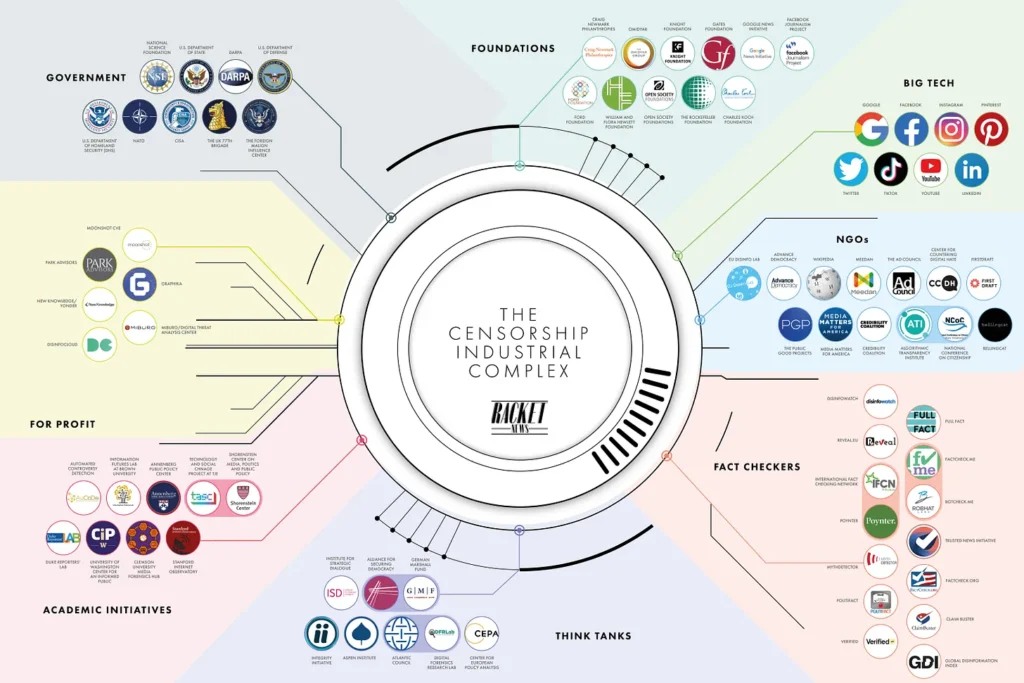
Report on the Censorship-Industrial Complex: The Top 50 Organizations to Know

The citizen’s starter kit to understanding the new global information cartel

Susan Schmidt,

Andrew Lowenthal,

Tom Wyatt,

Techno Fog, and 4 others

Originally published by Racket News on Substack on May 10, 2023

Introduction by Matt Taibbi

On January 17, 1961, outgoing President and former Supreme Allied Commander Dwight D. Eisenhower gave one of the most consequential speeches in American history. Eisenhower for eight years had been a popular president, whose appeal drew upon a reputation as a person of great personal fortitude, who’d guided the United States to victory in an existential fight for survival in World War II. Nonetheless, as he prepared to vacate the Oval Office for handsome young John F. Kennedy, he warned the country it was now at the mercy of a power even he could not overcome. 

Until World War II, America had no permanent arms manufacturing industry. Now it did, and this new sector, Eisenhower said, was building up around itself a cultural, financial, and political support system accruing enormous power. This “conjunction of an immense military establishment and a large arms industry is new in the American experience,” he said, adding:

In the councils of government, we must guard against the acquisition of unwarranted influence, whether sought or unsought, by the military-industrial complex. The potential for the disastrous rise of misplaced power exists and will persist. 

We must never let the weight of this combination endanger our liberties or democratic processes… Only an alert and knowledgeable citizenry can compel the proper meshing of the huge industrial and military machinery of defense with our peaceful methods and goals, so that security and liberty may prosper together. 

This was the direst of warnings, but the address has tended in the popular press to be ignored. After sixty-plus years, most of America – including most of the American left, which traditionally focused the most on this issue – has lost its fear that our arms industry might conquer democracy from within. 

Now, however, we’ve unfortunately found cause to reconsider Eisenhower’s warning.

While the civilian population only in recent years began haggling over “de-platforming” incidents involving figures like Alex Jones and Milo Yiannopoulos, government agencies had already long been advancing a new theory of international conflict, in which the informational landscape is more importantly understood as a battlefield than a forum for exchanging ideas. In this view, “spammy” ads, “junk” news, and the sharing of work from “disinformation agents” like Jones aren’t inevitable features of a free Internet, but sorties in a new form of conflict called “hybrid warfare.” 

In 1996, just as the Internet was becoming part of daily life in America, the U.S. Army published “Field Manual 100-6,” which spoke of “an expanding information domain termed the Global Information Environment” that contains “information processes and systems that are beyond the direct influence of the military.” Military commanders needed to understand that “information dominance” in the “GIE” would henceforth be a crucial element for “operating effectively.”

You’ll often see it implied that “information operations” are only practiced by America’s enemies, because only America’s enemies are low enough, and deprived enough of real firepower, to require the use of such tactics, needing as they do to “overcome military limitations.” We rarely hear about America’s own lengthy history with “active measures” and “information operations,” but popular media gives us space to read about the desperate tactics of the Asiatic enemy, perennially described as something like an incurable trans-continental golf cheat.

Indeed, part of the new mania surrounding “hybrid warfare” is the idea that while the American human being is accustomed to living in clear states of “war” or “peace,” the Russian, Chinese, or Iranian citizen is born into a state of constant conflict, where war is always ongoing, whether declared or not. In the face of such adversaries, America’s “open” information landscape is little more than military weakness.

In March of 2017, in a hearing of the House Armed Services Committee on hybrid war, chairman Mac Thornberry opened the session with ominous remarks, suggesting that in the wider context of history, an America built on constitutional principles of decentralized power might have been badly designed:

Americans are used to thinking of a binary state of either war or peace. That is the way our organizations, doctrine, and approaches are geared. Other countries, including Russia, China, and Iran, use a wider array of centrally controlled, or at least centrally directed, instruments of national power and influence to achieve their objectives…

Whether it is contributing to foreign political parties, targeted assassinations of opponents, infiltrating non-uniformed personnel such as the little green men, traditional media and social media, influence operations, or cyber-connected activity, all of these tactics and more are used to advance their national interests and most often to damage American national interests… 

The historical records suggest that hybrid warfare in one form or another may well be the norm for human conflict, rather than the exception.

Around that same time, i.e. shortly after the election of Donald Trump, it was becoming gospel among the future leaders of the “Censorship-Industrial Complex” that interference by “malign foreign threat actors” and the vicissitudes of Western domestic politics must be linked. Everything, from John Podesta’s emails to Trump’s Rust Belt primary victories to Brexit, were to be understood first and foremost as hybrid war events.

This is why the Trump-Russia scandal in the United States will likely be remembered as a crucial moment in 21st-century history, even though the investigation superficially ended a non-story, fake news in itself. What the Mueller investigation didn’t accomplish in ousting Trump from office, it did accomplish in birthing a vast new public-private bureaucracy devoted to stopping “mis-, dis-, and malinformation,” while smoothing public acquiescence to the emergence of a spate of new government agencies with “information warfare” missions. 

The “Censorship-Industrial Complex” is just the Military-Industrial Complex reborn for the “hybrid warfare” age.

Much like the war industry, pleased to call itself the “defense” sector, the “anti-disinformation” complex markets itself as merely defensive, designed to fend off the hostile attacks of foreign cyber-adversaries who unlike us have “military limitations.” The CIC, however, is neither wholly about defense, nor even mostly focused on foreign “disinformation.” It’s become instead a relentless, unified messaging system aimed primarily at domestic populations, who are told that political discord at home aids the enemy’s undeclared hybrid assault on democracy. 

They suggest we must rethink old conceptions about rights, and give ourselves over to new surveillance techniques like “toxicity monitoring,” replace the musty old free press with editors claiming a “nose for news” with an updated model that uses automated assignment tools like “newsworthy claim extraction,” and submit to frank thought-policing mechanisms like the “redirect method,” which sends ads at online browsers of dangerous content, pushing them toward “constructive alternative messages.”

Binding all this is a commitment to a new homogeneous politics, which the complex of public and private agencies listed below seeks to capture in something like a Unified Field Theory of neoliberal narrative, which can be perpetually tweaked and amplified online via algorithm and machine learning. This is what some of the organizations on this list mean when they talk about coming up with a “shared vocabulary” of information disorder, or “credibility,” or “media literacy.”

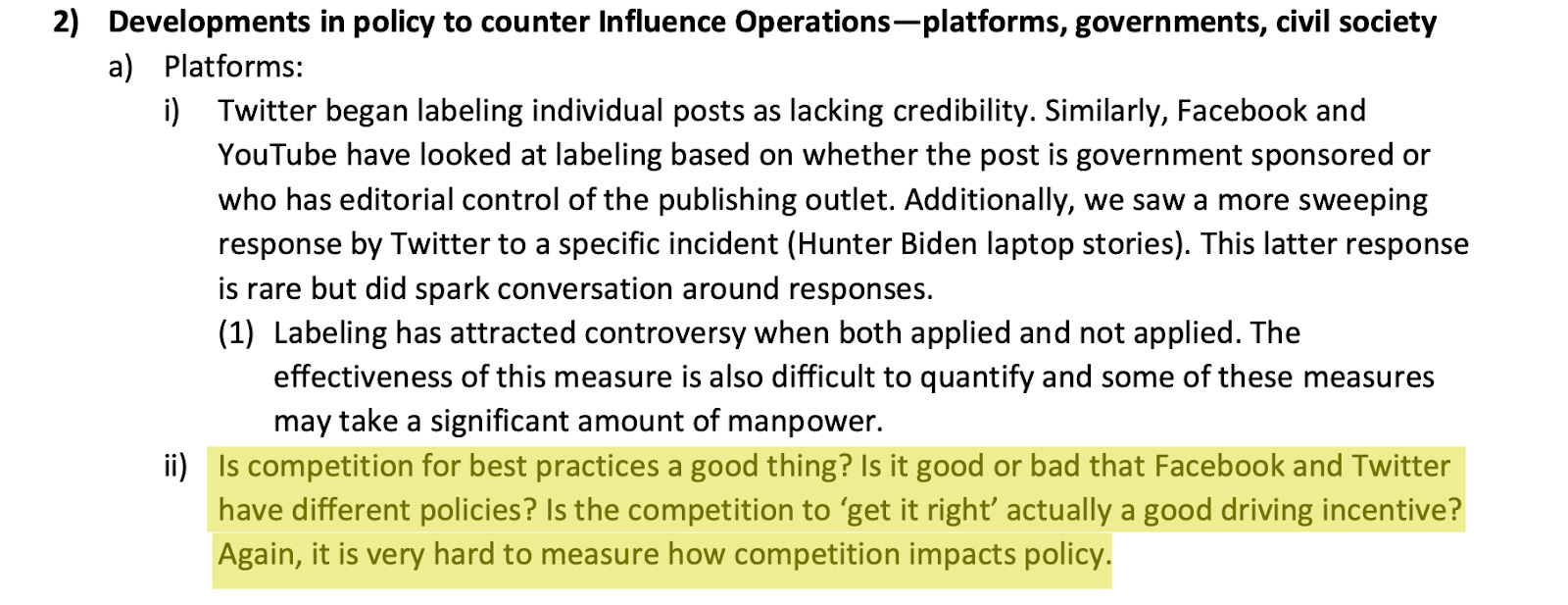
Anti-disinformation groups talk endlessly about building “resilience” to disinformation (which in practice means making sure the public hears approved narratives so often that anything else seems frightening or repellent), and audiences are trained to question not only the need for checks and balances, but competition. Competition is increasingly frowned upon not just in the “marketplace of ideas” (an idea itself more and more often described as outdated), but in the traditional capitalist sense. In the Twitter Files we repeatedly find documents like this unsigned “Sphere of Influence” review circulated by the Carnegie Endowment that wonders aloud if tech companies really need to be competing to “get it right”:
In place of competition, the groups we’ve been tracking favor the concept of the “shared endeavor” (one British group has even started a “Shared Endeavour” program), in which key “stakeholders” hash out their disagreements in private, but present a unified front.

Who are the leaders of these messaging campaigns? If you care to ask, the groups below are a good place to start. 

“The Top 50 List” is intended as a resource for reporters and researchers beginning their journey toward learning the scale and ambition of the “Censorship-Industrial Complex.” Written like a magazine feature, it tries to answer a few basic questions about funding, organization type, history, and especially, methodology. Many anti-disinformation groups adhere to the same formulaic approach to research, often using the same “hate-mapping,” guilt-by-association-type analysis to identify wrong-thinkers and suppressive persons. There is even a tendency to use what one Twitter Files source described as the same “hairball” graphs.

Where they compete, often, is in the area of gibberish verbiage describing their respective analytical methods. My favorite came from the Public Good Projects, which in a display of predictive skills reminiscent of the “unsinkable Titanic” described itself as the “Buzzfeed of public health.” 

Together, these groups are fast achieving what Eisenhower feared: the elimination of “balance” between the democratic need for liberalizing laws and institutions, and the vigilance required for military preparation. Democratic society requires the nourishment of free debate, disagreement, and intellectual tension, but the groups below seek instead that “shared vocabulary” to deploy on the hybrid battlefield. They propose to serve as the guardians of that “vocabulary,” which sounds very like the scenario Ike outlined in 1961, in which “public policy could itself become the captive of a scientific and technological elite.”

Without further ado, continue reading this introduction to the main – 50 – players in this “CIC”.


Related Posts

Tony Robinson October 4, 2026 Violence is easy to recognise when someone is being beaten, shot or killed. It becomes more difficult when nobody is holding a weapon. Poverty, discrimination, exploitation and repression can restrict a human life just as effectively, although they do so in very different ways and with very different consequences. Simply adding more categories to an ever-growing list of forms of violence does not really solve the problem. The more interesting question is what all these different situations have in common and why it makes sense to describe them using the same word. Human beings do not simply react to what happens around them. They remember the past, imagine things that do not yet exist, make plans and undertake projects. Workers organise because they imagine different working conditions; people migrate because they imagine another life somewhere else; social movements emerge because people refuse to accept the...
Photos © TFF 2000 Read PressInfo 90 “Lift the Sanctions and Bring More Aid to Yugoslavia” See Pictures from Belgrade © TFF 2000 Please reprint, copy, archive, quote or re-post this item, but please retain the source.
PART 2 — Diplomacy, Law and Nonviolent Power By Jan ObergTFF co-founder and director January 26, 2026 This is the second of four TFF-created idea portfolios designed to curb the global reach of the United States and, in both the short and long term, help catalyse a worldwide nonviolent resistance to what many observers describe as the Trump administration’s uniquely confrontational, destructive and world-threatening policies. These portfolios outline what governments and citizens across the world can do through dynamic diplomacy, creative initiatives, and strictly nonviolent means. They are typical TFF works in that we do not only tell what the problem is and how bad it will go – as 90+% of all commentators, experts and scholars do – we tell what we think can be done, inviting you to think of what you think you can do. It seems painfully clear to me that the current political dynamics in Washington increasingly resemble the most dangerous...

Recent Articles

Below are TFF-related media mentions, comments, videos and social media posts published elsewhere but not on this homepage. We happen to catch and list only a fraction. Regarding video comments and debates, we recommend that you go to the TFF Video Channel on Substack where many of them are reproduced. Jan Oberg is a contributor to China Daily – 52 million daily clicks – and Global Times, CGTN and CCTV (the national television), China Investment, Xinhua News Agency and several others. Articles and videos on these media very often multiply into countless Chinese (and Western media) that re-post them from these main media. Thanks to The China Academy, his analyses, interviews and comments are frequently posted on YouTube channels such as Thinkers Forum and Wave Media. These videos are often re-posted on Bilibili (China’s YouTube), the China Content Center on TikTok, and on the Chinese edition of TikTok, Douyin.com. This means reaching hundreds of millions of viewers worldwide over a year. While there are too many to catch on all these...
Jan Oberg TFF director October 13, 2026 According to Alfred Nobel’s will, the Nobel Peace Prize shall be awarded: ”to the person who has done the most or best to advance fellowship among nations, the abolition or reduction of standing armies, and the establishment and promotion of peace congresses.” Further down, he also expresses how the prize for the “champions of peace” shall be decided: “that for champions of peace by a committee of five persons to be selected by the Norwegian Storting. Alfred Nobel’s will is remarkably short and clear. But few seem to have read it. Nobel did not say that the committee itself should consist of members of parliament. He entrusted the Storting with appointing five persons. In principle, it could have selected diplomats, mediators, peace researchers, conflict-resolution specialists, or other individuals with recognised expertise in matters of peace from around the world. Instead, the Storting gradually...
The Quest for Humane Survival Richard Falk Professor emeritus, Princeton UniversityTFF Associate since 1986October 12, 2026 After decades of teaching and writing about international law in academic frameworks that were not institutionally situated within law school environments—at Princeton and the University of California, Santa Barbara—I found myself most receptive to the TWAIL outlook. It has been especially illuminating in clarifying the extent to which international law evolved as a dialogical critique of Europe’s efforts to legitimize its colonial undertakings. In particular, TWAIL has exposed how international law has functioned to legalize the subjugation of Third World peoples, securing conditions for exploitative investment and trade relations, the coercive enforcement of public debts, and an ideology of cultural superiority. TWAIL’s exposure of these economic legacies of colonialism has influenced my understanding of the history and development of international law, broadly conceived, as an ideological project of the Western sub-system of the world...

TFF on Substack

Discover and subscribe to more peace materials on TFF Substack

Most Popular

Below are TFF-related media mentions, comments, videos and social media posts published elsewhere but not on this homepage. We happen to catch and list only a fraction. Regarding video comments and debates, we recommend that you go to the TFF Video Channel on Substack where many of them are reproduced. Jan Oberg is a contributor to China Daily – 52 million daily clicks – and Global Times, CGTN and CCTV (the national television), China Investment, Xinhua News Agency and several others. Articles and videos on these media very often multiply into countless Chinese (and Western media) that re-post them from these main media. Thanks to The China Academy, his analyses, interviews and comments are frequently posted on YouTube channels such as Thinkers Forum and Wave Media. These videos are often re-posted on Bilibili (China’s YouTube), the China Content Center on TikTok, and on the Chinese edition of TikTok, Douyin.com. This means reaching hundreds of millions of viewers worldwide over a year. While there are too many to catch on all these...
Jan Oberg TFF director October 13, 2026 According to Alfred Nobel’s will, the Nobel Peace Prize shall be awarded: ”to the person who has done the most or best to advance fellowship among nations, the abolition or reduction of standing armies, and the establishment and promotion of peace congresses.” Further down, he also expresses how the prize for the “champions of peace” shall be decided: “that for champions of peace by a committee of five persons to be selected by the Norwegian Storting. Alfred Nobel’s will is remarkably short and clear. But few seem to have read it. Nobel did not say that the committee itself should consist of members of parliament. He entrusted the Storting with appointing five persons. In principle, it could have selected diplomats, mediators, peace researchers, conflict-resolution specialists, or other individuals with recognised expertise in matters of peace from around the world. Instead, the Storting gradually...
The Quest for Humane Survival Richard Falk Professor emeritus, Princeton UniversityTFF Associate since 1986October 12, 2026 After decades of teaching and writing about international law in academic frameworks that were not institutionally situated within law school environments—at Princeton and the University of California, Santa Barbara—I found myself most receptive to the TWAIL outlook. It has been especially illuminating in clarifying the extent to which international law evolved as a dialogical critique of Europe’s efforts to legitimize its colonial undertakings. In particular, TWAIL has exposed how international law has functioned to legalize the subjugation of Third World peoples, securing conditions for exploitative investment and trade relations, the coercive enforcement of public debts, and an ideology of cultural superiority. TWAIL’s exposure of these economic legacies of colonialism has influenced my understanding of the history and development of international law, broadly conceived, as an ideological project of the Western sub-system of the world...
Read More
girl-5894831_1280
Below are TFF-related media mentions, comments, videos and social media posts published elsewhere but not on this homepage. We happen to catch and list only a fraction. Regarding video comments and debates, we recommend that you go to the TFF Video Channel on Substack where many of them are reproduced. Jan Oberg is a contributor to China Daily – 52 million daily clicks – and Global Times, CGTN and CCTV (the national television), China Investment, Xinhua News Agency and several others. Articles and videos on these media very often multiply into countless Chinese (and Western media) that re-post them from these main media. Thanks to The China Academy, his analyses, interviews and comments are frequently posted on YouTube channels such as Thinkers Forum and Wave Media. These videos are often re-posted on Bilibili (China’s YouTube), the China Content Center on TikTok, and on the Chinese edition of TikTok, Douyin.com. This means reaching hundreds of millions of viewers worldwide over a year. While there are too many to catch on all these...
Nobel-Prize-Plaque
Jan Oberg TFF director October 13, 2026 According to Alfred Nobel’s will, the Nobel Peace Prize shall be awarded: ”to the person who has done the most or best to advance fellowship among nations, the abolition or reduction of standing armies, and the establishment and promotion of peace congresses.” Further down, he also expresses how the prize for the “champions of peace” shall be decided: “that for champions of peace by a committee of five persons to be selected by the Norwegian Storting. Alfred Nobel’s will is remarkably short and clear. But few seem to have read it. Nobel did not say that the committee itself should consist of members of parliament. He entrusted the Storting with appointing five persons. In principle, it could have selected diplomats, mediators, peace researchers, conflict-resolution specialists, or other individuals with recognised expertise in matters of peace from around the world. Instead, the Storting gradually...
law-419057_1280
The Quest for Humane Survival Richard Falk Professor emeritus, Princeton UniversityTFF Associate since 1986October 12, 2026 After decades of teaching and writing about international law in academic frameworks that were not institutionally situated within law school environments—at Princeton and the University of California, Santa Barbara—I found myself most receptive to the TWAIL outlook. It has been especially illuminating in clarifying the extent to which international law evolved as a dialogical critique of Europe’s efforts to legitimize its colonial undertakings. In particular, TWAIL has exposed how international law has functioned to legalize the subjugation of Third World peoples, securing conditions for exploitative investment and trade relations, the coercive enforcement of public debts, and an ideology of cultural superiority. TWAIL’s exposure of these economic legacies of colonialism has influenced my understanding of the history and development of international law, broadly conceived, as an ideological project of the Western sub-system of the world...
images-2
Advocates of nuclear disarmament are regularly dismissed by the champions of nuclear deterrence as naïve and unrealistic, utopian or even irresponsible. Yet this ‘doctrine’ of deterrence, regarded by France as the ‘cornerstone’ of its national security, is based on quasi-religious beliefs, a theory that cannot be proven, risky gambles and fragile assumptions. So much so that one might legitimately ask which side the ‘Care Bears’ are on. Marc FinaudVice-President of Initiatives for Nuclear Disarmament (IDN) October 9, 2026 This article was originally published on Pressenza When it comes to these things being treated as religious concepts, look here. Idealists and realists It was Hubert Védrine, François Mitterrand’s former Foreign Minister, who repeatedly coined the phrase: ‘Europeans are a sort of Care Bears who don’t realise they’re living in Jurassic Park’. He applies this reference to the cartoon for well-behaved children not only to what he regards as weakness or idealism...
8824b09f-33a5-43f9-9fd0-550f28cda24d_1536x1024
What the West Borrowed from Asia and What It Left Behind Jan Krikke October 8, 2026 The article was originally published here In the late 1960s, the musical Hair announced that the Age of Aquarius was dawning. Its opening anthem promised a transformation of human consciousness: an era of peace, harmony and understanding. Half a century later, a familiar echo of that promise is a meditation app offered by your employer. You can find it in the same list of benefits as the pension plan and the gym discount. How did a spiritual revolution become an employee benefit? The answer lies in the history of the movement known as New Age: where it came from, what it borrowed from Asia, and why the meaning of what it borrowed changed in the process. Two definitions will help. New Age is a loose label for a wide range of spiritual practices and...
Screenshot 2026-10-04 210142
Small and different + among the 10% most active + 9,000 texts + 150 Associates + 60 000 a day — and a stubborn belief that peace is smarter and must be secured by peaceful means. In 2026, the Transnational Foundation for Peace and Future Research (TFF) turns 40. On Monday, October 5, 2026, a new TFF homepage will go live — a new gateway to more than 9,000 articles, analyses, research papers and other contributions produced over four decades of independent peace research. But this is not simply a new website. For four decades, TFF has worked from a simple conviction: peace is smarter than militarism and can be brought about by peaceful means. This is not merely an aspiration. It is the principle expressed in the UN Charter and the Gandhian tradition that has guided our work from the beginning. TFF is a research-based, independent and people-financed foundation....



