Thalif Deen: US in Proxy War with Russia Doles out 100 Billion Dollars in Aid & Arms to Ukraine

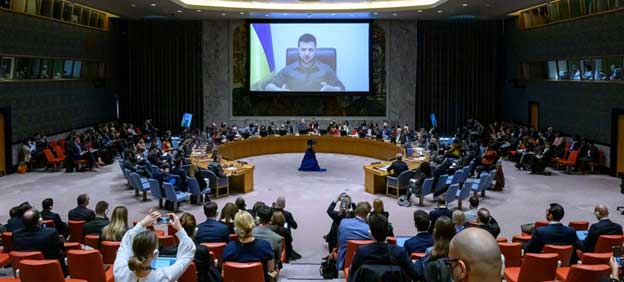
President Volodymyr Zelenskyy (on screen) of Ukraine, addresses the Security Council meeting on the situation in Ukraine. “We are dealing with a State that is turning the veto of the United Nations Security Council into the right to die”, President Zelynskyy warned. If it continues, countries will rely not on international law or global institutions to ensure security, but rather, on the power of their own arms. April 2022. Credit: UN Photo/Loey Felipe

Thalif Deen

January 24, 2023

UNITED NATIONS, Jan 2 2023 (IPS) – A US Senator once described Ukrainian President Volodymyr Zelensky, perhaps facetiously, as “a Winston Churchill in a tee shirt”.

And last month, when he addressed the US Congress – with the presence of about 100 Senators and 435 Congressmen – he tried to re-live that moment.

While most of the Senators and Congressmen were in business suits for the formal occasion, Zelensky opted for green military fatigues and a matching sweatshirt

And he was the second war-time head of government to address the US Congress, after British Prime Minister Winston Churchill’s 1941 address to Congress during World War II.

In his address December 21, the 44-year-old Zelensky appealed for increased economic aid, sophisticated weapons and security assistance.

Originally published at IPS on January 24, 2023

According to a report in the New York Times last month, if Congress passes the budget bill (it did), the US aid to Ukraine since the Russian invasion last February would amount to a hefty 100 billion dollars “allocated over four emergency spending packages.”

“We have artillery, yes thank you,” Zelensky told Senators and Congressmen, “We have it. But is it enough? Honestly, not really?”

Although the US has been sending a staggering array of weapons, including 1,400 Stinger missiles, GPS-guided joint Direct Attack Munition (JDAM) and the Patriot missile system, Ukraine has requested even more advanced weapons, including M1A2 Abrams battle tanks and F-16 fighter planes.

But the US is holding back both for security reasons.

According to the State Department, more than 40 US allies, have provided economic aid, political support or weapons to Ukraine in its hard-fought battle with Russia, one of the world’s major nuclear powers.

Norman Solomon, Executive Director of the Washington-based Institute for Public Accuracy (IPA) told IPS while the Russian government is entirely responsible for its horrendous decisions to invade Ukraine and to persist with warfare there, the United States has refused to engage in actual diplomacy to avert the war or to seek a workable end to it.

The vast ongoing shipments of arms from the U.S. to Ukraine are of such a huge magnitude that they signify many billions of dollars in profits for U.S.-based weapons makers, he pointed out.

And those shipments of weapons represent eagerness in Washington to escalate the conflagration rather than seek ways to reduce and end it, said Solomon, author of “War Made Easy: How Presidents and Pundits Keep Spinning Us to Death”

“The tremendous quantity of weaponry flowing from the USA to Ukraine can be understood as an extension of the U.S.-led NATO approach to Russia since the fall of the Soviet Union — encirclement and confrontation with Russia instead of trying to find genuine geopolitical solutions for Europe as a whole.”

The U.S. withdrawals from the Anti-Ballistic Missile (ABM) Treaty in 2002 and from the Intermediate-Range Nuclear Forces (INF) Treaty in 2019, he argued, were reckless steps for conflict between the world’s two nuclear superpowers that could end in global omnicide.

Now, the United States is proceeding to maximize the profits of its military-industrial complex while boosting the likelihood that the war in Ukraine will keep getting worse. The vows of victory in Ukraine, he noted, are fervent expressions of madness in Washington and in Moscow.

“Rather than pursue avenues for diplomacy that could bring the terrible suffering in Ukraine to an end, the U.S. government policy is to further enrich U.S. military contractors and escalate even further a war that is already a catastrophic reality,” he declared.

US Secretary of State Antony Blinken told reporters last month the United States will continue to work closely with more than 40 allies and partners in support of the people of Ukraine as they defend their freedom and independence with extraordinary courage and boundless determination.

“We will continue to support Ukraine for as long as it takes, so it can continue to defend itself and be in the strongest possible position at the negotiating table when the time comes,” he declared.

In a “Fact Sheet” released last July, the State Department provided a partial breakdown of US arms to Ukraine, which includes:

Over 1,400 Stinger anti-aircraft systems; more than 6,500 Javelin anti-armor systems.

Over 20,000 other anti-armor systems.

Over 700 Switchblade Tactical Unmanned Aerial Systems.

126 155mm Howitzers and up to 411,000 155mm artillery rounds.

72,000 105mm artillery rounds.

126 Tactical Vehicles to tow 155mm Howitzers.

22 Tactical Vehicles to recover equipment.

16 High Mobility Artillery Rocket Systems and ammunition.

Four Command Post vehicles.

Two National Advanced Surface-to-Air Missile Systems (NASAMS).

20 Mi-17 helicopters.

Counter-battery systems.

Hundreds of Armored High Mobility Multipurpose Wheeled Vehicles.

200 M113 Armored Personnel Carriers.

Over 10,000 grenade launchers and small arms.

Over 59,000,000 rounds of small arms ammunition.

75,000 sets of body armor and helmets.

Approximately 700 Phoenix Ghost Tactical Unmanned Aerial Systems.

Laser-guided rocket systems—and more.

The United States also continues to work with its allies and partners to provide Ukraine with additional capabilities to defend itself

According to the Central Intelligence Agency (CIA), the Russian Federation’s military and paramilitary services are equipped mostly with domestically-produced weapons systems, although since 2010, Russia has imported limited amounts of military hardware from several countries, including Czechia, France, Israel, Italy, Turkey, and Ukraine.

The Russian defense industry is also capable of designing, developing, and producing a full range of advanced air, land, missile, and naval systems. As of 2021, Russia is the world’s second largest exporter of military hardware.

The Russian armed forces include approximately 850,000 total active-duty troops (300,000 Ground Troops; 40,000 Airborne Troops; 150,000 Navy; 160,000 Aerospace Forces; 70,000 Strategic Rocket Forces; approximately 20,000 special operations forces; approximately 100,000 other uniformed personnel (command and control, cyber, support, logistics, security, etc.); estimated 200-250,000 Federal National Guard Troops.

IPS UN Bureau Report

Originally published at IPS on January 24, 2023
About the author

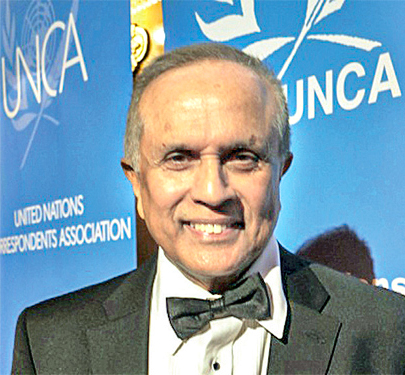
Thalif Deen, Senior Editor & Director, UN Bureau, Inter Press Service (IPS) news agency has been covering the United Nations since the late 1970s.

Please help TFF remain truly independent by contributing if you benefited from this article
Related Posts

Jan Oberg May 15, 2026 Go to this Fox News page and scroll the whole way down: President Donald Trump tells the world that his meeting with President Xi Jinping yielded a lot of very concrete political and economic results – of course, only where the Chinese side, according to him, agreed with him. He does not mention the Taiwan issue, but Secretary of State, Marco Rubio, says that it did not feature prominently in their talks and that the US policy on Taiwan has not changed. Then go to China Daily – or Global Times – and you will see that for the Chinese it is framework, principles, structure of cooperation etc. that matters – all embedded in the overall idea of “constructive bilateral relationship of strategic stability.” Nowhere is any concrete agreement or deal – all that Trump refers to – mentioned. At the general level, this gives you insights into the very different social...
Jan Oberg, TFF director April 9, 2026 I was recently invited to have a good, long talk about the world – and, of course, about peace too – with Boris Malagurski on his Weight of Chains Channel on YouTube. It was a real joy and seems to have been greatly appreciated by the viewers too. Mr Malagurski and I shall of course be grateful if you share this conversation in your circles – of course, only if you like what you see and hear 😉☮️ And remember that this one – like hundreds of others with TFF Associates – can be enjoyed at our TFF Video Collection.
A friendly quarrel while we agree that the US sanctions are a weapon of mass destruction and kill more people than wars do. And that we must talk much more about sanctions than we have so far. Jan Oberg, TFF director March 16, 2026 John Mearsheimer recently stated that U.S. sanctions murdered around 38 million people between 1971 and 2021 – see the video below. It is a dramatic figure, and it has spread quickly because it captures, in one sentence, the enormous human cost of modern sanctions. I share his concern about the destructive effects of economic coercion. But the specific number he cites — and the way he attributes it — deserves a friendly academic clarification. The figure comes from a 2023 Lancet Global Health article estimating the mortality effects of unilateral U.S. and EU sanctions over the past half‑century. This is the first point where Mearsheimer’s shorthand diverges from the text: the study...

Recent Articles

Serious but also a lot of laughs and positive energy. Because peace is also about conviviality and enchantment… Jan Oberg, TFF director November 16, 2026 This is a long (129 minutes) conversation with me. We cover very many, also personal, issues that makes a somewhat unusual media event. I am very grateful to Flemming Blicher for giving me this opportunity. I can’t remember any channel or editor who spent as much time as he did preparing it – including also asking me to answer a series of pre-interview questions, which are now posted under the conversation. If you sympathise with its content, please share it. Watch it here
A Message from Jan Oberg November 6, 2026 Over the past fifty years, I have devoted roughly 175,000 hours to research and public education for a more peaceful world: thinking, researching, writing, organising, publishing, debating, maintaining websites, corresponding, reaching out, leading a foundation, work in conflict and war zones, professorships, teaching courses and giving public lectures and doing media work. In short, ten hours a day, seven days a week, for half a century. The focus was on international political peace – analysing and trying to stop wars, address underlying conflicts and making alternative peace plans – at the desk and on the ground. Important as that has been and remains, it is only one kind of peace and it is now in a tragic militarist state compared with what it could have been.  Lately, however, I have found myself thinking about a concept from economics as well as everyday...
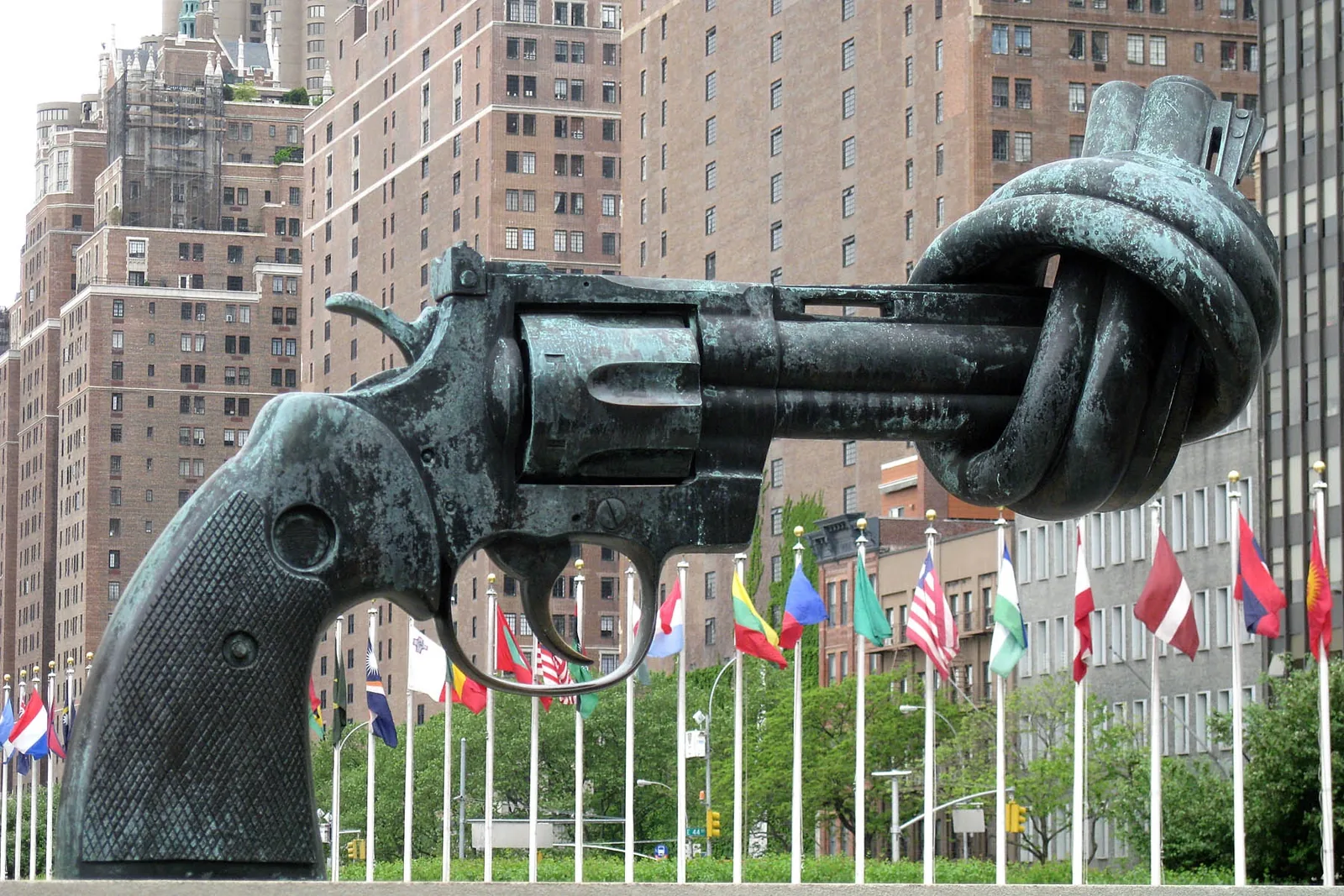
Photo above: Carl Fredrik Reuterswärd’s Non-Violence outside UN Headquarters in New York. Kirill Levin, CC BY-NC-SA 2. Jan Oberg November 3, 2026 I am happy to be published in Horizons which is produced by the Center for International Relations and Sustainable Development, CIRSD, in Belgrade. My contribution brings out a radical re-thinking of what concepts such as defence, security, deterrence – and peace – may mean if we want to create a more peaceful world. It also summarises a few things I have been working with the last few decades. Please read it here Og her er den på dansk, takket være Johnny Baltzersens lynhurtige oversættelse

TFF on Substack

Discover and subscribe to more peace materials on TFF Substack

Most Popular

Serious but also a lot of laughs and positive energy. Because peace is also about conviviality and enchantment… Jan Oberg, TFF director November 16, 2026 This is a long (129 minutes) conversation with me. We cover very many, also personal, issues that makes a somewhat unusual media event. I am very grateful to Flemming Blicher for giving me this opportunity. I can’t remember any channel or editor who spent as much time as he did preparing it – including also asking me to answer a series of pre-interview questions, which are now posted under the conversation. If you sympathise with its content, please share it. Watch it here
A Message from Jan Oberg November 6, 2026 Over the past fifty years, I have devoted roughly 175,000 hours to research and public education for a more peaceful world: thinking, researching, writing, organising, publishing, debating, maintaining websites, corresponding, reaching out, leading a foundation, work in conflict and war zones, professorships, teaching courses and giving public lectures and doing media work. In short, ten hours a day, seven days a week, for half a century. The focus was on international political peace – analysing and trying to stop wars, address underlying conflicts and making alternative peace plans – at the desk and on the ground. Important as that has been and remains, it is only one kind of peace and it is now in a tragic militarist state compared with what it could have been.  Lately, however, I have found myself thinking about a concept from economics as well as everyday...
Photo above: Carl Fredrik Reuterswärd’s Non-Violence outside UN Headquarters in New York. Kirill Levin, CC BY-NC-SA 2. Jan Oberg November 3, 2026 I am happy to be published in Horizons which is produced by the Center for International Relations and Sustainable Development, CIRSD, in Belgrade. My contribution brings out a radical re-thinking of what concepts such as defence, security, deterrence – and peace – may mean if we want to create a more peaceful world. It also summarises a few things I have been working with the last few decades. Please read it here Og her er den på dansk, takket være Johnny Baltzersens lynhurtige oversættelse
Read More
Screenshot 2026-11-10 174455
Serious but also a lot of laughs and positive energy. Because peace is also about conviviality and enchantment… Jan Oberg, TFF director November 16, 2026 This is a long (129 minutes) conversation with me. We cover very many, also personal, issues that makes a somewhat unusual media event. I am very grateful to Flemming Blicher for giving me this opportunity. I can’t remember any channel or editor who spent as much time as he did preparing it – including also asking me to answer a series of pre-interview questions, which are now posted under the conversation. If you sympathise with its content, please share it. Watch it here
AbstractVision_2017_#1_800 (kopia)
A Message from Jan Oberg November 6, 2026 Over the past fifty years, I have devoted roughly 175,000 hours to research and public education for a more peaceful world: thinking, researching, writing, organising, publishing, debating, maintaining websites, corresponding, reaching out, leading a foundation, work in conflict and war zones, professorships, teaching courses and giving public lectures and doing media work. In short, ten hours a day, seven days a week, for half a century. The focus was on international political peace – analysing and trying to stop wars, address underlying conflicts and making alternative peace plans – at the desk and on the ground. Important as that has been and remains, it is only one kind of peace and it is now in a tragic militarist state compared with what it could have been.  Lately, however, I have found myself thinking about a concept from economics as well as everyday...
knotted gun
Photo above: Carl Fredrik Reuterswärd’s Non-Violence outside UN Headquarters in New York. Kirill Levin, CC BY-NC-SA 2. Jan Oberg November 3, 2026 I am happy to be published in Horizons which is produced by the Center for International Relations and Sustainable Development, CIRSD, in Belgrade. My contribution brings out a radical re-thinking of what concepts such as defence, security, deterrence – and peace – may mean if we want to create a more peaceful world. It also summarises a few things I have been working with the last few decades. Please read it here Og her er den på dansk, takket være Johnny Baltzersens lynhurtige oversættelse
TFFPortfolioVign
UNITE-tillid, DREAM-velstand og andre konstruktive komponenter Normally we publish articles in English here. But this is a translation of a very important TFF document that should reach as many as possible in Denmark since this country’s government has been one of the most hardline in Europe and, up till now at least, has refused to use diplomacy and, instead, spent tremendous sums on arming Ukraine with the express goal of defeating Russia. Thus this – unique – article is in Danish. Vi er Johnny Baltzersen og hans Fælles Sikkerhed – Fælles Fremtid på Substack overmåde taknemmelige for at have oversat og publiceret TFF’s 2025-portfølje for fredsidéer med henblik på Ukraines fremtid. Vi håber den nu kan nå mange flere danskere – som også vil sprede den og skabe debat – nu den danske regerings og folketingspartiernes politik på dette område siden 2022 står nu – forudsigeligt – ved vejs ende....
JoGSS-Silent
Jan Oberg TFF director October 28, 2026 Exactly one month has now passed since I published my criticism of the introduction to the special issue on Johan Galtung published by the Journal of Global Security Studies, JoGSS, and of Tor Egil Førland’s chapter about Galtung which serves as a preview to his forthcoming biography of Galtung to be published by PRIO. See the original on The Transnational here and the same article on TFF Substack with many general and critical comments and, in particular, the people who decided to withdraw from the biography project in protest. The special issue itself was extraordinary. It was devoted to the intellectual legacy of one of the founders of peace research and contained a number of strong assessments of his personality, scholarship, intellectual trajectory, and public role. Such assessments are, of course, entirely legitimate. No scholar is beyond criticism, and neither was Johan Galtung....
Screenshot 2026-10-26 115647
An aspect of Iran’s culture and civilisation you’ve probably never heard about. Don’t be surprised if the US and Israel also try to bomb them. Jan ObergTFF director October 26, 2026 Today – under the “USraeli” threat of new “annihilating” bombings – opens the 7th International Conference on Peace and Conflict Resolution at Tehran’s University. As far as I can tell, this is the only permanent, advanced peace research institution in West Asia/the Middle East. Perhaps more countries in that region could be inspired? I mean, how many military “security” institutes and military academies do they have? Many peace research institutes and university departments have been established since the 1950s in the West. They are now all under attack; some have closed down, some have gone mainstream, yet others kept the name but do nothing to research peace and disseminate results or advice; instead, they cooperate with militarism’s platforms such...