
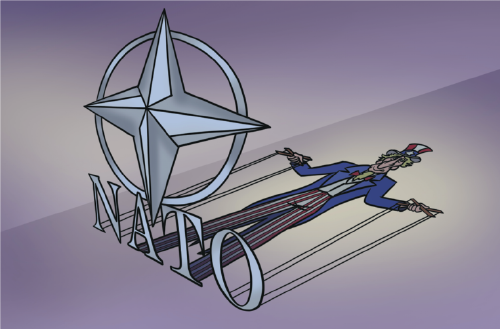
NATO’s Vilnius Summit – 30 years of conflict provocations

Jin Ding – China Daily

Jan Oberg

July 10, 2023

NATO’s next summit will take place in Vilnius, Lithuania, on July 11-12. Almost on the day 26 years ago – July 8-9, 1997 – NATO held a summit in Madrid which confirmed ”The Founding Act on Mutual Relations, Cooperation and Security Between NATO and the Russian Federation” – in other words, a permanent NATO-Russia Forum – that had been signed by Yeltsin and Clinton in Paris on May 27.

M. E. Sarotte’s brilliant 550-page analysis ”Not One Inch. America, Russia, and the Making of Post-Cold War Stalemate” can be read as one long illustration of how the US – and thereby NATO – in reality, has operated on a big-brother, condescending and manipulative attitude to Russia. Russia was never meant to become an equal partner, and whatever Russian concerns were taken into account, decisions were made to promote US/NATO interests in what was – and remains – a de facto very a-symmetrical relationship. Russia could be bought, but neither Russia nor NATO had any interest in making it look like that to the public.

Yeltsin promoted the mentioned Act as a boost for Russia; Clinton saw it as a sugar-coated pill for Russia to swallow NATO expansion whether or not by consent.

The Clinton administration – rather more than that of the G W Bush – masterminded this policy. As everyone today can see, it has led to a much worse and more dangerous Cold War 2.0 for us all.

What we know so far about the upcoming Vilnius Summit offers no indications that NATO has learned any lessons or re-thinks anything in the light of the Russian statements of concern over roughly 30 years, not to speak of its war on Ukraine.

Sarotte takes the reader through all the documentation for the fact that Russia – i.e. Gorbachev – was indeed given promises that NATO would not expand ”one inch” if it was accepted that the unified Germany would be a full NATO member. It was not written into a treaty, but the ’cascading’ documentation – at the National Security Archive at George Washington University in particular – is overwhelming nonetheless.

She explains the entire process of NATO expansion policies at the time and concludes on page 261: ”Although the US President did not say so explicitly, ”not once inch” was gaining a new meaning: not one inch was off-limits to the alliance.”

Here two statements on NATO’s 2023 Vilnius Summit page: ”NATO currently faces the most dangerous and unpredictable security environment since the Cold War. How will the Alliance continue to protect its one billion citizens and every inch of Allied territory? … NATO Leaders will meet to address the most pressing challenges for the Alliance, further strengthen NATO’s deterrence and defence and bring Ukraine closer to the Alliance.”

That’s where we are today. NATO knows it but does not have any moral or intellectual capacity to ask itself the one-word question: Why?

The bringing Ukraine closer to NATO, i.e. aiming at full membership – and three decades of NATO in Ukraine that consistently ignored the fact that in all opinion polls up to the invasion, only a tiny minority of the Ukrainians was in favour of NATO membership. However, almost 70% of all Ukrainians were in favour of holding a referendum to decide the future relations of Ukraine to Russia, NATO and the EU. Neither NATO nor Ukrainian leaders showed any respect for that democratic wish.

One is reminded of the former NATO SG’s reckless answer to a recent question about how he thought the Russians would react to his proposal to deploy some NATO country troops on Ukrainian territory: ”I don’t care!”

No, to put it crudely, sugar coat the expansion pill, we do not take Russia seriously, only our own defined interests, which are – as stated by the US Secretary of Defence: To weaken Russia militarily and, furthermore, weaken it economically so it will never be ”a problem” again. Then turn NATO’s full power towards confronting China, which is stated as a challenge for the – intellectually poor but only stated reason on NATO’s homepage – that it has values and interests different from those of NATO.

This points to another trend, or strategy, which for good reasons, are never highlighted in Western mainstream media: NATO’s daily violation of its own 1949 treaty provisions and its global expansion.

As for the Treaty – that few seem to ever have bothered to read – it is, for all practical purposes, a copy of the UN Charter with Article 5 about mutual defence among its European members added. Distinctly defensive in nature. The provocative – anything but ’defensive’ – alliance has broken its Treaty since 1999 when it did its first, international law-violating out-of-area operation in Yugoslavia, also based upon the lies about a genocide taking place in Kosovo and President Milosevic being, in Clinton’s words, Europe’s new Hitler.

In other words, NATO’s Treaty is about its members, and all members have to be European. At some point, expansion – the only raison d’etre of today’s NATO – runs out of new members – and certainly not Russia, which since 1954 has shown interest in joining NATO.

What do you do then? You invent a new category that is nowhere in the NATO Treaty: partners. NATO now has 31 members; Sweden is not mentioned by NATO in relation to Vilnius and is likely in for years of self-created troubles. But it has 39 partner states and plans to open an office in Tokyo in conjunction with its attempted containment, with AUKUS, of China and meddling – also against the historic Chou Enlai/Nixon agreement – in the Taiwan issue.

Vilnius will also turn the absurd goal of members spending 2% of their GNP on the military into a floor and not, as hitherto, a ceiling. It’s absurd because a military budget should be decided according to a comprehensive threat analysis, followed by a priority discussion and never be tied to a country’s economic ups and downs.

In summary, what we are seeing is a rampant, exclusivist militarism that ’doesn’t care’ about the other side or about the consequences of its own provocative policies devoid of the capacity for empathy, prudence and statesmanship covering up for its largest hubris blunder ever by intensifying its expansion plans against all rational calculations.

There are substantial reasons – as I have argued in my “TFF Abolish NATO Catalogue” – to see militarism as the main factor about which NATO and EU countries try to remain united. I do not think it will succeed. A kind of latter-days secular religion, a matter of faith, with NATO as its church and the leaders meeting as a congregation stating the same words over and over – and again.

Making oneself strong on one dimension while losing out on all other power dimensions – diplomacy, economy, legality, creativity, vision and culture – is a recipe for disaster. NATO no longer argues or analyses; it postulates and judges – judges everybody else.

It’s mind-boggling and deeply discouraging that this militarism is not problematised and opposed but largely tacitly accepted as the ’new normal’ in politics, media and also research – the latter basically financed by NATO governments. Apart from a tiny group of critical NATO scholars, the vitally important – for democracy – discourse about war and peace has been silenced and peace studies closed down, mainstreamed or turned into ’security’ studies. Just say the word SIPRI.

If NATO ’wins’ this game after having been the leading creator of ”the most dangerous and unpredictable security environment since the Cold War,” the rest of the world will likely approach an eschatological moment.

Peace workers and peace researchers ought to have more to say than they have hitherto.

This article has been published by Transcend Media Service, Centro Studi Sereno Regis in Italy, The Citizen in India and by China Daily.

Why not support one of the last handful of truly independent peace think tanks? We are financed exclusively by people like you and, as a principle, do not accept government or corporate funds.


Go here. It’s safe, fast and simple! Thanks a lot!

PhD, Peace & future researcher + ‌Art Photographer, Professor Emeritus and media commentator

Related Posts

Advocates of nuclear disarmament are regularly dismissed by the champions of nuclear deterrence as naïve and unrealistic, utopian or even irresponsible. Yet this ‘doctrine’ of deterrence, regarded by France as the ‘cornerstone’ of its national security, is based on quasi-religious beliefs, a theory that cannot be proven, risky gambles and fragile assumptions. So much so that one might legitimately ask which side the ‘Care Bears’ are on. Marc FinaudVice-President of Initiatives for Nuclear Disarmament (IDN) October 9, 2026 This article was originally published on Pressenza When it comes to these things being treated as religious concepts, look here. Idealists and realists It was Hubert Védrine, François Mitterrand’s former Foreign Minister, who repeatedly coined the phrase: ‘Europeans are a sort of Care Bears who don’t realise they’re living in Jurassic Park’. He applies this reference to the cartoon for well-behaved children not only to what he regards as weakness or idealism...
Tony Robinson October 4, 2026 Violence is easy to recognise when someone is being beaten, shot or killed. It becomes more difficult when nobody is holding a weapon. Poverty, discrimination, exploitation and repression can restrict a human life just as effectively, although they do so in very different ways and with very different consequences. Simply adding more categories to an ever-growing list of forms of violence does not really solve the problem. The more interesting question is what all these different situations have in common and why it makes sense to describe them using the same word. Human beings do not simply react to what happens around them. They remember the past, imagine things that do not yet exist, make plans and undertake projects. Workers organise because they imagine different working conditions; people migrate because they imagine another life somewhere else; social movements emerge because people refuse to accept the...
The agreement is catastrophic both because of what it says and what it doesn’t mention. It reduces further the major asset of security policies: Freedom of action. Jan Oberg TFF director September 25, 2026 A couple of hours before the agreement was signed on September 22, 2026, I published the following 13 hypotheses about what it would most likely contain on TFF Substack (in English). I was wrong on only the first point. Contrary to what Trump had written on his Truth Social platform, it does not appear to come into force immediately. In fact, it turned out to be worse than even I had anticipated. After these hypotheses now come a number of reflections in light of what the agreement actually contains, and does not contain, as well as the way in which it has generally been presented by major media outlets and by the public-service broadcaster DR. My...

Recent Articles

Photo above: Carl Fredrik Reuterswärd’s Non-Violence outside UN Headquarters in New York. Kirill Levin, CC BY-NC-SA 2. Jan Oberg November 3, 2026 I am happy to be published in Horizons which is produced by the Center for International Relations and Sustainable Development, CIRSD, in Belgrade. My contribution brings out a radical re-thinking of what concepts such as defence, security, deterrence – and peace – may mean if we want to create a more peaceful world. It also summarises a few things I have been working with the last few decades. Please read it here Og her er den på dansk, takket være Johnny Baltzersens lynhurtige oversættelse
UNITE-tillid, DREAM-velstand og andre konstruktive komponenter Normally we publish articles in English here. But this is a translation of a very important TFF document that should reach as many as possible in Denmark since this country’s government has been one of the most hardline in Europe and, up till now at least, has refused to use diplomacy and, instead, spent tremendous sums on arming Ukraine with the express goal of defeating Russia. Thus this – unique – article is in Danish. Vi er Johnny Baltzersen og hans Fælles Sikkerhed – Fælles Fremtid på Substack overmåde taknemmelige for at have oversat og publiceret TFF’s 2025-portfølje for fredsidéer med henblik på Ukraines fremtid. Vi håber den nu kan nå mange flere danskere – som også vil sprede den og skabe debat – nu den danske regerings og folketingspartiernes politik på dette område siden 2022 står nu – forudsigeligt – ved vejs ende....
Jan Oberg TFF director October 28, 2026 Exactly one month has now passed since I published my criticism of the introduction to the special issue on Johan Galtung published by the Journal of Global Security Studies, JoGSS, and of Tor Egil Førland’s chapter about Galtung which serves as a preview to his forthcoming biography of Galtung to be published by PRIO. See the original on The Transnational here and the same article on TFF Substack with many general and critical comments and, in particular, the people who decided to withdraw from the biography project in protest. The special issue itself was extraordinary. It was devoted to the intellectual legacy of one of the founders of peace research and contained a number of strong assessments of his personality, scholarship, intellectual trajectory, and public role. Such assessments are, of course, entirely legitimate. No scholar is beyond criticism, and neither was Johan Galtung....

TFF on Substack

Discover and subscribe to more peace materials on TFF Substack

Most Popular

Photo above: Carl Fredrik Reuterswärd’s Non-Violence outside UN Headquarters in New York. Kirill Levin, CC BY-NC-SA 2. Jan Oberg November 3, 2026 I am happy to be published in Horizons which is produced by the Center for International Relations and Sustainable Development, CIRSD, in Belgrade. My contribution brings out a radical re-thinking of what concepts such as defence, security, deterrence – and peace – may mean if we want to create a more peaceful world. It also summarises a few things I have been working with the last few decades. Please read it here Og her er den på dansk, takket være Johnny Baltzersens lynhurtige oversættelse
UNITE-tillid, DREAM-velstand og andre konstruktive komponenter Normally we publish articles in English here. But this is a translation of a very important TFF document that should reach as many as possible in Denmark since this country’s government has been one of the most hardline in Europe and, up till now at least, has refused to use diplomacy and, instead, spent tremendous sums on arming Ukraine with the express goal of defeating Russia. Thus this – unique – article is in Danish. Vi er Johnny Baltzersen og hans Fælles Sikkerhed – Fælles Fremtid på Substack overmåde taknemmelige for at have oversat og publiceret TFF’s 2025-portfølje for fredsidéer med henblik på Ukraines fremtid. Vi håber den nu kan nå mange flere danskere – som også vil sprede den og skabe debat – nu den danske regerings og folketingspartiernes politik på dette område siden 2022 står nu – forudsigeligt – ved vejs ende....
Jan Oberg TFF director October 28, 2026 Exactly one month has now passed since I published my criticism of the introduction to the special issue on Johan Galtung published by the Journal of Global Security Studies, JoGSS, and of Tor Egil Førland’s chapter about Galtung which serves as a preview to his forthcoming biography of Galtung to be published by PRIO. See the original on The Transnational here and the same article on TFF Substack with many general and critical comments and, in particular, the people who decided to withdraw from the biography project in protest. The special issue itself was extraordinary. It was devoted to the intellectual legacy of one of the founders of peace research and contained a number of strong assessments of his personality, scholarship, intellectual trajectory, and public role. Such assessments are, of course, entirely legitimate. No scholar is beyond criticism, and neither was Johan Galtung....
Read More
knotted gun
Photo above: Carl Fredrik Reuterswärd’s Non-Violence outside UN Headquarters in New York. Kirill Levin, CC BY-NC-SA 2. Jan Oberg November 3, 2026 I am happy to be published in Horizons which is produced by the Center for International Relations and Sustainable Development, CIRSD, in Belgrade. My contribution brings out a radical re-thinking of what concepts such as defence, security, deterrence – and peace – may mean if we want to create a more peaceful world. It also summarises a few things I have been working with the last few decades. Please read it here Og her er den på dansk, takket være Johnny Baltzersens lynhurtige oversættelse
TFFPortfolioVign
UNITE-tillid, DREAM-velstand og andre konstruktive komponenter Normally we publish articles in English here. But this is a translation of a very important TFF document that should reach as many as possible in Denmark since this country’s government has been one of the most hardline in Europe and, up till now at least, has refused to use diplomacy and, instead, spent tremendous sums on arming Ukraine with the express goal of defeating Russia. Thus this – unique – article is in Danish. Vi er Johnny Baltzersen og hans Fælles Sikkerhed – Fælles Fremtid på Substack overmåde taknemmelige for at have oversat og publiceret TFF’s 2025-portfølje for fredsidéer med henblik på Ukraines fremtid. Vi håber den nu kan nå mange flere danskere – som også vil sprede den og skabe debat – nu den danske regerings og folketingspartiernes politik på dette område siden 2022 står nu – forudsigeligt – ved vejs ende....
JoGSS-Silent
Jan Oberg TFF director October 28, 2026 Exactly one month has now passed since I published my criticism of the introduction to the special issue on Johan Galtung published by the Journal of Global Security Studies, JoGSS, and of Tor Egil Førland’s chapter about Galtung which serves as a preview to his forthcoming biography of Galtung to be published by PRIO. See the original on The Transnational here and the same article on TFF Substack with many general and critical comments and, in particular, the people who decided to withdraw from the biography project in protest. The special issue itself was extraordinary. It was devoted to the intellectual legacy of one of the founders of peace research and contained a number of strong assessments of his personality, scholarship, intellectual trajectory, and public role. Such assessments are, of course, entirely legitimate. No scholar is beyond criticism, and neither was Johan Galtung....
Screenshot 2026-10-26 115647
An aspect of Iran’s culture and civilisation you’ve probably never heard about. Don’t be surprised if the US and Israel also try to bomb them. Jan ObergTFF director October 26, 2026 Today – under the “USraeli” threat of new “annihilating” bombings – opens the 7th International Conference on Peace and Conflict Resolution at Tehran’s University. As far as I can tell, this is the only permanent, advanced peace research institution in West Asia/the Middle East. Perhaps more countries in that region could be inspired? I mean, how many military “security” institutes and military academies do they have? Many peace research institutes and university departments have been established since the 1950s in the West. They are now all under attack; some have closed down, some have gone mainstream, yet others kept the name but do nothing to research peace and disseminate results or advice; instead, they cooperate with militarism’s platforms such...
Screenshot 2026-10-15 141837
Let’s discuss using AI to create peace – in contrast to boring geopolitics devoid of creative healing and visions. Jan Oberg TFF director October 15, 2026 I asked VEED to create a short video exemplifying how peace is preferable to war, then chose the lady as a template. Simple as that. In less than a minute, it produced this video, which any peace-loving person would appreciate. The only problem is that human intelligence (HI), at least the one that exists among Western decision-makers, isn’t half as moral or smart as AI. I have used AI to dialogue about peace and peace plans, creative conflict resolution and visions of a better future for humankind. It so happens that I am having more stimulating, intelligent, creative and moral discussions with AI than I could possibly have with any EU or NATO leader today. Yes, AI has very problematic and dangerous aspects; used...
girl-5894831_1280
Below are TFF-related media mentions, comments, videos and social media posts published elsewhere but not on this homepage. We happen to catch and list only a fraction. Regarding video comments and debates, we recommend that you go to the TFF Video Channel on Substack where many of them are reproduced. Jan Oberg is a contributor to China Daily – 52 million daily clicks – and Global Times, CGTN and CCTV (the national television), China Investment, Xinhua News Agency and several others. Articles and videos on these media very often multiply into countless Chinese (and Western media) that re-post them from these main media. Thanks to The China Academy, his analyses, interviews and comments are frequently posted on YouTube channels such as Thinkers Forum and Wave Media. These videos are often re-posted on Bilibili (China’s YouTube), the China Content Center on TikTok, and on the Chinese edition of TikTok, Douyin.com. This means reaching hundreds of millions of viewers worldwide over a year. While there are too many to catch on all these...




