
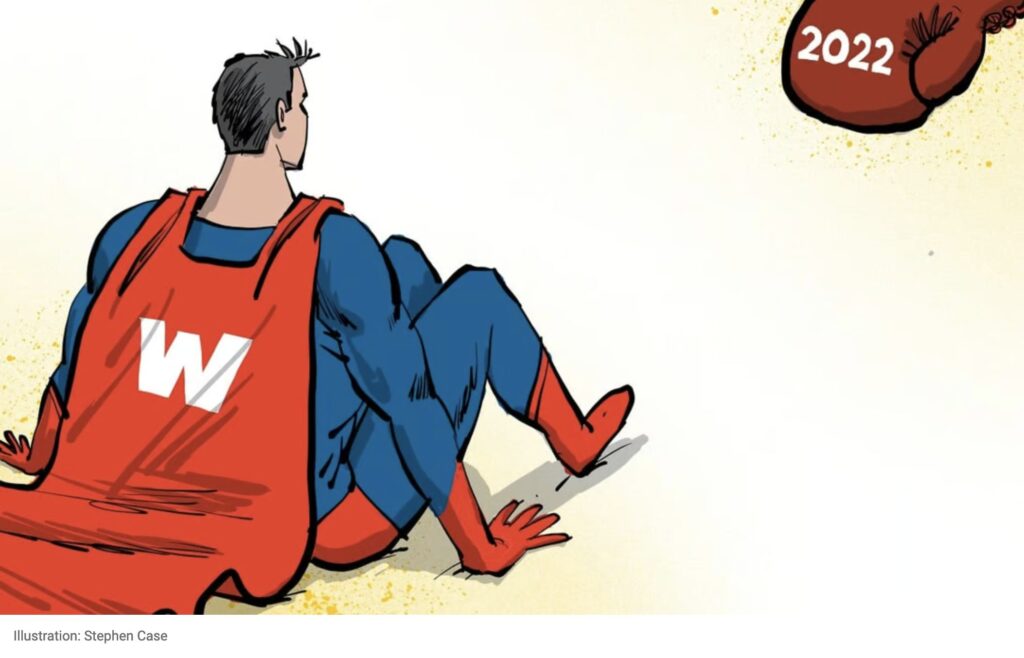
Wang Wen: Beyond China, as more nations reject the US-led order, 2022 will go down as the year of ‘de-Westernisation’

• From China’s socialist path to Latin America’s left turn and Asean’s neutral stance, more countries are quietly but firmly spurning the Western world order

• Instead, they seek to favour national interests, a more democratic form of international politics and mutual respect

Wang Wen

January 6, 2023

The global significance of 2022 has been grossly underestimated. Its importance to world history far exceeds that of 2001, when the September 11 attacks occurred, and 2008, when the global financial crisis broke out.

Instead, 2022 may be comparable to 1991, when the Cold War ended. If there’s a keyword, it’s “de-Westernisation”.

This is not just about Russia’s radical attempt, through the use of military power, to try to break the US-dominated international order. It is also about the unprecedented rising up of non-Western countries against the established order in search of a more independent stance.

China, after the successful convening of its 20th Communist Party congress and despite the challenges of Covid-19 and an economic downturn, continues to move steadily towards its goal of becoming a modern socialist power by 2050.

Originally published by the South China Morning Post, SCMP, on January 3, 2023

In Brazil, the re-election of Luiz Inacio Lula da Silva as president means that 80 per cent of Latin America is now under left-wing governments – in recent years, Mexico, Argentina, Peru, Chile, Honduras, Colombia and others have also chosen leaders on the left. They advocate keeping a distance from the United States and promoting greater Latin American independence and integration.

In Southeast Asia, which hosted the ASEAN, G20 and APEC summit meetings recently, the Association of Southeast Asian Nations has carefully kept the same distance from China as from the US, strengthening its neutral position through regional solidarity and economic vitality.

In Central Asia, leaders of Kyrgyzstan, Kazakhstan, Uzbekistan, Tajikistan and Turkmenistan continued to strengthen the heads-of-state consultation mechanism and signed important documents, including a treaty on “friendship, good neighbourliness and cooperation for the development of Central Asia in the 21st century”. In keeping an equal distance from Russia, the US, Europe and other powers, Central Asia is entering a new stage of national consolidation and regional integration.

In the Middle East, which has experienced the Arab spring and US anti-terrorism warfare, the 22 countries of the Arab world are increasingly focused on their strategic, independent development. The Saudi Vision 2030, Qatar National Vision 2030, New Kuwait Vision 2035, Oman Vision 2040 and United Arab Emirates’ Vision 2050, among others, are long-term development plans that have raised the world’s expectations.

The recent hosting of the Qatar World Cup, the China-Arab States Summit and China-Gulf Cooperation Council (GCC) Summit have also boosted the region’s global prestige and influence.

Regional powers harbouring dreams of greatness are also keeping a measured distance from the West. India has resisted Western pressure to join sanctions against Russia, keeping its policy of cooperation with China and Russia. As president of the Group of 20, better known as G20, in 2023, India has a huge opportunity to enhance its influence.

Western media tends to focus on the G2 scenario of US-China competition – when the world is presenting a dual-track scenario of Western hegemony vs a de-Westernised and more independent development.

The West cannot stop this trend. The US led the world in major crises in the past century, but its leadership has become less convincing in the wake of the Covid-19 pandemic and war in Ukraine. This has come as it faced unprecedented domestic challenges in addressing its own Covid-19 epidemic, racial conflict, economic recovery and political order.

Meanwhile, Europe’s share of the global economy continues to fall. And India’s economy has become bigger than that of Britain, its former colonial master, in a year that also saw a man of Indian descent become the British prime minister.

According to China’s official statistics, the country’s outward foreign direct investment in 2020 ranked first in the world for the first time. The country already ranks first in manufacturing output and trade in goods.

In recent years, China has also surpassed many Western countries in attracting foreign capital, showing that capital is hardly always locked in the West. In 2022, the world’s largest free-trade deal, the Regional Comprehensive Economic Partnership (RCEP), entered into force. This is a reflection of the loss of the West’s monopoly on free trade.

This de-Westernisation also extends to a growing de-dollarisation in global trade, as countries move away from the US dollar, and a “de-Americanisation” of technology.

Over the last 20 years, the US dollar’s share of international reserves has fallen steadily from above 70 per cent to below 60 per cent, now hovering around a 25-year low, according to the International Monetary Fund data. With the fourth industrial revolution, European and American countries have also lost their technological edge in smart technology, quantum computing, big data, 5G and more.

Together, the non-Western world is presenting a picture as never seen before. Their response to Western hegemony is not necessarily through confrontation, conflict or an insistence on checks and balances.

Instead, they are simply shaking off Western control by increasingly putting their national interests at the strategic centre. A more democratic form of international politics and mutual respect are their main demands.

A more equal political relationship between the West and the rest is being built, and this will be an important feature of world politics in this third decade of the 21st century. It will not be a mellow world in 2023, but the de-Westernisation movement is irreversible and will only evolve.

The Author

Wang Wen is a professor and executive dean at Chongyang Institute for Financial Studies, Renmin University of China.


Related Posts

Jan Oberg, TFF director April 9, 2026 I was recently invited to have a good, long talk about the world – and, of course, about peace too – with Boris Malagurski on his Weight of Chains Channel on YouTube. It was a real joy and seems to have been greatly appreciated by the viewers too. Mr Malagurski and I shall of course be grateful if you share this conversation in your circles – of course, only if you like what you see and hear 😉☮️ And remember that this one – like hundreds of others with TFF Associates – can be enjoyed at our TFF Video Collection.
A friendly quarrel while we agree that the US sanctions are a weapon of mass destruction and kill more people than wars do. And that we must talk much more about sanctions than we have so far. Jan Oberg, TFF director March 16, 2026 John Mearsheimer recently stated that U.S. sanctions murdered around 38 million people between 1971 and 2021 – see the video below. It is a dramatic figure, and it has spread quickly because it captures, in one sentence, the enormous human cost of modern sanctions. I share his concern about the destructive effects of economic coercion. But the specific number he cites — and the way he attributes it — deserves a friendly academic clarification. The figure comes from a 2023 Lancet Global Health article estimating the mortality effects of unilateral U.S. and EU sanctions over the past half‑century. This is the first point where Mearsheimer’s shorthand diverges from the text: the study...
This is not another geopolitical commentary on the Arctic. It is a visionary peace proposal that can save the region from militarised rivalry and ecological ruin. A blueprint for shared security, sustainable development, and human dignity — benefitting Greenland, the Arctic, and the rest of us. Jan Oberg TFF director Lund, Sweden, February 17, 2026 I. Four Principles for a New Arctic Vision The Arctic is often framed as a cold arena of rivalry — a place where great powers test each other’s resolve. But this worldview is outdated, unimaginative, and ultimately self‑defeating. The Arctic is not a vacuum waiting to be militarised; it is a living region, a climate stabiliser, and a cultural homeland whose future will shape the future of humanity. If we begin from that understanding, a far more rational Arctic order becomes possible — one that is peaceful, cooperative, and centred on the people who actually live there. This vision rests...

Recent Articles

UNITE-tillid, DREAM-velstand og andre konstruktive komponenter Normally we publish articles in English here. But this is a translation of a very important TFF document that should reach as many as possible in Denmark since this country’s government has been one of the most hardline in Europe and, up till now at least, has refused to use diplomacy and, instead, spent tremendous sums on arming Ukraine with the express goal of defeating Russia. Thus this – unique – article is in Danish. Vi er Johnny Baltzersen og hans Fælles Sikkerhed – Fælles Fremtid på Substack overmåde taknemmelige for at have oversat og publiceret TFF’s 2025-portfølje for fredsidéer med henblik på Ukraines fremtid. Vi håber den nu kan nå mange flere danskere – som også vil sprede den og skabe debat – nu den danske regerings og folketingspartiernes politik på dette område siden 2022 står nu – forudsigeligt – ved vejs ende....
Jan Oberg TFF director October 28, 2026 Exactly one month has now passed since I published my criticism of the introduction to the special issue on Johan Galtung published by the Journal of Global Security Studies, JoGSS, and of Tor Egil Førland’s chapter about Galtung which serves as a preview to his forthcoming biography of Galtung to be published by PRIO. See the original on The Transnational here and the same article on TFF Substack with many general and critical comments and, in particular, the people who decided to withdraw from the biography project in protest. The special issue itself was extraordinary. It was devoted to the intellectual legacy of one of the founders of peace research and contained a number of strong assessments of his personality, scholarship, intellectual trajectory, and public role. Such assessments are, of course, entirely legitimate. No scholar is beyond criticism, and neither was Johan Galtung....
An aspect of Iran’s culture and civilisation you’ve probably never heard about. Don’t be surprised if the US and Israel also try to bomb them. Jan ObergTFF director October 26, 2026 Today – under the “USraeli” threat of new “annihilating” bombings – opens the 7th International Conference on Peace and Conflict Resolution at Tehran’s University. As far as I can tell, this is the only permanent, advanced peace research institution in West Asia/the Middle East. Perhaps more countries in that region could be inspired? I mean, how many military “security” institutes and military academies do they have? Many peace research institutes and university departments have been established since the 1950s in the West. They are now all under attack; some have closed down, some have gone mainstream, yet others kept the name but do nothing to research peace and disseminate results or advice; instead, they cooperate with militarism’s platforms such...

TFF on Substack

Discover and subscribe to more peace materials on TFF Substack

Most Popular

UNITE-tillid, DREAM-velstand og andre konstruktive komponenter Normally we publish articles in English here. But this is a translation of a very important TFF document that should reach as many as possible in Denmark since this country’s government has been one of the most hardline in Europe and, up till now at least, has refused to use diplomacy and, instead, spent tremendous sums on arming Ukraine with the express goal of defeating Russia. Thus this – unique – article is in Danish. Vi er Johnny Baltzersen og hans Fælles Sikkerhed – Fælles Fremtid på Substack overmåde taknemmelige for at have oversat og publiceret TFF’s 2025-portfølje for fredsidéer med henblik på Ukraines fremtid. Vi håber den nu kan nå mange flere danskere – som også vil sprede den og skabe debat – nu den danske regerings og folketingspartiernes politik på dette område siden 2022 står nu – forudsigeligt – ved vejs ende....
Jan Oberg TFF director October 28, 2026 Exactly one month has now passed since I published my criticism of the introduction to the special issue on Johan Galtung published by the Journal of Global Security Studies, JoGSS, and of Tor Egil Førland’s chapter about Galtung which serves as a preview to his forthcoming biography of Galtung to be published by PRIO. See the original on The Transnational here and the same article on TFF Substack with many general and critical comments and, in particular, the people who decided to withdraw from the biography project in protest. The special issue itself was extraordinary. It was devoted to the intellectual legacy of one of the founders of peace research and contained a number of strong assessments of his personality, scholarship, intellectual trajectory, and public role. Such assessments are, of course, entirely legitimate. No scholar is beyond criticism, and neither was Johan Galtung....
An aspect of Iran’s culture and civilisation you’ve probably never heard about. Don’t be surprised if the US and Israel also try to bomb them. Jan ObergTFF director October 26, 2026 Today – under the “USraeli” threat of new “annihilating” bombings – opens the 7th International Conference on Peace and Conflict Resolution at Tehran’s University. As far as I can tell, this is the only permanent, advanced peace research institution in West Asia/the Middle East. Perhaps more countries in that region could be inspired? I mean, how many military “security” institutes and military academies do they have? Many peace research institutes and university departments have been established since the 1950s in the West. They are now all under attack; some have closed down, some have gone mainstream, yet others kept the name but do nothing to research peace and disseminate results or advice; instead, they cooperate with militarism’s platforms such...
Read More
TFFPortfolioVign
UNITE-tillid, DREAM-velstand og andre konstruktive komponenter Normally we publish articles in English here. But this is a translation of a very important TFF document that should reach as many as possible in Denmark since this country’s government has been one of the most hardline in Europe and, up till now at least, has refused to use diplomacy and, instead, spent tremendous sums on arming Ukraine with the express goal of defeating Russia. Thus this – unique – article is in Danish. Vi er Johnny Baltzersen og hans Fælles Sikkerhed – Fælles Fremtid på Substack overmåde taknemmelige for at have oversat og publiceret TFF’s 2025-portfølje for fredsidéer med henblik på Ukraines fremtid. Vi håber den nu kan nå mange flere danskere – som også vil sprede den og skabe debat – nu den danske regerings og folketingspartiernes politik på dette område siden 2022 står nu – forudsigeligt – ved vejs ende....
JoGSS-Silent
Jan Oberg TFF director October 28, 2026 Exactly one month has now passed since I published my criticism of the introduction to the special issue on Johan Galtung published by the Journal of Global Security Studies, JoGSS, and of Tor Egil Førland’s chapter about Galtung which serves as a preview to his forthcoming biography of Galtung to be published by PRIO. See the original on The Transnational here and the same article on TFF Substack with many general and critical comments and, in particular, the people who decided to withdraw from the biography project in protest. The special issue itself was extraordinary. It was devoted to the intellectual legacy of one of the founders of peace research and contained a number of strong assessments of his personality, scholarship, intellectual trajectory, and public role. Such assessments are, of course, entirely legitimate. No scholar is beyond criticism, and neither was Johan Galtung....
Screenshot 2026-10-26 115647
An aspect of Iran’s culture and civilisation you’ve probably never heard about. Don’t be surprised if the US and Israel also try to bomb them. Jan ObergTFF director October 26, 2026 Today – under the “USraeli” threat of new “annihilating” bombings – opens the 7th International Conference on Peace and Conflict Resolution at Tehran’s University. As far as I can tell, this is the only permanent, advanced peace research institution in West Asia/the Middle East. Perhaps more countries in that region could be inspired? I mean, how many military “security” institutes and military academies do they have? Many peace research institutes and university departments have been established since the 1950s in the West. They are now all under attack; some have closed down, some have gone mainstream, yet others kept the name but do nothing to research peace and disseminate results or advice; instead, they cooperate with militarism’s platforms such...
Screenshot 2026-10-15 141837
Let’s discuss using AI to create peace – in contrast to boring geopolitics devoid of creative healing and visions. Jan Oberg TFF director October 15, 2026 I asked VEED to create a short video exemplifying how peace is preferable to war, then chose the lady as a template. Simple as that. In less than a minute, it produced this video, which any peace-loving person would appreciate. The only problem is that human intelligence (HI), at least the one that exists among Western decision-makers, isn’t half as moral or smart as AI. I have used AI to dialogue about peace and peace plans, creative conflict resolution and visions of a better future for humankind. It so happens that I am having more stimulating, intelligent, creative and moral discussions with AI than I could possibly have with any EU or NATO leader today. Yes, AI has very problematic and dangerous aspects; used...
girl-5894831_1280
Below are TFF-related media mentions, comments, videos and social media posts published elsewhere but not on this homepage. We happen to catch and list only a fraction. Regarding video comments and debates, we recommend that you go to the TFF Video Channel on Substack where many of them are reproduced. Jan Oberg is a contributor to China Daily – 52 million daily clicks – and Global Times, CGTN and CCTV (the national television), China Investment, Xinhua News Agency and several others. Articles and videos on these media very often multiply into countless Chinese (and Western media) that re-post them from these main media. Thanks to The China Academy, his analyses, interviews and comments are frequently posted on YouTube channels such as Thinkers Forum and Wave Media. These videos are often re-posted on Bilibili (China’s YouTube), the China Content Center on TikTok, and on the Chinese edition of TikTok, Douyin.com. This means reaching hundreds of millions of viewers worldwide over a year. While there are too many to catch on all these...
Nobel-Prize-Plaque
Jan Oberg TFF director October 13, 2026 According to Alfred Nobel’s will, the Nobel Peace Prize shall be awarded: ”to the person who has done the most or best to advance fellowship among nations, the abolition or reduction of standing armies, and the establishment and promotion of peace congresses.” Further down, he also expresses how the prize for the “champions of peace” shall be decided: “that for champions of peace by a committee of five persons to be selected by the Norwegian Storting. Alfred Nobel’s will is remarkably short and clear. But few seem to have read it. Nobel did not say that the committee itself should consist of members of parliament. He entrusted the Storting with appointing five persons. In principle, it could have selected diplomats, mediators, peace researchers, conflict-resolution specialists, or other individuals with recognised expertise in matters of peace from around the world. Instead, the Storting gradually...



