
Insights into China’s victory over the Coronavirus

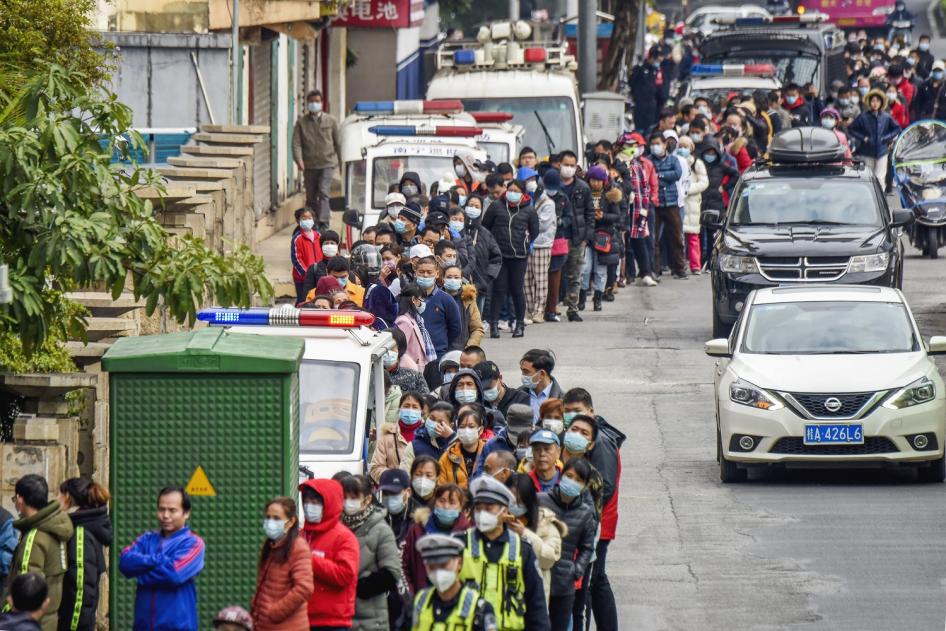
People line up to buy face masks from a medical supply company in Nanning, southern China’s Guangxi Zhuang Autonomous Region on Wednesday, January 29, 2020. © 2020 Chinatopix.

By Liu Jian, TFF Associate in Beijing

Read the author’s second article here

March 30, 2020

What we have experienced in the past two months is too dreamy and now, in retrospect, it seems not so real.

On January 23, the day before Chinese New Year’s Eve, people who were ready to celebrate the New Year were shocked by the sudden outbreak of the virus. Wuhan, a super big city with a population of 11 million, was declared closed by the government. Anxiety and unease quickly enveloped the whole country.

According to the government’s guidance, people cancelled New Year’s travels and family reunions one after another, stayed in their own homes according to experts’ suggestions, and kept updating the news with anxiety.

Usually, during the Chinese New Year, there will be 4 billion trips, 70% of which had been cancelled temporarily.

The government quickly organized forces to build two infectious disease hospitals in about 10 days, and soon dozens of other temporary hospitals were built.

Plane after plane, carrying medical workers from all over the country, quickly descended on Wuhan and, finally, more than 40,000 medical workers from other provinces took part in the war against the epidemic.

All kinds of enterprises across the country moved quickly to work 24 hours a day to expand the production of epidemic prevention materials. Logistics enterprises also moved to ensure that epidemic prevention materials could be quickly transported to the front line. Further, the army dispatched planes, vehicles and personnel to participate in the materiel support work.

In Wuhan, numerous government workers, police and volunteers took part in the epidemic prevention work. When the city pressed the pause button and shut down completely, they did their best to ensure that the basics of what all citizens would need could be delivered in time to every household and family who were isolated in their homes.

As I said, this is a city of 11 million people. Imagine what kind of scene it would be if that distribution of the necessities had not been effectively organised.

While a large number of medical workers were racing against time to save lives in Wuhan under China’s unique political system, prevention and isolation measures have also been implemented to every capillary of the country’s body and to every citizen.

People even joked on social media about the fact that they had never thought to be able to contribute to their country just by lying and relaxing at home!

With all people’s full-hearted efforts, the results began to show, more and more patients recovered and were discharged from hospital, and fewer and fewer new cases were reported.

Finally, after more than 50 days of fighting, there were no more new cases in the country.

This was a great battle in which all 1.4 billion Chinese participated.

However, new challenges are beginning to emerge.

As more and more people come back from other countries, the number of patients is increasing day by day, and everyone’s slightly relaxed, we are beginning to be nervous again.

Relevant departments are actively coping with the situation. In this fight against the virus, I believe we can achieve the final victory.

The cultural roots

Behind all this, there are deep cultural roots. There are several basic concepts here, in the Chinese context, their meanings are completely different.

The word country

First of all, in Chinese, the word “country(国家) ” is composed of two words: “country(国)” and “home(家)”, which means the “country” is the “home” of all its people, everybody is in the same big family. Only by ensuring the safety of a large family can there be hope for the safety of small families.

This is a concept deeply rooted in the genes of every Chinese.

National interests are higher than individual interests. In fact, there is another word in Chinese culture – “one family in the world”, which means that the whole world is actually a big family. Therefore, in the Chinese way of thinking, it is natural and logical to provide help to countries with serious epidemics such as Iran, Italy and Spain.

The Party

Secondly, the Chinese Communist Party is not a party in the Western sense. It is not a party quarrelling and competing with other parties for the interests of one or the other group. The Party is, rather, a team of experts who have been carefully selected to run the country and serve all the people in the best way.

One hundred years ago, everything collapsed in ancient China. Many people went to the West to look for a rescue plan. They returned and introduced the concept of a political party and formed various parties. However, from ancient times to 1921, the word “party” has always been a negative word in the Chinese context. It represented the self-interest of small groups and was despised by Confucianism.

At present, the “Party” generally refers to the Chinese Communist Party. However, I would like to say that the concept of “party” is only a designation or a suit made according to the Western model and worn by the governing body which is led fundamentally by Confucianism. (More about this philosophy at Wikipedia, at Encyclopædia Britannica, at ReligionFacts and at Ancient History Encyclopedia.

Therefore, when people in the West think that the one-party system in China is a dictatorship by the Communist Party, it a complete misunderstanding.

Public ownership

Finally, regarding public ownership, China is implementing a basic economic system with public ownership as the main body and multiple different ownership economies developing together. State-owned enterprises are not oriented to maximize profits, but to maximize social benefits, so when the crisis comes, resources can quickly be mobilized.

In fact, China’s public ownership economy has existed for more than 2,000 years. In 120 BC, in the Han Dynasty times, a big debate was held between senior government officials and experts and scholars composed of more than 60 people. The debate lasted for five months.

The theme of the debate was whether salt and iron, as important materials, should be managed by public ownership or private ownership. The conclusion was that public ownership should be maintained, but private economic participation should be appropriately allowed.

Today’s China, coming from more than 5,000 years of long history, carries its deep cultural genes.

Therefore, in order to understand what was done to fight and control the Coronavirus in the Wuhan campaign, it is absolutely essential to understand the significance of these three keywords in the Chinese context.

If you found this enlightening, please…


Related Posts

Photo above: Carl Fredrik Reuterswärd’s Non-Violence outside UN Headquarters in New York. Kirill Levin, CC BY-NC-SA 2. Jan Oberg November 3, 2026 I am happy to be published in Horizons which is produced by the Center for International Relations and Sustainable Development, CIRSD, in Belgrade. My contribution brings out a radical re-thinking of what concepts such as defence, security, deterrence – and peace – may mean if we want to create a more peaceful world. It also summarises a few things I have been working with the last few decades. Please read it here Og her er den på dansk, takket være Johnny Baltzersens lynhurtige oversættelse
UNITE-tillid, DREAM-velstand og andre konstruktive komponenter Normally we publish articles in English here. But this is a translation of a very important TFF document that should reach as many as possible in Denmark since this country’s government has been one of the most hardline in Europe and, up till now at least, has refused to use diplomacy and, instead, spent tremendous sums on arming Ukraine with the express goal of defeating Russia. Thus this – unique – article is in Danish. Vi er Johnny Baltzersen og hans Fælles Sikkerhed – Fælles Fremtid på Substack overmåde taknemmelige for at have oversat og publiceret TFF’s 2025-portfølje for fredsidéer med henblik på Ukraines fremtid. Vi håber den nu kan nå mange flere danskere – som også vil sprede den og skabe debat – nu den danske regerings og folketingspartiernes politik på dette område siden 2022 står nu – forudsigeligt – ved vejs ende....
Jan Oberg TFF director October 28, 2026 Exactly one month has now passed since I published my criticism of the introduction to the special issue on Johan Galtung published by the Journal of Global Security Studies, JoGSS, and of Tor Egil Førland’s chapter about Galtung which serves as a preview to his forthcoming biography of Galtung to be published by PRIO. See the original on The Transnational here and the same article on TFF Substack with many general and critical comments and, in particular, the people who decided to withdraw from the biography project in protest. The special issue itself was extraordinary. It was devoted to the intellectual legacy of one of the founders of peace research and contained a number of strong assessments of his personality, scholarship, intellectual trajectory, and public role. Such assessments are, of course, entirely legitimate. No scholar is beyond criticism, and neither was Johan Galtung....

Recent Articles

Photo above: Carl Fredrik Reuterswärd’s Non-Violence outside UN Headquarters in New York. Kirill Levin, CC BY-NC-SA 2. Jan Oberg November 3, 2026 I am happy to be published in Horizons which is produced by the Center for International Relations and Sustainable Development, CIRSD, in Belgrade. My contribution brings out a radical re-thinking of what concepts such as defence, security, deterrence – and peace – may mean if we want to create a more peaceful world. It also summarises a few things I have been working with the last few decades. Please read it here Og her er den på dansk, takket være Johnny Baltzersens lynhurtige oversættelse
UNITE-tillid, DREAM-velstand og andre konstruktive komponenter Normally we publish articles in English here. But this is a translation of a very important TFF document that should reach as many as possible in Denmark since this country’s government has been one of the most hardline in Europe and, up till now at least, has refused to use diplomacy and, instead, spent tremendous sums on arming Ukraine with the express goal of defeating Russia. Thus this – unique – article is in Danish. Vi er Johnny Baltzersen og hans Fælles Sikkerhed – Fælles Fremtid på Substack overmåde taknemmelige for at have oversat og publiceret TFF’s 2025-portfølje for fredsidéer med henblik på Ukraines fremtid. Vi håber den nu kan nå mange flere danskere – som også vil sprede den og skabe debat – nu den danske regerings og folketingspartiernes politik på dette område siden 2022 står nu – forudsigeligt – ved vejs ende....
Jan Oberg TFF director October 28, 2026 Exactly one month has now passed since I published my criticism of the introduction to the special issue on Johan Galtung published by the Journal of Global Security Studies, JoGSS, and of Tor Egil Førland’s chapter about Galtung which serves as a preview to his forthcoming biography of Galtung to be published by PRIO. See the original on The Transnational here and the same article on TFF Substack with many general and critical comments and, in particular, the people who decided to withdraw from the biography project in protest. The special issue itself was extraordinary. It was devoted to the intellectual legacy of one of the founders of peace research and contained a number of strong assessments of his personality, scholarship, intellectual trajectory, and public role. Such assessments are, of course, entirely legitimate. No scholar is beyond criticism, and neither was Johan Galtung....

TFF on Substack

Discover and subscribe to more peace materials on TFF Substack

Most Popular

Photo above: Carl Fredrik Reuterswärd’s Non-Violence outside UN Headquarters in New York. Kirill Levin, CC BY-NC-SA 2. Jan Oberg November 3, 2026 I am happy to be published in Horizons which is produced by the Center for International Relations and Sustainable Development, CIRSD, in Belgrade. My contribution brings out a radical re-thinking of what concepts such as defence, security, deterrence – and peace – may mean if we want to create a more peaceful world. It also summarises a few things I have been working with the last few decades. Please read it here Og her er den på dansk, takket være Johnny Baltzersens lynhurtige oversættelse
UNITE-tillid, DREAM-velstand og andre konstruktive komponenter Normally we publish articles in English here. But this is a translation of a very important TFF document that should reach as many as possible in Denmark since this country’s government has been one of the most hardline in Europe and, up till now at least, has refused to use diplomacy and, instead, spent tremendous sums on arming Ukraine with the express goal of defeating Russia. Thus this – unique – article is in Danish. Vi er Johnny Baltzersen og hans Fælles Sikkerhed – Fælles Fremtid på Substack overmåde taknemmelige for at have oversat og publiceret TFF’s 2025-portfølje for fredsidéer med henblik på Ukraines fremtid. Vi håber den nu kan nå mange flere danskere – som også vil sprede den og skabe debat – nu den danske regerings og folketingspartiernes politik på dette område siden 2022 står nu – forudsigeligt – ved vejs ende....
Jan Oberg TFF director October 28, 2026 Exactly one month has now passed since I published my criticism of the introduction to the special issue on Johan Galtung published by the Journal of Global Security Studies, JoGSS, and of Tor Egil Førland’s chapter about Galtung which serves as a preview to his forthcoming biography of Galtung to be published by PRIO. See the original on The Transnational here and the same article on TFF Substack with many general and critical comments and, in particular, the people who decided to withdraw from the biography project in protest. The special issue itself was extraordinary. It was devoted to the intellectual legacy of one of the founders of peace research and contained a number of strong assessments of his personality, scholarship, intellectual trajectory, and public role. Such assessments are, of course, entirely legitimate. No scholar is beyond criticism, and neither was Johan Galtung....
Read More
knotted gun
Photo above: Carl Fredrik Reuterswärd’s Non-Violence outside UN Headquarters in New York. Kirill Levin, CC BY-NC-SA 2. Jan Oberg November 3, 2026 I am happy to be published in Horizons which is produced by the Center for International Relations and Sustainable Development, CIRSD, in Belgrade. My contribution brings out a radical re-thinking of what concepts such as defence, security, deterrence – and peace – may mean if we want to create a more peaceful world. It also summarises a few things I have been working with the last few decades. Please read it here Og her er den på dansk, takket være Johnny Baltzersens lynhurtige oversættelse
TFFPortfolioVign
UNITE-tillid, DREAM-velstand og andre konstruktive komponenter Normally we publish articles in English here. But this is a translation of a very important TFF document that should reach as many as possible in Denmark since this country’s government has been one of the most hardline in Europe and, up till now at least, has refused to use diplomacy and, instead, spent tremendous sums on arming Ukraine with the express goal of defeating Russia. Thus this – unique – article is in Danish. Vi er Johnny Baltzersen og hans Fælles Sikkerhed – Fælles Fremtid på Substack overmåde taknemmelige for at have oversat og publiceret TFF’s 2025-portfølje for fredsidéer med henblik på Ukraines fremtid. Vi håber den nu kan nå mange flere danskere – som også vil sprede den og skabe debat – nu den danske regerings og folketingspartiernes politik på dette område siden 2022 står nu – forudsigeligt – ved vejs ende....
JoGSS-Silent
Jan Oberg TFF director October 28, 2026 Exactly one month has now passed since I published my criticism of the introduction to the special issue on Johan Galtung published by the Journal of Global Security Studies, JoGSS, and of Tor Egil Førland’s chapter about Galtung which serves as a preview to his forthcoming biography of Galtung to be published by PRIO. See the original on The Transnational here and the same article on TFF Substack with many general and critical comments and, in particular, the people who decided to withdraw from the biography project in protest. The special issue itself was extraordinary. It was devoted to the intellectual legacy of one of the founders of peace research and contained a number of strong assessments of his personality, scholarship, intellectual trajectory, and public role. Such assessments are, of course, entirely legitimate. No scholar is beyond criticism, and neither was Johan Galtung....
Screenshot 2026-10-26 115647
An aspect of Iran’s culture and civilisation you’ve probably never heard about. Don’t be surprised if the US and Israel also try to bomb them. Jan ObergTFF director October 26, 2026 Today – under the “USraeli” threat of new “annihilating” bombings – opens the 7th International Conference on Peace and Conflict Resolution at Tehran’s University. As far as I can tell, this is the only permanent, advanced peace research institution in West Asia/the Middle East. Perhaps more countries in that region could be inspired? I mean, how many military “security” institutes and military academies do they have? Many peace research institutes and university departments have been established since the 1950s in the West. They are now all under attack; some have closed down, some have gone mainstream, yet others kept the name but do nothing to research peace and disseminate results or advice; instead, they cooperate with militarism’s platforms such...
Screenshot 2026-10-15 141837
Let’s discuss using AI to create peace – in contrast to boring geopolitics devoid of creative healing and visions. Jan Oberg TFF director October 15, 2026 I asked VEED to create a short video exemplifying how peace is preferable to war, then chose the lady as a template. Simple as that. In less than a minute, it produced this video, which any peace-loving person would appreciate. The only problem is that human intelligence (HI), at least the one that exists among Western decision-makers, isn’t half as moral or smart as AI. I have used AI to dialogue about peace and peace plans, creative conflict resolution and visions of a better future for humankind. It so happens that I am having more stimulating, intelligent, creative and moral discussions with AI than I could possibly have with any EU or NATO leader today. Yes, AI has very problematic and dangerous aspects; used...
girl-5894831_1280
Below are TFF-related media mentions, comments, videos and social media posts published elsewhere but not on this homepage. We happen to catch and list only a fraction. Regarding video comments and debates, we recommend that you go to the TFF Video Channel on Substack where many of them are reproduced. Jan Oberg is a contributor to China Daily – 52 million daily clicks – and Global Times, CGTN and CCTV (the national television), China Investment, Xinhua News Agency and several others. Articles and videos on these media very often multiply into countless Chinese (and Western media) that re-post them from these main media. Thanks to The China Academy, his analyses, interviews and comments are frequently posted on YouTube channels such as Thinkers Forum and Wave Media. These videos are often re-posted on Bilibili (China’s YouTube), the China Content Center on TikTok, and on the Chinese edition of TikTok, Douyin.com. This means reaching hundreds of millions of viewers worldwide over a year. While there are too many to catch on all these...





