
Max Blumenthal arrest exposes the hypocrisy of Western media and ‘human rights’ NGOs

By Joe Emersberger

November 6, 2019

Grayzone: ‘This charge is 100% false’: Grayzone editor Max Blumenthal arrested months after reporting on Venezuelan opposition violence
Grayzone (10/28/19) reported that its editor, Max Blumenthal, had been arrested on “fabricated charge related to the siege of the Venezuelan embassy in Washington, DC.”

Grayzone editor Max Blumenthal, a prominent journalistic critic of US policy toward Venezuela,  was arrested by DC police on Friday, October 25, in connection with a protest at the Venezuelan embassy, and held incommunicado. But if you rely on corporate media, or even leading “press freedom” groups, you haven’t heard about this troubling encroachment on freedom of the press.

Originally posted on Fair.org on October 30, 2019 here

Blumenthal is a bestselling author whose work has appeared in such publications as the New York Times, CJR, The Nation and Salon. DC police arrested him at his home on a five-month-old arrest warrant, charging him with simple assault for his attempt to deliver food to the besieged Venezuelan embassy; he was held for two days, and for the first 36 hours was not allowed to speak with a lawyer. (In an interview with FAIR, Blumenthal noted that keeping arrestees—generally poor and African-American—from speaking with lawyers or family is par for the course in the DC criminal justice system.) As of this writing, there has been no mention of Blumenthal’s arrest in outlets like the New York Times, Washington Post and Reuters that constantly publish Venezuela-related content, or by the big “press freedom” NGOs.

When freelance US journalist Cody Weddle was detained in Venezuela for 12 hours, it made headlines in the New York Times (3/6/19), Washington Post (3/6/19),  Miami Herald (3/6/19), US Today (3/6/19), Guardian (3/6/19), UK Telegraph (3/6/19),  NPR (3/10/19), ABC (3/9/19) and Reuters (3/7/19). That’s not exhaustive, but you get the picture.

In Weddle’s case, the human rights industry also responded immediately. Jose Miguel Vivanco of Human Rights Watch tweeted about Cody Weddle’s detention, as did Reporters without Borders (RSF). The Committee to Protect Journalists (CPJ) also put out a statement immediately (3/6/19). There has been nothing from them about Blumenthal.

The two-hour detention of Univision’s Jorge Ramos in Venezuela was likewise big news. In fact, RSF was outraged that Cody Weddle’s detention happened “barely a week” after the Ramos incident.

Nobody should have a problem with Weddle’s arrest or Ramos’ detention getting the widespread attention they did. (The content in the reports about Venezuela is a separate issue.) What should anger anybody who isn’t consumed with hypocrisy is the point Ben Norton, writing in Grayzone (10/28/19), made about Blumenthal’s arrest:

If this had happened to a journalist in Venezuela, every Western human rights NGO and news wire would be howling about Maduro’s authoritarianism. It will be revealing to see how these same elements react to a clear-cut case of political repression in their own backyard.

Blumenthal’s arrest is another example of the legal harassment of US government critics, including  WikiLeaks’ Julian Assange and whistleblower Chelsea Manning–whose plights have similarly been neglected by Western media and NGOs that claim to support press freedom (FAIR.org, 11/3/18, 4/1/19).

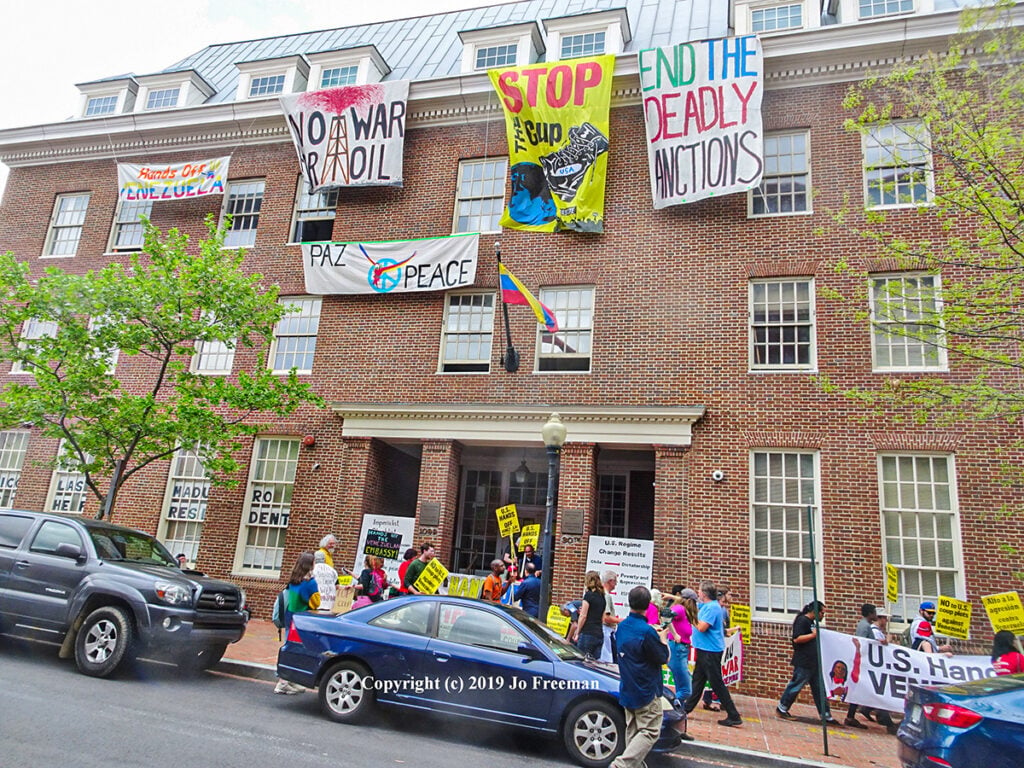
Several months ago, activists invited by the Venezuela government stayed in the Venezuelan embassy in Washington, DC, for over a month until they were finally evicted by police on May 24. The presence of the activists delayed a takeover of the embassy by representatives of the Trump-appointed Venezuelan government-in-exile led by Juan Guaidó. The majority of the world’s governments do not recognize Guaidó; that was dramatically highlighted on October 17 when Venezuela’s was voted onto the UN Human Rights Council despite US “lobbying” (i.e., bribes and threats).

Nevertheless, Trump’s recognition of Guaidó in January 2019 was the excuse for intensifying economic sanctions that had already killed thousands of people by the end of 2018. (Incidentally, Jorge Ramos’ two-hour “detention” also received more Western media attention than the study showing the already-lethal impact of Trump’s sanctions—FAIR.org, 6/14/19).

DN: Journalist Max Blumenthal Says He Was Arrested on False Charges
Democracy Now! (10/30/19) was one of the few US outlets to report on Blumenthal’s arrest.

With the complicity of DC police, Guaidó supporters tried to block food from being delivered to the embassy during the standoff with the activists. At one point, 78-year-old Jesse Jackson Sr. had to scuffle with Guaidó supporters to deliver food. The DC police were clearly intent on doing as little as possible, even with an elderly, high-profile visitor trying to make a delivery.  Former Green Party candidate Ajamu Baraka (age 66) was forced to act as Jackson’s bodyguard, thanks to the aggression of Guaidó supporters and the inaction of DC police.

Norton reported:

Court documents indicate the false charge of simple assault stems from Blumenthal’s participation in a delivery of food and sanitary supplies to peace activists and journalists inside the Venezuelan embassy on May 8, 2019.

Others attempting to deliver food were hit with charges months ago. Activist Ben Rubenstein and Veterans for Peace president Gary Condon (age 72) were beaten by police during the standoff for trying to toss a cucumber to activists inside the embassy. In fact, the warrant against Blumenthal was months old, and apparently initially rejected. Blumenthal explained:

If the government had at least told me I had a warrant I could have voluntarily surrendered and appeared at my own arraignment…. Instead, the federal government essentially enlisted the DC police to SWAT me, ensuring that I would be subjected to an early morning raid and then languish in prison for days without even the ability to call an attorney.

The lack of coverage of his arrest “is totally consistent with media coverage of the siege of the Venezuelan embassy,” Blumenthal told FAIR. “The violence, racism, sexism of the Venezuelan opposition—none of it was reported in the mainstream US press.” Aside from alternative outlets like Democracy Now! (10/30/19) and the World Socialist Website (10/30/19), one had to turn to Russian state media to find coverage of Blumenthal’s arrest. A Sputnik article (10/30/19) about the case cited damaging exposés Grayzone has published about Guaidó inner circle, one of which recently led to the resignation of right-wing economist Ricardo Hausmann from Guaidó’s shadow administration.

Here’s an idea for media outlets and NGOs concerned about the appeal of Russian public relations efforts: start doing your jobs by holding your own authoritarian politicians and politicized police forces to account.

Joe Emersberger

Joe Emersberger is a writer based in Canada whose work has appeared in Telesur English, ZNet and CounterPunch.

Note
See Jo Freeman’s report on what happened at the Embassy back in April 2019 – where you may find more photos like the one on top here.


Related Posts

Tony Robinson October 4, 2026 Violence is easy to recognise when someone is being beaten, shot or killed. It becomes more difficult when nobody is holding a weapon. Poverty, discrimination, exploitation and repression can restrict a human life just as effectively, although they do so in very different ways and with very different consequences. Simply adding more categories to an ever-growing list of forms of violence does not really solve the problem. The more interesting question is what all these different situations have in common and why it makes sense to describe them using the same word. Human beings do not simply react to what happens around them. They remember the past, imagine things that do not yet exist, make plans and undertake projects. Workers organise because they imagine different working conditions; people migrate because they imagine another life somewhere else; social movements emerge because people refuse to accept the...
Lena Petrova of “World Affairs In Context” with more than half a million subscribers on YouTube wanted to explore what a peace researcher like me has to say about, among other things, the First and the Second Cold War and why eethics has disappeared from politics. I am particularly happy about this conversation that also yielded an amazing number of very appreciative comments on YouTube. No doubt, people are longing for alternatives, including peace perspectives.
In contrast to most, we’ll bring alternatives, solutions, hope and strategies for a better future. Times are dangerous, yes, but that only intensifies the need for constructive thinking and action! Jan Oberg, TFF director April 13, 2026 The new TFF Peace Pulse uses video messages in a new way: Max 3-5-minute-long comments, ideas or perhaps mini-lectures, all about peace – positive peace. We launch them today on April 13, 2026 with a carefully crafted visual aesthetic fitting the content. We hope to publish them regularly from now on. We launch Peace Pulse (PP) – for a number of reasons. The world is in chaos, and there are countless reasons to feel concerned, frustrated, even angry. The atmosphere is saturated with doom and gloom, with negative energy and rear‑mirror thinking, while vision, imagination, alternatives, strategies and genuine future‑mindedness remain in short supply. And without them, we simply can’t save the world. Looking at problems from a hundred angles will...

Recent Articles

Below are TFF-related media mentions, comments, videos and social media posts published elsewhere but not on this homepage. We happen to catch and list only a fraction. Regarding video comments and debates, we recommend that you go to the TFF Video Channel on Substack where many of them are reproduced. Jan Oberg is a contributor to China Daily – 52 million daily clicks – and Global Times, CGTN and CCTV (the national television), China Investment, Xinhua News Agency and several others. Articles and videos on these media very often multiply into countless Chinese (and Western media) that re-post them from these main media. Thanks to The China Academy, his analyses, interviews and comments are frequently posted on YouTube channels such as Thinkers Forum and Wave Media. These videos are often re-posted on Bilibili (China’s YouTube), the China Content Center on TikTok, and on the Chinese edition of TikTok, Douyin.com. This means reaching hundreds of millions of viewers worldwide over a year. While there are too many to catch on all these...
Jan Oberg TFF director October 13, 2026 According to Alfred Nobel’s will, the Nobel Peace Prize shall be awarded: ”to the person who has done the most or best to advance fellowship among nations, the abolition or reduction of standing armies, and the establishment and promotion of peace congresses.” Further down, he also expresses how the prize for the “champions of peace” shall be decided: “that for champions of peace by a committee of five persons to be selected by the Norwegian Storting. Alfred Nobel’s will is remarkably short and clear. But few seem to have read it. Nobel did not say that the committee itself should consist of members of parliament. He entrusted the Storting with appointing five persons. In principle, it could have selected diplomats, mediators, peace researchers, conflict-resolution specialists, or other individuals with recognised expertise in matters of peace from around the world. Instead, the Storting gradually...
The Quest for Humane Survival Richard Falk Professor emeritus, Princeton UniversityTFF Associate since 1986October 12, 2026 After decades of teaching and writing about international law in academic frameworks that were not institutionally situated within law school environments—at Princeton and the University of California, Santa Barbara—I found myself most receptive to the TWAIL outlook. It has been especially illuminating in clarifying the extent to which international law evolved as a dialogical critique of Europe’s efforts to legitimize its colonial undertakings. In particular, TWAIL has exposed how international law has functioned to legalize the subjugation of Third World peoples, securing conditions for exploitative investment and trade relations, the coercive enforcement of public debts, and an ideology of cultural superiority. TWAIL’s exposure of these economic legacies of colonialism has influenced my understanding of the history and development of international law, broadly conceived, as an ideological project of the Western sub-system of the world...

TFF on Substack

Discover and subscribe to more peace materials on TFF Substack

Most Popular

Below are TFF-related media mentions, comments, videos and social media posts published elsewhere but not on this homepage. We happen to catch and list only a fraction. Regarding video comments and debates, we recommend that you go to the TFF Video Channel on Substack where many of them are reproduced. Jan Oberg is a contributor to China Daily – 52 million daily clicks – and Global Times, CGTN and CCTV (the national television), China Investment, Xinhua News Agency and several others. Articles and videos on these media very often multiply into countless Chinese (and Western media) that re-post them from these main media. Thanks to The China Academy, his analyses, interviews and comments are frequently posted on YouTube channels such as Thinkers Forum and Wave Media. These videos are often re-posted on Bilibili (China’s YouTube), the China Content Center on TikTok, and on the Chinese edition of TikTok, Douyin.com. This means reaching hundreds of millions of viewers worldwide over a year. While there are too many to catch on all these...
Jan Oberg TFF director October 13, 2026 According to Alfred Nobel’s will, the Nobel Peace Prize shall be awarded: ”to the person who has done the most or best to advance fellowship among nations, the abolition or reduction of standing armies, and the establishment and promotion of peace congresses.” Further down, he also expresses how the prize for the “champions of peace” shall be decided: “that for champions of peace by a committee of five persons to be selected by the Norwegian Storting. Alfred Nobel’s will is remarkably short and clear. But few seem to have read it. Nobel did not say that the committee itself should consist of members of parliament. He entrusted the Storting with appointing five persons. In principle, it could have selected diplomats, mediators, peace researchers, conflict-resolution specialists, or other individuals with recognised expertise in matters of peace from around the world. Instead, the Storting gradually...
The Quest for Humane Survival Richard Falk Professor emeritus, Princeton UniversityTFF Associate since 1986October 12, 2026 After decades of teaching and writing about international law in academic frameworks that were not institutionally situated within law school environments—at Princeton and the University of California, Santa Barbara—I found myself most receptive to the TWAIL outlook. It has been especially illuminating in clarifying the extent to which international law evolved as a dialogical critique of Europe’s efforts to legitimize its colonial undertakings. In particular, TWAIL has exposed how international law has functioned to legalize the subjugation of Third World peoples, securing conditions for exploitative investment and trade relations, the coercive enforcement of public debts, and an ideology of cultural superiority. TWAIL’s exposure of these economic legacies of colonialism has influenced my understanding of the history and development of international law, broadly conceived, as an ideological project of the Western sub-system of the world...
Read More
girl-5894831_1280
Below are TFF-related media mentions, comments, videos and social media posts published elsewhere but not on this homepage. We happen to catch and list only a fraction. Regarding video comments and debates, we recommend that you go to the TFF Video Channel on Substack where many of them are reproduced. Jan Oberg is a contributor to China Daily – 52 million daily clicks – and Global Times, CGTN and CCTV (the national television), China Investment, Xinhua News Agency and several others. Articles and videos on these media very often multiply into countless Chinese (and Western media) that re-post them from these main media. Thanks to The China Academy, his analyses, interviews and comments are frequently posted on YouTube channels such as Thinkers Forum and Wave Media. These videos are often re-posted on Bilibili (China’s YouTube), the China Content Center on TikTok, and on the Chinese edition of TikTok, Douyin.com. This means reaching hundreds of millions of viewers worldwide over a year. While there are too many to catch on all these...
Nobel-Prize-Plaque
Jan Oberg TFF director October 13, 2026 According to Alfred Nobel’s will, the Nobel Peace Prize shall be awarded: ”to the person who has done the most or best to advance fellowship among nations, the abolition or reduction of standing armies, and the establishment and promotion of peace congresses.” Further down, he also expresses how the prize for the “champions of peace” shall be decided: “that for champions of peace by a committee of five persons to be selected by the Norwegian Storting. Alfred Nobel’s will is remarkably short and clear. But few seem to have read it. Nobel did not say that the committee itself should consist of members of parliament. He entrusted the Storting with appointing five persons. In principle, it could have selected diplomats, mediators, peace researchers, conflict-resolution specialists, or other individuals with recognised expertise in matters of peace from around the world. Instead, the Storting gradually...
law-419057_1280
The Quest for Humane Survival Richard Falk Professor emeritus, Princeton UniversityTFF Associate since 1986October 12, 2026 After decades of teaching and writing about international law in academic frameworks that were not institutionally situated within law school environments—at Princeton and the University of California, Santa Barbara—I found myself most receptive to the TWAIL outlook. It has been especially illuminating in clarifying the extent to which international law evolved as a dialogical critique of Europe’s efforts to legitimize its colonial undertakings. In particular, TWAIL has exposed how international law has functioned to legalize the subjugation of Third World peoples, securing conditions for exploitative investment and trade relations, the coercive enforcement of public debts, and an ideology of cultural superiority. TWAIL’s exposure of these economic legacies of colonialism has influenced my understanding of the history and development of international law, broadly conceived, as an ideological project of the Western sub-system of the world...
images-2
Advocates of nuclear disarmament are regularly dismissed by the champions of nuclear deterrence as naïve and unrealistic, utopian or even irresponsible. Yet this ‘doctrine’ of deterrence, regarded by France as the ‘cornerstone’ of its national security, is based on quasi-religious beliefs, a theory that cannot be proven, risky gambles and fragile assumptions. So much so that one might legitimately ask which side the ‘Care Bears’ are on. Marc FinaudVice-President of Initiatives for Nuclear Disarmament (IDN) October 9, 2026 This article was originally published on Pressenza When it comes to these things being treated as religious concepts, look here. Idealists and realists It was Hubert Védrine, François Mitterrand’s former Foreign Minister, who repeatedly coined the phrase: ‘Europeans are a sort of Care Bears who don’t realise they’re living in Jurassic Park’. He applies this reference to the cartoon for well-behaved children not only to what he regards as weakness or idealism...
8824b09f-33a5-43f9-9fd0-550f28cda24d_1536x1024
What the West Borrowed from Asia and What It Left Behind Jan Krikke October 8, 2026 The article was originally published here In the late 1960s, the musical Hair announced that the Age of Aquarius was dawning. Its opening anthem promised a transformation of human consciousness: an era of peace, harmony and understanding. Half a century later, a familiar echo of that promise is a meditation app offered by your employer. You can find it in the same list of benefits as the pension plan and the gym discount. How did a spiritual revolution become an employee benefit? The answer lies in the history of the movement known as New Age: where it came from, what it borrowed from Asia, and why the meaning of what it borrowed changed in the process. Two definitions will help. New Age is a loose label for a wide range of spiritual practices and...
Screenshot 2026-10-04 210142
Small and different + among the 10% most active + 9,000 texts + 150 Associates + 60 000 a day — and a stubborn belief that peace is smarter and must be secured by peaceful means. In 2026, the Transnational Foundation for Peace and Future Research (TFF) turns 40. On Monday, October 5, 2026, a new TFF homepage will go live — a new gateway to more than 9,000 articles, analyses, research papers and other contributions produced over four decades of independent peace research. But this is not simply a new website. For four decades, TFF has worked from a simple conviction: peace is smarter than militarism and can be brought about by peaceful means. This is not merely an aspiration. It is the principle expressed in the UN Charter and the Gandhian tradition that has guided our work from the beginning. TFF is a research-based, independent and people-financed foundation....



