
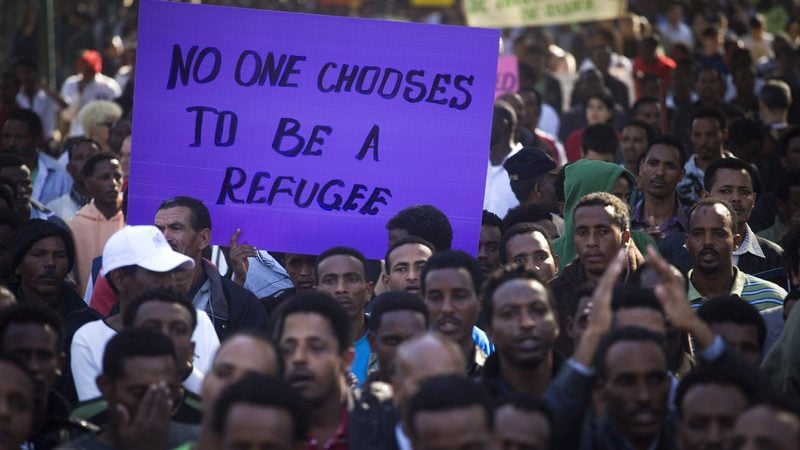
Somebody once said that courage is when you do something today you wouldn’t dare doing yesterday. That is why I decided to express my opinion whereas normally I would choose – wisely – to restrain my lips.

Have you ever had an opportunity to speak with your friends about migrants and mass immigration? Especially with your international friends living in different parts of the world and changing their residence like migrating birds? How do you explain your views if they differ from the usual, dominating or politically correct one?

Or, how do you actually explain that you are against immigration without risking being categorized as a racist?

During my latest visit to Switzerland, while conversing with a friend about many topics including politics, somehow we started discussing immigration.

My friend’s opinion was that Swiss people may seem cold and distant, but in reality they are very open-minded and friendly to other people coming to live in their country. He also noticed that many Europeans he had talked with lately with had expressed what he termed “racist opinions.”

Then I said to him “I believe that migration crisis and mixing of races is actually part of an agenda that’s been planned for years by the top elites who run international politics. And, certainly, I stand for de-globalization.

Now, when you have crossed that line and once your interlocutor has overcome the initial shock – and you realize what you said does sound racist to an innocent ear – you can start explaining what you actually mean:

What is your favorite country?
– Brazil.
– And what is something you really love about Brazil?
– Hmmm, the food.
– That is good, and what else, there must be something specific.
– Food and music.
– Excellent! Now imagine you have children and then grandchildren; imagine 30, 40 years from now your grandchildren ask you to tell them stories about Brazil and, nostalgically, you start to remember the heavenly taste of food you ate there and the music you loved listening to. Music that would give soul to that Brazil you love so much.

Then you decide to take your grandchildren to Brazil for a vacation. Then they can see for themselves. You go there but … that is no longer Brazil you used to know.

Now it is overcrowded with people from all around the world who live there and who don’t even look or act like Brazilians. You take your grandchildren to the restaurant, order your favorite Brazilian food and a person from eastern Europe is serving you. You ask for chef’s name and you find out he is Chinese.

You then try your food and it does not even taste like it used to taste, because that is no longer Brazilian food. You look around and you don’t see people who look like Brazilians. You go to the local market and the lady working there is Asian. You stroll down the streets and hear some unfamiliar beats, the music is clearly not Brazilian.

Does it resemble the country you remembered and used to like so much?
– No.
– Well that begs the questions: What has happened? What should the goal – the basic idea – be?

Should it be the long-term mixing of all the world’s races that threatens to destroy the particularity and uniqueness of each culture?

Without tradition, culture and society, people are lost like sheep in a flock.

And sheep are easy to control.

If we continue the mixing of many cultures together – the big ‘melting pot’ philosophy – we will eventually loose the original cultures and identities. They’ll be watered down.

There won’t be diversity, there won’t be nothing that makes us unique and special, we will all be the same, mixed and lost in some kind of generalised, or mass, global identity.

I have to say it, don’t I? I am not a racist.

I love all people. I love learning about different cultures and religions. I have friends all around the world. I have been on 6 continents, I’ve visited more than 30 countries. I read a lot about other countries, especially the “third world” ones.

I just happen to think that the strategy pursued by the international community if problematic or plain wrong. It needs to be challenged – also without being met with the accusation that such a challenge is backward-looking or racist. It isn’t – and I am not.

Look at how we could think and act instead! Instead of pushing the migration agenda, why don’t we focus more on helping the less developed countries so people won’t have the need to leave?

Why does the West – the US, NATO and/or the EU countries – intervene economically, politically and militarily in other countries, attack them and often start wars against them in order to impose their own agendas?

And why does the international so-called community create immigration conferences, panels, laws, policies and strategies in order to save those “poor, innocent” people without realizing that they are not saving them at all?

Why don’t we, instead, react strongly against such interventions, against such inhuman acts of violence which also contradict all international laws?

No, I’d suggest that we must learn from earlier mistakes and develop new policies so that we stop destroying other people’s countries and help them in all kinds of benevolent ways to use their potential to the maximum.

Its old hat but true: Prevention is better than cure.

If we did something like that, they wouldn’t have to leave their countries and many times their families and hearts behind.

You, my friend, migrated because of work, right? You have a degree and you are very good at what you do, so you can go wherever you want, but you are also respected wherever you go, and you can integrate easily, almost everywhere.

But when you migrate as an asylum seeker or refugee, when you flee your home trying to escape a dangerous and oppressive situation, when you travel to another country searching for asylum, sad, broken and without a penny in your pocket, you will never become an equal there.

You have examples all over Europe now. Black people are not integrating with white people, French people fear Muslims more than kids fear darkness. In Germany, a lady who cleans toilets or serves you in a bar will never be a German lady, but most probably remain a marginalised ‘Eastern European immigrant.’

In the 1990s many people fled from my country, Serbia, escaping the wars in former Yugoslavia and the bombing of Serbia and Kosovo. I don’t blame them, for sure. They probably felt they had no other choice. People don’t leave lightly what they love.

They are now all over Germany, Switzerland, Austria, Canada, Australia – and they come home for a vacation or to visit the family they left behind. Nostalgically, they enjoy those ten days of vacation and then, with empty souls, leave their hearts behind in their village or town, they go back to Germany, where they never fully integrated and they never felt at home and they were never actually happy.

I don’t know anyone who wouldn’t come permanently back if only they had economic security and stability guaranteed back home.

Why, in the first place, did the international ‘community’ first bomb my country and then have to accept to host the victims of that – criminal – policy? Making both the ‘guests’ and the ‘hosts’ unhappy forever?

Do you see the difference there, my friend? I don’t have anything against people who move to other countries. I myself don’t live in my country of origin. I have often moved – because of my big desire for knowledge and I my enormous inner passion for exploring the unknown, my hunger for new, distant places. For getting lost in new horizons.

But I am not forced to leave. Why do powerful countries create such situations where people have no choice, where they are forced to leave? It creates misery for everyone, including themselves.

My friend! Do you understand better now the difference between people who wander because they love to explore different cultures and places, or maybe because they fall in love in some of them and stay, people who move because they want to grow professionally – and all the other people who are forced to leave their countries because they are being systematically destroyed, people who wander because they are lost?

I’ve been surprised to read abut the immigration document signed on 10th and 11th of December 2018 in Marrakesh as a result of the Intergovernmental conference to adopt the global compact for safe, orderly and regular migration. On page 32, the worda “we oblige” is used 44 times, and the term “obligation” 87 times (Starcevic, 2018, p. 24).

Why are these words with such a strong connotations used so many times?

Why are countries obliged to follow the agenda of global mobility and migration-dissemination? Why not discuss, first, why it increases almost exponentially?

Why is critical thinking being censored and everyone who opposes this agenda is labeled racist?

Do we really think we can live in a happy world once when we will hardly even know where we come from, where our origins are and which language our parents or grandparents used to speak?

Do we really think a human being can be happy without her/his community, her/his society, her/his group of those similar to him. Without the tradition that nurtures the values of her/his culture?

Do we really think that by mixing it all together, creating shadows of what we use to be, creating new people who – loosing their old tradition, heritage, values and community – accepted to be slaves somewhere far away of consumerism in pursuit of a false happiness in shape of money and power?

It seems that, only when it is too late, do we realize it is not what really makes us happy.

We’ve got to re-search – and discuss much more – why millions of people are moving around and why the numbers of refugees and asylum-seekers skyrocket instead of discussing only whether we accept or like immigrants or not.

Note
Starcevic, M. Globalni migracioni pak: Strategija za porobljavanje Evrope in Geopolitika, p. 24, April 2019.


Related Posts

Below are TFF-related media mentions, comments, videos and social media posts published elsewhere but not on this homepage. We happen to catch and list only a fraction. Regarding video comments and debates, we recommend that you go to the TFF Video Channel on Substack where many of them are reproduced. Jan Oberg is a contributor to China Daily – 52 million daily clicks – and Global Times, CGTN and CCTV (the national television), China Investment, Xinhua News Agency and several others. Articles and videos on these media very often multiply into countless Chinese (and Western media) that re-post them from these main media. Thanks to The China Academy, his analyses, interviews and comments are frequently posted on YouTube channels such as Thinkers Forum and Wave Media. These videos are often re-posted on Bilibili (China’s YouTube), the China Content Center on TikTok, and on the Chinese edition of TikTok, Douyin.com. This means reaching hundreds of millions of viewers worldwide over a year. While there are too many to catch on all these...
Jan Oberg TFF director October 13, 2026 According to Alfred Nobel’s will, the Nobel Peace Prize shall be awarded: ”to the person who has done the most or best to advance fellowship among nations, the abolition or reduction of standing armies, and the establishment and promotion of peace congresses.” Further down, he also expresses how the prize for the “champions of peace” shall be decided: “that for champions of peace by a committee of five persons to be selected by the Norwegian Storting. Alfred Nobel’s will is remarkably short and clear. But few seem to have read it. Nobel did not say that the committee itself should consist of members of parliament. He entrusted the Storting with appointing five persons. In principle, it could have selected diplomats, mediators, peace researchers, conflict-resolution specialists, or other individuals with recognised expertise in matters of peace from around the world. Instead, the Storting gradually...
The Quest for Humane Survival Richard Falk Professor emeritus, Princeton UniversityTFF Associate since 1986October 12, 2026 After decades of teaching and writing about international law in academic frameworks that were not institutionally situated within law school environments—at Princeton and the University of California, Santa Barbara—I found myself most receptive to the TWAIL outlook. It has been especially illuminating in clarifying the extent to which international law evolved as a dialogical critique of Europe’s efforts to legitimize its colonial undertakings. In particular, TWAIL has exposed how international law has functioned to legalize the subjugation of Third World peoples, securing conditions for exploitative investment and trade relations, the coercive enforcement of public debts, and an ideology of cultural superiority. TWAIL’s exposure of these economic legacies of colonialism has influenced my understanding of the history and development of international law, broadly conceived, as an ideological project of the Western sub-system of the world...

Recent Articles

Below are TFF-related media mentions, comments, videos and social media posts published elsewhere but not on this homepage. We happen to catch and list only a fraction. Regarding video comments and debates, we recommend that you go to the TFF Video Channel on Substack where many of them are reproduced. Jan Oberg is a contributor to China Daily – 52 million daily clicks – and Global Times, CGTN and CCTV (the national television), China Investment, Xinhua News Agency and several others. Articles and videos on these media very often multiply into countless Chinese (and Western media) that re-post them from these main media. Thanks to The China Academy, his analyses, interviews and comments are frequently posted on YouTube channels such as Thinkers Forum and Wave Media. These videos are often re-posted on Bilibili (China’s YouTube), the China Content Center on TikTok, and on the Chinese edition of TikTok, Douyin.com. This means reaching hundreds of millions of viewers worldwide over a year. While there are too many to catch on all these...
Jan Oberg TFF director October 13, 2026 According to Alfred Nobel’s will, the Nobel Peace Prize shall be awarded: ”to the person who has done the most or best to advance fellowship among nations, the abolition or reduction of standing armies, and the establishment and promotion of peace congresses.” Further down, he also expresses how the prize for the “champions of peace” shall be decided: “that for champions of peace by a committee of five persons to be selected by the Norwegian Storting. Alfred Nobel’s will is remarkably short and clear. But few seem to have read it. Nobel did not say that the committee itself should consist of members of parliament. He entrusted the Storting with appointing five persons. In principle, it could have selected diplomats, mediators, peace researchers, conflict-resolution specialists, or other individuals with recognised expertise in matters of peace from around the world. Instead, the Storting gradually...
The Quest for Humane Survival Richard Falk Professor emeritus, Princeton UniversityTFF Associate since 1986October 12, 2026 After decades of teaching and writing about international law in academic frameworks that were not institutionally situated within law school environments—at Princeton and the University of California, Santa Barbara—I found myself most receptive to the TWAIL outlook. It has been especially illuminating in clarifying the extent to which international law evolved as a dialogical critique of Europe’s efforts to legitimize its colonial undertakings. In particular, TWAIL has exposed how international law has functioned to legalize the subjugation of Third World peoples, securing conditions for exploitative investment and trade relations, the coercive enforcement of public debts, and an ideology of cultural superiority. TWAIL’s exposure of these economic legacies of colonialism has influenced my understanding of the history and development of international law, broadly conceived, as an ideological project of the Western sub-system of the world...

TFF on Substack

Discover and subscribe to more peace materials on TFF Substack

Most Popular

Below are TFF-related media mentions, comments, videos and social media posts published elsewhere but not on this homepage. We happen to catch and list only a fraction. Regarding video comments and debates, we recommend that you go to the TFF Video Channel on Substack where many of them are reproduced. Jan Oberg is a contributor to China Daily – 52 million daily clicks – and Global Times, CGTN and CCTV (the national television), China Investment, Xinhua News Agency and several others. Articles and videos on these media very often multiply into countless Chinese (and Western media) that re-post them from these main media. Thanks to The China Academy, his analyses, interviews and comments are frequently posted on YouTube channels such as Thinkers Forum and Wave Media. These videos are often re-posted on Bilibili (China’s YouTube), the China Content Center on TikTok, and on the Chinese edition of TikTok, Douyin.com. This means reaching hundreds of millions of viewers worldwide over a year. While there are too many to catch on all these...
Jan Oberg TFF director October 13, 2026 According to Alfred Nobel’s will, the Nobel Peace Prize shall be awarded: ”to the person who has done the most or best to advance fellowship among nations, the abolition or reduction of standing armies, and the establishment and promotion of peace congresses.” Further down, he also expresses how the prize for the “champions of peace” shall be decided: “that for champions of peace by a committee of five persons to be selected by the Norwegian Storting. Alfred Nobel’s will is remarkably short and clear. But few seem to have read it. Nobel did not say that the committee itself should consist of members of parliament. He entrusted the Storting with appointing five persons. In principle, it could have selected diplomats, mediators, peace researchers, conflict-resolution specialists, or other individuals with recognised expertise in matters of peace from around the world. Instead, the Storting gradually...
The Quest for Humane Survival Richard Falk Professor emeritus, Princeton UniversityTFF Associate since 1986October 12, 2026 After decades of teaching and writing about international law in academic frameworks that were not institutionally situated within law school environments—at Princeton and the University of California, Santa Barbara—I found myself most receptive to the TWAIL outlook. It has been especially illuminating in clarifying the extent to which international law evolved as a dialogical critique of Europe’s efforts to legitimize its colonial undertakings. In particular, TWAIL has exposed how international law has functioned to legalize the subjugation of Third World peoples, securing conditions for exploitative investment and trade relations, the coercive enforcement of public debts, and an ideology of cultural superiority. TWAIL’s exposure of these economic legacies of colonialism has influenced my understanding of the history and development of international law, broadly conceived, as an ideological project of the Western sub-system of the world...
Read More
girl-5894831_1280
Below are TFF-related media mentions, comments, videos and social media posts published elsewhere but not on this homepage. We happen to catch and list only a fraction. Regarding video comments and debates, we recommend that you go to the TFF Video Channel on Substack where many of them are reproduced. Jan Oberg is a contributor to China Daily – 52 million daily clicks – and Global Times, CGTN and CCTV (the national television), China Investment, Xinhua News Agency and several others. Articles and videos on these media very often multiply into countless Chinese (and Western media) that re-post them from these main media. Thanks to The China Academy, his analyses, interviews and comments are frequently posted on YouTube channels such as Thinkers Forum and Wave Media. These videos are often re-posted on Bilibili (China’s YouTube), the China Content Center on TikTok, and on the Chinese edition of TikTok, Douyin.com. This means reaching hundreds of millions of viewers worldwide over a year. While there are too many to catch on all these...
Nobel-Prize-Plaque
Jan Oberg TFF director October 13, 2026 According to Alfred Nobel’s will, the Nobel Peace Prize shall be awarded: ”to the person who has done the most or best to advance fellowship among nations, the abolition or reduction of standing armies, and the establishment and promotion of peace congresses.” Further down, he also expresses how the prize for the “champions of peace” shall be decided: “that for champions of peace by a committee of five persons to be selected by the Norwegian Storting. Alfred Nobel’s will is remarkably short and clear. But few seem to have read it. Nobel did not say that the committee itself should consist of members of parliament. He entrusted the Storting with appointing five persons. In principle, it could have selected diplomats, mediators, peace researchers, conflict-resolution specialists, or other individuals with recognised expertise in matters of peace from around the world. Instead, the Storting gradually...
law-419057_1280
The Quest for Humane Survival Richard Falk Professor emeritus, Princeton UniversityTFF Associate since 1986October 12, 2026 After decades of teaching and writing about international law in academic frameworks that were not institutionally situated within law school environments—at Princeton and the University of California, Santa Barbara—I found myself most receptive to the TWAIL outlook. It has been especially illuminating in clarifying the extent to which international law evolved as a dialogical critique of Europe’s efforts to legitimize its colonial undertakings. In particular, TWAIL has exposed how international law has functioned to legalize the subjugation of Third World peoples, securing conditions for exploitative investment and trade relations, the coercive enforcement of public debts, and an ideology of cultural superiority. TWAIL’s exposure of these economic legacies of colonialism has influenced my understanding of the history and development of international law, broadly conceived, as an ideological project of the Western sub-system of the world...
images-2
Advocates of nuclear disarmament are regularly dismissed by the champions of nuclear deterrence as naïve and unrealistic, utopian or even irresponsible. Yet this ‘doctrine’ of deterrence, regarded by France as the ‘cornerstone’ of its national security, is based on quasi-religious beliefs, a theory that cannot be proven, risky gambles and fragile assumptions. So much so that one might legitimately ask which side the ‘Care Bears’ are on. Marc FinaudVice-President of Initiatives for Nuclear Disarmament (IDN) October 9, 2026 This article was originally published on Pressenza When it comes to these things being treated as religious concepts, look here. Idealists and realists It was Hubert Védrine, François Mitterrand’s former Foreign Minister, who repeatedly coined the phrase: ‘Europeans are a sort of Care Bears who don’t realise they’re living in Jurassic Park’. He applies this reference to the cartoon for well-behaved children not only to what he regards as weakness or idealism...
8824b09f-33a5-43f9-9fd0-550f28cda24d_1536x1024
What the West Borrowed from Asia and What It Left Behind Jan Krikke October 8, 2026 The article was originally published here In the late 1960s, the musical Hair announced that the Age of Aquarius was dawning. Its opening anthem promised a transformation of human consciousness: an era of peace, harmony and understanding. Half a century later, a familiar echo of that promise is a meditation app offered by your employer. You can find it in the same list of benefits as the pension plan and the gym discount. How did a spiritual revolution become an employee benefit? The answer lies in the history of the movement known as New Age: where it came from, what it borrowed from Asia, and why the meaning of what it borrowed changed in the process. Two definitions will help. New Age is a loose label for a wide range of spiritual practices and...
Screenshot 2026-10-04 210142
Small and different + among the 10% most active + 9,000 texts + 150 Associates + 60 000 a day — and a stubborn belief that peace is smarter and must be secured by peaceful means. In 2026, the Transnational Foundation for Peace and Future Research (TFF) turns 40. On Monday, October 5, 2026, a new TFF homepage will go live — a new gateway to more than 9,000 articles, analyses, research papers and other contributions produced over four decades of independent peace research. But this is not simply a new website. For four decades, TFF has worked from a simple conviction: peace is smarter than militarism and can be brought about by peaceful means. This is not merely an aspiration. It is the principle expressed in the UN Charter and the Gandhian tradition that has guided our work from the beginning. TFF is a research-based, independent and people-financed foundation....




