
Dansk Institut for Internationale Studier, DIIS, har netop udgivet en publikation om ”Trolde i dit feed. Russisk desinformation”, der specielt skal hjælpe gymnasieelever med at forstå fake news.

Dog kun russiske.

Rapporten er selv et glimrende eksempel på desinformation og fake news – eller snarere fortiede nyheder, der er værre end fake, nemlig fakta og perspektiver på begivenheder, du aldrig får.
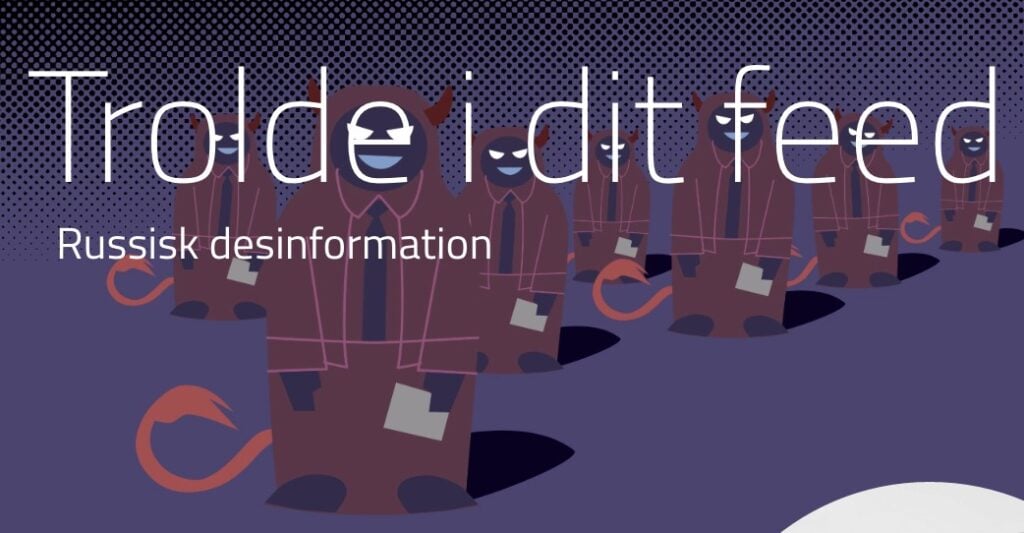
Layout fra Dansk Institut for Internationale Studiers (DIIS) publikation “Trolde i dit feed”

Derfor har vi på TFF taget et kig på DIIS’s arbejde.

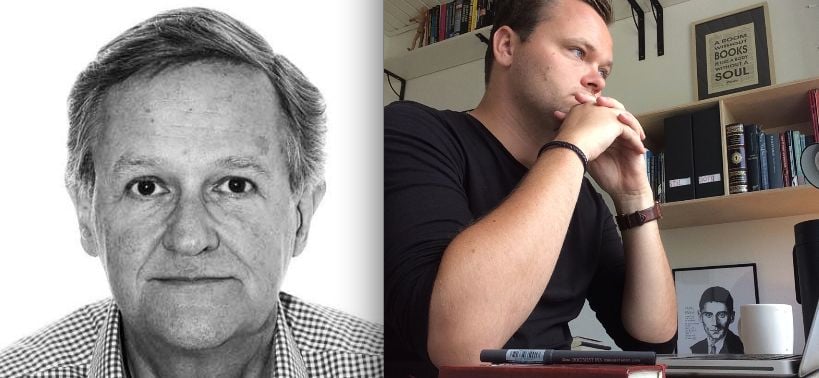
Først fra et fra et freds- og konfliktperspektiv med Jan Øberg og dernæst et retorisk perspektiv med Jesper Munk Jakobsen.

”Trolde i dit feed. Russisk desinformation” kan findes her.

Jan Øberg

Læser man DIIS’s publikation om russisk desinformation fra et freds- og konflikt- perspektiv, vil det være nemt at konkludere, at Rusland bliver fremstillet som en ensidig negativ bidrager til konflikten mod vesten og Danmark.

Det man undlader at informere læseren om er, at Rusland er part i en omfattende konflikt med mange aktører. Rusland fremstår som den udfarende, Vesten som den re-aktive.

En konflikt studerer man ved at undersøge hvor mange og hvem, der er dens parter.

Derefter bruger man en enkel ABC til at forstå hvad konflikten drejer sig om – nemlig A for Attituder, B for Behaviour eller adfærd og C for Conflict eller konflikt – hvad er det for et problem, der gør at partnerne er i konflikt?

Og har man gjort sig ulejligheden at undersøge konfliktens ABC, så kan man bedre lave en Diagnose, en Prognose og foreslå en Behandling af konflikten – dvs. få den løst.

Det er alt dette som konfliktanalfabeter ikke fatter eller gider. De tror – som vore medier, mange eksperter samt stor set alle politikere – at de har sagt noget relevant hvis de peger på at dem dér er de gode og dem dér er de onde.

Den konflikt, som Rusland er en aktør i, har mængder af deltagere, f.eks. de 29 lande i NATO. Konflikten udspilles også i områder, der ikke tilhører NATO som f.eks. i Syrien og Ukraine og i forhold til Kina og Iran.

Men hvad gør man på DIIS?

Man blæser på sammenhænge, gør det let for sig og ser ikke på hvad konflikten (C), som Rusland er en del af, handler om eller Attituderne (A) – F.eks på russernes erfaring og perspektiv eller hvordan de ser på sig selv og på os i vesten.

Nej, der er kun én part og den opfører sig (Adfærd) på en skrækkelig måde og den er altid først ude så vi – de gode – må re-agere.

Da man opererer på denne lidet faglige måde foreholder man også de unge læsere den vigtige egenskab ved konflikten at den er en a-symmetrisk konflikt i en række henseender. Rusland er underlegen hvad angår økonomisk, international politisk-diplomatisk magt, medieindflydelse og hvad angår konventionelle forsvarsstyrker. Rusland er kun Vesten/NATO en ligeværdig partner hvad angår atomvåbnene – men den undtagelse er ligegyldig fordi alle atomstater har absurd mange og kan ødelægge kloden flere gange.

Derfor kan man skrive som følger uden at blinke – et af mange eksempler i rapporten:

”Du skal forestille dig, at en politisk aktør (fx Rusland) har en lang række mål, som de gerne vil opnå. Fx kan der vore en politisk omvæltning et sted i verden, som påvirker aktørens interesser i en negativ retning. Det får måske vores aktør til at beslutte sig for at påvirke sine interesser og genoprette sin indflydelse.
Det var faktisk, hvad der skete i Ukraine i februar 2014. Omfattende demonstrationer og gadekampe i hovedstaden Kiev fik pludselig landets daværende præsident Viktor Janukovitj til at flygte til Rusland. Han blev kort efter afløst af den nuværende Petro Porosjenko, som ønsker tætte forbindelser til både EU og NATO, og er meget kritisk overfor Rusland.
Rusland svarede igen på denne udvikling ved først at erobre og annektere Krim…”

Man må åbenbart gå ud fra at elever og lærere intet ved og ikke tænker selv, så hér får de en fin lille troldeversion, forsimplet og skævvredet til at passe til vore danske interesser og tækkes stat, folketing og forsvarsministerium, der jo finansierer DIIS. (Hvilket i parantes turde stride mod at instituttet kalder sig uafhængigt).

Danmark er mere eller mindre permanent krigsførende og NATO-medlem og altså part i konflikten med Rusland. Men det behøver eleverne ikke at vide noget om fordi  – netop! – vi er de gode og russerne er de dumme og onde!

Og hvad forties så? At Rusland er en del af en konflikt med NATO/Vesten og at sidstnævnte også bruger desinformation, propaganda, opdigtede historier, markedsføring af løgne, infiltrerer valg i andre lande, påvirker befolkninger via medier og til disse formål bruger mange gange flere midler.

Samt vælter sig ind i lande, specielt i Mellemøsten, i et omfang som gøre Ruslands folkeretsovertrædelser til den rene barnemad.

Til alt held kan man – lærere og elever – læse om den slags i troværdige, faktabaserede vestlige rapporter.

I et kapitel i rapporten bliver eleverne belært om hvordan de selv kan tjekke information. Da jeg så at man anbefaler Google til at fakta-tjekke, der er offentlig kendt for at censurere blandt andet russiske hjemmesider og hvis chef også rådgiver amerikanske sikkerhedsmyndigheder, gad jeg ikke læse mere.

Nå, alt bliver nok bedre. DIIS har lige fået ny bestyrelsesformand. Han er specialist i turisme i Vestjylland med fokus på blandet andet Blokhus og Rebild Bakker.

Jesper Munk Jakobsen

Der er en række punkter i DIIS’s publikation, som man kan bør kritisk over for, når man ser nærmere på argumentation, sprogbrug og kilder. Dem vil jeg forsøge at udfolde herunder.

DIIS vil gerne advare eleverne på ungdomsuddannelserne om desinformation fra Rusland.

Så hvad er desinformation?

DIIS definerer desinformation på følgende måde:
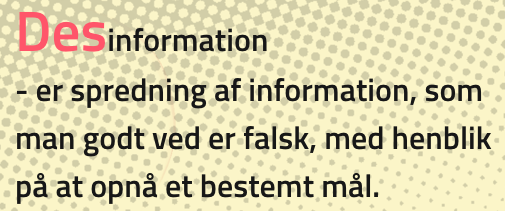
Dansk Institut for International Studiers (DIIS)

definition af desinformationDIIS henviser ikke i materialet til, hvordan de er kommet frem til denne definition.

Selvom dette er en informationsbrochure, er det bemærkelsesværdigt, at afsenderen ikke har valgt at begrunde sin definition af ”desinformation”, da den umiddelbart bygger på motivfortolkning.

Når DIIS skriver ”som man godt ved er falsk” stiller denne definition et krav til modtageren om, at man skal evne at gå ind i afsenderens hoved for at vide, at den information man finder frem til på internettet er falsk og fremlagt med fuldt overlæg.

Det er dermed et usædvanlig krævende fortolkningsarbejde, som DIIS kræver af gymnasieeleverne. Derfor vil jeg også mene, at det kræver en usædvanlig grundig begrundelse, som kan klæde gymnasieeleverne ordentligt på til fremover at stå imod desinformation fra Rusland.

Det får de desværre ikke, og tilbage står en snæver og diffus definition, som jeg mener højst bør udvikle læserens kritiske sans overfor forfatterne selv.

Tro på os, for de andre lyver

Men hvad er ”falsk” information ifølge DIIS?

Jeg ved fra min kommunikationsfaglige baggrund, at der anvendes mange bevidste sproglige handlinger, som man bruger bevidst strategisk. Det handler om at tilgå eller fremlægge en sag med henblik på, hvad der er mest fordelagtigt for afsenderen for dermed at overbevise sit publikum.

Så hvad er forskellen mellem desinformation og begreber som undladelser, vinkling, spind eller framing?

I en politisk sag i et demokrati træffes beslutninger på baggrund af argumenter. En afsender vil naturligvis fremlægge de argumenter, som fremmer hans sag og i højere grad undlade at fremlægge modpartens argumenter imod sin egen sag.

I videnskaben er det mere nærliggende af slå nogle sandheder fast som, at jorden er rund, men når det drejer sig om menneskelige konflikter og geopolitik, er der utallige synsvinkler og perspektiver.

Derfor vil jeg påstå, at der ikke én måde at udlægge information på. Der er ikke én objektiv virkelighed, men lige så mange virkeligheder, som der er mennesker på jorden. Vi udlægger verden forskelligt, afhængigt af hvem af os der er fortæller.

DIIS fortæller, at desinformation er, hvor nogen videreformidler noget som er ”falsk”. Da DIIS ikke kommer med nogen definition på det, kunne et kritisk spørgsmål være. Hvad er definitionen på, at noget er falsk?

Den oplagte sammenligning er begrebet ”Fake News”, som Trump anvender flittigt og kritiseres lige så flittigt for at bruge. I og med at DIIS ikke fremlægger nogen definition af, hvad der er falsk, kunne man henledes mod Trumps løse definition, som ofte netop henviser vil vinkling, undladelser og framing.

Fx når CNN vinkler en historie, og Trump mener, at de undlader at viderebringe informationer, som han måske synes ville være en mere ”sand” udlægning.

DIIS advarer senere i brochuren også om spredning af ”løgne” om sociale medier: ”Men de (sociale medier) kan også bruges til at sprede løgne og påvirke folks holdninger.”

Så igen, hvad er en løgn? DIIS fremlægger følgende eksempler fra Ukraine-krisen på løgne uden yderligere belæg, henvisninger eller argumentation:

  • at omvæltningerne i Kiev var arrangeret af USA’s efterretningstjenester
  • at beboerne på Krim og i Østukraine var i fare for ukrainske fascister og nazister og derfor måtte have hjælp fra Rusland
  • at ukrainske soldater begik overgreb mod civile i Østukraine.

Det er en fuldstændig legitim mission at ville modbevise løgne, men der bør være et minimumskrav om at modvise det sagligt, hvis man vil fremstå, som en troværdig afsender.

Man kan ikke bare udokumenteret fremlægge en påstand om, hvad Rusland har sagt og derefter hævde, at det er falsk uden yderligere begrundelse. Forfatterne kunne hævde, at i og med det er falsk, kan det ikke modbevises, da det aldrig har fundet sted.

Det er netop denne brochures problem – at der ikke er nogle henvisninger, og derfor kan den kritiske læser ikke tjekke Ruslands argumentation for deres påstande. Dog bliver der også argumenteret senere for, at man ikke skal tro på det de russiske medier skriver.

På den måde fratager man sig selv ansvaret for at være saglig, og læseren bliver efterladt med et udsagn om – Tro på os, for de andre lyver.

Derfor er en generel stor kritik af brochuren, at der ikke er en eneste henvisning til dokumentation, undersøgelser og artikler, som underbygger de overordnede påstande.

Det betyder, at DIIS, som beder sine læsere om fremover at være kritiske omkring det de læser ikke kan afprøve denne afsenders påstande, men skal sluge dem ukritisk.

Det paradoksale er, at hvis gymnasieeleverne æder de her informationer råt, er det et bevis på, at de netop ikke er kritisk bevidste omkring de informationer, som de læser. Man kunne lave den simple øvelse:

Hvis man læste det her i Rusland, vil man så klandre Danmark for desinformation i kraft af de snævre definitioner og manglen på dokumentation?

Eller man erstattede ”Danmark” med ”Rusland” i nedenstående eksempel fra brochuren og spurgte sig selv, om vi som danske borgere ville mene, at der er belæg for det, som vi bliver anklaget for her?

”Du skal forestille dig, at en politisk aktør (fx Rusland) har en lang række mål, som de gerne vil opnå. Fx kan der være en politisk omvæltning et sted i verden, som påvirker aktørens interesser i en negativ retning.”

Vær kritisk, men kun over for Rusland

Hvis denne brochure handlede om, at gøre gymnasium-eleverne kritisk bevidste, er det tankevækkende, at DIIS ser sig selv som en legitim aktør, uden selv at skulle stå til ansvar for at fremlægge nogen form for rygdækning for sine påstande.

Måske, fordi det netop vil underminere denne teksts overordnede troværdighed.

Nemlig at hele diskussionen om desinformation, falsk, fake-news, spin osv. er en gråzone, som stater og magthavere primært (igen se på Trump) anvender løst, som parader for modargumenter fx fra Rusland om, at der andre måder at opfatte verdenen på.

Der bliver ikke nogen steder i dette materiale gjort opmærksom på, at Danmark også har interesser og motiver, når de formidler. Du skal altså være kritisk, men du behøver altså ikke være kritisk overfor din egen stat.

Det her materiale har et 100 pct. ensidigt fokus og giver det indtryk af, at Danmark og alle andre lande er rene som sne. Samtidig påtager man sig rollen som objektiv formidler af verden.

Man kan i denne læsning kun komme frem til den åbenlyse konklusion, at man skal være kritisk overfor det, som bliver skrevet om Rusland og det de russiske medier skriver, og hvis man læser den samme information flere gange, skal man fortsat være skeptisk.

Hvis man køber det, så køber man også implicit, at man skal tro ukritisk på den information, som kommer fra sin egen stat. For dette materiale mangler argumentation og dokumentation for sine påstande og uddanner derfor ikke læseren til at være kritisk.

Efter min overbevisning er dette materiale ikke velegnet som undervisningsmateriale på landets ungdomsuddannelser, med mindre brochuren selv bliver genstand for kritik.

Related Posts

Below are TFF-related media mentions, comments, videos and social media posts published elsewhere but not on this homepage. We happen to catch and list only a fraction. Regarding video comments and debates, we recommend that you go to the TFF Video Channel on Substack where many of them are reproduced. Jan Oberg is a contributor to China Daily – 52 million daily clicks – and Global Times, CGTN and CCTV (the national television), China Investment, Xinhua News Agency and several others. Articles and videos on these media very often multiply into countless Chinese (and Western media) that re-post them from these main media. Thanks to The China Academy, his analyses, interviews and comments are frequently posted on YouTube channels such as Thinkers Forum and Wave Media. These videos are often re-posted on Bilibili (China’s YouTube), the China Content Center on TikTok, and on the Chinese edition of TikTok, Douyin.com. This means reaching hundreds of millions of viewers worldwide over a year. While there are too many to catch on all these...
Jan Oberg TFF director October 13, 2026 According to Alfred Nobel’s will, the Nobel Peace Prize shall be awarded: ”to the person who has done the most or best to advance fellowship among nations, the abolition or reduction of standing armies, and the establishment and promotion of peace congresses.” Further down, he also expresses how the prize for the “champions of peace” shall be decided: “that for champions of peace by a committee of five persons to be selected by the Norwegian Storting. Alfred Nobel’s will is remarkably short and clear. But few seem to have read it. Nobel did not say that the committee itself should consist of members of parliament. He entrusted the Storting with appointing five persons. In principle, it could have selected diplomats, mediators, peace researchers, conflict-resolution specialists, or other individuals with recognised expertise in matters of peace from around the world. Instead, the Storting gradually...
The Quest for Humane Survival Richard Falk Professor emeritus, Princeton UniversityTFF Associate since 1986October 12, 2026 After decades of teaching and writing about international law in academic frameworks that were not institutionally situated within law school environments—at Princeton and the University of California, Santa Barbara—I found myself most receptive to the TWAIL outlook. It has been especially illuminating in clarifying the extent to which international law evolved as a dialogical critique of Europe’s efforts to legitimize its colonial undertakings. In particular, TWAIL has exposed how international law has functioned to legalize the subjugation of Third World peoples, securing conditions for exploitative investment and trade relations, the coercive enforcement of public debts, and an ideology of cultural superiority. TWAIL’s exposure of these economic legacies of colonialism has influenced my understanding of the history and development of international law, broadly conceived, as an ideological project of the Western sub-system of the world...

Recent Articles

Below are TFF-related media mentions, comments, videos and social media posts published elsewhere but not on this homepage. We happen to catch and list only a fraction. Regarding video comments and debates, we recommend that you go to the TFF Video Channel on Substack where many of them are reproduced. Jan Oberg is a contributor to China Daily – 52 million daily clicks – and Global Times, CGTN and CCTV (the national television), China Investment, Xinhua News Agency and several others. Articles and videos on these media very often multiply into countless Chinese (and Western media) that re-post them from these main media. Thanks to The China Academy, his analyses, interviews and comments are frequently posted on YouTube channels such as Thinkers Forum and Wave Media. These videos are often re-posted on Bilibili (China’s YouTube), the China Content Center on TikTok, and on the Chinese edition of TikTok, Douyin.com. This means reaching hundreds of millions of viewers worldwide over a year. While there are too many to catch on all these...
Jan Oberg TFF director October 13, 2026 According to Alfred Nobel’s will, the Nobel Peace Prize shall be awarded: ”to the person who has done the most or best to advance fellowship among nations, the abolition or reduction of standing armies, and the establishment and promotion of peace congresses.” Further down, he also expresses how the prize for the “champions of peace” shall be decided: “that for champions of peace by a committee of five persons to be selected by the Norwegian Storting. Alfred Nobel’s will is remarkably short and clear. But few seem to have read it. Nobel did not say that the committee itself should consist of members of parliament. He entrusted the Storting with appointing five persons. In principle, it could have selected diplomats, mediators, peace researchers, conflict-resolution specialists, or other individuals with recognised expertise in matters of peace from around the world. Instead, the Storting gradually...
The Quest for Humane Survival Richard Falk Professor emeritus, Princeton UniversityTFF Associate since 1986October 12, 2026 After decades of teaching and writing about international law in academic frameworks that were not institutionally situated within law school environments—at Princeton and the University of California, Santa Barbara—I found myself most receptive to the TWAIL outlook. It has been especially illuminating in clarifying the extent to which international law evolved as a dialogical critique of Europe’s efforts to legitimize its colonial undertakings. In particular, TWAIL has exposed how international law has functioned to legalize the subjugation of Third World peoples, securing conditions for exploitative investment and trade relations, the coercive enforcement of public debts, and an ideology of cultural superiority. TWAIL’s exposure of these economic legacies of colonialism has influenced my understanding of the history and development of international law, broadly conceived, as an ideological project of the Western sub-system of the world...

TFF on Substack

Discover and subscribe to more peace materials on TFF Substack

Most Popular

Below are TFF-related media mentions, comments, videos and social media posts published elsewhere but not on this homepage. We happen to catch and list only a fraction. Regarding video comments and debates, we recommend that you go to the TFF Video Channel on Substack where many of them are reproduced. Jan Oberg is a contributor to China Daily – 52 million daily clicks – and Global Times, CGTN and CCTV (the national television), China Investment, Xinhua News Agency and several others. Articles and videos on these media very often multiply into countless Chinese (and Western media) that re-post them from these main media. Thanks to The China Academy, his analyses, interviews and comments are frequently posted on YouTube channels such as Thinkers Forum and Wave Media. These videos are often re-posted on Bilibili (China’s YouTube), the China Content Center on TikTok, and on the Chinese edition of TikTok, Douyin.com. This means reaching hundreds of millions of viewers worldwide over a year. While there are too many to catch on all these...
Jan Oberg TFF director October 13, 2026 According to Alfred Nobel’s will, the Nobel Peace Prize shall be awarded: ”to the person who has done the most or best to advance fellowship among nations, the abolition or reduction of standing armies, and the establishment and promotion of peace congresses.” Further down, he also expresses how the prize for the “champions of peace” shall be decided: “that for champions of peace by a committee of five persons to be selected by the Norwegian Storting. Alfred Nobel’s will is remarkably short and clear. But few seem to have read it. Nobel did not say that the committee itself should consist of members of parliament. He entrusted the Storting with appointing five persons. In principle, it could have selected diplomats, mediators, peace researchers, conflict-resolution specialists, or other individuals with recognised expertise in matters of peace from around the world. Instead, the Storting gradually...
The Quest for Humane Survival Richard Falk Professor emeritus, Princeton UniversityTFF Associate since 1986October 12, 2026 After decades of teaching and writing about international law in academic frameworks that were not institutionally situated within law school environments—at Princeton and the University of California, Santa Barbara—I found myself most receptive to the TWAIL outlook. It has been especially illuminating in clarifying the extent to which international law evolved as a dialogical critique of Europe’s efforts to legitimize its colonial undertakings. In particular, TWAIL has exposed how international law has functioned to legalize the subjugation of Third World peoples, securing conditions for exploitative investment and trade relations, the coercive enforcement of public debts, and an ideology of cultural superiority. TWAIL’s exposure of these economic legacies of colonialism has influenced my understanding of the history and development of international law, broadly conceived, as an ideological project of the Western sub-system of the world...
Read More
girl-5894831_1280
Below are TFF-related media mentions, comments, videos and social media posts published elsewhere but not on this homepage. We happen to catch and list only a fraction. Regarding video comments and debates, we recommend that you go to the TFF Video Channel on Substack where many of them are reproduced. Jan Oberg is a contributor to China Daily – 52 million daily clicks – and Global Times, CGTN and CCTV (the national television), China Investment, Xinhua News Agency and several others. Articles and videos on these media very often multiply into countless Chinese (and Western media) that re-post them from these main media. Thanks to The China Academy, his analyses, interviews and comments are frequently posted on YouTube channels such as Thinkers Forum and Wave Media. These videos are often re-posted on Bilibili (China’s YouTube), the China Content Center on TikTok, and on the Chinese edition of TikTok, Douyin.com. This means reaching hundreds of millions of viewers worldwide over a year. While there are too many to catch on all these...
Nobel-Prize-Plaque
Jan Oberg TFF director October 13, 2026 According to Alfred Nobel’s will, the Nobel Peace Prize shall be awarded: ”to the person who has done the most or best to advance fellowship among nations, the abolition or reduction of standing armies, and the establishment and promotion of peace congresses.” Further down, he also expresses how the prize for the “champions of peace” shall be decided: “that for champions of peace by a committee of five persons to be selected by the Norwegian Storting. Alfred Nobel’s will is remarkably short and clear. But few seem to have read it. Nobel did not say that the committee itself should consist of members of parliament. He entrusted the Storting with appointing five persons. In principle, it could have selected diplomats, mediators, peace researchers, conflict-resolution specialists, or other individuals with recognised expertise in matters of peace from around the world. Instead, the Storting gradually...
law-419057_1280
The Quest for Humane Survival Richard Falk Professor emeritus, Princeton UniversityTFF Associate since 1986October 12, 2026 After decades of teaching and writing about international law in academic frameworks that were not institutionally situated within law school environments—at Princeton and the University of California, Santa Barbara—I found myself most receptive to the TWAIL outlook. It has been especially illuminating in clarifying the extent to which international law evolved as a dialogical critique of Europe’s efforts to legitimize its colonial undertakings. In particular, TWAIL has exposed how international law has functioned to legalize the subjugation of Third World peoples, securing conditions for exploitative investment and trade relations, the coercive enforcement of public debts, and an ideology of cultural superiority. TWAIL’s exposure of these economic legacies of colonialism has influenced my understanding of the history and development of international law, broadly conceived, as an ideological project of the Western sub-system of the world...
images-2
Advocates of nuclear disarmament are regularly dismissed by the champions of nuclear deterrence as naïve and unrealistic, utopian or even irresponsible. Yet this ‘doctrine’ of deterrence, regarded by France as the ‘cornerstone’ of its national security, is based on quasi-religious beliefs, a theory that cannot be proven, risky gambles and fragile assumptions. So much so that one might legitimately ask which side the ‘Care Bears’ are on. Marc FinaudVice-President of Initiatives for Nuclear Disarmament (IDN) October 9, 2026 This article was originally published on Pressenza When it comes to these things being treated as religious concepts, look here. Idealists and realists It was Hubert Védrine, François Mitterrand’s former Foreign Minister, who repeatedly coined the phrase: ‘Europeans are a sort of Care Bears who don’t realise they’re living in Jurassic Park’. He applies this reference to the cartoon for well-behaved children not only to what he regards as weakness or idealism...
8824b09f-33a5-43f9-9fd0-550f28cda24d_1536x1024
What the West Borrowed from Asia and What It Left Behind Jan Krikke October 8, 2026 The article was originally published here In the late 1960s, the musical Hair announced that the Age of Aquarius was dawning. Its opening anthem promised a transformation of human consciousness: an era of peace, harmony and understanding. Half a century later, a familiar echo of that promise is a meditation app offered by your employer. You can find it in the same list of benefits as the pension plan and the gym discount. How did a spiritual revolution become an employee benefit? The answer lies in the history of the movement known as New Age: where it came from, what it borrowed from Asia, and why the meaning of what it borrowed changed in the process. Two definitions will help. New Age is a loose label for a wide range of spiritual practices and...
Screenshot 2026-10-04 210142
Small and different + among the 10% most active + 9,000 texts + 150 Associates + 60 000 a day — and a stubborn belief that peace is smarter and must be secured by peaceful means. In 2026, the Transnational Foundation for Peace and Future Research (TFF) turns 40. On Monday, October 5, 2026, a new TFF homepage will go live — a new gateway to more than 9,000 articles, analyses, research papers and other contributions produced over four decades of independent peace research. But this is not simply a new website. For four decades, TFF has worked from a simple conviction: peace is smarter than militarism and can be brought about by peaceful means. This is not merely an aspiration. It is the principle expressed in the UN Charter and the Gandhian tradition that has guided our work from the beginning. TFF is a research-based, independent and people-financed foundation....





