
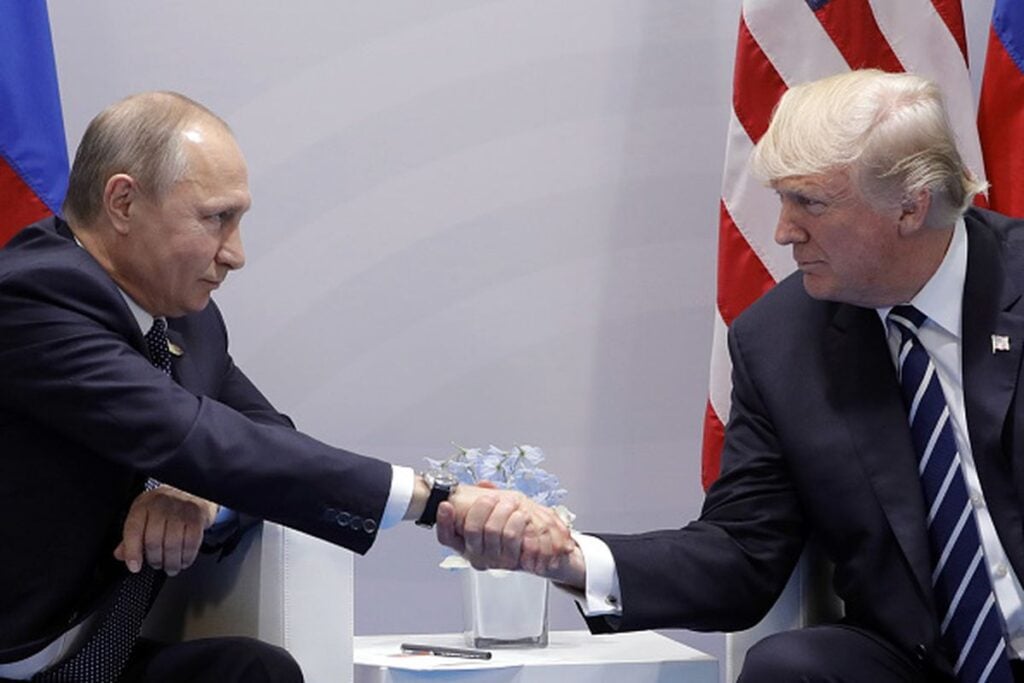
(Russia President Vladimir Putin and US President Donald Trump shake hands during a bilateral meeting on the sidelines of the G20 summit in 2017. Photo: Mikhail Metzel/TASS via Getty Images)

By Gordon M. Hahn

5 July, 2018

The Trump-Putin summit was successfully delayed by the liberal/neocon, Washington/NATO deep state network. By the time, Trump fought his way free from the morass of the collapsing ‘Russiagate’ investigation, relations were so bad that Putin rejected Trump’s invitation to the White House and agreed to meet in neighboring Finland. This suggests the level of distrust Putin has towards Washington, his low expectations for a successful summit, and the high price he is likely to demand for concessions on his part.

With the summit at hand, it is important for the Trump administration to understand what are the key problems that have tightly wound the Russian-Western knot, for only by understanding the way the knot was tied can it be untied. This will be a long process that will take at least two US presidential terms to resolve. With half of one term already in the past and the knot only tied more tightly, it is imperative that significant progress on the most dangerous issues — Ukraine and Syria — be made and initial steps towards not a ‘grand bargain’ but rather a real reset be concluded with Moscow.

Originally published at gordonhahn.com

Change the Approach
The first thing that needs to change is the piecemeal approach to relations. Whether it is called ‘constructive engagement,’ limited engagement, or misleadingly a ‘reset,’ the approach of dealing with issues that are easiest to resolve or where we have common interests alone is insufficient and a non-starter as far as putting the relationship where it should be.

By definition, an approach that seeks to avoid areas where there are disagreements will not resolve a deeply troubled relationship that is putting international security and peace at risk. Only addressing the core differences complicating relations can a qualitatively new relationship be forged. Changing this approach requires abandoning 19th century geopolitical thinking, which dictates that the West seek to dominate the Eurasian ‘heartland’ (read: Russia) in order to dominate global politics.

More globally, the West has been and remains the ‘champion’ when it comes to interference in the politics of other states.

It also means abandoning the approach of designing policies from hubris rooted in the sense that Western democracy is morally superior to authoritarianism. Although the latter is true, it does not afford the West the right to interfere, not less destabilize other societies. However, any society has the right to influence with prudence others, and that can be done in less aggressive but ultimately more effective ways.

New Approach
Rather than dealing with secondary issues, those which are easiest to resolve, or those in which we have common interests, contacts must address the core problems in the inter-state US-Russian or larger Western-Russian relationship. Those issues are NATO expansion, EU expansion, U.S. missile defense, Ukraine, Syria, and interference in each other’s domestic politics. Rather, than expanding Western institutions in complete disregard of Russian interests, the West must work closely with Moscow.

The West must acknowledge its responsibility in the making of the original crisis which equals if not exceeds that of Moscow in its deepening in Crimea and Donbass. The crisis in Ukraine is a direct result of these two policies, which led NATO to declare Ukraine (and Georgia) will be NATO members at numerous NATO summits and in other fora, led the EU to push too hard and too early for an association agreement with the corrupt Viktor Yanukovych government, and which led the West, especially Washington, to lend opposition-promotion assistance to revolutionaries and endorse a clearly illegal oligarch-ultranationalist revolt in February 2014 despite an agreement that essentially ensured Yanukovych’s departure from the presidency in ten months.

In Syria, Putin’s Russia has won. Regime change is over. The U.S. in its hubris miscalculated in going a bridge too far. Ambition led to supply weapons either intentionally or accidentally — and in denial of the obvious — to Islamists and jihadists. This was a direct consequence of US President Barak Obama’s haste to carry forth his gravely misguided Muslim Brotherhood-based regime change strategy in the Islamic world. Syria’s longstanding ties to Moscow and the presence of North Caucasus-based mujahedin within the ranks first of the Al Qa`ida-affiliated ‘Jabhat al-Nusra’ jihadi group and then of the Islamic State or ISIS prompted Putin’s limited and strategically successful intervention.

More globally, the West has been and remains the ‘champion’ when it comes to interference in the politics of other states. For financial reasons alone, Russia cannot hold a candle to US efforts in this regard, no less those of the entire West. Rather than seeking to dominate or willfully ‘transforming’ Eurasia in the Western image, the West should more gently propose democratization and work on strengthening its own democratic order to serve as a model for non- and less democratic states to emulate. Those living in non- or less democratic states who want change have access to all the information they need on the Internet, except in the most authoritarian countries. Even in the latter, access is possible if more difficult. The native population and opposition leaders understand the intricacies of their nation’s culture far better than outsiders do and can therefore better fashion a peaceful, stable regime transformation. If this is not what they want, then they are unlikely to establish a democratic order when they seize power.

Change the Goal and Strategy
The core problem in Western-Russian relations has been Western, especially, NATO expansion. NATO expansion, carried forth on the back of EU expansion, effectively ‘militarized’ Western democracy-promotion and EU expansion, insulting Russian ‘honor’ and trust in the West in the wake of Cold War-ending Western promises that NATO would not expand beyond reunified Germany and turning Russia away from democracy. Washington and Brussels must discard, therefore, its basic goal of expanding the community of democracies in brinksmanship-like fashion–everywhere and immediately, regardless of those expansions’ effects on the Russian and Chinese geostrategic calculation. This means abandoning the strategy of achieving that goal: NATO and EU expansion. These two prongs of the main strategy, especially NATO expansion, have added greater cost of driving Russia into China’s increasingly powerful arms, as I predicted a quarter of a century ago.

New Goal and Strategy
Regarding security, the West should seek to integrate Europe and Eurasia first in the area of negotiating ongoing conflicts and preventing new conflicts by reinvigorating the Organization of Security and Cooperation in Europe (OSCE) as the main multilateral forum for Western-Eurasian relations. It should also become the locus of negotiations between NATO and the Collective Security Treaty Organization (CSTO) on building a new European security architecture (NESA).

During the life of the NESA negotiations, the West should institute an openly declared moratorium on NATO expansion. After such the NESA is in place negotiations might begin with the Shanghai Cooperation Organization (SCO) on a Eurasia-wide security architecture. Similarly, the European Union should learn from its misbegotten unilateral expansionism and ‘Eastern Partnership’ and seek to negotiate a gradual integration of the EU and the Eurasian Economic Union (EEU).
As in security integration, so too in economic integration, once an EU-EEU union or some other accommodation is reached, SCO and China perhaps can be brought into the mix in negotiating a free trade zone for Eurasia writ large, from Beijing to Belfast.

Thus, trade expansion would replace military-political expansion, and incentives should replace sanctions. Economic integration, development and growth will help grow democracy in non- and less democratic states more spontaneously and organically. In sum, it is better to have the Russians (and the Chinese) inside the tent pissing out, than outside the tent pissing in.

It is important to note, however, that I am talking about very long-term negotiations and integration processes, and the negotiations must not be approached with the idea that a major agreement or any agreements at all must be achieved at all costs to Western interests. Non-Western partners must also be willing to sacrifice some of their present interests for the sake of the benefits of stability and cooperation that will accrue in future.

Change the Tactics
In Ukraine, the U.S. must get more involved in the Minsk 2 negotiating process. Without a clear signal from Trump that Washington is not interested in expanding NATO to Ukraine or using the crisis to isolate Moscow through sanctions and the like and intends to lead the search for a solution, Moscow is unlikely to make any meaningful concessions. The Europeans are too divided and weak to concentrate Kiev’s mind on a peaceful settlement in Donbass and the reality that Crimea is lost forever. Moreover, as long as Washington remains at arm’s length from the process, Putin will suspect that any agreement can be easily scuttled by Kiev and/or Washington.

In Syria, de-confliction and stabilization in Syria, including the withdrawal of Iranian Revolutionary Guards (IRG) troops, is in the US interest, and these can benefit from greater US-Russian cooperation. Even Putin appears concerned about the threat to Israel posed by the IRG and Hezbollah. Putin undertook a limited intervention for a reason: he wants to limit the conflict and the need for any military role in the region if possible. Washington could be able to convince Moscow to abandon its support for the elements of the Iran presence in Syria and Lebanon that arrived in the context of the Syrian civil war.

Democracy-promotion has become too careless about the risk of destabilizing other societies, too centered on opposition-promotion, and too kinetically and broadly applied. Democracy-promotion should encourage only peaceful and cooperative forms of regime transformation, should be offered to both regime and opposition no matter how persistently a particular regime may refuse such advice, and more kinetic, potentially subversive assistance should be applied only to those states that intend to harm the most vital American and Western interests without previous, indeed recent provocations, which to the apparent surprise of some frequently occur.

The Summit: From Prescription to Prediction
Putting aside the above prescription for what should be the Trump administration’s ‘real reset’ and turning to what is more likely, we are likely to see any systematic unfolding of a grand strategy towards a grand bargain. The relationship is too antagonistic, distrustful, and complicated to achieve that without shutting down NATO expansion, and Trump appears to lack the courage to move in that direction. Instead we will see a summit of small steps towards potentially important but not game-changing agreements. There is very likely to be some agreement towards extending the START nuclear arms treaty by executive order as well as negotiating a replacement treaty to be signed at the end of the first or beginning of a second Trump term.

For the Ukrainian crisis, Trump might propose the creation of a US-Russian working group to assist the Minsk process. Should Trump be convinced that only US involvement can resolve the issue, perhaps the group could be incorporated into the Minsk process. He might also hint that in return for some Moscow concessions on Ukraine, such as backing a more expanded version of the proposed peacekeeping mission beyond the line of contact, he might be willing to put pressure on Kiev to finally fulfill its Minsk agreement obligation to engage a dialogue with the Donbass rebel regions’ representatives:

(1) on the modalities related to conducting elections in the Donbass, (2) on a Ukrainian law to be adopted according to Minsk-2 ‘On the temporary order of local government in certain areas of the Donetsk and the Lugansk regions,’ or (3) ‘with respect to the future operation of these areas on the basis of the Law,’ or, for that matter, (4) on any other subject related to the crisis. Washington pressure on Kiev to talk directly with the rebels may be possible now that four years too late some of the Washington institutions that supported the Maidan revolt and illegal overthrow of Yanukovych such as the Atlantic Council and Freedom House, are waking up to the neofascist threat on the edges of the Maidan regime and in society.

In Syria, the Trump administration has abandoned any attempt to salvage the mess or Obama’s Muslim Brotherhood strategy that made it. In addition, to discussions and perhaps new mechanism for de-confliction and joint efforts to ensure humanitarian assistance, Trump might try to address the Iranian issue in part by offering talks on a new nuclear treaty with Teheran co-sponsored with Moscow and in part by proposing some new negotiating mechanism co-sponsored with Moscow for the Israeli-Palestinian conflict towards creating a Palestinian state using the leverage over Israel garnered by way of the transfer of the US embassy to Jerusalem. Trump might offer assistance in stabilizing Syria or at least in not destabilizing Syria again along with sanctions relief in return for concessions from Putin on Ukraine. Working groups on mutual non-interference in each other’s domestic politics and cyber security might also emerge.

None of these measures can by themselves even if they achieved the final results can resolve the ultimate security dilemma that sits at the heart of the tattered US-Russian relationship, but they can begin to stop the bleeding, de-escalate the several crises at hand, and create a footing for a later turn towards better relations. But only an end to NATO expansion can untie knot of the ‘new cold war’ that has been creeping towards Russian-American military confrontation in Europe and forging the Sino-Russian Eurasian alliance.

Originally published at gordonhahn.com

Related Posts

A friendly quarrel while we agree that the US sanctions are a weapon of mass destruction and kill more people than wars do. And that we must talk much more about sanctions than we have so far. Jan Oberg, TFF director March 16, 2026 John Mearsheimer recently stated that U.S. sanctions murdered around 38 million people between 1971 and 2021 – see the video below. It is a dramatic figure, and it has spread quickly because it captures, in one sentence, the enormous human cost of modern sanctions. I share his concern about the destructive effects of economic coercion. But the specific number he cites — and the way he attributes it — deserves a friendly academic clarification. The figure comes from a 2023 Lancet Global Health article estimating the mortality effects of unilateral U.S. and EU sanctions over the past half‑century. This is the first point where Mearsheimer’s shorthand diverges from the text: the study...
The MSC’s closed groupthink militarism offers only one prescription — more weapons — even as record military expenditures, squeezed from taxpayers in economic crisis, destroy diplomacy and drive escalation to the highest war risks in decades. Jan Oberg TFF director February 13, 2026 From Dialogue Forum to Militarised Ritual For decades, the Munich Security Conference (MSC) – which opened today and runs till Sunday – was one of the few places where adversaries could meet without theatrics. Founded in 1963 as the Wehrkundetagung, it served as a discreet Cold War dialogue forum between NATO and the Warsaw Pact. Even at moments of high tension, Soviet and later Russian representatives were present, and Munich allowed uncomfortable messages to be delivered directly rather than through press releases or military manoeuvres. That era has vanished. The MSC has become something entirely different: a €13–20 million annual gathering of a closed Western security elite, a polished meeting...
PART 2 — Diplomacy, Law and Nonviolent Power By Jan ObergTFF co-founder and director January 26, 2026 This is the second of four TFF-created idea portfolios designed to curb the global reach of the United States and, in both the short and long term, help catalyse a worldwide nonviolent resistance to what many observers describe as the Trump administration’s uniquely confrontational, destructive and world-threatening policies. These portfolios outline what governments and citizens across the world can do through dynamic diplomacy, creative initiatives, and strictly nonviolent means. They are typical TFF works in that we do not only tell what the problem is and how bad it will go – as 90+% of all commentators, experts and scholars do – we tell what we think can be done, inviting you to think of what you think you can do. It seems painfully clear to me that the current political dynamics in Washington increasingly resemble the most dangerous...

Recent Articles

Below are TFF-related media mentions, comments, videos and social media posts published elsewhere but not on this homepage. We happen to catch and list only a fraction. Regarding video comments and debates, we recommend that you go to the TFF Video Channel on Substack where many of them are reproduced. Jan Oberg is a contributor to China Daily – 52 million daily clicks – and Global Times, CGTN and CCTV (the national television), China Investment, Xinhua News Agency and several others. Articles and videos on these media very often multiply into countless Chinese (and Western media) that re-post them from these main media. Thanks to The China Academy, his analyses, interviews and comments are frequently posted on YouTube channels such as Thinkers Forum and Wave Media. These videos are often re-posted on Bilibili (China’s YouTube), the China Content Center on TikTok, and on the Chinese edition of TikTok, Douyin.com. This means reaching hundreds of millions of viewers worldwide over a year. While there are too many to catch on all these...
Jan Oberg TFF director October 13, 2026 According to Alfred Nobel’s will, the Nobel Peace Prize shall be awarded: ”to the person who has done the most or best to advance fellowship among nations, the abolition or reduction of standing armies, and the establishment and promotion of peace congresses.” Further down, he also expresses how the prize for the “champions of peace” shall be decided: “that for champions of peace by a committee of five persons to be selected by the Norwegian Storting. Alfred Nobel’s will is remarkably short and clear. But few seem to have read it. Nobel did not say that the committee itself should consist of members of parliament. He entrusted the Storting with appointing five persons. In principle, it could have selected diplomats, mediators, peace researchers, conflict-resolution specialists, or other individuals with recognised expertise in matters of peace from around the world. Instead, the Storting gradually...
The Quest for Humane Survival Richard Falk Professor emeritus, Princeton UniversityTFF Associate since 1986October 12, 2026 After decades of teaching and writing about international law in academic frameworks that were not institutionally situated within law school environments—at Princeton and the University of California, Santa Barbara—I found myself most receptive to the TWAIL outlook. It has been especially illuminating in clarifying the extent to which international law evolved as a dialogical critique of Europe’s efforts to legitimize its colonial undertakings. In particular, TWAIL has exposed how international law has functioned to legalize the subjugation of Third World peoples, securing conditions for exploitative investment and trade relations, the coercive enforcement of public debts, and an ideology of cultural superiority. TWAIL’s exposure of these economic legacies of colonialism has influenced my understanding of the history and development of international law, broadly conceived, as an ideological project of the Western sub-system of the world...

TFF on Substack

Discover and subscribe to more peace materials on TFF Substack

Most Popular

Below are TFF-related media mentions, comments, videos and social media posts published elsewhere but not on this homepage. We happen to catch and list only a fraction. Regarding video comments and debates, we recommend that you go to the TFF Video Channel on Substack where many of them are reproduced. Jan Oberg is a contributor to China Daily – 52 million daily clicks – and Global Times, CGTN and CCTV (the national television), China Investment, Xinhua News Agency and several others. Articles and videos on these media very often multiply into countless Chinese (and Western media) that re-post them from these main media. Thanks to The China Academy, his analyses, interviews and comments are frequently posted on YouTube channels such as Thinkers Forum and Wave Media. These videos are often re-posted on Bilibili (China’s YouTube), the China Content Center on TikTok, and on the Chinese edition of TikTok, Douyin.com. This means reaching hundreds of millions of viewers worldwide over a year. While there are too many to catch on all these...
Jan Oberg TFF director October 13, 2026 According to Alfred Nobel’s will, the Nobel Peace Prize shall be awarded: ”to the person who has done the most or best to advance fellowship among nations, the abolition or reduction of standing armies, and the establishment and promotion of peace congresses.” Further down, he also expresses how the prize for the “champions of peace” shall be decided: “that for champions of peace by a committee of five persons to be selected by the Norwegian Storting. Alfred Nobel’s will is remarkably short and clear. But few seem to have read it. Nobel did not say that the committee itself should consist of members of parliament. He entrusted the Storting with appointing five persons. In principle, it could have selected diplomats, mediators, peace researchers, conflict-resolution specialists, or other individuals with recognised expertise in matters of peace from around the world. Instead, the Storting gradually...
The Quest for Humane Survival Richard Falk Professor emeritus, Princeton UniversityTFF Associate since 1986October 12, 2026 After decades of teaching and writing about international law in academic frameworks that were not institutionally situated within law school environments—at Princeton and the University of California, Santa Barbara—I found myself most receptive to the TWAIL outlook. It has been especially illuminating in clarifying the extent to which international law evolved as a dialogical critique of Europe’s efforts to legitimize its colonial undertakings. In particular, TWAIL has exposed how international law has functioned to legalize the subjugation of Third World peoples, securing conditions for exploitative investment and trade relations, the coercive enforcement of public debts, and an ideology of cultural superiority. TWAIL’s exposure of these economic legacies of colonialism has influenced my understanding of the history and development of international law, broadly conceived, as an ideological project of the Western sub-system of the world...
Read More
girl-5894831_1280
Below are TFF-related media mentions, comments, videos and social media posts published elsewhere but not on this homepage. We happen to catch and list only a fraction. Regarding video comments and debates, we recommend that you go to the TFF Video Channel on Substack where many of them are reproduced. Jan Oberg is a contributor to China Daily – 52 million daily clicks – and Global Times, CGTN and CCTV (the national television), China Investment, Xinhua News Agency and several others. Articles and videos on these media very often multiply into countless Chinese (and Western media) that re-post them from these main media. Thanks to The China Academy, his analyses, interviews and comments are frequently posted on YouTube channels such as Thinkers Forum and Wave Media. These videos are often re-posted on Bilibili (China’s YouTube), the China Content Center on TikTok, and on the Chinese edition of TikTok, Douyin.com. This means reaching hundreds of millions of viewers worldwide over a year. While there are too many to catch on all these...
Nobel-Prize-Plaque
Jan Oberg TFF director October 13, 2026 According to Alfred Nobel’s will, the Nobel Peace Prize shall be awarded: ”to the person who has done the most or best to advance fellowship among nations, the abolition or reduction of standing armies, and the establishment and promotion of peace congresses.” Further down, he also expresses how the prize for the “champions of peace” shall be decided: “that for champions of peace by a committee of five persons to be selected by the Norwegian Storting. Alfred Nobel’s will is remarkably short and clear. But few seem to have read it. Nobel did not say that the committee itself should consist of members of parliament. He entrusted the Storting with appointing five persons. In principle, it could have selected diplomats, mediators, peace researchers, conflict-resolution specialists, or other individuals with recognised expertise in matters of peace from around the world. Instead, the Storting gradually...
law-419057_1280
The Quest for Humane Survival Richard Falk Professor emeritus, Princeton UniversityTFF Associate since 1986October 12, 2026 After decades of teaching and writing about international law in academic frameworks that were not institutionally situated within law school environments—at Princeton and the University of California, Santa Barbara—I found myself most receptive to the TWAIL outlook. It has been especially illuminating in clarifying the extent to which international law evolved as a dialogical critique of Europe’s efforts to legitimize its colonial undertakings. In particular, TWAIL has exposed how international law has functioned to legalize the subjugation of Third World peoples, securing conditions for exploitative investment and trade relations, the coercive enforcement of public debts, and an ideology of cultural superiority. TWAIL’s exposure of these economic legacies of colonialism has influenced my understanding of the history and development of international law, broadly conceived, as an ideological project of the Western sub-system of the world...
images-2
Advocates of nuclear disarmament are regularly dismissed by the champions of nuclear deterrence as naïve and unrealistic, utopian or even irresponsible. Yet this ‘doctrine’ of deterrence, regarded by France as the ‘cornerstone’ of its national security, is based on quasi-religious beliefs, a theory that cannot be proven, risky gambles and fragile assumptions. So much so that one might legitimately ask which side the ‘Care Bears’ are on. Marc FinaudVice-President of Initiatives for Nuclear Disarmament (IDN) October 9, 2026 This article was originally published on Pressenza When it comes to these things being treated as religious concepts, look here. Idealists and realists It was Hubert Védrine, François Mitterrand’s former Foreign Minister, who repeatedly coined the phrase: ‘Europeans are a sort of Care Bears who don’t realise they’re living in Jurassic Park’. He applies this reference to the cartoon for well-behaved children not only to what he regards as weakness or idealism...
8824b09f-33a5-43f9-9fd0-550f28cda24d_1536x1024
What the West Borrowed from Asia and What It Left Behind Jan Krikke October 8, 2026 The article was originally published here In the late 1960s, the musical Hair announced that the Age of Aquarius was dawning. Its opening anthem promised a transformation of human consciousness: an era of peace, harmony and understanding. Half a century later, a familiar echo of that promise is a meditation app offered by your employer. You can find it in the same list of benefits as the pension plan and the gym discount. How did a spiritual revolution become an employee benefit? The answer lies in the history of the movement known as New Age: where it came from, what it borrowed from Asia, and why the meaning of what it borrowed changed in the process. Two definitions will help. New Age is a loose label for a wide range of spiritual practices and...
Screenshot 2026-10-04 210142
Small and different + among the 10% most active + 9,000 texts + 150 Associates + 60 000 a day — and a stubborn belief that peace is smarter and must be secured by peaceful means. In 2026, the Transnational Foundation for Peace and Future Research (TFF) turns 40. On Monday, October 5, 2026, a new TFF homepage will go live — a new gateway to more than 9,000 articles, analyses, research papers and other contributions produced over four decades of independent peace research. But this is not simply a new website. For four decades, TFF has worked from a simple conviction: peace is smarter than militarism and can be brought about by peaceful means. This is not merely an aspiration. It is the principle expressed in the UN Charter and the Gandhian tradition that has guided our work from the beginning. TFF is a research-based, independent and people-financed foundation....




