
• On the occasion of the NATO Summit in Brussels and the Putin-Trump meeting in Helsinki
This analysis comes in two parts – one critical and one constructive: This one on “NATO’s crisis and the Transatlantic conflict” and the second on “Make NATO civilian and civilised.”
My apologies for writing a bit long, it isn’t comme il faut nowadays. But I happen to be a researcher who believes in knowledge, background and intellectual arguments in fields such as defence, security and peace – in other words, belonging to a race threatened by extinction in the era of fake and marketing. Indeed, so old fashioned am I that I don’t believe in world security matters being dealt with in Twitter- or spin doctor- style or in narratives and diplomacy conducted through advertisement videos.
The follow-up second part of this analysis can be found here.
• •
When the Berlin Wall came down and the Soviet Union dissolved and the Warsaw Pact disappeared, a few of us argued that the appropriate response would be to close down NATO and develop a new all-European peace system and a policy for conflict-handling to replace the predominantly military security thinking that had dominated during the First Cold War.
I had a particular reason for arguing that at the time. As part of the research I did for my PhD (1981) on Denmark’s defence and security policy in a global perspective, I had interviewed a small number of middle-level civilian and military personnel at NATO’s HQ in Brussels. They all basically told me the same three things – remember this was the late 1970s, or about 10 years before the Cold War ended:
– My parents’ belong to a generation that knows what war is, we are here at NATO to prevent a repetition (war prevention goal – which is not the same as peace, but let that pass).
– NATO is for the maintenance of peace, not for war, and the most important thing is Art 5 in our Treaty: If one member is attacked, all shall come to its rescue – “all for one and one for all” (the defensive principle, the musketeer pledge).
– The only – only – reason, NATO exists today is the presence and nature of the Soviet Union and the Warsaw Pact (raison d’etre, existential argument – however a little strange, perhaps, in that the Warsaw Pact was established in 1955, NATO in 1949 – but defining the world in such terms that my own profession seems utterly important is nothing new to human beings).
Western leaders – that is, until one of the worst, Bill Clinton, took over in 1994 – showed statesmanship and told Gorbachev that they would not expand NATO an inch and that the divided Germany would be neutral if unified. There was no talk of closing NATO in those circles, however – nobody who took Gorbachev intellectually sound and visionary idea about a new European House seriously.
No, they had won the Cold War. The Soviet Union had lost and became a militarily a dwarf in comparison to what it had been. And that wasn’t that strong either: The Warsaw Pact’s military expenditures varied between 60 and 80% per cent of those of NATO and it vastly inferior in terms of technological quality, innovation capacity and discipline – but stronger in quantities, e.g. the number of tanks.
The 2nd Cold War
We’re in Cold War 2 – of course not a repetition because of all the differences between that world and today’s. Ten of the former Warsaw Pact countries are now full NATO members, neutral states back then like Sweden and Austria have abolished that – wise – policy. And, mind you, the military expenditures of Russia – one country facing NATO’s 29 – are 8 per cent of NATO – yes, you got it right: Eight per cent of NATOs military expenditures in spite of all the propaganda about Russia and Putin representing an existential threat to Europe and the US if not the whole world. Who said disinformation was used only by Russia?
The Clinton Administration decided to not give a damn about the promises made and started the expansion of NATO in 1994, the new (humanitarian!!) interventionism in Yugoslavia – devoid of knowledge about its complexities, of common sense and without a UN Security Council mandate and one gross violation of international law after the other including the bombing of Serbia to carve out a forever-failed state, Kosovo state – the second Albanian state in Europe. Oh Crimea, what a crime in comparison!
And then came, one-by-one, incrementally – the new NATO members right up under the skirts of Russia in total defiance of its history psychology and legitimate near-abroad security perceptions.
The wisdom of softer borders and neutrals, of dialogue and confidence-building – like Finland that started the OSCE, like Sweden under Palme that started common security and Germany under Brandt that started rapproachment and Ostpolitik etc – all gone today.
Imagine a Russia-led alliance with 12 times more military than the US making Mexico and Canada new members. Sure, Washington would love it.
Facts, analyses, intellectual understanding went out of the window long ago – in Western mainstream media and politics, from Right to Left too, the latter believing in humanitarian intervention and human rights advocates flying F-16.
We’re living in dangerous times because facts, knowledge, science and common sense play virtually no role anymore. And because the peace discourse has disappeared decades ago.
Today’s Western security policy managers are anti-intellectuals, seemingly unaware of their moral responsibilities and under much less control than when Dwight D. Eisenhower in his farewell speech in 1961 warned the world and the US itself about the MIC – the Military-Industrial Complex. (Bless him for doing so and curse those who never listened but made it a cancer on Western civilisation).
99% of these security managers would not be able to offer an intellectually decent definition of concepts such as deterrence, defensive/offensive, conflict-resolution, or peace. They don’t write books.
But – at least some of them have a button close to them with which they can kill millions.
Today we are facing a Western militarist cancer in which policies are run by, not the MIC, but the MIMAC – the Military-Industrial-MEDIA-ACADEMIC Complex. And it is de facto out of any democratic control.
Enemies are invented and marketed, one after the other, and the new WMD – Weapons of Mass Deception – consists marketing companies, military academies, militaries in civilian institute, military corporations influencing/steering media narratives, social media censorship (Facebook and Google) etc. (Say Syria since 2011).
By and large this is what explains all the wars, in the Middle East in particular, all the millions dead and wounded, all the hatred, terrorism (which thanks to the idiotic U.S. Global War on Terror since 9/11 2001 has boosted the number of dead and wounded in political terror acts from about 1 100 to 32 000.
The inverse proportionality between intellectual and military capacity is in and of itself the largest threat to humanity’s survival.
So is the absence – or woefully inadequate power – of a vibrant public dialogue about peace, social peace actions and peace policies. No government has peace advisers, no government even thinks of matching peace research with military research investment and no government has a peace policy or minister. Don’t even know that such things might be a good idea.
The discourse, as I said, is non-existing. Militarism – the Juggernaut – has no brakes. And, so, we’re in the Second Cold War that more knowledgeable and responsible people would have avoided.
You can read about it all in details in these ten articles from TFF in 2016.
NATO crisis indicators
People talk far too much about Trump, the person(ality). And far too little about the system that brought him on stage and runs him to a large extent – as large as anyone can run Trump. Remember, Kennedy was killed some time after a revolutionary speech about a new world peace order.
The day we talk as much about MIMAC as we talk about Trump and his sex life or Tweets, there might be some hope – but don’t expect it in media and a Western, Christian culture that is obsessed with individuals and individual morality and hardly can spell the word structure. MIMAC is a structure and not exactly benign – but did you ever hear about it in the mainstream press?
1. Since 1989, the West – not Russia – has destroyed the importance of international law; it began in Yugoslavia – probably the richest event since 1989 in terms of consequences for that country, the region, Europe and the world.
2. We got a Middle East destroyed beyond repair – physically, economically (e.g. sanctions), culturally and in terms of fomenting terrorism.
3. We got a US unilateralism, US First, helter-skelter policy that sees, consistently, the world out there as its enemies – one way or the other – NATO allies, Russia, China, Middle Eastern leaders, North Korea – and whose main contribution to the rest of the world is: threats, trade wars, sanctions, bad words, arms trade to authoritarian allies like Saudi Arabia that is not exactly a democracy but now the third largest military spender, larger than Russia.
4. We got a Turkey, NATO’s second largest military power, basically having departed, contributed heavily to the destruction of Syria, have US nukes stored on its territory, is becoming more and more authoritarian (hardly compatible with NATO’s defence of democracy) and makes deal after deal with arch-enemy Russia. In other words, a very serious problem for NATO.
5. We got a NATO that has done nothing under its seemingly brainwashed Secretary-General Stoltenberg – once a highly respected Norwegian PM with a humanist family background – speaking like a US ventriloquist’s dummy about how good all the confrontational, expansive initiatives are – all legitimated with the same three mantras: Security, Stabiliy and Peace – none of which will ever appear with those policy kinds of initiatives.
6. We now get a Trump Administration that tries – for God knows which time the last 4-5 decades – to sell the argument that “the Europeans ought to pay more”! The magic formula is “2 per cent of GNP” – without the slightest analysis of threats or opportunities! If a country does well in general, the alliance will get more military? Asn vice-versa? Intellectually, this is nonsense, pure and simple. It has nothing to do with security and peace.
Furthermore, anyone knowing just a little about these matters are perfectly aware that the US is in Europe for the sake of the US itself, not for the blue-eyed people of Europe. Europe has always been and remains the forward defence area of the American territory and it is in Europe the war shall be fought, not on US territory. Therefore also the Ballistic Missile Defence in Europ – shooting down whatever retaliatory missile Moscow might fire in response to a US attack upon it – and shoot it down over Europe.
Every single forward deployment, every new NATO member is today much much less secure than before. Why? Because when you join an alliance and make the borders hard – there is no way to avoid that Russian military defensive preparation for the eventuality of an attack upon it, will target every single of these countries. Simple military logic – any NATO general would do the same if situated in a Russian military planning unit.
7. We got a NATO that – running out of raison d’etre with the end of the First Cold War – tries to reinvent itself. Read its Treaty here that states that it shall adhere to the UN Charter and solve conflict by peaceful means, support democracy and freedom and international… NATO is today a criminal organisation in the sense that it consistently violates everything it was founded to work for. Even works against it own fine priciples!
8. Since the 1990s, NATO member states have violated international law and its own Charter which states that it pertains to Europe and North America. What does NATO do, then, with a new office in Kuwait, with commitments way outside its member territories, with formalised cooperation with the Gulf States with a Danish ambassador there as a go-between?
9. Finally, and most importantly, NATO members have invested trillions of dollars on increasing their security. How come we are now in a new Cold War? How come everybody is talking about the need for even larger investments in this one type of security, the military? How come such a well-endowed alliance can feel threatened – and lack a genuine trust-building and cooperative policy with its old-time enemy, Russia? How come that NATO members’ War on Terror has only produced much more terror? How come the democracy and freedom NATO shall protect seem to be in crisis too? Why all these wars, destroyed countries and refugees problems – instead of peace by peaceful means and much more peaceful world?
Something is wrong. Very very wrong. With NATO.
NATO is what its members make it: Change it completely or dissolve it
You may now think that I mix “NATO, the alliance” with “NATO members” above. True! There comes a time when a Club that once had noble purposes falls apart because of its members’ reckless, immoral and constitution-violating behaviour. The centre simply doesn’t hold. There comes a time when you cannot healthily maintain a figleaf distinction between the organisation and its members. Call it compromised, corruption, de-moralization or decay and think, for instance, of the Swedish Academy.
NATO turns 70 next year. Age is not itself an argument for or against anything. The UN is even older and its Charter is still the most important governments have ever signed.
But NATO members, lead by the U.S., have undermined the organisation and all the noble principles it once stood for. (Also by having nuclear weapons which are not mentioned in the Treaty but militates against any concept of peace by peaceful means). In particular, since the end of the First Cold War, its net contribution to the world has become negative, destructive. NATO today stands for North Atlantic Treaty Obsolescence.
In conclusion, crap NATO as we know it!
Let’s use the anniversary to discuss how it can survive in a completely new shape and avoid the fate of its then beloved enemy, the Warsaw Pact – without which it should have been heavily reformed or closed down about 30 years ago.
Note
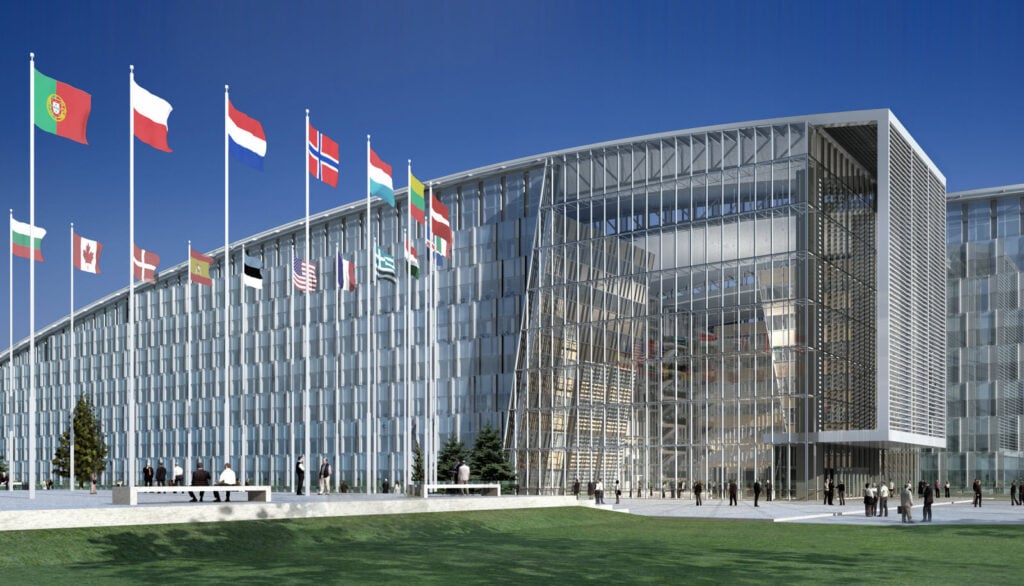
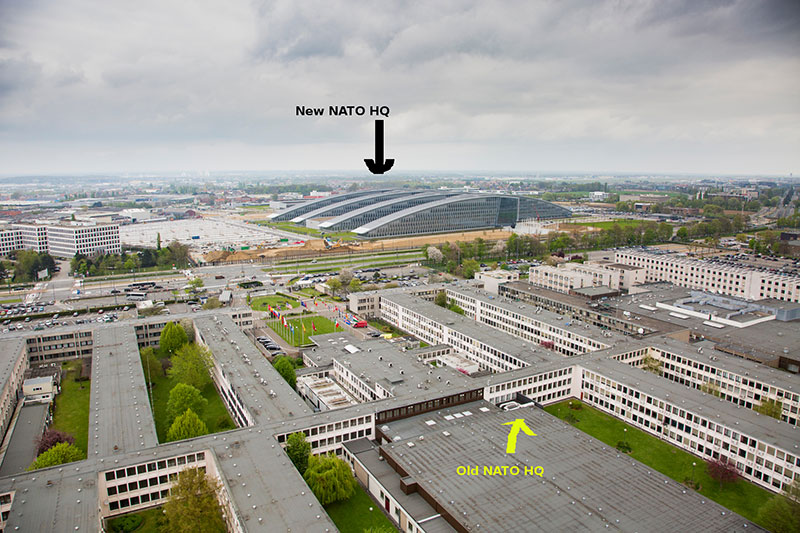
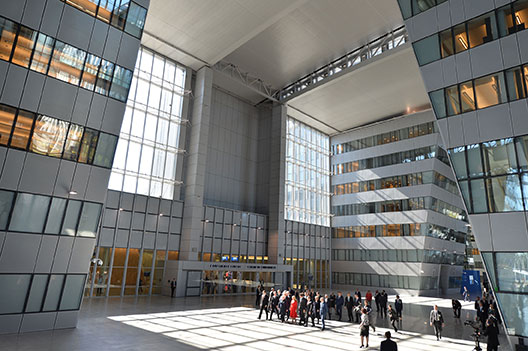
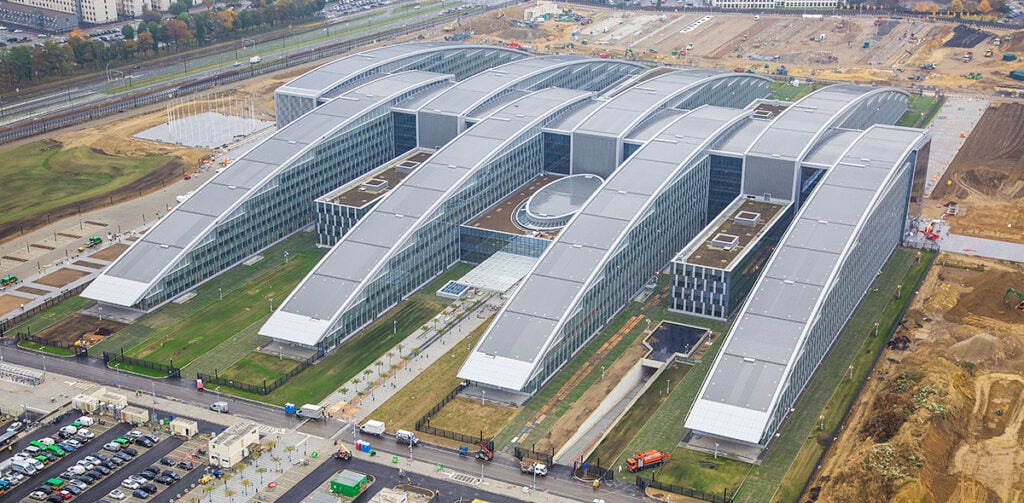
The photos in this article are all of the new NATO HQ that seems to have cost US$ 1230 million taxpayer dollars, no built in modesty there. NATO started out a bit more modestly. And here’s how Reuters covered the new HQ with a video tour.







8 Responses
Good and thorough. We ned not jump to headline reading. So just continue
Many thanks, dear Vibeke – TFF and I surely will. The market is not exactly satisfied… 🙂
Sane and sensible ideas! As UN Secretary General Guterres said only a couple of days ago, we need a new world summit, not for making war, but for ensuring comprehensive security to save all of us from the scourge of war, first of all by getting rid of nuclear weapons. There has been continuous war, bloodshed and devastation during the past few decades with enormous human suffering. Unless we wish to continue on the current path and destroy the world in a supreme act of folly it is time to change course and think of establishing peace by peaceful means.
Yes
NATO is a joke and dangerous monster all at the same time , NATO is completely out of date and out of any sensible control ( but is costing a fortune ) . Just imagine for a moment the monumental effects and ramifications in NATO HQ and in Western Government circles ,if Russia put NATO to this moral test , by saying just these few crazy words….”CAN WE JOIN ” ……..
Now is the right time to initiate a new Helsinki Conference and Agreement for common security and disarmament in Europe. Europeans are no longer willing to fight US wars. Germany, France, and soon UK, with Corbyn soon in 10 Downing(?), could negotiate a peaceful agreement with Russia. When this is accomplished, Europe and Russia could make a similar agreement with China and SCO, breaking the negative and destructive spiral of war and useless armament of the US. With or without Trump, the US Empire now falling, imploding by poverty, infrastructure collapse, and Neoliberal Fascism. … Large parts of US, NATO, European, and Russian military hardwear are dysfunctional, obsolete, or simply rusting away. Recently a dogfight between a Lockheed Martin F-35 and an old F-4 Phantom was staged. The F-35 was knocked out. In two interviews in 2007 with Tom Engelhardt, Chalmers Johnson pointed out that many of the anti-ballistic missles can’t get out of their silos, and were not meant to. Their meaning is to rip off the taxpayers Same applies to European NATO hardwear. About 80 % of it is either obsolete or simply rusts away. This is also the case with the Russian hardwear. Also Russia have its industrial-military complex. Quote by a Swedish military, knowing what is was talking about, “Russia has only military capacity to occupy o n e of the Baltic states”. That is, it doesn’t have the economy, industry, or military to even think of any European military adventures. What is left for the global warring states, are small elite units, making war against poor peoples in poor countries, who can not defend themselves. Modern states can no longer afford buying the “advanced”, sophisticated, complicated, expensive weapons systems that the militaries don’t need, and don’t know the tactic or strategic consquenses of. … Welfare, participatorial democracy, equality, justice, or more stupid wars? —
If NATO is an organisation of mutual assistance when one member is threatened militarily, the other members acting to restore Peace, why has it been used offensively in Afghanistan and Libya. Is it just another attempt to give credibility to military adventures by the US?
Dear Gordon Clark – you are right. It’s way outside the Treaty on which it is based. I’m saying a bit about exactly that in the article – and, also, that the best and most reasonable would be for it to return to its Treaty provisions – which are actually quite good and in the spirit of the UN Charter too.