Ralph Nader: The 20th Anniversary of the Sociocide of Iraq by Bush and Cheney

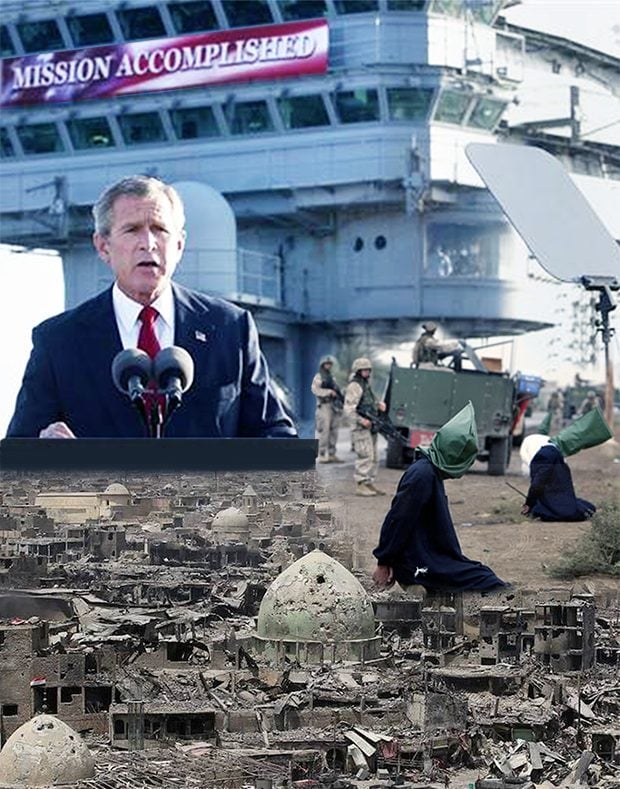
Composite portrait: (top) President George W. Bush aboard the USS Abraham Lincoln announces the end of major combat in Iraq, May 1, 2003 (Stephen Jaffe, AFP); (middle right) U.S. Marines arrest Iraqi council members (hooded) in Baghdad, Nov. 2, 2004 (Anja Niedringhaus, AP); (bottom) Mosul’s Old City neighbourhood reduced to ruins by U.S. bombardments in a campaign against ISIS, July 14, 2017 (Andrea Dicenzo, AFP)

Ralph Nader

March 22, 2023

23 Feb 2023
I wrote the following column ten years ago. Note the absence of any accountability or regret by Bush, Cheney and their co-war criminals. Ten years ago [now 20 years ago, on March 19, 2003], George W. Bush and Dick Cheney, as war criminals, launched the sociocide of the people of Iraq – replete with embedded television and newspaper reporters chronicling the invasion through the Bush lens. That illegal war of aggression was, of course, based on recognized lies, propaganda and cover-ups that duped or co-opted leading news institutions such as the New York Times and the Washington Post.

Originally published at Human Wrongs Watch on February 23, 2023

Wars of aggression – this one blowing apart a country of 25 million people ruled by a weakened despot surrounded by far more powerful adversaries – Israel, Turkey and Iran – are major crimes under international law and the UN Charter. The Bush/Cheney war was also unconstitutional, never declared by Congress, as Senator Robert Byrd eloquently pointed out at the time. Moreover, many of the acts of torture and brutality perpetrated against the Iraqi people are illegal under various federal statutes.

Over one million Iraqis died due to the invasion, the occupation and the denial of health and safety necessities for infants, children and adults. Far more Iraqis were injured and sickened. Birth defects and cancers continue to set lethal records. Five million Iraqis became refugees, many fleeing into Jordan, Syria and other countries.

Nearly five thousand U.S. soldiers died. Many other soldiers committed suicide. Well over 150,000 Americans were injured or sickened, far more than the official Pentagon under-estimate, which restricts nonfatal casualty counts only to those incurred directly in the line of fire.

So far, the Iraq War has monetarily cost taxpayers about $2 trillion. Tens of billions more will be spent for veteran’s disabilities in addition to continuing expenses in Iraq. Taxpayers are paying over $600 million a year to guard the giant U.S. Embassy and its personnel in Baghdad, more than what our government spends for OSHA, whose task is to reduce the number of American workers who die annually from workplace disease and trauma – currently about 58,000.

All for what results? Before the invasion, there was no al-Qaeda in Saddam Hussein’s secular dictatorship. Now a growing al-Qaeda in Iraq is terrorizing the country with ever bolder car bombings and suicide attacks taking dozens of lives at a time and spilling forcefully over into Syria.

Iraq is a police state with sectarian struggles between the dominant Shiites and the insurgent Sunnis who lived together peacefully and intermarried for centuries. There were no sectarian slaughters of this kind before the invasion, except for Saddam Hussein’s bloodbath against rebellious Shiites. The Shiites were egged on by President George H.W. Bush, who promptly abandoned them to the deadly strafing by Saddam’s helicopter gunships at the end of the preventable first Gulf War in 1991.

Iraq is a country in ruins with a political and wealthy upper class raking off profits from the oil industry. The U.S. is now widely hated in that part of Asia. Bush/Cheney ordered the use of cluster bombs, comprised of white phosphorous and depleted uranium, against the people of Fallujah, where infant birth deformities have skyrocketed.

As Raed Jarrar, an Iraqi-American analyst, observed, “Complete destruction of the Iraqi national identity.” Moreover, the sectarian system introduced by the U.S. invaders in 2003, resulting in Iraqis being favoured or excluded based on their sectarian and ethnic affiliations, laid the basis for the current cruel chaos and violence – a nasty, brutish form of divide and rule.

The results back home in our country are soldiers and their extended families suffering in many ways from broken lives. Phil Donahue’s gripping documentary Body of War follows the pain-wracked life of one soldier returning in 2004 from Iraq as a paraplegic. That soldier, Tomas Young, nearing the end of his devastated life, has just written a penetrating letter to George W. Bush, which every American should read.

The lessons from this unnecessary quagmire should be: first, how to stop any more wars of aggression by the Washington warmongers – the same neocon draft dodgers are at it again regarding Iran and Syria. And second, the necessity to hold accountable the leading perpetrators of this brutal carnage and financial wreckage who are presently at large – fugitives from justice earning fat lecture and consulting fees.

In the nine months running up to the March 2003 invasion of Iraq, at least three hundred prominent, retired military officers, diplomats and national security officials publicly spoke out against the Bush/Cheney drumbeats to war. Their warnings were prophetically accurate. They included retired Generals Anthony Zinni and William Odom, and Admiral Shanahan. Even Brent Scowcroft and James Baker, two of President George H.W. Bush’s closest advisors, strongly opposed the invasion.

These outspoken truthsayers, notwithstanding their prestige and experience, were overwhelmed by a runaway White House, a disgraceful patsy mainstream media and an abdicatory Congress. Multi-billionaire George Soros was also courageously outspoken.

Unfortunately, prior to the invasion, he did not provide a budget and secretariat for these men and women to provide continuity and to multiply their numbers around the country, through the mass media and on Capitol Hill. By the time he came around to organizing and publicizing such an organized effort, it was after the invasion, in July 2003.

Nine months earlier, I believe George Soros could have provided the necessary resources to stop Bush/Cheney and their lies from stampeding our government and our country into war.

Mr Soros can still build the grassroots pressure for the exercise of the rule of law under our Constitution and move Congress toward public hearings in the Senate designed to establish an investigative arm of the Justice Department to pursue the proper enforcement against Bush/Cheney and their accomplices.

After all, the Justice Department had such a special prosecutor’s office during the Watergate scandal and was moving to indict a resigned Richard Nixon before President Ford pardoned him.

Compare the Watergate break-in and obstruction of justice by Nixon with the horrendous crimes coming out of the Bush and Cheney war against Iraq – a nation that never threatened the U.S. but whose destruction takes a continuing toll on our country.

Additional note:
As Senators, Hillary Clinton and Joe Biden voted for the Iraq war in 2003. Will President Biden, Congress and other Americans recognize the massive war crimes committed against the Iraqi people with appropriate declarations and actions on March 19, 2023?

Originally published at Human Wrongs Watch on February 23, 2023

About the author
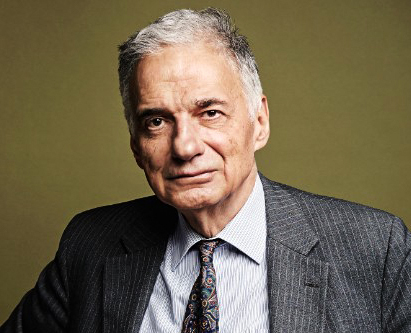
Ralph Nader is a US political activist, author, lecturer, and attorney noted for his involvement in consumer protection, environmentalism, and government reform causes. The son of Lebanese immigrants to the United States, Nader attended Princeton University and Harvard Law School. Go to Original – nader.org

Please help TFF remain truly independent by contributing if you benefited from this article
Related Posts

Jan Oberg May 15, 2026 Go to this Fox News page and scroll the whole way down: President Donald Trump tells the world that his meeting with President Xi Jinping yielded a lot of very concrete political and economic results – of course, only where the Chinese side, according to him, agreed with him. He does not mention the Taiwan issue, but Secretary of State, Marco Rubio, says that it did not feature prominently in their talks and that the US policy on Taiwan has not changed. Then go to China Daily – or Global Times – and you will see that for the Chinese it is framework, principles, structure of cooperation etc. that matters – all embedded in the overall idea of “constructive bilateral relationship of strategic stability.” Nowhere is any concrete agreement or deal – all that Trump refers to – mentioned. At the general level, this gives you insights into the very different social...
Jan Oberg, TFF director April 9, 2026 I was recently invited to have a good, long talk about the world – and, of course, about peace too – with Boris Malagurski on his Weight of Chains Channel on YouTube. It was a real joy and seems to have been greatly appreciated by the viewers too. Mr Malagurski and I shall of course be grateful if you share this conversation in your circles – of course, only if you like what you see and hear 😉☮️ And remember that this one – like hundreds of others with TFF Associates – can be enjoyed at our TFF Video Collection.
A friendly quarrel while we agree that the US sanctions are a weapon of mass destruction and kill more people than wars do. And that we must talk much more about sanctions than we have so far. Jan Oberg, TFF director March 16, 2026 John Mearsheimer recently stated that U.S. sanctions murdered around 38 million people between 1971 and 2021 – see the video below. It is a dramatic figure, and it has spread quickly because it captures, in one sentence, the enormous human cost of modern sanctions. I share his concern about the destructive effects of economic coercion. But the specific number he cites — and the way he attributes it — deserves a friendly academic clarification. The figure comes from a 2023 Lancet Global Health article estimating the mortality effects of unilateral U.S. and EU sanctions over the past half‑century. This is the first point where Mearsheimer’s shorthand diverges from the text: the study...

Recent Articles

Serious but also a lot of laughs and positive energy. Because peace is also about conviviality and enchantment… Jan Oberg, TFF director November 16, 2026 This is a long (129 minutes) conversation with me. We cover very many, also personal, issues that makes a somewhat unusual media event. I am very grateful to Flemming Blicher for giving me this opportunity. I can’t remember any channel or editor who spent as much time as he did preparing it – including also asking me to answer a series of pre-interview questions, which are now posted under the conversation. If you sympathise with its content, please share it. Watch it here
A Message from Jan Oberg November 6, 2026 Over the past fifty years, I have devoted roughly 175,000 hours to research and public education for a more peaceful world: thinking, researching, writing, organising, publishing, debating, maintaining websites, corresponding, reaching out, leading a foundation, work in conflict and war zones, professorships, teaching courses and giving public lectures and doing media work. In short, ten hours a day, seven days a week, for half a century. The focus was on international political peace – analysing and trying to stop wars, address underlying conflicts and making alternative peace plans – at the desk and on the ground. Important as that has been and remains, it is only one kind of peace and it is now in a tragic militarist state compared with what it could have been.  Lately, however, I have found myself thinking about a concept from economics as well as everyday...
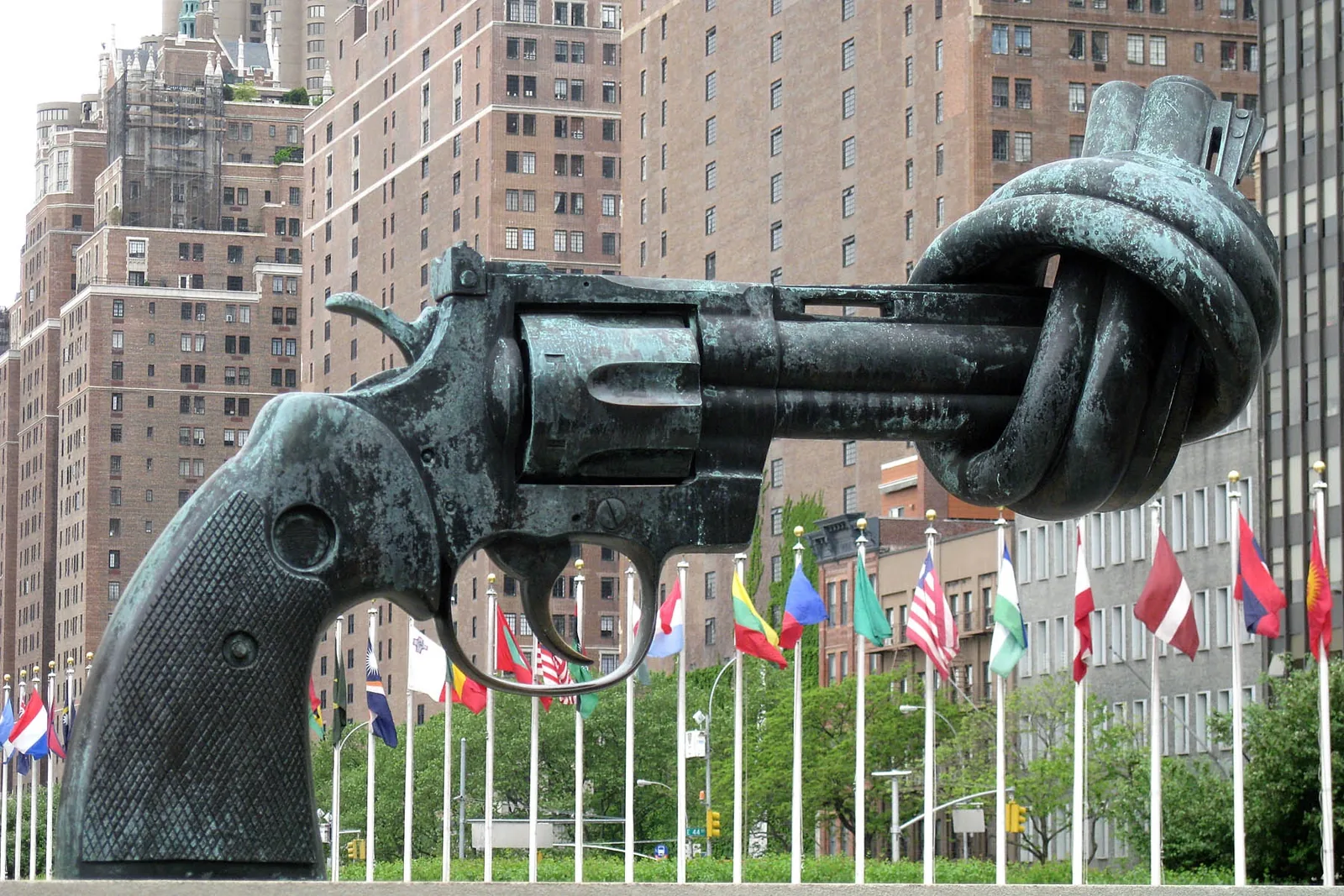
Photo above: Carl Fredrik Reuterswärd’s Non-Violence outside UN Headquarters in New York. Kirill Levin, CC BY-NC-SA 2. Jan Oberg November 3, 2026 I am happy to be published in Horizons which is produced by the Center for International Relations and Sustainable Development, CIRSD, in Belgrade. My contribution brings out a radical re-thinking of what concepts such as defence, security, deterrence – and peace – may mean if we want to create a more peaceful world. It also summarises a few things I have been working with the last few decades. Please read it here Og her er den på dansk, takket være Johnny Baltzersens lynhurtige oversættelse

TFF on Substack

Discover and subscribe to more peace materials on TFF Substack

Most Popular

Serious but also a lot of laughs and positive energy. Because peace is also about conviviality and enchantment… Jan Oberg, TFF director November 16, 2026 This is a long (129 minutes) conversation with me. We cover very many, also personal, issues that makes a somewhat unusual media event. I am very grateful to Flemming Blicher for giving me this opportunity. I can’t remember any channel or editor who spent as much time as he did preparing it – including also asking me to answer a series of pre-interview questions, which are now posted under the conversation. If you sympathise with its content, please share it. Watch it here
A Message from Jan Oberg November 6, 2026 Over the past fifty years, I have devoted roughly 175,000 hours to research and public education for a more peaceful world: thinking, researching, writing, organising, publishing, debating, maintaining websites, corresponding, reaching out, leading a foundation, work in conflict and war zones, professorships, teaching courses and giving public lectures and doing media work. In short, ten hours a day, seven days a week, for half a century. The focus was on international political peace – analysing and trying to stop wars, address underlying conflicts and making alternative peace plans – at the desk and on the ground. Important as that has been and remains, it is only one kind of peace and it is now in a tragic militarist state compared with what it could have been.  Lately, however, I have found myself thinking about a concept from economics as well as everyday...
Photo above: Carl Fredrik Reuterswärd’s Non-Violence outside UN Headquarters in New York. Kirill Levin, CC BY-NC-SA 2. Jan Oberg November 3, 2026 I am happy to be published in Horizons which is produced by the Center for International Relations and Sustainable Development, CIRSD, in Belgrade. My contribution brings out a radical re-thinking of what concepts such as defence, security, deterrence – and peace – may mean if we want to create a more peaceful world. It also summarises a few things I have been working with the last few decades. Please read it here Og her er den på dansk, takket være Johnny Baltzersens lynhurtige oversættelse
Read More
Screenshot 2026-11-10 174455
Serious but also a lot of laughs and positive energy. Because peace is also about conviviality and enchantment… Jan Oberg, TFF director November 16, 2026 This is a long (129 minutes) conversation with me. We cover very many, also personal, issues that makes a somewhat unusual media event. I am very grateful to Flemming Blicher for giving me this opportunity. I can’t remember any channel or editor who spent as much time as he did preparing it – including also asking me to answer a series of pre-interview questions, which are now posted under the conversation. If you sympathise with its content, please share it. Watch it here
AbstractVision_2017_#1_800 (kopia)
A Message from Jan Oberg November 6, 2026 Over the past fifty years, I have devoted roughly 175,000 hours to research and public education for a more peaceful world: thinking, researching, writing, organising, publishing, debating, maintaining websites, corresponding, reaching out, leading a foundation, work in conflict and war zones, professorships, teaching courses and giving public lectures and doing media work. In short, ten hours a day, seven days a week, for half a century. The focus was on international political peace – analysing and trying to stop wars, address underlying conflicts and making alternative peace plans – at the desk and on the ground. Important as that has been and remains, it is only one kind of peace and it is now in a tragic militarist state compared with what it could have been.  Lately, however, I have found myself thinking about a concept from economics as well as everyday...
knotted gun
Photo above: Carl Fredrik Reuterswärd’s Non-Violence outside UN Headquarters in New York. Kirill Levin, CC BY-NC-SA 2. Jan Oberg November 3, 2026 I am happy to be published in Horizons which is produced by the Center for International Relations and Sustainable Development, CIRSD, in Belgrade. My contribution brings out a radical re-thinking of what concepts such as defence, security, deterrence – and peace – may mean if we want to create a more peaceful world. It also summarises a few things I have been working with the last few decades. Please read it here Og her er den på dansk, takket være Johnny Baltzersens lynhurtige oversættelse
TFFPortfolioVign
UNITE-tillid, DREAM-velstand og andre konstruktive komponenter Normally we publish articles in English here. But this is a translation of a very important TFF document that should reach as many as possible in Denmark since this country’s government has been one of the most hardline in Europe and, up till now at least, has refused to use diplomacy and, instead, spent tremendous sums on arming Ukraine with the express goal of defeating Russia. Thus this – unique – article is in Danish. Vi er Johnny Baltzersen og hans Fælles Sikkerhed – Fælles Fremtid på Substack overmåde taknemmelige for at have oversat og publiceret TFF’s 2025-portfølje for fredsidéer med henblik på Ukraines fremtid. Vi håber den nu kan nå mange flere danskere – som også vil sprede den og skabe debat – nu den danske regerings og folketingspartiernes politik på dette område siden 2022 står nu – forudsigeligt – ved vejs ende....
JoGSS-Silent
Jan Oberg TFF director October 28, 2026 Exactly one month has now passed since I published my criticism of the introduction to the special issue on Johan Galtung published by the Journal of Global Security Studies, JoGSS, and of Tor Egil Førland’s chapter about Galtung which serves as a preview to his forthcoming biography of Galtung to be published by PRIO. See the original on The Transnational here and the same article on TFF Substack with many general and critical comments and, in particular, the people who decided to withdraw from the biography project in protest. The special issue itself was extraordinary. It was devoted to the intellectual legacy of one of the founders of peace research and contained a number of strong assessments of his personality, scholarship, intellectual trajectory, and public role. Such assessments are, of course, entirely legitimate. No scholar is beyond criticism, and neither was Johan Galtung....
Screenshot 2026-10-26 115647
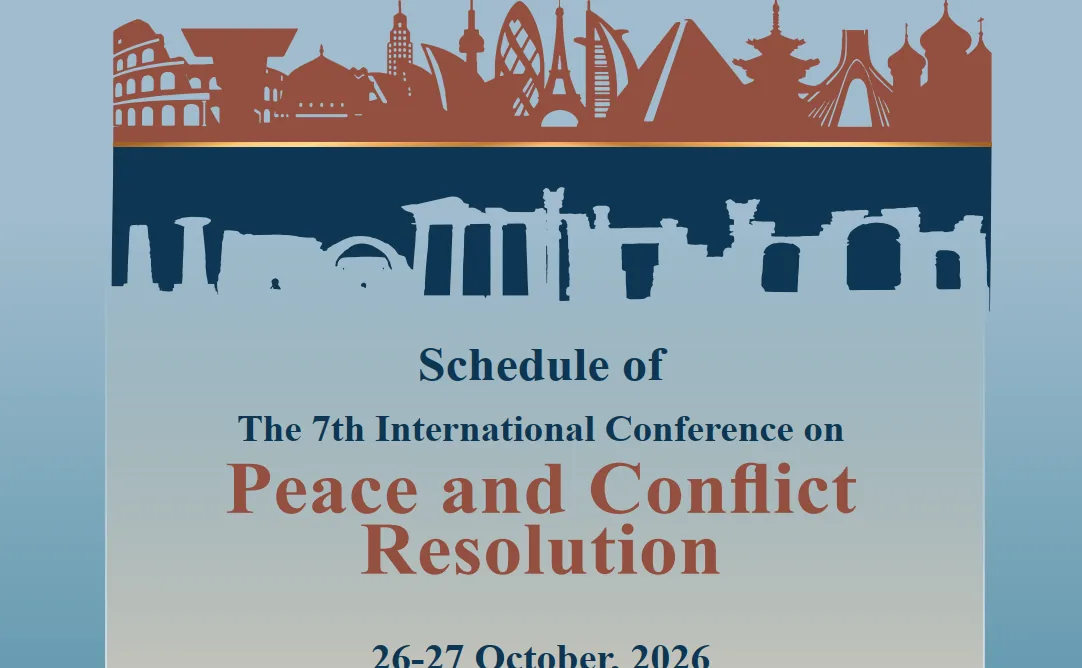
An aspect of Iran’s culture and civilisation you’ve probably never heard about. Don’t be surprised if the US and Israel also try to bomb them. Jan ObergTFF director October 26, 2026 Today – under the “USraeli” threat of new “annihilating” bombings – opens the 7th International Conference on Peace and Conflict Resolution at Tehran’s University. As far as I can tell, this is the only permanent, advanced peace research institution in West Asia/the Middle East. Perhaps more countries in that region could be inspired? I mean, how many military “security” institutes and military academies do they have? Many peace research institutes and university departments have been established since the 1950s in the West. They are now all under attack; some have closed down, some have gone mainstream, yet others kept the name but do nothing to research peace and disseminate results or advice; instead, they cooperate with militarism’s platforms such...