
Photo Credit: The Cradle

Pepe Escobar

February 1, 2023

As Beijing’s Belt and Road Initiative enters its 10th year, a strong Sino-Russian geostrategic partnership has revitalized the BRI across the Global South.

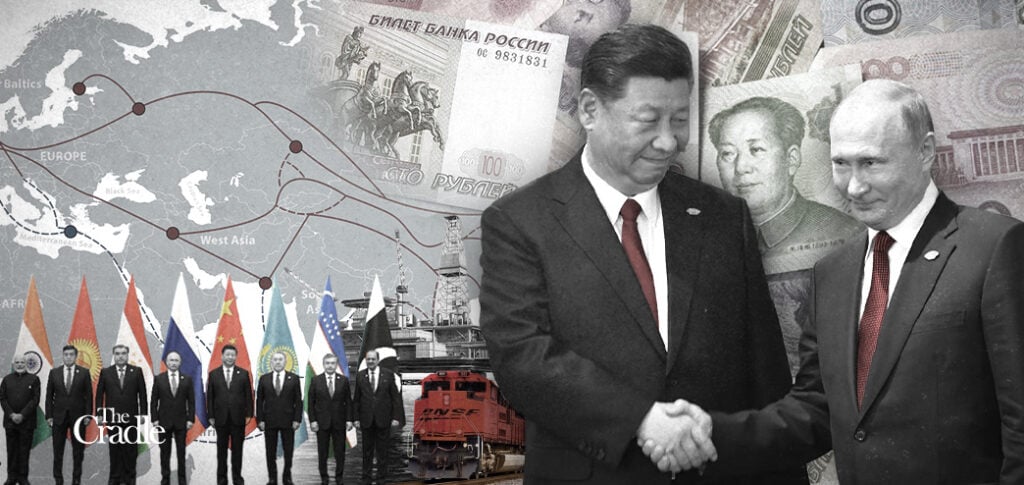
The year 2022 ended with a Zoom call to end all Zoom calls: Presidents Vladimir Putin and Xi Jinping discussing all aspects of the Russia-China strategic partnership in an exclusive video call.

Putin told Xi how “Russia and China managed to ensure record high growth rates of mutual trade,” meaning “we will be able to reach our target of $200 billion by 2024 ahead of schedule.”

On their coordination to “form a just world order based on international law,” Putin emphasized how “we share the same views on the causes, course, and logic of the ongoing transformation of the global geopolitical landscape.”

Originally published at The Cradle on 6 January 2023

Facing “unprecedented pressure and provocations from the west,” Putin noted how Russia-China are not only defending their own interests “but also all those who stand for a truly democratic world order and the right of countries to freely determine their own destiny.”

Earlier, Xi had announced that Beijing will hold the 3rd Belt and Road Forum in 2023. This has been confirmed, off the record, by diplomatic sources. The forum was initially designed to be bi-annual, first held in 2017 and then in 2019. 2021 didn’t happen because of Covid-19.

The return of the forum signals not only a renewed drive but an extremely significant landmark as the Belt and Road Initiative (BRI), launched in Astana and then Jakarta in 2013, will be celebrating its 10th anniversary.

BRI version 2.0

That set the tone for 2023 across the whole geopolitical and geoeconomic spectrum. In parallel to its geoconomic breadth and reach, BRI has been conceived as China’s overarching foreign policy concept up to the mid-century. Now it’s time to tweak things. BRI 2.0 projects, along its several connectivity corridors, are bound to be re-dimensioned to adapt to the post-Covid environment, the reverberations of the war in Ukraine, and a deeply debt-distressed world.
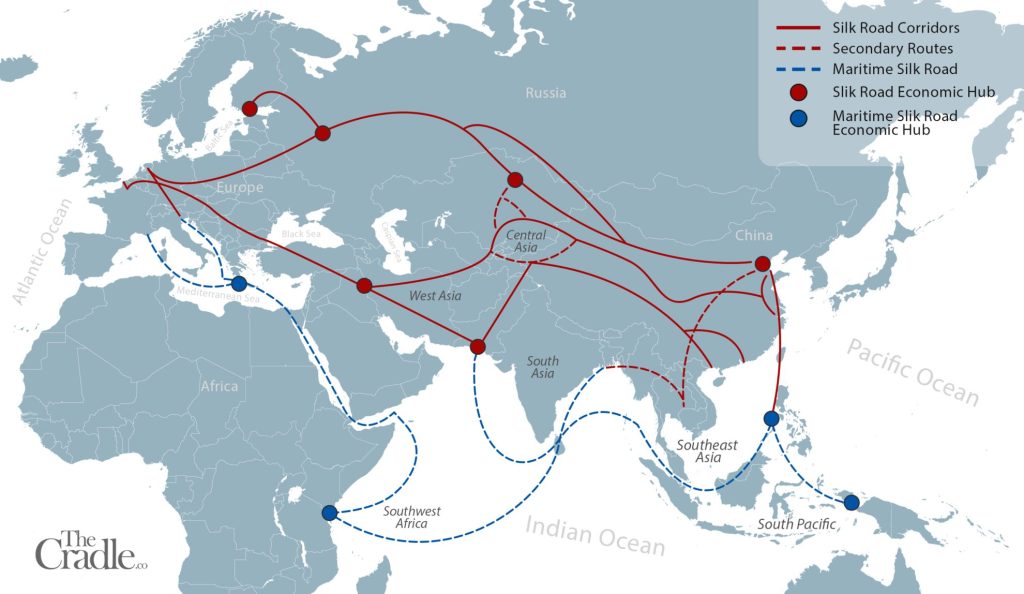
Map of BRI (Photo Credit: The Cradle)

And then there’s the interlocking of the connectivity drive via BRI with the connectivity drive via the International North-South Transportation Corridor (INTSC), whose main players are Russia, Iran and India.

Expanding on the geoeconomic drive of the Russia-China partnership as discussed by Putin and Xi, the fact that Russia, China, Iran and India are developing interlocking trade partnerships should establish that BRICS members Russia, India and China, plus Iran as one of the upcoming members of the expanded BRICS+, are the ‘Quad’ that really matter across Eurasia.

The new Politburo Standing Committee in Beijing, which are totally aligned with Xi’s priorities, will be keenly focused on solidifying concentric spheres of geoeconomic influence across the Global South.

How China plays ‘strategic ambiguity’

This has nothing to do with balance of power, which is a western concept that additionally does not connect with China’s five millennia of history. Neither is this another inflection of “unity of the center” – the geopolitical representation according to which no nation is able to threaten the center, China, as long as it is able to maintain order.

These cultural factors that in the past may have prevented China from accepting an alliance under the concept of parity have now vanished when it comes to the Russia-China strategic partnership.

Back in February 2022, days before the events that led to Russia’s Special Military Operation (SMO) in Ukraine, Putin and Xi, in person, had announced that their partnership had “no limits” – even if they hold different approaches on how Moscow should deal with a Kiev lethally instrumentalized by the west to threaten Russia.

In a nutshell: Beijing will not “abandon” Moscow because of Ukraine – as much as it will not openly show support. The Chinese are playing their very own subtle interpretation of what Russians define as  “strategic ambiguity.”

Connectivity in West Asia

In West Asia, BRI projects will advance especially fast in Iran, as part of the 25-year deal signed between Beijing and Tehran and the definitive demise of the Joint Comprehensive Plan of Action (JCPOA) – or Iran nuclear deal – which will translate into no European investment in the Iranian economy.

Iran is not only a BRI partner but also a full-fledged Shanghai Cooperation Organization (SCO) member. It has clinched a free trade agreement with the Eurasia Economic Union (EAEU), which consists of post-Soviet states Russia, Armenia, Belarus, Kazakhstan and Kyrgyzstan.

And Iran is, today, arguably the key interconnector of the INSTC, opening up the Indian Ocean and beyond, interconnecting not only with Russia and India but also China, Southeast Asia, and even, potentially, Europe – assuming the EU leadership will one day see which way the wind is blowing.
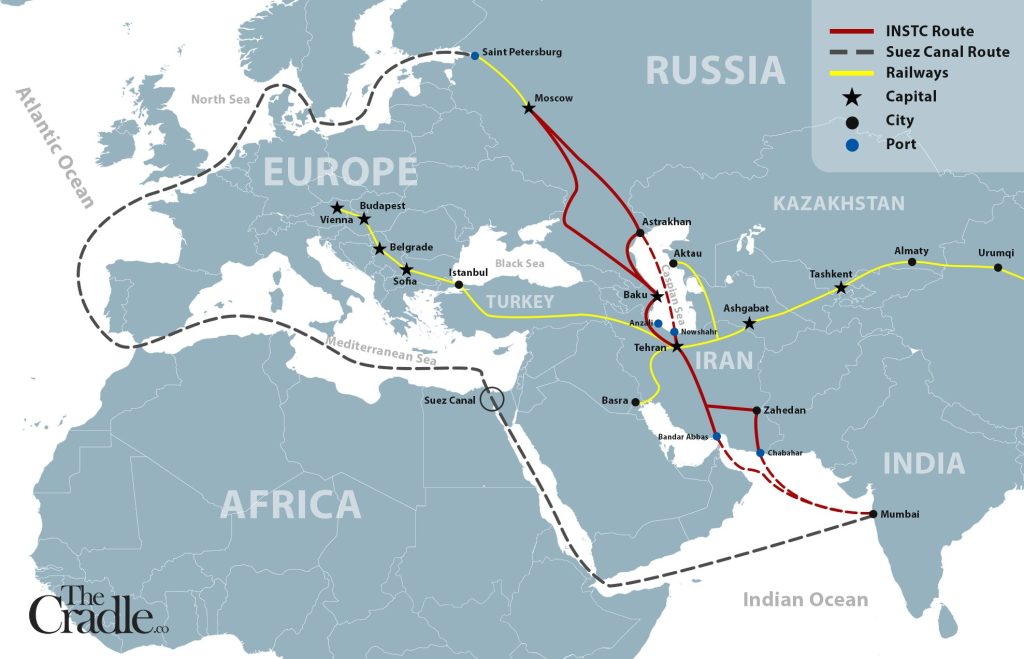
Map of INSTC (Photo Credit: The Cradle)

So here we have heavily US-sanctioned Iran profiting simultaneously from BRI, INSTC and the EAEU free trade deal. The three critical BRICS members – India, China, Russia – will be particularly interested in the development of the trans-Iranian transit corridor – which happens to be the shortest route between most of the EU and South and Southeast Asia, and will provide faster, cheaper transportation.

Add to this the groundbreaking planned Russia-Transcaucasia-Iran electric power corridor, which could become the definitive connectivity link capable of smashing the antagonism between Azerbaijan and Armenia.

In the Arab world, Xi has already rearranged the chessboard. Xi’s December trip to Saudi Arabia should be the diplomatic blueprint on how to rapidly establish a post-modern quid pro quo between two ancient, proud civilizations to facilitate a New Silk Road revival.

Rise of the Petro-yuan

Beijing may have lost huge export markets within the collective west – so a replacement was needed. The Arab leaders who lined up in Riyadh to meet Xi saw ten thousand sharpened (western) knives suddenly approaching and calculated it was time to strike a new balance.

That means, among other things, that Saudi Crown Prince Mohammad bin Salman (MbS) has adopted a more multipolar agenda: no more weaponizing of Salafi-Jihadism across Eurasia, and a door wide open to the Russia-China strategic partnership. Hubris strikes hard at the heart of the Hegemon.

Credit Suisse strategist Zoltan Pozsar, in two striking successive newsletters, titled War and Commodity Encumbrance (December 27) and War and Currency Statecraft (December 29), pointed out the writing on the wall.

Pozsar fully understood what Xi meant when he said China is “ready to work with the GCC” to set up a “new paradigm of all-dimensional energy cooperation” within a timeline of “three to five years.”

China will continue to import a lot of crude, long-term, from GCC nations, and way more Liquified Natural Gas (LNG). Beijing will “strengthen our cooperation in the upstream sector, engineering services, as well as [downstream] storage, transportation, and refinery. The Shanghai Petroleum and Natural Gas Exchange platform will be fully utilized for RMB settlement in oil and gas trade…and we could start currency swap cooperation.”

Pozsar summed it all up, thus: “GCC oil flowing East + renminbi invoicing = the dawn of the petroyuan.”

And not only that. In parallel, the BRI gets a renewed drive, because the previous model – oil for weapons – will be replaced with oil for sustainable development (construction of factories, new job opportunities).

And that’s how BRI meets MbS’s Vision 2030.

Apart from Michael Hudson, Poszar may be the only western economic analyst who understands the global shift in power: “The multipolar world order,” he says,” is being built not by G7 heads of state but by the ‘G7 of the East’ (the BRICS heads of state), which is a G5 really.” Because of the move toward an expanded BRICS+, he took the liberty to round up the number.

And the rising global powers know how to balance their relations too. In West Asia, China is playing slightly different strands of the same BRI trade/connectivity strategy, one for Iran and another for the Persian Gulf monarchies.

China’s Comprehensive Strategic Partnership with Iran is a 25-year deal under which China invests $400 billion into Iran’s economy in exchange for a steady supply of Iranian oil at a steep discount. While at his summit with the GCC, Xi emphasized “investments in downstream petrochemical projects, manufacturing, and infrastructure” in exchange for paying for energy in yuan.

How to play the New Great Game

BRI 2.0 was also already on a roll during a series of Southeast Asian summits in November. When Xi met with Thai Prime Minister Prayut Chan-o-cha at the APEC (Asia-Pacific Economic Cooperation) Summit in Bangkok, they pledged to finally connect the up-and-running China-Laos high-speed railway to the Thai railway system. This is a 600km-long project, linking Bangkok to Nong Khai on the border with Laos, to be completed by 2028.

And in an extra BRI push, Beijing and Bangkok agreed to coordinate the development of China’s Shenzhen-Zhuhai-Hong Kong Greater Bay Area and the Yangtze River Delta with Thailand’s Eastern Economic Corridor (EEC).

In the long run, China essentially aims to replicate in West Asia its strategy across Southeast Asia. Beijing trades more with the ASEAN than with either Europe or the US. The ongoing, painful slow motion crash of the collective west may ruffle a few feathers in a civilization that has seen, from afar, the rise and fall of Greeks, Romans, Parthians, Arabs, Ottomans, Spanish, Dutch, British. The Hegemon after all is just the latest in a long list.

In practical terms, BRI 2.0 projects will now be subjected to more scrutiny: This will be the end of impractical proposals and sunk costs, with lifelines extended to an array of debt-distressed nations. BRI will be placed at the heart of BRICS+ expansion – building on a consultation panel in May 2022 attended by foreign ministers and representatives from South America, Africa and Asia that showed, in practice, the global range of possible candidate countries.

Implications for the Global South

Xi’s fresh mandate from the 20th Communist Party Congress has signalled the irreversible institutionalization of BRI, which happens to be his signature policy. The Global South is fast drawing serious conclusions, especially in contrast with the glaring politicization of the G20 that was visible at its November summit in Bali.

So Poszar is a rare gem: a western analyst who understands that the BRICS are the new G5 that matter and that they’re leading the road towards BRICS+. He also gets that the Quad that really matters is the three main BRICS-plus-Iran.

Acute supply chain decoupling, the crescendo of western hysteria over Beijing’s position on the war in Ukraine, and serious setbacks on Chinese investments in the west all play on the development of BRI 2.0. Beijing will be focusing simultaneously on several nodes of the Global South, especially neighbours in ASEAN and across Eurasia.

Think, for instance, the Beijing-funded Jakarta-Bandung high-speed railway, Southeast Asia’s first: a BRI project opening this year as Indonesia hosts the rotating ASEAN chairmanship. China is also building the East Coast Rail Link in Malaysia and has renewed negotiations with the Philippines for three railway projects.

Then there are the superposed interconnections. The EAEU will clinch a free trade zone deal with Thailand. On the sidelines of the epic return of Luiz Inácio Lula da Silva to power in Brazil, this past Sunday, officials of Iran and Saudi Arabia met amid smiles to discuss – what else – BRICS+. Excellent choice of venue: Brazil is regarded by virtually every geopolitical player as prime neutral territory.

From Beijing’s point of view, the stakes could not be higher, as the drive behind BRI 2.0 across the Global South is not to allow China to be dependent on western markets. Evidence of this is in its combined approach towards Iran and the Arab world.

China losing both US and EU market demand, simultaneously, may end up being just a bump in the (multipolar) road, even as the crash of the collective west may seem suspiciously timed to take China down.

The year 2023 will proceed with China playing the New Great Game deep inside, crafting a globalization 2.0 that is institutionally supported by a network encompassing BRI, BRICS+, the SCO, and with the help of its Russian strategic partner, the EAEU and OPEC+ too. No wonder the usual suspects are dazed and confused.

Originally published at The Cradle on 6 January 2023

Please help TFF remain truly independent by contributing if you benefited from this article

Related Posts

Jan Oberg, TFF director April 9, 2026 I was recently invited to have a good, long talk about the world – and, of course, about peace too – with Boris Malagurski on his Weight of Chains Channel on YouTube. It was a real joy and seems to have been greatly appreciated by the viewers too. Mr Malagurski and I shall of course be grateful if you share this conversation in your circles – of course, only if you like what you see and hear 😉☮️ And remember that this one – like hundreds of others with TFF Associates – can be enjoyed at our TFF Video Collection.
This is not another geopolitical commentary on the Arctic. It is a visionary peace proposal that can save the region from militarised rivalry and ecological ruin. A blueprint for shared security, sustainable development, and human dignity — benefitting Greenland, the Arctic, and the rest of us. Jan Oberg TFF director Lund, Sweden, February 17, 2026 I. Four Principles for a New Arctic Vision The Arctic is often framed as a cold arena of rivalry — a place where great powers test each other’s resolve. But this worldview is outdated, unimaginative, and ultimately self‑defeating. The Arctic is not a vacuum waiting to be militarised; it is a living region, a climate stabiliser, and a cultural homeland whose future will shape the future of humanity. If we begin from that understanding, a far more rational Arctic order becomes possible — one that is peaceful, cooperative, and centred on the people who actually live there. This vision rests...
PART 2 — Diplomacy, Law and Nonviolent Power By Jan ObergTFF co-founder and director January 26, 2026 This is the second of four TFF-created idea portfolios designed to curb the global reach of the United States and, in both the short and long term, help catalyse a worldwide nonviolent resistance to what many observers describe as the Trump administration’s uniquely confrontational, destructive and world-threatening policies. These portfolios outline what governments and citizens across the world can do through dynamic diplomacy, creative initiatives, and strictly nonviolent means. They are typical TFF works in that we do not only tell what the problem is and how bad it will go – as 90+% of all commentators, experts and scholars do – we tell what we think can be done, inviting you to think of what you think you can do. It seems painfully clear to me that the current political dynamics in Washington increasingly resemble the most dangerous...

Recent Articles

Below are TFF-related media mentions, comments, videos and social media posts published elsewhere but not on this homepage. We happen to catch and list only a fraction. Regarding video comments and debates, we recommend that you go to the TFF Video Channel on Substack where many of them are reproduced. Jan Oberg is a contributor to China Daily – 52 million daily clicks – and Global Times, CGTN and CCTV (the national television), China Investment, Xinhua News Agency and several others. Articles and videos on these media very often multiply into countless Chinese (and Western media) that re-post them from these main media. Thanks to The China Academy, his analyses, interviews and comments are frequently posted on YouTube channels such as Thinkers Forum and Wave Media. These videos are often re-posted on Bilibili (China’s YouTube), the China Content Center on TikTok, and on the Chinese edition of TikTok, Douyin.com. This means reaching hundreds of millions of viewers worldwide over a year. While there are too many to catch on all these...
Jan Oberg TFF director October 13, 2026 According to Alfred Nobel’s will, the Nobel Peace Prize shall be awarded: ”to the person who has done the most or best to advance fellowship among nations, the abolition or reduction of standing armies, and the establishment and promotion of peace congresses.” Further down, he also expresses how the prize for the “champions of peace” shall be decided: “that for champions of peace by a committee of five persons to be selected by the Norwegian Storting. Alfred Nobel’s will is remarkably short and clear. But few seem to have read it. Nobel did not say that the committee itself should consist of members of parliament. He entrusted the Storting with appointing five persons. In principle, it could have selected diplomats, mediators, peace researchers, conflict-resolution specialists, or other individuals with recognised expertise in matters of peace from around the world. Instead, the Storting gradually...
The Quest for Humane Survival Richard Falk Professor emeritus, Princeton UniversityTFF Associate since 1986October 12, 2026 After decades of teaching and writing about international law in academic frameworks that were not institutionally situated within law school environments—at Princeton and the University of California, Santa Barbara—I found myself most receptive to the TWAIL outlook. It has been especially illuminating in clarifying the extent to which international law evolved as a dialogical critique of Europe’s efforts to legitimize its colonial undertakings. In particular, TWAIL has exposed how international law has functioned to legalize the subjugation of Third World peoples, securing conditions for exploitative investment and trade relations, the coercive enforcement of public debts, and an ideology of cultural superiority. TWAIL’s exposure of these economic legacies of colonialism has influenced my understanding of the history and development of international law, broadly conceived, as an ideological project of the Western sub-system of the world...

TFF on Substack

Discover and subscribe to more peace materials on TFF Substack

Most Popular

Below are TFF-related media mentions, comments, videos and social media posts published elsewhere but not on this homepage. We happen to catch and list only a fraction. Regarding video comments and debates, we recommend that you go to the TFF Video Channel on Substack where many of them are reproduced. Jan Oberg is a contributor to China Daily – 52 million daily clicks – and Global Times, CGTN and CCTV (the national television), China Investment, Xinhua News Agency and several others. Articles and videos on these media very often multiply into countless Chinese (and Western media) that re-post them from these main media. Thanks to The China Academy, his analyses, interviews and comments are frequently posted on YouTube channels such as Thinkers Forum and Wave Media. These videos are often re-posted on Bilibili (China’s YouTube), the China Content Center on TikTok, and on the Chinese edition of TikTok, Douyin.com. This means reaching hundreds of millions of viewers worldwide over a year. While there are too many to catch on all these...
Jan Oberg TFF director October 13, 2026 According to Alfred Nobel’s will, the Nobel Peace Prize shall be awarded: ”to the person who has done the most or best to advance fellowship among nations, the abolition or reduction of standing armies, and the establishment and promotion of peace congresses.” Further down, he also expresses how the prize for the “champions of peace” shall be decided: “that for champions of peace by a committee of five persons to be selected by the Norwegian Storting. Alfred Nobel’s will is remarkably short and clear. But few seem to have read it. Nobel did not say that the committee itself should consist of members of parliament. He entrusted the Storting with appointing five persons. In principle, it could have selected diplomats, mediators, peace researchers, conflict-resolution specialists, or other individuals with recognised expertise in matters of peace from around the world. Instead, the Storting gradually...
The Quest for Humane Survival Richard Falk Professor emeritus, Princeton UniversityTFF Associate since 1986October 12, 2026 After decades of teaching and writing about international law in academic frameworks that were not institutionally situated within law school environments—at Princeton and the University of California, Santa Barbara—I found myself most receptive to the TWAIL outlook. It has been especially illuminating in clarifying the extent to which international law evolved as a dialogical critique of Europe’s efforts to legitimize its colonial undertakings. In particular, TWAIL has exposed how international law has functioned to legalize the subjugation of Third World peoples, securing conditions for exploitative investment and trade relations, the coercive enforcement of public debts, and an ideology of cultural superiority. TWAIL’s exposure of these economic legacies of colonialism has influenced my understanding of the history and development of international law, broadly conceived, as an ideological project of the Western sub-system of the world...
Read More
girl-5894831_1280
Below are TFF-related media mentions, comments, videos and social media posts published elsewhere but not on this homepage. We happen to catch and list only a fraction. Regarding video comments and debates, we recommend that you go to the TFF Video Channel on Substack where many of them are reproduced. Jan Oberg is a contributor to China Daily – 52 million daily clicks – and Global Times, CGTN and CCTV (the national television), China Investment, Xinhua News Agency and several others. Articles and videos on these media very often multiply into countless Chinese (and Western media) that re-post them from these main media. Thanks to The China Academy, his analyses, interviews and comments are frequently posted on YouTube channels such as Thinkers Forum and Wave Media. These videos are often re-posted on Bilibili (China’s YouTube), the China Content Center on TikTok, and on the Chinese edition of TikTok, Douyin.com. This means reaching hundreds of millions of viewers worldwide over a year. While there are too many to catch on all these...
Nobel-Prize-Plaque
Jan Oberg TFF director October 13, 2026 According to Alfred Nobel’s will, the Nobel Peace Prize shall be awarded: ”to the person who has done the most or best to advance fellowship among nations, the abolition or reduction of standing armies, and the establishment and promotion of peace congresses.” Further down, he also expresses how the prize for the “champions of peace” shall be decided: “that for champions of peace by a committee of five persons to be selected by the Norwegian Storting. Alfred Nobel’s will is remarkably short and clear. But few seem to have read it. Nobel did not say that the committee itself should consist of members of parliament. He entrusted the Storting with appointing five persons. In principle, it could have selected diplomats, mediators, peace researchers, conflict-resolution specialists, or other individuals with recognised expertise in matters of peace from around the world. Instead, the Storting gradually...
law-419057_1280
The Quest for Humane Survival Richard Falk Professor emeritus, Princeton UniversityTFF Associate since 1986October 12, 2026 After decades of teaching and writing about international law in academic frameworks that were not institutionally situated within law school environments—at Princeton and the University of California, Santa Barbara—I found myself most receptive to the TWAIL outlook. It has been especially illuminating in clarifying the extent to which international law evolved as a dialogical critique of Europe’s efforts to legitimize its colonial undertakings. In particular, TWAIL has exposed how international law has functioned to legalize the subjugation of Third World peoples, securing conditions for exploitative investment and trade relations, the coercive enforcement of public debts, and an ideology of cultural superiority. TWAIL’s exposure of these economic legacies of colonialism has influenced my understanding of the history and development of international law, broadly conceived, as an ideological project of the Western sub-system of the world...
images-2
Advocates of nuclear disarmament are regularly dismissed by the champions of nuclear deterrence as naïve and unrealistic, utopian or even irresponsible. Yet this ‘doctrine’ of deterrence, regarded by France as the ‘cornerstone’ of its national security, is based on quasi-religious beliefs, a theory that cannot be proven, risky gambles and fragile assumptions. So much so that one might legitimately ask which side the ‘Care Bears’ are on. Marc FinaudVice-President of Initiatives for Nuclear Disarmament (IDN) October 9, 2026 This article was originally published on Pressenza When it comes to these things being treated as religious concepts, look here. Idealists and realists It was Hubert Védrine, François Mitterrand’s former Foreign Minister, who repeatedly coined the phrase: ‘Europeans are a sort of Care Bears who don’t realise they’re living in Jurassic Park’. He applies this reference to the cartoon for well-behaved children not only to what he regards as weakness or idealism...
8824b09f-33a5-43f9-9fd0-550f28cda24d_1536x1024
What the West Borrowed from Asia and What It Left Behind Jan Krikke October 8, 2026 The article was originally published here In the late 1960s, the musical Hair announced that the Age of Aquarius was dawning. Its opening anthem promised a transformation of human consciousness: an era of peace, harmony and understanding. Half a century later, a familiar echo of that promise is a meditation app offered by your employer. You can find it in the same list of benefits as the pension plan and the gym discount. How did a spiritual revolution become an employee benefit? The answer lies in the history of the movement known as New Age: where it came from, what it borrowed from Asia, and why the meaning of what it borrowed changed in the process. Two definitions will help. New Age is a loose label for a wide range of spiritual practices and...
Screenshot 2026-10-04 210142
Small and different + among the 10% most active + 9,000 texts + 150 Associates + 60 000 a day — and a stubborn belief that peace is smarter and must be secured by peaceful means. In 2026, the Transnational Foundation for Peace and Future Research (TFF) turns 40. On Monday, October 5, 2026, a new TFF homepage will go live — a new gateway to more than 9,000 articles, analyses, research papers and other contributions produced over four decades of independent peace research. But this is not simply a new website. For four decades, TFF has worked from a simple conviction: peace is smarter than militarism and can be brought about by peaceful means. This is not merely an aspiration. It is the principle expressed in the UN Charter and the Gandhian tradition that has guided our work from the beginning. TFF is a research-based, independent and people-financed foundation....




