
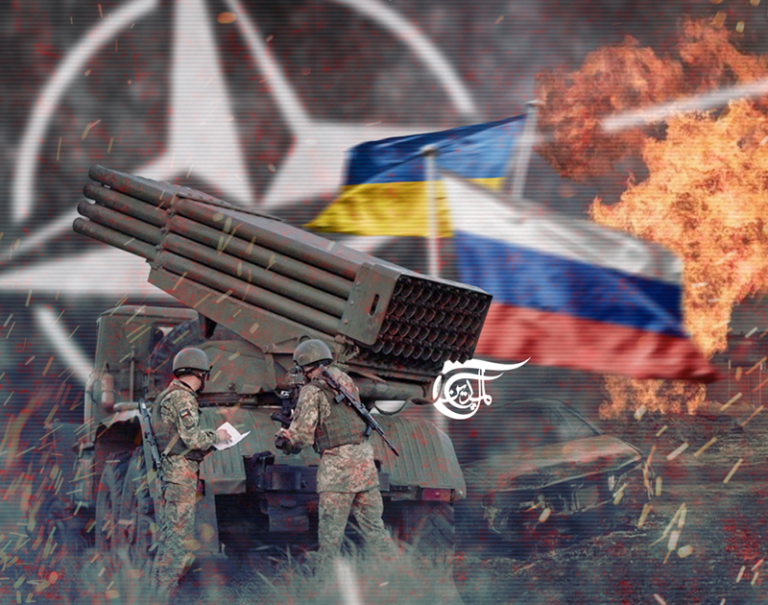
Ben Norton: NATO Admits It Wants ‘Ukrainians to Keep Dying’ to Bleed Russia, Not Peace

Ben Norton

May 18, 2022

NATO sees Ukrainians as mere cannon fodder in its imperial proxy war on Russia

The US-led NATO military alliance has made it clear that it is willing to fight to the last Ukrainian in order to bleed Russia and advance Western geopolitical interests.

In a shockingly blunt admission, The Washington Post acknowledged that some NATO member states want “Ukrainians to keep fighting, and dying” in order to prevent Russia from making political gains.

Originally published at Globalresearch

In an April 5 report on peace talks between Ukraine and Russia, the major US newspaper disclosed that NATO is afraid that Kyiv may give in to some of Moscow’s demands.

The Washington Post wrote explicitly: “For some in NATO, it’s better for the Ukrainians to keep fighting, and dying than to achieve a peace that comes too early or at too high a cost to Kyiv and the rest of Europe.”

Anonymous Western diplomats emphasized that “there are limits to how many compromises some in NATO will support to win the peace,” and that they would rather prolong the war in Ukraine if they can prevent Russia from having its security concerns met.

The newspaper said that NATO members are desperate not to give “Russian President Vladimir Putin any semblance of victory,” and are more than willing to force Ukrainians into the meat grinder to do so.

US National Security Advisor Jake Sullivan noted that the administration of Ukrainian President Volodymyr Zelensky is closely coordinating with Washington, and is in “near-daily contact” with the White House. It is evident who is really in charge.

The newspaper likewise revealed that the US military has more than 100,000 troops deployed in Europe.

The Washington Post has a close relationship with the US government. The newspaper is owned by $200-billionaire Jeff Bezos, one of the richest human beings in history.

Bezos is also the founder and executive chairman of mega-corporation Amazon, which has tens of billions of dollars worth of contracts with the CIA, Pentagon, NSA, FBI, ICE, and other US government agencies.

If The Washington Post is disclosing this information about NATO, with quotes from senior White House officials, it clearly got the green light from its handlers in Washington.

This report is a semi-official confirmation that NATO sees Ukrainians as mere cannon fodder in its imperial proxy war on Russia.

In fact, some Western officials have stated this openly.

A former senior State Department official, hard-line right-wing war hawk Eliot A. Cohen, boasted in an article in The Atlantic magazine that the “United States and its NATO allies are engaged in a proxy war with Russia.”

He effused proudly, “They are supplying thousands of munitions and hopefully doing much else – sharing intelligence, for example – with the intent of killing Russian soldiers,” adding, “the more and faster the better.”

The State Department veteran declared that the “stream of arms going into Ukraine needs to be a flood.”

This is exactly what NATO member states are doing: flooding Russia’s neighbour with weapons.

Instead of supporting peace talks with Russia, the United States and European Union have been actively escalating the war, sending Ukraine billions of dollars worth of weapons, including tens of thousands of anti-tank missiles, thousands of anti-aircraft missiles, and hundreds of kamikaze drones, as well as tanks and armoured vehicles.

What goes unmentioned is how US and European arms corporations have heavily profited from the war. The stocks of private military contractors skyrocketed after Russia sent its troops into Ukraine on February 24, as Western governments pledged to substantially increase their military expenditure.

The Joe Biden administration immediately delivered $350 million in weapons in late February, before pledging an additional $13.6 billion in aid for Ukraine in March, of which $6.5 billion in military support.

The foreign ministers of NATO met at the military alliance’s headquarters in Brussels on April 6 and 7 and pledged to escalate the war in Ukraine even further.

The Western politicians were joined by representatives of several non-NATO members, including Japan, South Korea, Georgia, Finland, Sweden, Australia, and New Zealand.

Ukrainian Foreign Minister Dmytro Kuleba travelled to Brussels for the meeting, where he dispelled any doubt that NATO wants more war instead of peace.

“I came here today to discuss three most important things: weapons, weapons, and weapons,” Kuleba summarized.

NATO Secretary-General Jens Stoltenberg similarly declared, “After the invasion, allies stepped up with additional military support, with more military equipment, and it was a clear message from the meeting today that allies should do more and are ready to do more to provide more equipment, and they realize and recognize the urgency.”

Stoltenberg boasted that direct NATO military support for Ukraine goes back to 2014 and that tens of thousands of Ukrainian soldiers were trained by NATO in the past eight years, long before Russia invaded.

NATO transparently prefers that Ukrainians keep sacrificing their lives in hopes of weakening and destabilizing Russia.

Meanwhile, Ukrainians who think peace should be the solution, not more war, face dire consequences.

A Ukrainian negotiator who had participated in peace talks with Russia, Denys Kyreyev, was murdered, reportedly by the Security Service of Ukraine (SBU), which is notorious for being influenced by neo-Nazis and other far-right extremists.

All of this extreme violence and warmongering flies directly in the face of NATO’s claim to be a supposed “defensive” alliance.

The reality is NATO has never been devoted to defence, let alone democracy. Among the military alliance’s founding members in 1949 was the fascist dictatorship of Portugal.

During the first cold war, NATO supported former Nazi collaborators and fascists in its infamous Operation Gladio. With NATO support, far-right extremists carried out terrorist attacks in Europe to try to repress the left-wing, especially during Italy’s notorious Years of Lead.

When the first cold war ended, NATO continued to expand onto Russia’s borders, repeatedly violating promises made by the United States, Britain, and France that the military alliance would not move “one inch eastward” after the reunification of Germany in 1990.

In bombing campaigns in the 1990s, NATO destroyed and carved up the former Yugoslavia, which no longer exists as a country.

Then NATO helped the United States launch its war in Afghanistan in 2001, and maintained a joint military occupation until 2021.

In 2011, NATO waged war on Libya, the most prosperous country in Africa. The Western military campaign shattered Libya’s state. Foreign fossil fuel corporations soon pillaged the North African nation’s massive oil reserves.

Still today, in 2022, Libya has no unified central government. It does, however, have open-air slave markets for Sub-Saharan African refugees.

The ruins of Libya, Afghanistan, and former Yugoslavia show what NATO truly offers the world.

And the US-led military alliance is now prepared to sacrifice Ukraine to advance the interests of Washington and Wall Street.

Originally published at Globalresearch

About the author

Ben Norton is an experienced independent journalist focused on geopolitics and US foreign policy. Here is his homepage.

Please help TFF remain truly independent by contributing if you benefited from this article

Related Posts

The agreement is catastrophic both because of what it says and what it doesn’t mention. It reduces further the major asset of security policies: Freedom of action. Jan Oberg TFF director September 25, 2026 A couple of hours before the agreement was signed on September 22, 2026, I published the following 13 hypotheses about what it would most likely contain on TFF Substack (in English). I was wrong on only the first point. Contrary to what Trump had written on his Truth Social platform, it does not appear to come into force immediately. In fact, it turned out to be worse than even I had anticipated. After these hypotheses now come a number of reflections in light of what the agreement actually contains, and does not contain, as well as the way in which it has generally been presented by major media outlets and by the public-service broadcaster DR. My...
Jan Oberg May 15, 2026 Go to this Fox News page and scroll the whole way down: President Donald Trump tells the world that his meeting with President Xi Jinping yielded a lot of very concrete political and economic results – of course, only where the Chinese side, according to him, agreed with him. He does not mention the Taiwan issue, but Secretary of State, Marco Rubio, says that it did not feature prominently in their talks and that the US policy on Taiwan has not changed. Then go to China Daily – or Global Times – and you will see that for the Chinese it is framework, principles, structure of cooperation etc. that matters – all embedded in the overall idea of “constructive bilateral relationship of strategic stability.” Nowhere is any concrete agreement or deal – all that Trump refers to – mentioned. At the general level, this gives you insights into the very different social...
Jan Oberg, TFF director April 9, 2026 I was recently invited to have a good, long talk about the world – and, of course, about peace too – with Boris Malagurski on his Weight of Chains Channel on YouTube. It was a real joy and seems to have been greatly appreciated by the viewers too. Mr Malagurski and I shall of course be grateful if you share this conversation in your circles – of course, only if you like what you see and hear 😉☮️ And remember that this one – like hundreds of others with TFF Associates – can be enjoyed at our TFF Video Collection.

Recent Articles

The Quest for Humane Survival Richard Falk Professor emeritus, Princeton UniversityTFF Associate since 1986October 12, 2026 After decades of teaching and writing about international law in academic frameworks that were not institutionally situated within law school environments—at Princeton and the University of California, Santa Barbara—I found myself most receptive to the TWAIL outlook. It has been especially illuminating in clarifying the extent to which international law evolved as a dialogical critique of Europe’s efforts to legitimize its colonial undertakings. In particular, TWAIL has exposed how international law has functioned to legalize the subjugation of Third World peoples, securing conditions for exploitative investment and trade relations, the coercive enforcement of public debts, and an ideology of cultural superiority. TWAIL’s exposure of these economic legacies of colonialism has influenced my understanding of the history and development of international law, broadly conceived, as an ideological project of the Western sub-system of the world...
Advocates of nuclear disarmament are regularly dismissed by the champions of nuclear deterrence as naïve and unrealistic, utopian or even irresponsible. Yet this ‘doctrine’ of deterrence, regarded by France as the ‘cornerstone’ of its national security, is based on quasi-religious beliefs, a theory that cannot be proven, risky gambles and fragile assumptions. So much so that one might legitimately ask which side the ‘Care Bears’ are on. Marc FinaudVice-President of Initiatives for Nuclear Disarmament (IDN) October 9, 2026 This article was originally published on Pressenza When it comes to these things being treated as religious concepts, look here. Idealists and realists It was Hubert Védrine, François Mitterrand’s former Foreign Minister, who repeatedly coined the phrase: ‘Europeans are a sort of Care Bears who don’t realise they’re living in Jurassic Park’. He applies this reference to the cartoon for well-behaved children not only to what he regards as weakness or idealism...
What the West Borrowed from Asia and What It Left Behind Jan Krikke October 8, 2026 The article was originally published here In the late 1960s, the musical Hair announced that the Age of Aquarius was dawning. Its opening anthem promised a transformation of human consciousness: an era of peace, harmony and understanding. Half a century later, a familiar echo of that promise is a meditation app offered by your employer. You can find it in the same list of benefits as the pension plan and the gym discount. How did a spiritual revolution become an employee benefit? The answer lies in the history of the movement known as New Age: where it came from, what it borrowed from Asia, and why the meaning of what it borrowed changed in the process. Two definitions will help. New Age is a loose label for a wide range of spiritual practices and...

TFF on Substack

Discover and subscribe to more peace materials on TFF Substack

Most Popular

The Quest for Humane Survival Richard Falk Professor emeritus, Princeton UniversityTFF Associate since 1986October 12, 2026 After decades of teaching and writing about international law in academic frameworks that were not institutionally situated within law school environments—at Princeton and the University of California, Santa Barbara—I found myself most receptive to the TWAIL outlook. It has been especially illuminating in clarifying the extent to which international law evolved as a dialogical critique of Europe’s efforts to legitimize its colonial undertakings. In particular, TWAIL has exposed how international law has functioned to legalize the subjugation of Third World peoples, securing conditions for exploitative investment and trade relations, the coercive enforcement of public debts, and an ideology of cultural superiority. TWAIL’s exposure of these economic legacies of colonialism has influenced my understanding of the history and development of international law, broadly conceived, as an ideological project of the Western sub-system of the world...
Advocates of nuclear disarmament are regularly dismissed by the champions of nuclear deterrence as naïve and unrealistic, utopian or even irresponsible. Yet this ‘doctrine’ of deterrence, regarded by France as the ‘cornerstone’ of its national security, is based on quasi-religious beliefs, a theory that cannot be proven, risky gambles and fragile assumptions. So much so that one might legitimately ask which side the ‘Care Bears’ are on. Marc FinaudVice-President of Initiatives for Nuclear Disarmament (IDN) October 9, 2026 This article was originally published on Pressenza When it comes to these things being treated as religious concepts, look here. Idealists and realists It was Hubert Védrine, François Mitterrand’s former Foreign Minister, who repeatedly coined the phrase: ‘Europeans are a sort of Care Bears who don’t realise they’re living in Jurassic Park’. He applies this reference to the cartoon for well-behaved children not only to what he regards as weakness or idealism...
What the West Borrowed from Asia and What It Left Behind Jan Krikke October 8, 2026 The article was originally published here In the late 1960s, the musical Hair announced that the Age of Aquarius was dawning. Its opening anthem promised a transformation of human consciousness: an era of peace, harmony and understanding. Half a century later, a familiar echo of that promise is a meditation app offered by your employer. You can find it in the same list of benefits as the pension plan and the gym discount. How did a spiritual revolution become an employee benefit? The answer lies in the history of the movement known as New Age: where it came from, what it borrowed from Asia, and why the meaning of what it borrowed changed in the process. Two definitions will help. New Age is a loose label for a wide range of spiritual practices and...
Read More
law-419057_1280
The Quest for Humane Survival Richard Falk Professor emeritus, Princeton UniversityTFF Associate since 1986October 12, 2026 After decades of teaching and writing about international law in academic frameworks that were not institutionally situated within law school environments—at Princeton and the University of California, Santa Barbara—I found myself most receptive to the TWAIL outlook. It has been especially illuminating in clarifying the extent to which international law evolved as a dialogical critique of Europe’s efforts to legitimize its colonial undertakings. In particular, TWAIL has exposed how international law has functioned to legalize the subjugation of Third World peoples, securing conditions for exploitative investment and trade relations, the coercive enforcement of public debts, and an ideology of cultural superiority. TWAIL’s exposure of these economic legacies of colonialism has influenced my understanding of the history and development of international law, broadly conceived, as an ideological project of the Western sub-system of the world...
images-2
Advocates of nuclear disarmament are regularly dismissed by the champions of nuclear deterrence as naïve and unrealistic, utopian or even irresponsible. Yet this ‘doctrine’ of deterrence, regarded by France as the ‘cornerstone’ of its national security, is based on quasi-religious beliefs, a theory that cannot be proven, risky gambles and fragile assumptions. So much so that one might legitimately ask which side the ‘Care Bears’ are on. Marc FinaudVice-President of Initiatives for Nuclear Disarmament (IDN) October 9, 2026 This article was originally published on Pressenza When it comes to these things being treated as religious concepts, look here. Idealists and realists It was Hubert Védrine, François Mitterrand’s former Foreign Minister, who repeatedly coined the phrase: ‘Europeans are a sort of Care Bears who don’t realise they’re living in Jurassic Park’. He applies this reference to the cartoon for well-behaved children not only to what he regards as weakness or idealism...
8824b09f-33a5-43f9-9fd0-550f28cda24d_1536x1024
What the West Borrowed from Asia and What It Left Behind Jan Krikke October 8, 2026 The article was originally published here In the late 1960s, the musical Hair announced that the Age of Aquarius was dawning. Its opening anthem promised a transformation of human consciousness: an era of peace, harmony and understanding. Half a century later, a familiar echo of that promise is a meditation app offered by your employer. You can find it in the same list of benefits as the pension plan and the gym discount. How did a spiritual revolution become an employee benefit? The answer lies in the history of the movement known as New Age: where it came from, what it borrowed from Asia, and why the meaning of what it borrowed changed in the process. Two definitions will help. New Age is a loose label for a wide range of spiritual practices and...
Screenshot 2026-10-04 210142
Small and different + among the 10% most active + 9,000 texts + 150 Associates + 60 000 a day — and a stubborn belief that peace is smarter and must be secured by peaceful means. In 2026, the Transnational Foundation for Peace and Future Research (TFF) turns 40. On Monday, October 5, 2026, a new TFF homepage will go live — a new gateway to more than 9,000 articles, analyses, research papers and other contributions produced over four decades of independent peace research. But this is not simply a new website. For four decades, TFF has worked from a simple conviction: peace is smarter than militarism and can be brought about by peaceful means. This is not merely an aspiration. It is the principle expressed in the UN Charter and the Gandhian tradition that has guided our work from the beginning. TFF is a research-based, independent and people-financed foundation....
Living-Peace-Sign-Budapest-copy
Tony Robinson October 4, 2026 Violence is easy to recognise when someone is being beaten, shot or killed. It becomes more difficult when nobody is holding a weapon. Poverty, discrimination, exploitation and repression can restrict a human life just as effectively, although they do so in very different ways and with very different consequences. Simply adding more categories to an ever-growing list of forms of violence does not really solve the problem. The more interesting question is what all these different situations have in common and why it makes sense to describe them using the same word. Human beings do not simply react to what happens around them. They remember the past, imagine things that do not yet exist, make plans and undertake projects. Workers organise because they imagine different working conditions; people migrate because they imagine another life somewhere else; social movements emerge because people refuse to accept the...
b54a1f10-8c65-4f0b-9dd5-4abc0a7d04cc_2659x2659
It’s a matter of principles, courage, vision and pulling together – while the militarist world is falling apart… Peter Langille October 3, 2026 “Here, then, is the problem which we present to you, stark and dreadful and inescapable: Shall we put an end to the human race; or shall mankind renounce war?”The Bertrand Russell—Albert Einstein Manifesto, July 9, 1955 ⁕ The forecast for what’s ahead is worrisome. The sharp rise in armed conflicts over the past three years is adding to what was already the highest level in over seventy years. Genocides, which should be prevented are supported. A shared climate emergency that jeopardises survival is ignored. Diverse polls now suggest that people are war-weary, worried and interested in a more effective United Nations. And, there are viable policy options for a more secure world! Yet governments are doubling-down, betting on more war and investing heavily. If current trends persist,...





