
The US has been at war 225 out of 243 years since 1776

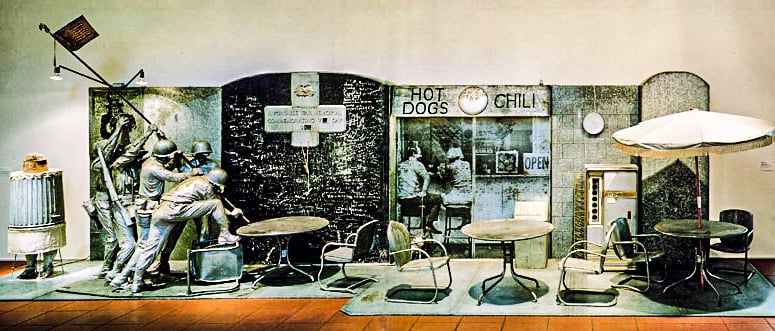
Edward Kienholz, “Portable War Memorial,” 1968

 Sabir Shah

April 14, 2022

The US Has Been at war for more than 92 percent of the time

The American history of overt and covert foreign interventions dates back to 1811, when it had invaded Chile, just a year after this South American country had gained independence from Spain.

Research conducted by the “Jang Group and Geo Television Network” reveals that the United States has been at war for about 225 of the 243 years since its inception in 1776. While the number of US foreign military interventions had stood at 188 till 2017, the world super power was found involved in 117 “partisan electoral interventions” between 1946 and 2000 or around one of every nine ballot exercises held since Second World War.

Originally posted on The News International in Pakistan on January 9th, 2020

This means that the United States has been at war for more than 92 per cent of the time since its birth, making critics view that the rulers of the land found by Christopher Columbus have been addicted to the use of military might and intoxicated with their successes against weaker nations that could not defend themselves for one reason or the other. Or in other words, the United States has only been at peace for less than 20 years.

In one of its November 23, 2017 reports, a known British media house “Channel 4 News” had carried a research undertaken by the Institute for Politics and Strategy at Carnegie Mellon University, a private research university based in Pittsburgh, Pennsylvania State. The researcher had calculated the vast scale of election interventions by both the US and Russia.

The media outlet had stated: “According to his research, there were 117 “partisan electoral interventions” between 1946 and 2000. That’s around one of every nine competitive elections held since Second World War.

The majority of these – almost 70 per cent – were cases of US interference. And these are not all from the Cold War era; 21 such interventions took place between 1990 and 2000, of which 18 were by the United States, and 60 different independent countries have been the targets of such interventions.”

The researcher interviewed by “Channel News 4” had maintained: “But almost two thirds of interventions were done in secret, with voters having no idea that foreign powers were actively trying to influence the results. According to Levin’s research, those countries where secret tactics have been deployed by the US include: Guatemala, Brazil, El Salvador, Haiti, Panama, Israel, Lebanon, Iran, Greece, Italy, Malta, Slovakia, Romania, Bulgaria, Albania, Sri Lanka, the Philippines, South Vietnam and Japan.”

He had asserted: “For Russia, the list of covert interventions includes: France, Denmark, Italy, Greece, West Germany, Japan, India, Pakistan, Bangladesh, the Congo, Venezuela, Chile, Costa Rica, and the US.”

By the way, the United States also has a long history of rigging polls, supporting military coups, channelling funds and spreading political propaganda in other countries.

The United States engaged in 46 military interventions from 1948–1991. From 1992–2017, this number had increased four-fold to 188

The United States has been involved in a number of foreign interventions throughout its history.

It was engaged in 46 military interventions from 1948–1991. “The National Interest”, an American bimonthly international affairs magazine, had carried a report in 2017, which had held: “The United States engaged in 46 military interventions from 1948–1991. From 1992–2017, this number had increased four-fold to 188. These statistics introduce two important puzzles. First, why would military interventions rise at the same time success in military interventions has been declining? Second, why would military interventions increase after the Cold War?”

The journal had added: “In other words, if the United States only intervenes with armed force when its vital interests are at stake, why intervene more often when there are arguably fewer vital interests at stake? The answer is that Washington too often intervenes militarily when it should not – and US security and prosperity have both suffered as a result.”

Between 1947 and 1989, the United States tried to change other nations’ governments 72 times

According to the prestigious “The Washington Post”, till December 2016, the United States had tried to change other countries’ governments 72 times during the Cold War.

The widely-read and quoted American media house had written: “Between 1947 and 1989, the United States tried to change other nations’ governments 72 times. That’s a remarkable number. It includes 66 covert operations and six overt ones. Of course, that doesn’t excuse Russia’s meddling in the 2016 US presidential election. These 72 US operations were during the Cold War – meaning that, in most cases, the Soviet Union was covertly supporting anti-US forces.”

“The Washington Post” had asserted: “We examined unclassified Central Intelligence Agency documents and historical academic research on US interventions to identify 27 US clandestine operations carried out between 1949 and 2000. Most US “secret wars” were against other democratic states.”

The report continued: “Unclassified documents published by the US national security archive at George Washington University show that the British government helped the United States overthrow Mohammad Mosaddegh, a democratically elected prime minister of Iran, and tried to block the release of information about its involvement in the coup.”

The 143-year old ace American newspaper had gone on to write: “But that’s just one example. In 1954, an anti-Communist “army” trained and armed by the CIA deposed democratically elected president Jacobo Arbenz Guzman in Guatemala – leading to years of violent civil war and rightist rule. Fifty-seven years later, Guatemalan President Alvaro Colom, on behalf of the state, asked Guzman’s family for forgiveness. And in 1981, President Ronald Reagan authorized the funding for the CIA-led “secret wars” against the democratically elected Sandinista government in Nicaragua. These are but a few examples of the US covert operations abroad.”

Please help TFF post more informative articles like this and to remain truly independent by contributing if you benefited from this article
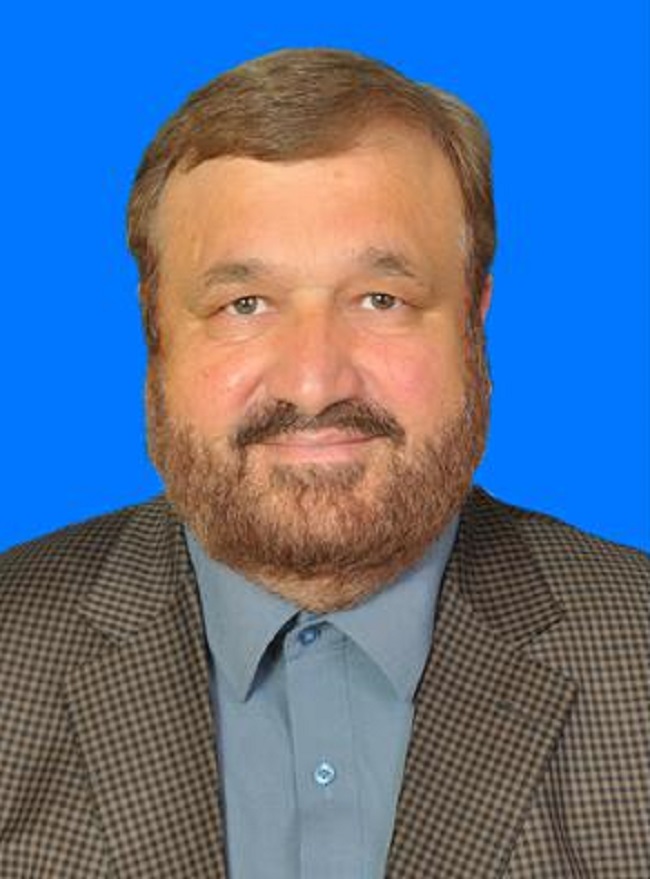
Syed Muhammad Sabir Shah or more commonly as Pir Sabir Shah is a Pakistani politician from the Khyber-Pakhtunkhwa province of Pakistan. He served as the 18th Chief Minister of the province from 20 October 1993 to 25 February 1994. He was advisor to Prime minister of Pakistan Nawaz Sharif from 1997 to 1999.


2 Responses

  1. Well written and documented. USA has always acted like Cowboy. Shoot first and ask questions later.

  2. Thanks for this information. USA has always maintained that its interference in other countries were to advance democracy but the reality is that it has supported the worst dictators and despots around the world to advance its economic and geo-political interests.

Related Posts

Jan Oberg May 15, 2026 Go to this Fox News page and scroll the whole way down: President Donald Trump tells the world that his meeting with President Xi Jinping yielded a lot of very concrete political and economic results – of course, only where the Chinese side, according to him, agreed with him. He does not mention the Taiwan issue, but Secretary of State, Marco Rubio, says that it did not feature prominently in their talks and that the US policy on Taiwan has not changed. Then go to China Daily – or Global Times – and you will see that for the Chinese it is framework, principles, structure of cooperation etc. that matters – all embedded in the overall idea of “constructive bilateral relationship of strategic stability.” Nowhere is any concrete agreement or deal – all that Trump refers to – mentioned. At the general level, this gives you insights into the very different social...
Jan Oberg, TFF director April 9, 2026 I was recently invited to have a good, long talk about the world – and, of course, about peace too – with Boris Malagurski on his Weight of Chains Channel on YouTube. It was a real joy and seems to have been greatly appreciated by the viewers too. Mr Malagurski and I shall of course be grateful if you share this conversation in your circles – of course, only if you like what you see and hear 😉☮️ And remember that this one – like hundreds of others with TFF Associates – can be enjoyed at our TFF Video Collection.
A friendly quarrel while we agree that the US sanctions are a weapon of mass destruction and kill more people than wars do. And that we must talk much more about sanctions than we have so far. Jan Oberg, TFF director March 16, 2026 John Mearsheimer recently stated that U.S. sanctions murdered around 38 million people between 1971 and 2021 – see the video below. It is a dramatic figure, and it has spread quickly because it captures, in one sentence, the enormous human cost of modern sanctions. I share his concern about the destructive effects of economic coercion. But the specific number he cites — and the way he attributes it — deserves a friendly academic clarification. The figure comes from a 2023 Lancet Global Health article estimating the mortality effects of unilateral U.S. and EU sanctions over the past half‑century. This is the first point where Mearsheimer’s shorthand diverges from the text: the study...

Recent Articles

Photo above: Carl Fredrik Reuterswärd’s Non-Violence outside UN Headquarters in New York. Kirill Levin, CC BY-NC-SA 2. Jan Oberg November 3, 2026 I am happy to be published in Horizons which is produced by the Center for International Relations and Sustainable Development, CIRSD, in Belgrade. My contribution brings out a radical re-thinking of what concepts such as defence, security, deterrence – and peace – may mean if we want to create a more peaceful world. It also summarises a few things I have been working with the last few decades. Please read it here Og her er den på dansk, takket være Johnny Baltzersens lynhurtige oversættelse
UNITE-tillid, DREAM-velstand og andre konstruktive komponenter Normally we publish articles in English here. But this is a translation of a very important TFF document that should reach as many as possible in Denmark since this country’s government has been one of the most hardline in Europe and, up till now at least, has refused to use diplomacy and, instead, spent tremendous sums on arming Ukraine with the express goal of defeating Russia. Thus this – unique – article is in Danish. Vi er Johnny Baltzersen og hans Fælles Sikkerhed – Fælles Fremtid på Substack overmåde taknemmelige for at have oversat og publiceret TFF’s 2025-portfølje for fredsidéer med henblik på Ukraines fremtid. Vi håber den nu kan nå mange flere danskere – som også vil sprede den og skabe debat – nu den danske regerings og folketingspartiernes politik på dette område siden 2022 står nu – forudsigeligt – ved vejs ende....
Jan Oberg TFF director October 28, 2026 Exactly one month has now passed since I published my criticism of the introduction to the special issue on Johan Galtung published by the Journal of Global Security Studies, JoGSS, and of Tor Egil Førland’s chapter about Galtung which serves as a preview to his forthcoming biography of Galtung to be published by PRIO. See the original on The Transnational here and the same article on TFF Substack with many general and critical comments and, in particular, the people who decided to withdraw from the biography project in protest. The special issue itself was extraordinary. It was devoted to the intellectual legacy of one of the founders of peace research and contained a number of strong assessments of his personality, scholarship, intellectual trajectory, and public role. Such assessments are, of course, entirely legitimate. No scholar is beyond criticism, and neither was Johan Galtung....

TFF on Substack

Discover and subscribe to more peace materials on TFF Substack

Most Popular

Photo above: Carl Fredrik Reuterswärd’s Non-Violence outside UN Headquarters in New York. Kirill Levin, CC BY-NC-SA 2. Jan Oberg November 3, 2026 I am happy to be published in Horizons which is produced by the Center for International Relations and Sustainable Development, CIRSD, in Belgrade. My contribution brings out a radical re-thinking of what concepts such as defence, security, deterrence – and peace – may mean if we want to create a more peaceful world. It also summarises a few things I have been working with the last few decades. Please read it here Og her er den på dansk, takket være Johnny Baltzersens lynhurtige oversættelse
UNITE-tillid, DREAM-velstand og andre konstruktive komponenter Normally we publish articles in English here. But this is a translation of a very important TFF document that should reach as many as possible in Denmark since this country’s government has been one of the most hardline in Europe and, up till now at least, has refused to use diplomacy and, instead, spent tremendous sums on arming Ukraine with the express goal of defeating Russia. Thus this – unique – article is in Danish. Vi er Johnny Baltzersen og hans Fælles Sikkerhed – Fælles Fremtid på Substack overmåde taknemmelige for at have oversat og publiceret TFF’s 2025-portfølje for fredsidéer med henblik på Ukraines fremtid. Vi håber den nu kan nå mange flere danskere – som også vil sprede den og skabe debat – nu den danske regerings og folketingspartiernes politik på dette område siden 2022 står nu – forudsigeligt – ved vejs ende....
Jan Oberg TFF director October 28, 2026 Exactly one month has now passed since I published my criticism of the introduction to the special issue on Johan Galtung published by the Journal of Global Security Studies, JoGSS, and of Tor Egil Førland’s chapter about Galtung which serves as a preview to his forthcoming biography of Galtung to be published by PRIO. See the original on The Transnational here and the same article on TFF Substack with many general and critical comments and, in particular, the people who decided to withdraw from the biography project in protest. The special issue itself was extraordinary. It was devoted to the intellectual legacy of one of the founders of peace research and contained a number of strong assessments of his personality, scholarship, intellectual trajectory, and public role. Such assessments are, of course, entirely legitimate. No scholar is beyond criticism, and neither was Johan Galtung....
Read More
knotted gun
Photo above: Carl Fredrik Reuterswärd’s Non-Violence outside UN Headquarters in New York. Kirill Levin, CC BY-NC-SA 2. Jan Oberg November 3, 2026 I am happy to be published in Horizons which is produced by the Center for International Relations and Sustainable Development, CIRSD, in Belgrade. My contribution brings out a radical re-thinking of what concepts such as defence, security, deterrence – and peace – may mean if we want to create a more peaceful world. It also summarises a few things I have been working with the last few decades. Please read it here Og her er den på dansk, takket være Johnny Baltzersens lynhurtige oversættelse
TFFPortfolioVign
UNITE-tillid, DREAM-velstand og andre konstruktive komponenter Normally we publish articles in English here. But this is a translation of a very important TFF document that should reach as many as possible in Denmark since this country’s government has been one of the most hardline in Europe and, up till now at least, has refused to use diplomacy and, instead, spent tremendous sums on arming Ukraine with the express goal of defeating Russia. Thus this – unique – article is in Danish. Vi er Johnny Baltzersen og hans Fælles Sikkerhed – Fælles Fremtid på Substack overmåde taknemmelige for at have oversat og publiceret TFF’s 2025-portfølje for fredsidéer med henblik på Ukraines fremtid. Vi håber den nu kan nå mange flere danskere – som også vil sprede den og skabe debat – nu den danske regerings og folketingspartiernes politik på dette område siden 2022 står nu – forudsigeligt – ved vejs ende....
JoGSS-Silent
Jan Oberg TFF director October 28, 2026 Exactly one month has now passed since I published my criticism of the introduction to the special issue on Johan Galtung published by the Journal of Global Security Studies, JoGSS, and of Tor Egil Førland’s chapter about Galtung which serves as a preview to his forthcoming biography of Galtung to be published by PRIO. See the original on The Transnational here and the same article on TFF Substack with many general and critical comments and, in particular, the people who decided to withdraw from the biography project in protest. The special issue itself was extraordinary. It was devoted to the intellectual legacy of one of the founders of peace research and contained a number of strong assessments of his personality, scholarship, intellectual trajectory, and public role. Such assessments are, of course, entirely legitimate. No scholar is beyond criticism, and neither was Johan Galtung....
Screenshot 2026-10-26 115647
An aspect of Iran’s culture and civilisation you’ve probably never heard about. Don’t be surprised if the US and Israel also try to bomb them. Jan ObergTFF director October 26, 2026 Today – under the “USraeli” threat of new “annihilating” bombings – opens the 7th International Conference on Peace and Conflict Resolution at Tehran’s University. As far as I can tell, this is the only permanent, advanced peace research institution in West Asia/the Middle East. Perhaps more countries in that region could be inspired? I mean, how many military “security” institutes and military academies do they have? Many peace research institutes and university departments have been established since the 1950s in the West. They are now all under attack; some have closed down, some have gone mainstream, yet others kept the name but do nothing to research peace and disseminate results or advice; instead, they cooperate with militarism’s platforms such...
Screenshot 2026-10-15 141837
Let’s discuss using AI to create peace – in contrast to boring geopolitics devoid of creative healing and visions. Jan Oberg TFF director October 15, 2026 I asked VEED to create a short video exemplifying how peace is preferable to war, then chose the lady as a template. Simple as that. In less than a minute, it produced this video, which any peace-loving person would appreciate. The only problem is that human intelligence (HI), at least the one that exists among Western decision-makers, isn’t half as moral or smart as AI. I have used AI to dialogue about peace and peace plans, creative conflict resolution and visions of a better future for humankind. It so happens that I am having more stimulating, intelligent, creative and moral discussions with AI than I could possibly have with any EU or NATO leader today. Yes, AI has very problematic and dangerous aspects; used...
girl-5894831_1280
Below are TFF-related media mentions, comments, videos and social media posts published elsewhere but not on this homepage. We happen to catch and list only a fraction. Regarding video comments and debates, we recommend that you go to the TFF Video Channel on Substack where many of them are reproduced. Jan Oberg is a contributor to China Daily – 52 million daily clicks – and Global Times, CGTN and CCTV (the national television), China Investment, Xinhua News Agency and several others. Articles and videos on these media very often multiply into countless Chinese (and Western media) that re-post them from these main media. Thanks to The China Academy, his analyses, interviews and comments are frequently posted on YouTube channels such as Thinkers Forum and Wave Media. These videos are often re-posted on Bilibili (China’s YouTube), the China Content Center on TikTok, and on the Chinese edition of TikTok, Douyin.com. This means reaching hundreds of millions of viewers worldwide over a year. While there are too many to catch on all these...



