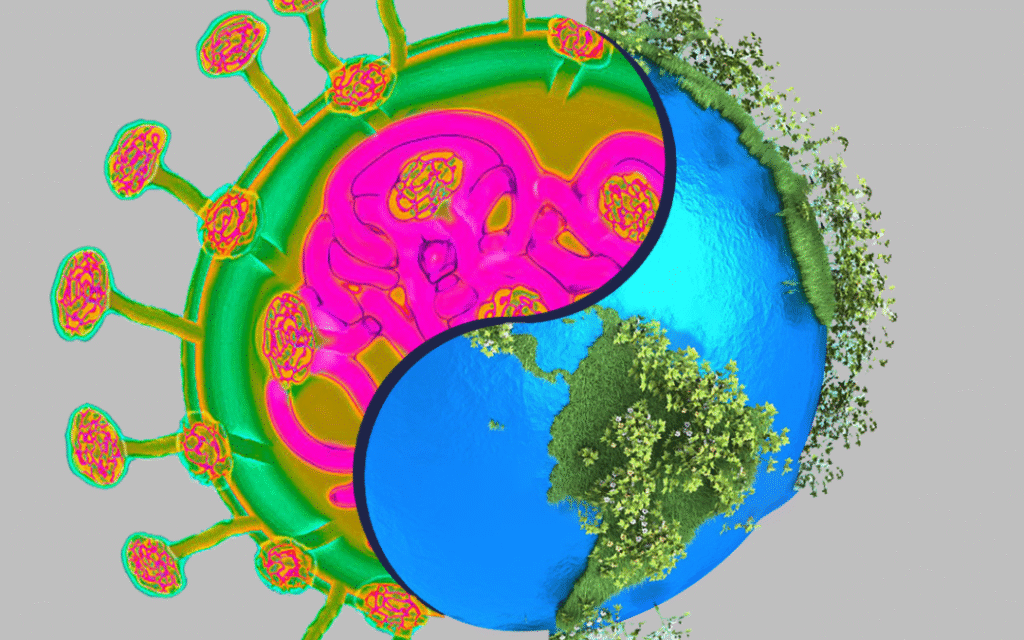
Imagine, it is the year 2050 and we are looking back to the origin and evolution of the coronavirus pandemic over the last three decades. Extrapolating from recent events, we offer the following scenario for such a view from the future.
As we move into the second half of our twenty-first century, we can finally make sense of the origin and impact of the coronavirus that struck the world in 2020 from an evolutionary systemic perspective. Today, in 2050, looking back on the past 40 turbulent years on our home planet, it seems obvious that the Earth had taken charge of teaching our human family.
Our planet taught us the primacy of understanding of our situation in terms of whole systems, identified by some far-sighted thinkers as far back as the mid-nineteenth century. This widening human awareness revealed how the planet actually functions, its living biosphere systemically powered by the daily flow of photons from our mother star, the Sun.
Originally posted on EthicalMarkets
False theories of human development
Eventually, this expanded awareness overcame the cognitive limitations and incorrect assumptions and ideologies that had created the crises of the twentieth century. False theories of human development and progress , measured myopically by prices and money-based metrics, such as GDP, culminated in rising social and environmental losses: pollution of air, water and land; destruction of biological diversity; loss of ecosystem services, all exacerbated by global heating, rising sea levels, and massive climate disruptions.
These myopic policies had also driven social breakdowns, inequality, poverty, mental and physical illness, addiction, loss of trust in institutions — including media, academia, and science itself — as well as loss of community solidarity. They had also led to the pandemics of the 21st century, SARS, MERS, AIDS, influenza, and the various coronaviruses that emerged back in 2020.
During the last decades of the 20th century, humanity had exceeded the Earth’s carrying capacity. The human family had grown to 7.6 billion by 2020 and had continued its obsession with economic, corporate, and technological growth that had caused the rising existential crises threating humanity’s very survival.
By driving this excessive growth with fossil fuels, humans had heated the atmosphere to such an extent that the United Nations (UN) climate science consortium, IPCC noted in its 2020 update that humanity had only ten years left to turn this crisis situation around.
As far back as 2000, all the means were already at hand: we had the know-how, and had designed efficient renewable technologies and circular economic systems, based on nature’s ecological principles.
By 2000, patriarchal societies were losing control over their female populations, due to the forces of urbanization and education. Women themselves had begun to take control of their bodies and fertility rates began to tumble even before the turn of the twenty-first century.
Widespread revolts against the top-down narrow economic model of globalization and its male-dominated elites led to disruptions of the unsustainable paths of development driven by fossil fuels, nuclear power, militarism, profit, greed, and egocentric leadership.
Military budgets which had starved health and education needs for human development, gradually shifted from tanks and battleships to less expensive, less violent information warfare. By the early 21st century, international competition for power focused more on social propaganda, persuasion technologies, infiltration and control of the global internet.
In 2020, the coronavirus pandemic‘s priorities in medical facilities competed with victims in emergency rooms, whether those wounded by gun violence or patients with other life threatening conditions. In 2019, the nationwide US movement of schoolchildren had joined with the medical profession in challenging gun violence as a public health crisis. Strict gun laws gradually followed, along with rejection of gun manufacturers in pension funds’ assets crippling the gun lobby and, in many countries, guns were purchased back by governments from gun owners and destroyed, as Australia had done in the 20th century.
This greatly reduced global arms sales, together with international laws requiring expensive annual licenses and insurance, while global taxation reduced the wasteful arms races of previous centuries. Conflicts between nations are now largely governed by international treaties and transparency.
Now in 2050, conflicts rarely involve military means, shifting to internet propaganda, spying and cyber warfare.
By 2020, these revolts exhibited all the fault lines in human societies: from racism and ignorance, conspiracy theories, xenophobia and scapegoating of “the other“ to various cognitive biases — technological determinism, theory-induced blindness, and the fatal, widespread misunderstanding that confused money with actual wealth.
Money, as we all know today, was a useful invention: all currencies are simply social protocols (physical or virtual tokens of trust), operating on social platforms with network effects, their prices fluctuating to the extent that their various users trust and use them. Yet, countries and elites all over the world became enthralled with money and with gambling in the “global financial casino,” further encouraging the seven deadly sins over traditional values of cooperation, sharing, mutual aid, and the Golden Rule.
Gaia’s response
Scientists and environmental activists had warned of the dire consequences of these unsustainable societies and retrogressive value systems for decades, but until the 2020 pandemic corporate and political leaders, and other elites, stubbornly resisted these warnings. Previously unable to break their intoxication with financial profits and political power, their own citizens forced the re-focus on the well-being and survival of humanity and the community of life.
Incumbent fossilized industries fought to retain their tax breaks and subsidies in all countries as gas and oil prices collapsed. But they were less able to buy political favours and support of their privileges. It took the global reactions of millions of young people, “grassroots globalists,“ and indigenous peoples, who understood the systemic processes of our planet Gaia – a self-organizing, self-regulating biosphere which for billions of years had managed all planetary evolution without interference from cognitively-challenged humans.
In the first years of our twenty-first century, Gaia responded in an unexpected way, as it had so often during the long history of evolution. Humans’ clear-cutting large areas of tropical rainforests and massive intrusions into other ecosystems around the world, had fragmented these self-regulating ecosystems and fractured the web of life. One of the many consequences of these destructive actions was that some viruses, which had lived in symbiosis with certain animal species, jumped from those species to others and to humans, where they were highly toxic or deadly.
People in many countries and regions, marginalized by the narrow profit-oriented economic globalization, assuaged their hunger by seeking “bush meat“ in these newly exposed wild areas, killing monkeys, civets, pangolins, rodents and bats, as additional protein sources. These wild species, carrying a variety of viruses were also sold live in “wet markets,” further exposing ever more urban populations to these new viruses.
Back in the 1960s, for example, an obscure virus jumped from a rare species of monkeys killed as “bush meat” and eaten by humans in West Africa. From there it spread to the United States where it was identified as the HIV virus and caused the AIDS epidemic. Over four decades, they caused the deaths of an estimated 39 million people worldwide, about half a percent of the world population.
Four decades later, the impact of the coronavirus was swift and dramatic. In 2020, the virus jumped from a species of bats to humans in China, and from there it rapidly spread around the world, decimating world population by an estimated 50 million in just one decade.
From the vantage point of our year 2050, we can look back at the sequence of these viruses: SARS, MERS, and the global impact of the various coronavirus mutations which began back in 2020. Eventually, such pandemics were stabilized, partly by the outright bans on “wet markets“ all over China in 2020. Such bans spread to other countries and global markets, cutting the trading of wild animals and reducing vectors, along with better public health systems, preventive care and the development of effective vaccines and drugs.
Lessons
The basic lessons for humans in our tragic 50 years of self-inflicted global crises – the afflictions of pandemics, flooded cities, burned forestlands, droughts and other increasingly violent climate disasters – were simple, many based on the discoveries of Charles Darwin and other biologists in the nineteenth and twentieth centuries:
- We humans are one species with very little variation in our basic DNA.
- We evolved with other species in the planet’s biosphere by natural selection, responding to changes and stresses in our various habitats and environments.
- We are a global species, having migrated out of the African continent to all others, competing with other species, causing various extinctions.
- Our planetary colonization and success, in this Anthropocene Age of our twenty-first century, was largely due to our abilities to bond, cooperate, share and evolve in ever-larger populations and organizations.
- Humanity grew from roving bands of nomads to live in settled agricultural villages, to towns, and the mega-cities of the twentieth century, where over 50% of our populations lived. Until the climate crises and those of the pandemics in the first years of our 21st century, all forecasts predicted that these mega-cities would keep growing and that human populations would reach 10 billion by today, in 2050.
Now we know why human populations topped out at the 7.6 billion in 2030, as expected in the most hopeful scenario of the IPCC, as well as in the global urban surveys by social scientists documenting the decline of fertility in Empty Planet (2019).
The newly aware “grassroots globalists”, the armies of school children, global environmentalists and empowered women joined with green, more ethical investors and entrepreneurs in localized markets. Millions were served by microgrid cooperatives, powered by renewable electricity, adding to the world’s cooperative enterprises, which even by 2012 employed more people worldwide than all the for-profit companies combined.
They no longer used the false money metrics of GDP, but in 2015 switched to steering their societies by the UN’s SDGs, their 17 goals of sustainability and restoration of all ecosystems and human health.
These new social goals and metrics all focused on cooperation, sharing and knowledge-richer forms of human development, using renewable resources and maximizing efficiency. This long term sustainability, equitably distributed, benefits all members of the human family within the tolerance of other species in our living biosphere.
Competition and creativity flourish with good ideas driving out less useful ones, along with science-based ethical standards and deepening information in self-reliant and more connected societies at all levels from local to global.
Global response
When the coronavirus struck in 2020, the human responses were at first chaotic and insufficient, but soon became increasingly coherent and even dramatically different. Global trade shrunk to only transporting rare goods, shifting to trading information. Instead of shipping cakes, cookies and biscuits around the planet, we shipped their recipes, and all the other recipes for creating plant-based foods and beverages; and locally we installed green technologies: solar, wind, geothermal energy sources, LED lighting, electric vehicles, boats, and even aircraft.
Fossil fuel reserves stayed safely in the ground, as carbon was seen as a resource, much too precious to burn. The excess CO2 in the atmosphere from fossil fuel burning was captured by organic soil bacteria, deep-rooted plants, billions of newly planted trees, and in the widespread re-balancing of the human food systems based on agro-chemical industrial agribusiness, advertising and global trading of a few monocultured crops. This over-dependence on fossil fuels, pesticides, fertilizers, antibiotics in animal-raised meat diets, all were based on the planet’s dwindling freshwater and proved unsustainable.
Today, in 2050, our global foods are produced locally, including many more overlooked indigenous and wild crops, saltwater agriculture and all the other salt-loving (halophyte) food plants whose complete proteins are healthier for human diets.
Mass tourism, and travel in general, decreased radically, along with air traffic and phased-out fossil fuel use. Communities around the world stabilized in small- to medium-sized population centers, which became largely self-reliant with local and regional production of food and energy. Fossil-fuel use virtually disappeared, as already by 2020 it could no longer compete with rapidly developing renewable energy resources and corresponding new technologies and upcycling of all formerly-wasted resources into our circular economies of today.
Because of the danger of infections in mass gatherings, sweat shops, large chain stores, as well as sports events and entertainment in large arenas gradually disappeared.
Democratic politics became more rational, since demagogues could no longer assemble thousands in large rallies to hear them. Their empty promises were also curbed in social media, as these profit-making monopolies were broken up by 2025 and now in 2050 are regulated as public utilities serving the public good in all countries.
The global-casino financial markets collapsed, and economic activities shifted back from the financial sector to credit unions and public banks in our cooperative sectors of today. The manufacture of goods and our service-based economies revived traditional barter and informal voluntary sectors, local currencies, as well as numerous non-monetary transactions that had developed during the height of the pandemics. As a consequence of wide-spread decentralization and the growth of self-reliant communities, our economies of today in 2050, have become regenerative rather than extractive, and the poverty gaps and inequality of the money-obsessed, exploitive models have largely disappeared.
The pandemic of 2020, which crashed global markets, finally upended the ideologies of money and market fundamentalism. Central banks’ tools no longer worked, so “helicopter money“ and direct cash payments to needy families, such as pioneered by Brazil, became the only means of maintaining purchasing power to smooth orderly economic transitions to sustainable societies.
This shifted US and European politicians to creating new money and these stimulus policies replaced “austerity“ and were rapidly invested in all the renewable resource infrastructure in their respective Green New Deal plans.
When the coronavirus spread to domestic animals, cattle, and other ruminants, sheep and goats, some of these animals became carriers of the disease without themselves showing any symptoms. Consequently, the slaughter and consumption of animals dropped dramatically around the world.
Pasturing and factory-raising of animals had added almost 15% of annual global greenhouse gases. Big meat-producing multinational corporations became shorted by savvy investors as the next group of “stranded assets”, along with fossil fuel companies.
Some switched entirely to plant-based foods with numerous meat, fish, and cheese analogs. Beef became very expensive and rare, and cows were usually owned by families, as traditionally, on small farms for local milk, cheese, and meat, along with eggs from their chickens.
After the pandemic
After the pandemics subsided, and expensive, vaccines had been developed, global travel was allowed only with the vaccination certificates of today, used mainly by traders and wealthy people. The majority of the world’s populations now prefer the pleasures of community and online meetings and communicating, along with travelling locally by public transport, electric cars, and by the solar and wind-powered sailboats we all enjoy today. As a consequence, air pollution has decreased dramatically in all major cities around the world.
With the growth of self-reliant communities, so-called “urban villages” have sprung up in many cities – re-designed neighbourhoods that display high-density structures combined with ample common green spaces. These areas boast significant energy savings and a healthy, safe, and community-oriented environment with drastically reduced levels of pollution.
Today’s eco-cities include food grown in high rise buildings with solar rooftops, vegetable gardens, and electric public transport, after automobiles were largely banned from urban streets in 2030. These streets were reclaimed by pedestrians, cyclists and people on scooters browsing in smaller local stores, craft galleries and farmer’s markets. Solar electric vehicles for inter-town use often charge and discharge their batteries at night to balance electricity in single-family houses.
Free-standing solar-powered vehicle re-charger units are available in all areas, reducing use of fossil-based electricity from obsolete centralized utilities, many of which went bankrupt by 2030.
After all the dramatic changes we enjoy today, we realize that our lives are now less stressful, healthier, and more satisfying, and our communities plan for the long-term future.
To assure the sustainability of our new ways of life, we realize that restoring ecosystems around the world is crucial so that viruses dangerous to humans are confined again to other animal species where they do no harm.
To restore ecosystems worldwide, our global shift to organic, regenerative agriculture flourished, along with plant-based foods, beverages and all the saltwater-grown foods and kelp dishes we enjoy. The billions of trees which we planted around the world after 2020, along with the agricultural improvements gradually restored ecosystems.
As a consequence of all these changes, the global climate has finally stabilized, with today’s CO2 concentrations in the atmosphere returning to the safe level of 350 parts per million. Higher sea levels will remain for a century and many cities now flourish on safer, higher ground.
Climate catastrophes are now rare, while many weather events still continue to disrupt our lives, just as they had in previous centuries. The multiple global crises and pandemics, due to our earlier ignorance of planetary processes and feedback loops, had widespread tragic consequences for individuals and communities. Yet, we humans have learned many painful lessons.
Today, looking back from 2050, we realize that the Earth is our wisest teacher, and its terrible lessons may have saved humanity and large parts of our shared planetary community of life from extinction.
If you liked this article, reward TFF with a dollar or five…

Fritjof Capra, Ph.D., physicist and systems theorist, is the author of several international bestsellers, including The Tao of Physics (1975) and The Web of Life (1996). He is coauthor, with Pier Luigi Luisi, of the multidisciplinary textbook, The Systems View of Life. Capra’s online course (www.capracourse.net) is based on his textbook.
Hazel Henderson, D.Sc.Hon., FRSA, futurist, systems and science-policy analyst, is author of “The Politics of the Solar Age” (1981, 1986) and other books, including “Mapping the Global Transition to the Solar Age” (2014). Henderson is CEO of Ethical Markets Media Certified B. Corporation, USA (www.ethicalmarkets.com), publishers of the Green Transition Scoreboard ®, and the forthcoming textbook and global TV series “Transforming Finance.” And she has been a TFF Associate since 2003.