NATO expansion’s open door policy and war or peace in the Donbass

By Gordon M. Hahn

July 25, 2019

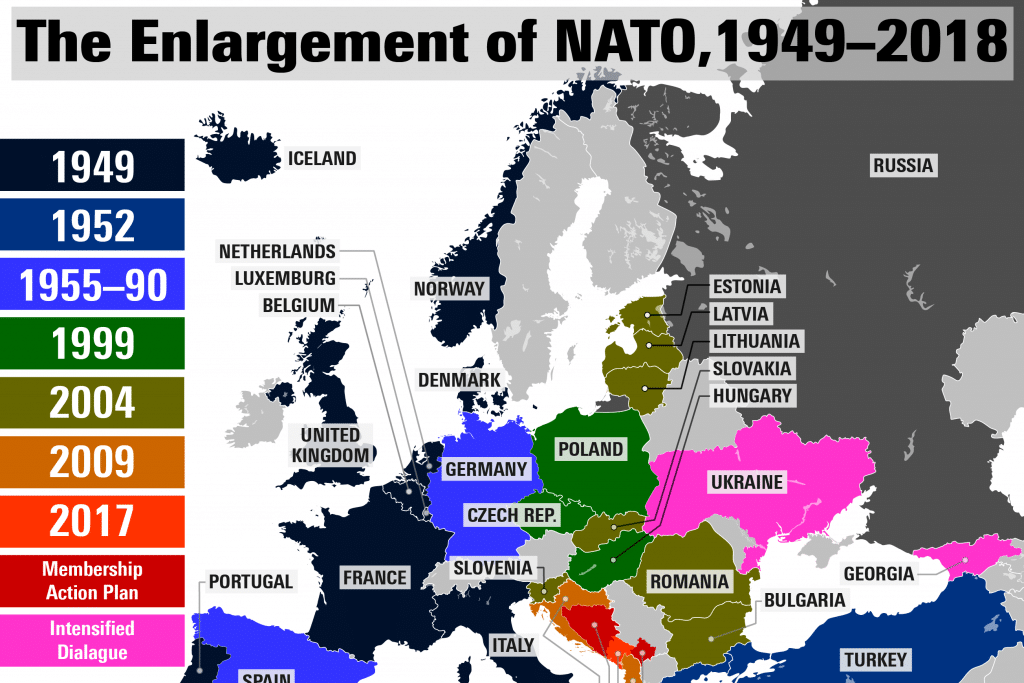
NATO expansion has contributed to the causal matrix of two wars: the 2008 Georgian-South Ossetiyan/Russian Five-Day War and the ongoing Donbass civil war. The West’s April 2008 promise that both Georgia and Ukraine will become NATO members encouraged Georgian nationalism and Saakashvili’s war in South Ossetiya and consequently led to Georgia’s de facto loss of its South Ossetiyan as well as Abkhaziyan territories.

Originally published on Gordon M. Hahn homepage
– while Poroshenko was still president.

Similarly, NATO expansion encouraged the rise of ultranationalism in Ukraine, especially western Ukraine, and the ultra-nationalist-led February 2014 Maidan revolt, leading to Ukraine’s loss of Crimea and civil war in eastern Ukraine’s Donbass regions of Donetsk and Luhansk.

NATO expansion now is poised to help re-start the Donbass civil war or spark a larger Ukrainian civil war (and/or similar conflicts involving Moldova and its breakaway republic of Transdnestr).

Specifically, the NATO/western Ukraine nexus confounds resolution of the Donbass civil war. On the one hand, western Ukraine is the only one of Ukraine’s mega-regions that supports Ukraine becoming a NATO member, a policy NATO also supports.

On the other hand, western Ukraine is the only mega-region in Ukraine that opposes all the measures that could address the grievances that drive Donbass resistance to Kyiv. All the other mega-regions have majorities that support some of the compromises that might resolve the civil war.

In this way, western Ukraine, representatives of which dominate Ukraine’s Maidan government, are holding the rest of Ukraine hostage to its nationalist/ultra-nationalist orientation; an orientation that is supported in turn by the West’s policy of NATO expansion. 

Countrywide opinion on NATO membership

A Western public opinion survey in October 2018 found that only 36 percent of Ukrainian citizens “want Ukraine to be a NATO member-state by the year 2030” – the poll did not include very anti-NATO Crimea and Donbass. Only in Western Ukraine is there a majority – 64 percent, supports NATO membership. This includes the ultra-nationalist hotbed of Lviv (Lvov), where 77 percent support  it. In central Ukraine, 33 percent support it; this includes the capitol Kyiv, where only 38 percent support NATO membership. In southern Ukraine, only 21 percent support it. In eastern Ukraine only 17 percent. This includes the major industrial center of Kharkiv (Kharkov), where only 16 percent support it. Kherson Oblast was polled separately, and there only 28 percent support NATO membership.

Therefore, the issue sharply divides western Ukraine from the rest of the country, where universally there are strong majorities against Ukraine becoming a member of the military bloc – as can be seen here.

Despite the lack of public support for NATO membership countrywide, now former Ukrainian President Petro Poroshenko’s has submitted to the Ukraine’s parliament, the Verkhovna  Rada, a proposal to add a new “constitutional norm” to Ukraine’s constitution stipulating Ukraine will become a NATO member. The Rada accepted the submission for consideration and sent a draft to the Constitutional Court for its review in September (www.pravda.com.ua/rus/news/2018/09/20/7192667/).

Whether a gimmick for his presidential re-election campaign or not, the issue of NATO expansion so used can only further polarize eastern and southern Ukraine from western Ukraine, sewing the seeds for another civil war, involving more regions.

The possibility that forces in Kyiv will machinate the holding of such a referendum cannot be rejected out of hand, and that could regenerate internecine conflict in Donbass and elsewhere in Ukraine.

The key to war or peace

Poroshenko’s move is in part an attempt to secure his base of support in western Ukraine as he is running behind in the presidential race, according to the polls. But this is the same western Ukraine that opposes any compromises with the Donbass insurgents; the leverage against a peace agreement is anchored in pro-NATO western Ukraine. The region holds the key to war or peace no less than the Kremlin. 

A January 2018 opinion survey carried out by Kyiv’s Democratic Initiative Foundation found that readiness to compromise decreases in Ukraine as one moves from east to west. Thus, 30.5% of the inhabitants of the South, 23% of the East, and 25.5% of the Donbass responded they are ready to support compromises for peace, but in western Ukraine only 8% expressed such readiness.

Moreover, the survey demonstrated that only western Ukraine resists all of the possible solutions to the Donbass war. The adoption of a constitutional amendment granting special status or autonomy to Donbass (Donetsk and Luhansk regions) is opposed by 55 percent in the west and 59 percent in central Ukraine, while in Donbass only 41 percent oppose such a compromise and in eastern Ukraine and southern Ukraine only 32 percent and 29 percent oppose such a solution.

A constitutional amendment that would give the Russian language the status of an official state language like the Ukrainian language is opposed by 68 percent in the west, 57 percent in the center, 48 percent in Donbass, but in the east only 29 percent oppose and 44 percent support such a compromise, and in the south only 20 percent oppose and 54 percent support such a compromise.

On the issue of granting a full amnesty to all insurgents, in the west only 6 percent support full amnesty, where as in the south and east support reaches 28 percent and 29 precent in Donbass and the south. respectively.

The proposal of holding elections in the Donbass under conditions proposed by the insurgents is supported only by 5 percent in the west, 9 percent in the center, 12 percent in Donbass, 19 percent in the south, and 23 percent in the east.

Regarding the proposal to allow local police, court, prosecutorial personnel in the Donbass to be appointed locally by the self-proclaimed insurgent authorities in Donetsk and Luhansk, only 10 percent in the west agree, 12.5 percent in the center, 23 percent in the Donbass, 24 percent in the east, and 33 percent in the south.

On granting the rebel territories special political and economic ties to Russia, only 12 percent in the west support it (56 percent are against), in the center – 16 and 59 percent, respectively, in the east – 25 and 35 percent, in the south – 32 and 35 percent, and, not surprisingly in Donbass, more approve than disapprove – 38 and 32 percent, respectively.

Finally, it is the western and, to a lesser degree, the central mega-regions that cling to Ukraine becoming a NATO member even at the cost of continuing war in Donbass rejecting a compromise in the form of the adoption of a law instituting neutral or non-aligned status for Ukraine – i.e., non-membership of Ukraine in NATO.

In western Ukraine 56 percent oppose, and only 15 percent support such a compromise. In central Ukraine, the division is again less stark – 51 percent opposed to such a law, with 25 percent approving. In the rest of the country, except for Donbass (43 percent against 35 percent for), a majority support such a compromise: in the South, “for” 52 percent support and 16 percent are opposed; and in the east – 54 percent support and 24 percent oppose the adoption of such a law. See the source here.

Thus, NATO’s continuing support for Ukrainian membership in the alliance provides political and even military cover for western Ukraine’s strong resistance to peace.

If NATO expansion did not exist as a Western policy, those in western Ukraine would be forced to re-think their stance on NATO membership and opposition to compromise with the Donbass (and, incidentally, the rest of the east and the south).

The West ignores warning signs

Washington and Brussels are well aware of this dangerous split in Ukraine as they (hopefully) were when the issue sparked the original crisis in 2013 through the trojan horse of EU membership. Nevertheless, they persist in their NATO expansion policy.

Most importantly, the United States continues to refuse ending or putting an official moratorium on the policy of NATO expansion and persists in pursuing NATO membership for Ukraine.

This was again made clear when US envoy for the Minsk peace process Kurt Volker stated that Washington cannot dictate such matters to sovereign states.

Moreover, the West is putting very little pressure on Kyiv, as the country has sank deeper and deeper into neo-fascist rule over the last four years, as I warned already in 2014. A short list of authoritarian measures in recent years includes:

– a ban on the use of communist and fascist symbols, only enforced against fascist symbols, since key parties and organizations that back the current regime use them;

– the closing of numerous television programs and stations that do not tow the government’s ultranationalist line (most recent case here).

– the establishment of the leaders of the World War II Organization of Ukrainian Nationalists (OUN) and Ukrainian Partisan Army (UPA) – which allied with Nazi German invaders and assisted or led in some cases efforts to slaughter Jews, Poles, and Russians – as heroes of the Ukrainian nation;

– the adoption of laws limiting the use of the Russian language in media and publishing;

– adoption of a new Law on Education that discriminates against minority language use, especially Russian language use, in schools protested by the Romanian, Hungarian, and Russian governments and the EU Vienna commission;

– the adoption of an even more draconian “Law on Languages” mandating full Ukrainization of language use in Ukraine outside of interpersonal communication and religious services – see source here and here.

– the adoption by the Lviv (Lvov) Oblast (regional) government of a law banning the use of the Russian language in media, publishing, literature, and music;

– and the adoption of a law-making the OUN and UPA salute the official salute of Maidan Ukraine’s military and police.

Moreover, a draft law has been submitted to the Rada that would ban the Russian Orthodox Church, with the fate of believers and their freedom of association and speech rights remaining unclear.

It is not just the growing ethnic, even apartheid state aspect of the Maidan regime that is worrisome. Even in the ‘civic sector’ Maidan’s ‘free and fair elections’ are not entirely free and fair, with vote-buying rampant. And this is despite its functioning in conditions of the removal of almost all anti-regime and opposition elements from the polity by dint of the loss of Crimea and the civil war in Donbass – see source here.

To all this can be added the murder of journalists, pogroms against Gypsy-Roma that have wounded and killed several, the storming of courtrooms by neo-fascist groups to intimidate judges and juries, the storming of local government institutions to intimidate public officials, and unpunished war crimes committed by ultra-nationalist and neofascist volunteer battalions.

Even Western government-tied NGOs that helped in the rise of the Maidan revolt and continue to support it, despite definitive proof that the regime was born of a neo-fascist terrorist false flag operation that saw neo-fascist snipers shoot police, demonstrators and journalists that sparked the overthrow of president Viktor Yanukovych on 20 February 2014, are beginning to shyly ring the alarm bell, with both Freedom House and the Atlantic Council having done so, not to mention international human rights organizations.

Yet putting aside their democratization principles, Western governments have proven willing to hold hostage even a present NATO member’s (Hungary’s) attempts to protect the minority language rights of its ethnic kin in Ukraine to the Ukrainian chauvinism of western Ukraine.

The US State Department recently appealed to Budapest to not allow the new Ukrainian Law on Education get in the way of Ukrainian-NATO cooperation, after Budapest warned it will block any Ukrainian bid for NATO membership if the new Law on Education is not amended (See source here).

How to prevent repeated mistakes

As long as this bending over backwards to accommodate the Maidan regime’s dependence on ultra-nationalism and neo-fascists for the NATO expasion’s sake, we can expect growing polarization in Ukraine – now not just between the west and Donbass but between the south and east, on the one hand, and Kyiv, on the other hand, as well as within the south and east and even in Kyiv where there are substantial ethnic Russian, Russophone populations.

One can therefore also expect more pushback from Moscow, perhaps some of it rather nasty. What is happening in Ukraine justifies the worst fears and claims of the most inveterate anti-Western Russians, playing into their political hands in power struggles on the streets and inside the Kremlin.

In other words, the West is repeating the mistake it has already made several times with each successive round of NATO expansion, lending unwitting support to the worst elements in Russian politics.

Moreover, the support of polarized sides by outside powers in the West and from Russia is crucial in the ongoing Donbass conflict and the rise of tensions in the south and east.

Indeed, civil wars are quite often caused and prolonged by foreign actors supporting the internal combatant sides, and in such cases it is only the firm intent to secure the peace that convinces the civil war’s opposing sides to sit down in earnest at the negotiating table.

For example, for South Yemeni president, Ali Nasser Mohammad, has spoken of how in the latter period of the 1960s’ North Yemeni civil war, the opposing Yemeni sides could not reach agreement through bilateral negotiations. Only when their main foreign patrons, Egyptian President Nasser and Saudi King Faisal, came to an agreement on ending the conflict was progress made in the inter-Yemeni talks.

It would be prudent for the West to at least begin reigning in Ukraine’s ultranationalist inclinations and pushing it to negotiate directly with the Donbass insurgent governments. For Moscow’s part, it should do the same in relation to Donbass and refrain from exacerbating tensions elsewhere in the south and east of Ukraine.

Trump and Putin must aggressively engage on these issues, especially as President Poroshenko and other presidential candidates are likely to be rushing to outbid each other in terms of their nationalist credentials for the duration of the presidential election campaign leading to further provocative steps.

They must also show restraint in their own actions, in particular with regard to NATO’s growing military build-up in eastern Europe and Polish proposals for a military base in that country.

Otherwise, the danger of a war in 21st century Europe will only grow.
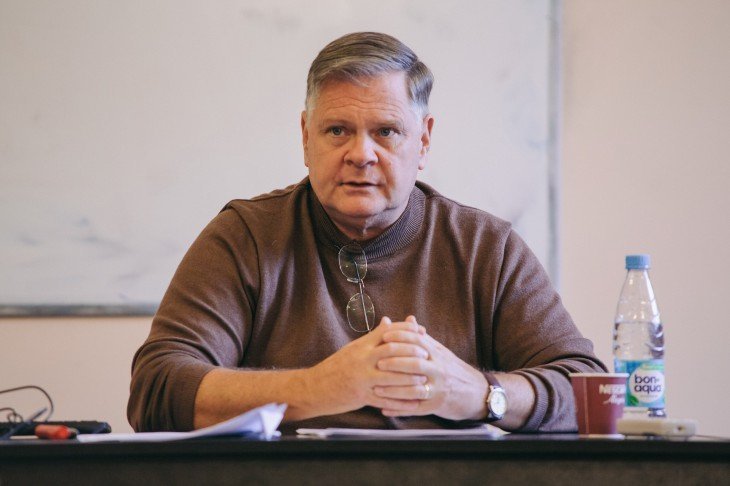
Gordon M. Hahn, Ph.D.

Gordon M. Hahn, Ph.D., is a Senior Researcher at the Center for Terrorism and Intelligence Studies (CETIS), Akribis Group, San Jose, California, www.cetisresearch.org; an expert analyst at Corr Analytics, http://www.canalyt.com; and an analyst at Geostrategic Forecasting Corporation (Chicago), www.geostrategicforecasting.com. Dr. Hahn is also the author of the four books, most recently Ukraine Over the Edge: Russia, the West, and the ‘New Cold War. He also has published numerous think tank reports, academic articles, analyses, and commentaries in both English and Russian language media.


Related Posts

Small and different + among the 10% most active + 9,000 texts + 150 Associates + 60 000 a day — and a stubborn belief that peace is smarter and must be secured by peaceful means. In 2026, the Transnational Foundation for Peace and Future Research (TFF) turns 40. On Monday, October 5, 2026, a new TFF homepage will go live — a new gateway to more than 9,000 articles, analyses, research papers and other contributions produced over four decades of independent peace research. But this is not simply a new website. For four decades, TFF has worked from a simple conviction: peace is smarter than militarism and can be brought about by peaceful means. This is not merely an aspiration. It is the principle expressed in the UN Charter and the Gandhian tradition that has guided our work from the beginning. TFF is a research-based, independent and people-financed foundation....
Johan Galtung 1930-2024October 2015 Published here on October 3, 2026 Let us focus on Civilization for conflict analysis and remedies. Major forms of disorder use violence; war is state organized violence. The most belligerent states are the United States of America and Israel, both with civilization roots. National Evangelism, the US Protestant Christian civilization– more national than evangelical–justifies US warfare as exceptionalism of a people chosen by God, with a manifest destiny to run the world. Orthodox Judaism justifies Israeli warfare to conquer and expand from Nile to Euphrates as a religious right and duty to the Eternal One. The third most belligerent country, the UK, no longer believes it is God-chosen but chosen by the USA; not quite the same but something. But the root cause of global disorder lies in the Occident–with Islam–seeing itself as the single, universal civilization valid for all at all times, all others being...
Jan Oberg PhD, director, The Transnational Foundation for Peace and Future Research, TFFLund, Sweden October 2, 2026 This is my full original manuscript. The Chinese Academy of Social Science, CASS, makes two publications out if it. 1. China’s Five-year plan emphasized the capabilities of basic research and original innovation. It is regarded as the goal of the future social development, which, as required, should be significantly enhanced. Can you comment on the importance of original innovation in research and academic study? I believe it is easier to define “original innovation” in the natural sciences than in social sciences. The breaking points of what constitutes something new, or innovative, are not quite as sharp in the latter. But in both fields it is about opening up something that was closed, unseen, unexplored before – making manifest what was earlier latent. Innovations come in many forms and shapes – naming something that was...

Recent Articles

What the West Borrowed from Asia and What It Left Behind Jan Krikke October 8, 2026 The article was originally published here In the late 1960s, the musical Hair announced that the Age of Aquarius was dawning. Its opening anthem promised a transformation of human consciousness: an era of peace, harmony and understanding. Half a century later, a familiar echo of that promise is a meditation app offered by your employer. You can find it in the same list of benefits as the pension plan and the gym discount. How did a spiritual revolution become an employee benefit? The answer lies in the history of the movement known as New Age: where it came from, what it borrowed from Asia, and why the meaning of what it borrowed changed in the process. Two definitions will help. New Age is a loose label for a wide range of spiritual practices and...
Small and different + among the 10% most active + 9,000 texts + 150 Associates + 60 000 a day — and a stubborn belief that peace is smarter and must be secured by peaceful means. In 2026, the Transnational Foundation for Peace and Future Research (TFF) turns 40. On Monday, October 5, 2026, a new TFF homepage will go live — a new gateway to more than 9,000 articles, analyses, research papers and other contributions produced over four decades of independent peace research. But this is not simply a new website. For four decades, TFF has worked from a simple conviction: peace is smarter than militarism and can be brought about by peaceful means. This is not merely an aspiration. It is the principle expressed in the UN Charter and the Gandhian tradition that has guided our work from the beginning. TFF is a research-based, independent and people-financed foundation....
Tony Robinson October 4, 2026 Violence is easy to recognise when someone is being beaten, shot or killed. It becomes more difficult when nobody is holding a weapon. Poverty, discrimination, exploitation and repression can restrict a human life just as effectively, although they do so in very different ways and with very different consequences. Simply adding more categories to an ever-growing list of forms of violence does not really solve the problem. The more interesting question is what all these different situations have in common and why it makes sense to describe them using the same word. Human beings do not simply react to what happens around them. They remember the past, imagine things that do not yet exist, make plans and undertake projects. Workers organise because they imagine different working conditions; people migrate because they imagine another life somewhere else; social movements emerge because people refuse to accept the...

TFF on Substack

Discover and subscribe to more peace materials on TFF Substack

Most Popular

What the West Borrowed from Asia and What It Left Behind Jan Krikke October 8, 2026 The article was originally published here In the late 1960s, the musical Hair announced that the Age of Aquarius was dawning. Its opening anthem promised a transformation of human consciousness: an era of peace, harmony and understanding. Half a century later, a familiar echo of that promise is a meditation app offered by your employer. You can find it in the same list of benefits as the pension plan and the gym discount. How did a spiritual revolution become an employee benefit? The answer lies in the history of the movement known as New Age: where it came from, what it borrowed from Asia, and why the meaning of what it borrowed changed in the process. Two definitions will help. New Age is a loose label for a wide range of spiritual practices and...
Small and different + among the 10% most active + 9,000 texts + 150 Associates + 60 000 a day — and a stubborn belief that peace is smarter and must be secured by peaceful means. In 2026, the Transnational Foundation for Peace and Future Research (TFF) turns 40. On Monday, October 5, 2026, a new TFF homepage will go live — a new gateway to more than 9,000 articles, analyses, research papers and other contributions produced over four decades of independent peace research. But this is not simply a new website. For four decades, TFF has worked from a simple conviction: peace is smarter than militarism and can be brought about by peaceful means. This is not merely an aspiration. It is the principle expressed in the UN Charter and the Gandhian tradition that has guided our work from the beginning. TFF is a research-based, independent and people-financed foundation....
Tony Robinson October 4, 2026 Violence is easy to recognise when someone is being beaten, shot or killed. It becomes more difficult when nobody is holding a weapon. Poverty, discrimination, exploitation and repression can restrict a human life just as effectively, although they do so in very different ways and with very different consequences. Simply adding more categories to an ever-growing list of forms of violence does not really solve the problem. The more interesting question is what all these different situations have in common and why it makes sense to describe them using the same word. Human beings do not simply react to what happens around them. They remember the past, imagine things that do not yet exist, make plans and undertake projects. Workers organise because they imagine different working conditions; people migrate because they imagine another life somewhere else; social movements emerge because people refuse to accept the...
Read More
8824b09f-33a5-43f9-9fd0-550f28cda24d_1536x1024
What the West Borrowed from Asia and What It Left Behind Jan Krikke October 8, 2026 The article was originally published here In the late 1960s, the musical Hair announced that the Age of Aquarius was dawning. Its opening anthem promised a transformation of human consciousness: an era of peace, harmony and understanding. Half a century later, a familiar echo of that promise is a meditation app offered by your employer. You can find it in the same list of benefits as the pension plan and the gym discount. How did a spiritual revolution become an employee benefit? The answer lies in the history of the movement known as New Age: where it came from, what it borrowed from Asia, and why the meaning of what it borrowed changed in the process. Two definitions will help. New Age is a loose label for a wide range of spiritual practices and...
Screenshot 2026-10-04 210142
Small and different + among the 10% most active + 9,000 texts + 150 Associates + 60 000 a day — and a stubborn belief that peace is smarter and must be secured by peaceful means. In 2026, the Transnational Foundation for Peace and Future Research (TFF) turns 40. On Monday, October 5, 2026, a new TFF homepage will go live — a new gateway to more than 9,000 articles, analyses, research papers and other contributions produced over four decades of independent peace research. But this is not simply a new website. For four decades, TFF has worked from a simple conviction: peace is smarter than militarism and can be brought about by peaceful means. This is not merely an aspiration. It is the principle expressed in the UN Charter and the Gandhian tradition that has guided our work from the beginning. TFF is a research-based, independent and people-financed foundation....
Living-Peace-Sign-Budapest-copy
Tony Robinson October 4, 2026 Violence is easy to recognise when someone is being beaten, shot or killed. It becomes more difficult when nobody is holding a weapon. Poverty, discrimination, exploitation and repression can restrict a human life just as effectively, although they do so in very different ways and with very different consequences. Simply adding more categories to an ever-growing list of forms of violence does not really solve the problem. The more interesting question is what all these different situations have in common and why it makes sense to describe them using the same word. Human beings do not simply react to what happens around them. They remember the past, imagine things that do not yet exist, make plans and undertake projects. Workers organise because they imagine different working conditions; people migrate because they imagine another life somewhere else; social movements emerge because people refuse to accept the...
b54a1f10-8c65-4f0b-9dd5-4abc0a7d04cc_2659x2659
It’s a matter of principles, courage, vision and pulling together – while the militarist world is falling apart… Peter Langille October 3, 2026 “Here, then, is the problem which we present to you, stark and dreadful and inescapable: Shall we put an end to the human race; or shall mankind renounce war?”The Bertrand Russell—Albert Einstein Manifesto, July 9, 1955 ⁕ The forecast for what’s ahead is worrisome. The sharp rise in armed conflicts over the past three years is adding to what was already the highest level in over seventy years. Genocides, which should be prevented are supported. A shared climate emergency that jeopardises survival is ignored. Diverse polls now suggest that people are war-weary, worried and interested in a more effective United Nations. And, there are viable policy options for a more secure world! Yet governments are doubling-down, betting on more war and investing heavily. If current trends persist,...
010
Johan Galtung 1930-2024October 2015 Published here on October 3, 2026 Let us focus on Civilization for conflict analysis and remedies. Major forms of disorder use violence; war is state organized violence. The most belligerent states are the United States of America and Israel, both with civilization roots. National Evangelism, the US Protestant Christian civilization– more national than evangelical–justifies US warfare as exceptionalism of a people chosen by God, with a manifest destiny to run the world. Orthodox Judaism justifies Israeli warfare to conquer and expand from Nile to Euphrates as a religious right and duty to the Eternal One. The third most belligerent country, the UK, no longer believes it is God-chosen but chosen by the USA; not quite the same but something. But the root cause of global disorder lies in the Occident–with Islam–seeing itself as the single, universal civilization valid for all at all times, all others being...
Screenshot 2026-10-02 011738
Jan Oberg PhD, director, The Transnational Foundation for Peace and Future Research, TFFLund, Sweden October 2, 2026 This is my full original manuscript. The Chinese Academy of Social Science, CASS, makes two publications out if it. 1. China’s Five-year plan emphasized the capabilities of basic research and original innovation. It is regarded as the goal of the future social development, which, as required, should be significantly enhanced. Can you comment on the importance of original innovation in research and academic study? I believe it is easier to define “original innovation” in the natural sciences than in social sciences. The breaking points of what constitutes something new, or innovative, are not quite as sharp in the latter. But in both fields it is about opening up something that was closed, unseen, unexplored before – making manifest what was earlier latent. Innovations come in many forms and shapes – naming something that was...