Stop the ongoing U.S. economic terrorism against Iran and help its people!

You have certainly not heard much about this in the West. And it didn’t get a fraction of the media attention (and none of the hundreds of millions of Euro pledges by the perversely rich) that the Notre Dame fire did.

However, if disastrous floods had hit 28 out of 31 provinces and affected 10 million people in some European country or in the US, I believe you would have heard about it from Day One.

But now it is Iran. Only the Iranians.

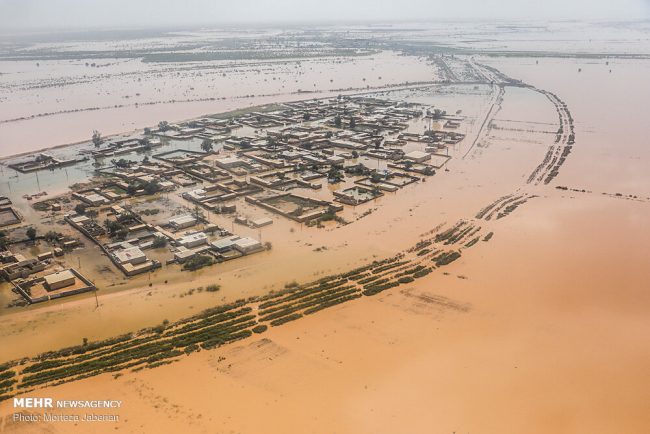
The situation is disastrous but not so much because thousands have died. Rather, because floods of this magnitude are likely to have terrible long-term consequences for agricultural and other production, infrastructure, energy production, transport and daily lives (see pictures below and on the links).

The basic facts about 3 weeks into the disaster are:

28 of 31 provinces affected, the area around Shiraz the most. 78 people have died and 1076 have been injured. 10 million Iranians have been affected and 2 million seem to be in direct need of assistance. More can be studied at the UN OCHA’s Reliefweb.

Please enlighten yourself also by some Iranian media sources and Iranian foreign minister Javad Zarif’s statements here. And here.

This comes on top of economic sanctions that have already hit virtually every single Iranian very hard when going about their daily lives. The author has seen how this was already bad in 2012-2016 – since then, everything has grown worse.

Here some data by the IMF.

Yes, the corruption is everywhere in Iran but the US sanctions are extremely tight, the loss of oil export income is severe (to benefit Saudi Arabia and others).

And now this flood disaster on top of it all (more background and pictures from Iran’s Fars News Agency here).

The cruelty of not helping in this situation can only be condemned from a humanitarian, human rights and moral perspective no matter what one may otherwise think about Iranian politics and leadership.

Sanctions make humanitarian aid much more difficult

It is well known that the Trump administration wants others to think about Iran and how it puts pressure and threats to bear on other countries to prevent them from cooperating with Iran and bringing humanitarian aid in violation of these US sanctions.

Reuters reports the statement of the Iranian Red Crescent three weeks into the disaster: “U.S. sanctions have prevented the Iranian Red Crescent from obtaining any foreign financial aid to assist victims of flooding that has killed at least 70 people and inundated some 1,900 communities, the group said on Sunday.”

As of today, the only Europeans to deliver assistance are Russia, Turkey, Switzerland, Germany and France according to the UN OCHA’s Reliefweb.

The main reason, one may assume, is that the US has imposed sanctions on Iran since 1979 and now applies the toughest sanctions ever on the Iranian people (after having withdrawn from the nuclear deal, the JCPOA, in clear violation of international law, since it was embedded in a UN Security Council resolution).

Iran, you may say, is being punished for having fulfilled all its obligations of the JCPOA and accepting the most severe inspections ever.
The US also applies so-called secondary sanctions – sanctions against other countries which do not adhere to US sanctions but continue to deal with Iran. The US believes, it seems, that it can intimidate and financially punish countries – including NATO and EU – should they not adhere to US laws (and diktats) on their own territory

Such extra-territorial application of US laws should, of course, be unacceptable for any other sovereign states. And it goes without saying that the US would never accept foreign laws to be implemented on its territory. But the US seems to believe that it is so exceptional that others should make exceptional decisions in favour of this exceptionally unlawful US policy.

The Trump administration – also defiant of the UN Court ruling

What few have noticed is that Iran won a case at the UN International Court of Justice in October last year. Read Newsweek’s report here. The ICJ ruled and ordered that the United States remove sanctions that target humanitarian trade, food, medicine and civil aviation.

But instead of abiding by the ICJ’s decision, Secretary of State, Mike Pompeo announces with what must be termed outrageous arguments that the U.S. couldn’t care less.

Mainstream US-obedient media of course politely refrained from putting such a law-defying US statement on their front pages – omission being much more important than fake as I have pointed out time and again before.

As if this should not be enough, the US announced on April 8, 2019 – i.e. also Pompeo – that the US places Iran’s Revolutionary Guard Corps on its list of terrorist organisations.

https://www.youtube.com/watch?v=gcip8gPUQzo

Listen very carefully to the justifications and the accusations. One doesn’t have to be psychologist or psychiatrist to get the thought that we are here witnessing a brilliant piece of psycho-political projection – projection of one’s own dark sides on somebody else.

This is also outrageous in the light of the fact that the Corps is a major agent in dealing with the flood disaster on the ground (as it has holds proportionately huge resources in the Iranian budget). Are we likely to soon hear the argument that no aid should go to Iran because it would go (also) to this “terrorist” organisation?

EU and NATO countries should practise civil disobedience in support of the Iranian people

One must wonder how much longer the United States will get away with such step-by-step measures and exceptional arrogance vis-a-vis the international “community” without loud and clear criticism and alternative action by EU and NATO countries.

As I say in the video above, it is high time that EU and NATO countries – and other countries for that matter – practise civil disobedience against US diktat. If only a few countries, companies and banks continue co-operating with Iran, it will be easy for US authorities such as US Treasury to pursue them legally and punish them in various ways.

But not so if some 25-30 countries, all their companies and banks simply ignored US policies and accelerated their civilian co-operation with Iran. It would, beyond the slightest doubt, be a win-win strategy on contrast to US policies which may look like win (US/West) and loose (Iran) but, sooner or later will – drag down these other countries in the decline and fall process of the US. That is – loose/loose

We can all do some little thing for fellow human beings. I voiced my criticism here with the Iranian PressTV

https://www.youtube.com/watch?v=z0BC7yoUZz8&feature=youtu.be

And I made a small donation to the Iranian Red Crescent on this link, also to try my Swedish bank. It went through. (Well, see below in red).

You can do it too.

Actions and words go best together.

Correction

It turned out that what I wrote was not true. A few days later, I received a message from the Swedish Nordea Bank that the US $ 5 I had sent – partly as a test, partly as small donation to the suffering Iranians – had been blocked and returned to my account. The reason “because of the sanctions in the country.”

In other words, this leading Swedish bank accepts the secondary sanctions installed by the US and applies US laws on its own territory. Even preventing a small sum as humanitarian relief to the Iranian Red Crescent. Cruelty and stupidity go hand in hand.

Further recommended reading and watching

Photos of the catastrophe from The Middle East Eye

First assessment of the economic costs – Reuters

Efforts to establish an insurance fund hampered by lack of resources – AlJazeera

The Iranian Red Crescent

Peace & future researcher + ‌Art Photographer

4 Responses

  1. The only description for what the current US regime is doing to Iran in support of its friends Netanyahu and Mohammed bin Salman is economic terrorism. These extraterritorial sanctions are illegal and go against the letter and the spirit of the landmark nuclear agreement that Iran signed with all the five permanent members of the Security Council, plus Germany, and they go against the explicit provisions of the UN Security Council Resolution 2231 which lifted all the sanctions on Iran. US sanctions on Iraq killed over half a million children, and these sanctions on Iran will do the same. The current US regime openly violates international law and is forcing others to do the same. It is up to other peace-loving and law-abiding nations of the world to stand up to those illegal acts and say that they do not tolerate the killing of millions of innocent people in order to satisfy rogue regimes in the United States, Israel and Saudi Arabia. Enough is enough.

  2. Thanks for your good work, I am terribly ashamed of my country, the U.S. and will share the information.

  3. Thank you, JMMorgan – I understand your feeling. Although I live in Sweden, I was born in Denmark and I feel ashamed also of that country’s more or less constant involvement in US-instigated warfare. But, that said, we cannot be responsible for everything deeply immoral leaders do which is not in our name. I appreciate your words. Best – Jan Oberg

  4. It is sad that the Western media are not showing more interest in the flood disaster in Iran. However, at the moment, this does not seem to be a big topic in other media either. At least on CGTN and RT and even on Press TV, I hardly read anything about it. Obviously all media follow the mainstream. Perhaps there have been too many “natural disasters” recently, so that a saturation effect has occurred. What is the situation on the ground in the meantime: Is the Iranian government cooperating with international aid organisations? Then there is another question which often comes to my mind: Do these flood disasters have anything to do with weather manipulation? Mike Pompeo is completely unsuitable as foreign minister and diplomat, he constantly behaves like an elephant in a china shop. Is this madness with method? After all, he hasn’t instigated a major war yet. George W. Bush’s administration was in office for less than a year, and his Foreign Minister, General Colin Powell, who was widely respected, had already brought about a war against Afghanistan. Donald Trump is now in office for more than two years and he has not yet initiated such a war. On the one hand this could be a reason for hope, on the other hand this might be the calm before the storm, a preparation time before a soon to come much bigger catastrophe, against which the wars in Afghanistan, Iraq and Libya pale. Powerful rulers tend to despise negotiation and diplomacy. Instead, they threaten or blackmail supposedly weaker states and dictate their terms. The representative of such a policy is former CIA Director Mike Pompeo, the current US Secretary of State. Such a policy shows stupidity. Even in times of war, it brings the population in occupied countries up against the rulers and thus contributes to defeat. Politicians seem to use the word “terrorist organisation” rather arbitrarily, depending on their interests. This term is therefore more political. However, it seems plausible to me to say that if there is a state-run organisation that deserves the term “terrorist organisation,” it is the CIA, which budget is 84 billion dollars (2018), almost six times the total military spending of Iran in 2017.

Related Posts

The Quest for Humane Survival Richard Falk Professor emeritus, Princeton UniversityTFF Associate since 1986October 12, 2026 After decades of teaching and writing about international law in academic frameworks that were not institutionally situated within law school environments—at Princeton and the University of California, Santa Barbara—I found myself most receptive to the TWAIL outlook. It has been especially illuminating in clarifying the extent to which international law evolved as a dialogical critique of Europe’s efforts to legitimize its colonial undertakings. In particular, TWAIL has exposed how international law has functioned to legalize the subjugation of Third World peoples, securing conditions for exploitative investment and trade relations, the coercive enforcement of public debts, and an ideology of cultural superiority. TWAIL’s exposure of these economic legacies of colonialism has influenced my understanding of the history and development of international law, broadly conceived, as an ideological project of the Western sub-system of the world...
Small and different + among the 10% most active + 9,000 texts + 150 Associates + 60 000 a day — and a stubborn belief that peace is smarter and must be secured by peaceful means. In 2026, the Transnational Foundation for Peace and Future Research (TFF) turns 40. On Monday, October 5, 2026, a new TFF homepage will go live — a new gateway to more than 9,000 articles, analyses, research papers and other contributions produced over four decades of independent peace research. But this is not simply a new website. For four decades, TFF has worked from a simple conviction: peace is smarter than militarism and can be brought about by peaceful means. This is not merely an aspiration. It is the principle expressed in the UN Charter and the Gandhian tradition that has guided our work from the beginning. TFF is a research-based, independent and people-financed foundation....
Tony Robinson October 4, 2026 Violence is easy to recognise when someone is being beaten, shot or killed. It becomes more difficult when nobody is holding a weapon. Poverty, discrimination, exploitation and repression can restrict a human life just as effectively, although they do so in very different ways and with very different consequences. Simply adding more categories to an ever-growing list of forms of violence does not really solve the problem. The more interesting question is what all these different situations have in common and why it makes sense to describe them using the same word. Human beings do not simply react to what happens around them. They remember the past, imagine things that do not yet exist, make plans and undertake projects. Workers organise because they imagine different working conditions; people migrate because they imagine another life somewhere else; social movements emerge because people refuse to accept the...

Recent Articles

The Quest for Humane Survival Richard Falk Professor emeritus, Princeton UniversityTFF Associate since 1986October 12, 2026 After decades of teaching and writing about international law in academic frameworks that were not institutionally situated within law school environments—at Princeton and the University of California, Santa Barbara—I found myself most receptive to the TWAIL outlook. It has been especially illuminating in clarifying the extent to which international law evolved as a dialogical critique of Europe’s efforts to legitimize its colonial undertakings. In particular, TWAIL has exposed how international law has functioned to legalize the subjugation of Third World peoples, securing conditions for exploitative investment and trade relations, the coercive enforcement of public debts, and an ideology of cultural superiority. TWAIL’s exposure of these economic legacies of colonialism has influenced my understanding of the history and development of international law, broadly conceived, as an ideological project of the Western sub-system of the world...
Advocates of nuclear disarmament are regularly dismissed by the champions of nuclear deterrence as naïve and unrealistic, utopian or even irresponsible. Yet this ‘doctrine’ of deterrence, regarded by France as the ‘cornerstone’ of its national security, is based on quasi-religious beliefs, a theory that cannot be proven, risky gambles and fragile assumptions. So much so that one might legitimately ask which side the ‘Care Bears’ are on. Marc FinaudVice-President of Initiatives for Nuclear Disarmament (IDN) October 9, 2026 This article was originally published on Pressenza When it comes to these things being treated as religious concepts, look here. Idealists and realists It was Hubert Védrine, François Mitterrand’s former Foreign Minister, who repeatedly coined the phrase: ‘Europeans are a sort of Care Bears who don’t realise they’re living in Jurassic Park’. He applies this reference to the cartoon for well-behaved children not only to what he regards as weakness or idealism...
What the West Borrowed from Asia and What It Left Behind Jan Krikke October 8, 2026 The article was originally published here In the late 1960s, the musical Hair announced that the Age of Aquarius was dawning. Its opening anthem promised a transformation of human consciousness: an era of peace, harmony and understanding. Half a century later, a familiar echo of that promise is a meditation app offered by your employer. You can find it in the same list of benefits as the pension plan and the gym discount. How did a spiritual revolution become an employee benefit? The answer lies in the history of the movement known as New Age: where it came from, what it borrowed from Asia, and why the meaning of what it borrowed changed in the process. Two definitions will help. New Age is a loose label for a wide range of spiritual practices and...

TFF on Substack

Discover and subscribe to more peace materials on TFF Substack

Most Popular

The Quest for Humane Survival Richard Falk Professor emeritus, Princeton UniversityTFF Associate since 1986October 12, 2026 After decades of teaching and writing about international law in academic frameworks that were not institutionally situated within law school environments—at Princeton and the University of California, Santa Barbara—I found myself most receptive to the TWAIL outlook. It has been especially illuminating in clarifying the extent to which international law evolved as a dialogical critique of Europe’s efforts to legitimize its colonial undertakings. In particular, TWAIL has exposed how international law has functioned to legalize the subjugation of Third World peoples, securing conditions for exploitative investment and trade relations, the coercive enforcement of public debts, and an ideology of cultural superiority. TWAIL’s exposure of these economic legacies of colonialism has influenced my understanding of the history and development of international law, broadly conceived, as an ideological project of the Western sub-system of the world...
Advocates of nuclear disarmament are regularly dismissed by the champions of nuclear deterrence as naïve and unrealistic, utopian or even irresponsible. Yet this ‘doctrine’ of deterrence, regarded by France as the ‘cornerstone’ of its national security, is based on quasi-religious beliefs, a theory that cannot be proven, risky gambles and fragile assumptions. So much so that one might legitimately ask which side the ‘Care Bears’ are on. Marc FinaudVice-President of Initiatives for Nuclear Disarmament (IDN) October 9, 2026 This article was originally published on Pressenza When it comes to these things being treated as religious concepts, look here. Idealists and realists It was Hubert Védrine, François Mitterrand’s former Foreign Minister, who repeatedly coined the phrase: ‘Europeans are a sort of Care Bears who don’t realise they’re living in Jurassic Park’. He applies this reference to the cartoon for well-behaved children not only to what he regards as weakness or idealism...
What the West Borrowed from Asia and What It Left Behind Jan Krikke October 8, 2026 The article was originally published here In the late 1960s, the musical Hair announced that the Age of Aquarius was dawning. Its opening anthem promised a transformation of human consciousness: an era of peace, harmony and understanding. Half a century later, a familiar echo of that promise is a meditation app offered by your employer. You can find it in the same list of benefits as the pension plan and the gym discount. How did a spiritual revolution become an employee benefit? The answer lies in the history of the movement known as New Age: where it came from, what it borrowed from Asia, and why the meaning of what it borrowed changed in the process. Two definitions will help. New Age is a loose label for a wide range of spiritual practices and...
Read More
law-419057_1280
The Quest for Humane Survival Richard Falk Professor emeritus, Princeton UniversityTFF Associate since 1986October 12, 2026 After decades of teaching and writing about international law in academic frameworks that were not institutionally situated within law school environments—at Princeton and the University of California, Santa Barbara—I found myself most receptive to the TWAIL outlook. It has been especially illuminating in clarifying the extent to which international law evolved as a dialogical critique of Europe’s efforts to legitimize its colonial undertakings. In particular, TWAIL has exposed how international law has functioned to legalize the subjugation of Third World peoples, securing conditions for exploitative investment and trade relations, the coercive enforcement of public debts, and an ideology of cultural superiority. TWAIL’s exposure of these economic legacies of colonialism has influenced my understanding of the history and development of international law, broadly conceived, as an ideological project of the Western sub-system of the world...
images-2
Advocates of nuclear disarmament are regularly dismissed by the champions of nuclear deterrence as naïve and unrealistic, utopian or even irresponsible. Yet this ‘doctrine’ of deterrence, regarded by France as the ‘cornerstone’ of its national security, is based on quasi-religious beliefs, a theory that cannot be proven, risky gambles and fragile assumptions. So much so that one might legitimately ask which side the ‘Care Bears’ are on. Marc FinaudVice-President of Initiatives for Nuclear Disarmament (IDN) October 9, 2026 This article was originally published on Pressenza When it comes to these things being treated as religious concepts, look here. Idealists and realists It was Hubert Védrine, François Mitterrand’s former Foreign Minister, who repeatedly coined the phrase: ‘Europeans are a sort of Care Bears who don’t realise they’re living in Jurassic Park’. He applies this reference to the cartoon for well-behaved children not only to what he regards as weakness or idealism...
8824b09f-33a5-43f9-9fd0-550f28cda24d_1536x1024
What the West Borrowed from Asia and What It Left Behind Jan Krikke October 8, 2026 The article was originally published here In the late 1960s, the musical Hair announced that the Age of Aquarius was dawning. Its opening anthem promised a transformation of human consciousness: an era of peace, harmony and understanding. Half a century later, a familiar echo of that promise is a meditation app offered by your employer. You can find it in the same list of benefits as the pension plan and the gym discount. How did a spiritual revolution become an employee benefit? The answer lies in the history of the movement known as New Age: where it came from, what it borrowed from Asia, and why the meaning of what it borrowed changed in the process. Two definitions will help. New Age is a loose label for a wide range of spiritual practices and...
Screenshot 2026-10-04 210142
Small and different + among the 10% most active + 9,000 texts + 150 Associates + 60 000 a day — and a stubborn belief that peace is smarter and must be secured by peaceful means. In 2026, the Transnational Foundation for Peace and Future Research (TFF) turns 40. On Monday, October 5, 2026, a new TFF homepage will go live — a new gateway to more than 9,000 articles, analyses, research papers and other contributions produced over four decades of independent peace research. But this is not simply a new website. For four decades, TFF has worked from a simple conviction: peace is smarter than militarism and can be brought about by peaceful means. This is not merely an aspiration. It is the principle expressed in the UN Charter and the Gandhian tradition that has guided our work from the beginning. TFF is a research-based, independent and people-financed foundation....
Living-Peace-Sign-Budapest-copy
Tony Robinson October 4, 2026 Violence is easy to recognise when someone is being beaten, shot or killed. It becomes more difficult when nobody is holding a weapon. Poverty, discrimination, exploitation and repression can restrict a human life just as effectively, although they do so in very different ways and with very different consequences. Simply adding more categories to an ever-growing list of forms of violence does not really solve the problem. The more interesting question is what all these different situations have in common and why it makes sense to describe them using the same word. Human beings do not simply react to what happens around them. They remember the past, imagine things that do not yet exist, make plans and undertake projects. Workers organise because they imagine different working conditions; people migrate because they imagine another life somewhere else; social movements emerge because people refuse to accept the...
b54a1f10-8c65-4f0b-9dd5-4abc0a7d04cc_2659x2659
It’s a matter of principles, courage, vision and pulling together – while the militarist world is falling apart… Peter Langille October 3, 2026 “Here, then, is the problem which we present to you, stark and dreadful and inescapable: Shall we put an end to the human race; or shall mankind renounce war?”The Bertrand Russell—Albert Einstein Manifesto, July 9, 1955 ⁕ The forecast for what’s ahead is worrisome. The sharp rise in armed conflicts over the past three years is adding to what was already the highest level in over seventy years. Genocides, which should be prevented are supported. A shared climate emergency that jeopardises survival is ignored. Diverse polls now suggest that people are war-weary, worried and interested in a more effective United Nations. And, there are viable policy options for a more secure world! Yet governments are doubling-down, betting on more war and investing heavily. If current trends persist,...