
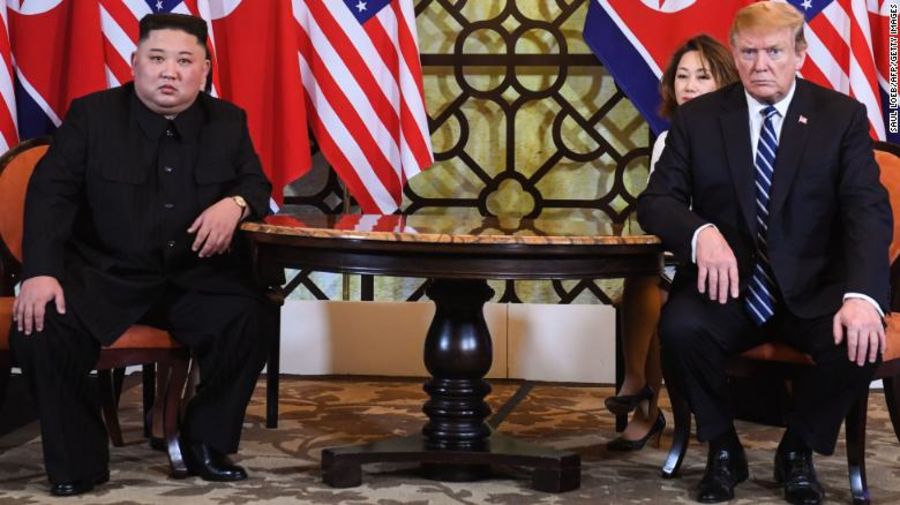
Why the Kim-Trump Summit was a – predictable – fiasco

Peace can never be achieved this way

a) The issue is about peace, not only nuclear weapons. The US has not been willing to sign a peace agreement after all these years. After some kind of peace process and treaty has been achieved, you can turn to the specific issue of nuclear weapons.

b) Making peace takes time, thorough preparations, lots of different expertise, long consultations and only face-to-face meetings when all are sure that, when the parties finally meet at top level, some kind of deal will be signed.

c) This would have been an issue for the UN if it were respected and used fairly by member states around the world. Naive and egotist people believe they can do miracles without the institutions of the international system. Probably Trump and Kim are in the same category believing that they are all capable and great guys of history (worthy of, perhaps even, the Nobel Peace Prize).

d) Peace is not a goal that can be achieved by measuring personal chemistry of some ‘great guys’. A medical doctor may be a great guy but if s/he knows nothing about the science of medicine, the result will be quackery. Peace-making is about identifying interests, addressing systematically the problems standing between parties, dealing with deep serious, inter-connected and very difficult issues in a broad time and space perspective.

Neither this Summit’s great guys nor the media have the slightest expertise on what it takes to make peace – while, as we all know, they know everything about war and the military. And, so, they seem quite surprised at the failure of this Summit.

It’s a hugely a-symmetrical conflict

a) The military expenditures of the US are 100-150 times larger than North Korea’s.

b) South Korea’s military expenditures are 5 times larger – and you can add Japan (6 times larger) and China (20 times larger)

c) The US has 6550 nuclear weapons, North Korea perhaps 15 (and hardly the technology to carry them anywhere far).

The nonsense repeated again and again for years that North Korea is a huge threat to world peace is just that – nonsense. But it serves a purpose.

Ask yourself who needs “de-nuclearization” in this world…

Symmetrical and a-symmetrical conflicts must be handled in different ways and this one is a-symmetrical on all scales – an issue you have not seen any commentator mention.

And throughout modern history, the US has inflicted much more harm on North Korea than the other way around.

Sanctions means hell and amounts to terrorism

Sanctions are so easy to install, you don’t even have to think. Lifting them proves – invariably – to be much more difficult. In the meantime, they play into the hands of hardliners and destroy any middle class that could bring about political changes – and create a mafia class instead.

Over time, they destroy civil society and kill more and more innocent civilians in larger or smaller numbers for which reason the are – according to any definition of terrorism – a terrorist weapon. A weapon of mass destruction.

See, that’s why the US can not lift the sanctions on North Korea now. Trump admits it was a central issue!

Why should North Korea trust the US?

The US has disappointed/cheated North Korea before – particularly after the Agreed Framework negotiated by Jimmy Carter in 1994.

The US has withdrawn from the most important deal about nuclear weapons, the JCPOA with Iran – while Iran has kept its promises point by point.

The US spares no opportunity to demonise, threaten and install primary and secondary sanctions on the very side that has kept its promises while the US itself violates international law and keeps harassing Iran’s leaders as well as its people.

Libya’s Ghadafi ended up being killed in the gutter after having sworn he would never acquire nuclear weapons.

Saddam was accused of having them and then murdered while not having them. Anybody apologised?

Do Western media and politicians seriously believe that they don’t see such things in Pyongyang?

Remember, nuclear weapons have terrible consequences even when not used physically.

That’s a good enough reason that they should be abolished.

Possession of nukes – not proliferation – is the issue

The general approach also in the Western media is biased and incompetent: How much can this President get the North Koreans to accept? De-nuclearization for no American de-nuclearisation, that seems to be Trump deal-making. Only because the conflict is so a-symmetrical.

And that comes after of the US itself refusing to have anything to do with the treaty for nuclear abolition and after its US Nuclear Posture Review that makes the use of nuclear weapons more likely and possible by “conventionalising” them and – right after the US (with a false pretext) has left the INF Treaty – the real reason being that it wants to be able to produce intermediate-range missiles in the region where the Koreas and China happen to be.

This reality show peace-making should stop. It could stop if US decision-makers and media learned to spell at least these three words: knowledge, humility and fairness.

Postscript

On March 29, 2019, Reuters published what looks to me to be a plausible explanation for the fiasco: With a piece of paper, Trump called on Kim to hand over nuclear weapons – “it included a blunt call for the transfer of Pyongyang’s nuclear weapons and bomb fuel to the United States, according to the document seen by Reuters.”
This speaks volumes of the US/Trump perception of itself and of North Korea and of the amateurish approach that characterizes the foreign policy of the administration in Washington. No wonder it did not want to comment on it.

Peace & future researcher + ‌Art Photographer

7 Responses

  1. All this shows the folly of Trump’s decision to withdraw from the landmark Iran nuclear deal, which for the first time in the history of non-proliferation negotiations Iran agreed to detailed conditions, including constant supervision and inspection by the International Atomic Energy Agency (IAEA). That agreement was not just based on a few photographs and expressions of goodwill, but on verifiable tests and conditions and mutual rights and responsibilities, endorsed unanimously by the Security Council Resolution 2231 and by the EU. So far, according to 14 reports by the IAEA, Iran has fully complied with her side of the bargain, while the United States has failed to honour its commitments by withdrawing from the agreement. Under these circumstances, why should anyone trust any commitments made by the United States?

  2. Yes, I was not there – but according to quite a few indicators for such meetings, this one was at least not a success. Taking the risk of predicting the future, based on knowledge, is what a social scientist should not refrain from. A doctor who doesn’t dare take the risks of performing surgery according to the diagnosis isn’t worth much. PArticularly not if you’re the patient. But thanks anyway, Sam.

  3. Thank you for this article. Frantic rushing to a public get-together with no intention of doing the needed preparation and actual action (on the part of the USA)cannot succeed, but the work needs to be continued, as North and South Korea have already shown it can be done. The USA, as in its behavior towards Russia, seems to prefer conflict.

  4. americans wants to establish asystem of threat that will guarantee whatever they pretend to every country of the whole world. Thay don’t wnt to guarantee nothing to their counterpart and pretend to have in change whatever they asks. so, they want to master everyone nations and everyone entities even give nothing in change. they pretend to command all the nations of the world, steal and exploit their resources, dictate their wishes, kill everyone they decide to kill. assassins, bully, evil, rogue, satanic cabal in charge from over one century, a infamous group of zionists, banksters, industrials, militars had the complete control of american state from the death of JFK, while in past some president tryed to do something (some good presidents, the few americans have had . . . we must remember JFK wasn’t the sole to die by that cabal . . . ), now that president are only puppet in their hands. Now things are changing, there are, fortunately some strong nations which decided to not accomplish their dictates, they are suffering and we, the people, the cannon fodder of their frequent crimes, must stand up and help the nations that are the only obstacle of their infamous wishes.

  5. Well, pappagone – I wouldn’t use the words you do (as is obvious from my article here). Also, you do not address the specific issue of nuclear weapons and US-Korean relations. But that is OK. If the “Americans”, as you say, or the system are so bad, the important thing to do is what a doctor does: Find out what the problem is (diagnosis) and let’s find ways to cure it. Merely describing the malaise – like you do – will, I am afraid, not lead to much change. At least not constructive change for humankind – or the said Americans. – Jan Oberg

Related Posts

The Quest for Humane Survival Richard Falk Professor emeritus, Princeton UniversityTFF Associate since 1986October 12, 2026 After decades of teaching and writing about international law in academic frameworks that were not institutionally situated within law school environments—at Princeton and the University of California, Santa Barbara—I found myself most receptive to the TWAIL outlook. It has been especially illuminating in clarifying the extent to which international law evolved as a dialogical critique of Europe’s efforts to legitimize its colonial undertakings. In particular, TWAIL has exposed how international law has functioned to legalize the subjugation of Third World peoples, securing conditions for exploitative investment and trade relations, the coercive enforcement of public debts, and an ideology of cultural superiority. TWAIL’s exposure of these economic legacies of colonialism has influenced my understanding of the history and development of international law, broadly conceived, as an ideological project of the Western sub-system of the world...
Advocates of nuclear disarmament are regularly dismissed by the champions of nuclear deterrence as naïve and unrealistic, utopian or even irresponsible. Yet this ‘doctrine’ of deterrence, regarded by France as the ‘cornerstone’ of its national security, is based on quasi-religious beliefs, a theory that cannot be proven, risky gambles and fragile assumptions. So much so that one might legitimately ask which side the ‘Care Bears’ are on. Marc FinaudVice-President of Initiatives for Nuclear Disarmament (IDN) October 9, 2026 This article was originally published on Pressenza When it comes to these things being treated as religious concepts, look here. Idealists and realists It was Hubert Védrine, François Mitterrand’s former Foreign Minister, who repeatedly coined the phrase: ‘Europeans are a sort of Care Bears who don’t realise they’re living in Jurassic Park’. He applies this reference to the cartoon for well-behaved children not only to what he regards as weakness or idealism...
What the West Borrowed from Asia and What It Left Behind Jan Krikke October 8, 2026 The article was originally published here In the late 1960s, the musical Hair announced that the Age of Aquarius was dawning. Its opening anthem promised a transformation of human consciousness: an era of peace, harmony and understanding. Half a century later, a familiar echo of that promise is a meditation app offered by your employer. You can find it in the same list of benefits as the pension plan and the gym discount. How did a spiritual revolution become an employee benefit? The answer lies in the history of the movement known as New Age: where it came from, what it borrowed from Asia, and why the meaning of what it borrowed changed in the process. Two definitions will help. New Age is a loose label for a wide range of spiritual practices and...

Recent Articles

The Quest for Humane Survival Richard Falk Professor emeritus, Princeton UniversityTFF Associate since 1986October 12, 2026 After decades of teaching and writing about international law in academic frameworks that were not institutionally situated within law school environments—at Princeton and the University of California, Santa Barbara—I found myself most receptive to the TWAIL outlook. It has been especially illuminating in clarifying the extent to which international law evolved as a dialogical critique of Europe’s efforts to legitimize its colonial undertakings. In particular, TWAIL has exposed how international law has functioned to legalize the subjugation of Third World peoples, securing conditions for exploitative investment and trade relations, the coercive enforcement of public debts, and an ideology of cultural superiority. TWAIL’s exposure of these economic legacies of colonialism has influenced my understanding of the history and development of international law, broadly conceived, as an ideological project of the Western sub-system of the world...
Advocates of nuclear disarmament are regularly dismissed by the champions of nuclear deterrence as naïve and unrealistic, utopian or even irresponsible. Yet this ‘doctrine’ of deterrence, regarded by France as the ‘cornerstone’ of its national security, is based on quasi-religious beliefs, a theory that cannot be proven, risky gambles and fragile assumptions. So much so that one might legitimately ask which side the ‘Care Bears’ are on. Marc FinaudVice-President of Initiatives for Nuclear Disarmament (IDN) October 9, 2026 This article was originally published on Pressenza When it comes to these things being treated as religious concepts, look here. Idealists and realists It was Hubert Védrine, François Mitterrand’s former Foreign Minister, who repeatedly coined the phrase: ‘Europeans are a sort of Care Bears who don’t realise they’re living in Jurassic Park’. He applies this reference to the cartoon for well-behaved children not only to what he regards as weakness or idealism...
What the West Borrowed from Asia and What It Left Behind Jan Krikke October 8, 2026 The article was originally published here In the late 1960s, the musical Hair announced that the Age of Aquarius was dawning. Its opening anthem promised a transformation of human consciousness: an era of peace, harmony and understanding. Half a century later, a familiar echo of that promise is a meditation app offered by your employer. You can find it in the same list of benefits as the pension plan and the gym discount. How did a spiritual revolution become an employee benefit? The answer lies in the history of the movement known as New Age: where it came from, what it borrowed from Asia, and why the meaning of what it borrowed changed in the process. Two definitions will help. New Age is a loose label for a wide range of spiritual practices and...

TFF on Substack

Discover and subscribe to more peace materials on TFF Substack

Most Popular

The Quest for Humane Survival Richard Falk Professor emeritus, Princeton UniversityTFF Associate since 1986October 12, 2026 After decades of teaching and writing about international law in academic frameworks that were not institutionally situated within law school environments—at Princeton and the University of California, Santa Barbara—I found myself most receptive to the TWAIL outlook. It has been especially illuminating in clarifying the extent to which international law evolved as a dialogical critique of Europe’s efforts to legitimize its colonial undertakings. In particular, TWAIL has exposed how international law has functioned to legalize the subjugation of Third World peoples, securing conditions for exploitative investment and trade relations, the coercive enforcement of public debts, and an ideology of cultural superiority. TWAIL’s exposure of these economic legacies of colonialism has influenced my understanding of the history and development of international law, broadly conceived, as an ideological project of the Western sub-system of the world...
Advocates of nuclear disarmament are regularly dismissed by the champions of nuclear deterrence as naïve and unrealistic, utopian or even irresponsible. Yet this ‘doctrine’ of deterrence, regarded by France as the ‘cornerstone’ of its national security, is based on quasi-religious beliefs, a theory that cannot be proven, risky gambles and fragile assumptions. So much so that one might legitimately ask which side the ‘Care Bears’ are on. Marc FinaudVice-President of Initiatives for Nuclear Disarmament (IDN) October 9, 2026 This article was originally published on Pressenza When it comes to these things being treated as religious concepts, look here. Idealists and realists It was Hubert Védrine, François Mitterrand’s former Foreign Minister, who repeatedly coined the phrase: ‘Europeans are a sort of Care Bears who don’t realise they’re living in Jurassic Park’. He applies this reference to the cartoon for well-behaved children not only to what he regards as weakness or idealism...
What the West Borrowed from Asia and What It Left Behind Jan Krikke October 8, 2026 The article was originally published here In the late 1960s, the musical Hair announced that the Age of Aquarius was dawning. Its opening anthem promised a transformation of human consciousness: an era of peace, harmony and understanding. Half a century later, a familiar echo of that promise is a meditation app offered by your employer. You can find it in the same list of benefits as the pension plan and the gym discount. How did a spiritual revolution become an employee benefit? The answer lies in the history of the movement known as New Age: where it came from, what it borrowed from Asia, and why the meaning of what it borrowed changed in the process. Two definitions will help. New Age is a loose label for a wide range of spiritual practices and...
Read More
law-419057_1280
The Quest for Humane Survival Richard Falk Professor emeritus, Princeton UniversityTFF Associate since 1986October 12, 2026 After decades of teaching and writing about international law in academic frameworks that were not institutionally situated within law school environments—at Princeton and the University of California, Santa Barbara—I found myself most receptive to the TWAIL outlook. It has been especially illuminating in clarifying the extent to which international law evolved as a dialogical critique of Europe’s efforts to legitimize its colonial undertakings. In particular, TWAIL has exposed how international law has functioned to legalize the subjugation of Third World peoples, securing conditions for exploitative investment and trade relations, the coercive enforcement of public debts, and an ideology of cultural superiority. TWAIL’s exposure of these economic legacies of colonialism has influenced my understanding of the history and development of international law, broadly conceived, as an ideological project of the Western sub-system of the world...
images-2
Advocates of nuclear disarmament are regularly dismissed by the champions of nuclear deterrence as naïve and unrealistic, utopian or even irresponsible. Yet this ‘doctrine’ of deterrence, regarded by France as the ‘cornerstone’ of its national security, is based on quasi-religious beliefs, a theory that cannot be proven, risky gambles and fragile assumptions. So much so that one might legitimately ask which side the ‘Care Bears’ are on. Marc FinaudVice-President of Initiatives for Nuclear Disarmament (IDN) October 9, 2026 This article was originally published on Pressenza When it comes to these things being treated as religious concepts, look here. Idealists and realists It was Hubert Védrine, François Mitterrand’s former Foreign Minister, who repeatedly coined the phrase: ‘Europeans are a sort of Care Bears who don’t realise they’re living in Jurassic Park’. He applies this reference to the cartoon for well-behaved children not only to what he regards as weakness or idealism...
8824b09f-33a5-43f9-9fd0-550f28cda24d_1536x1024
What the West Borrowed from Asia and What It Left Behind Jan Krikke October 8, 2026 The article was originally published here In the late 1960s, the musical Hair announced that the Age of Aquarius was dawning. Its opening anthem promised a transformation of human consciousness: an era of peace, harmony and understanding. Half a century later, a familiar echo of that promise is a meditation app offered by your employer. You can find it in the same list of benefits as the pension plan and the gym discount. How did a spiritual revolution become an employee benefit? The answer lies in the history of the movement known as New Age: where it came from, what it borrowed from Asia, and why the meaning of what it borrowed changed in the process. Two definitions will help. New Age is a loose label for a wide range of spiritual practices and...
Screenshot 2026-10-04 210142
Small and different + among the 10% most active + 9,000 texts + 150 Associates + 60 000 a day — and a stubborn belief that peace is smarter and must be secured by peaceful means. In 2026, the Transnational Foundation for Peace and Future Research (TFF) turns 40. On Monday, October 5, 2026, a new TFF homepage will go live — a new gateway to more than 9,000 articles, analyses, research papers and other contributions produced over four decades of independent peace research. But this is not simply a new website. For four decades, TFF has worked from a simple conviction: peace is smarter than militarism and can be brought about by peaceful means. This is not merely an aspiration. It is the principle expressed in the UN Charter and the Gandhian tradition that has guided our work from the beginning. TFF is a research-based, independent and people-financed foundation....
Living-Peace-Sign-Budapest-copy
Tony Robinson October 4, 2026 Violence is easy to recognise when someone is being beaten, shot or killed. It becomes more difficult when nobody is holding a weapon. Poverty, discrimination, exploitation and repression can restrict a human life just as effectively, although they do so in very different ways and with very different consequences. Simply adding more categories to an ever-growing list of forms of violence does not really solve the problem. The more interesting question is what all these different situations have in common and why it makes sense to describe them using the same word. Human beings do not simply react to what happens around them. They remember the past, imagine things that do not yet exist, make plans and undertake projects. Workers organise because they imagine different working conditions; people migrate because they imagine another life somewhere else; social movements emerge because people refuse to accept the...
b54a1f10-8c65-4f0b-9dd5-4abc0a7d04cc_2659x2659
It’s a matter of principles, courage, vision and pulling together – while the militarist world is falling apart… Peter Langille October 3, 2026 “Here, then, is the problem which we present to you, stark and dreadful and inescapable: Shall we put an end to the human race; or shall mankind renounce war?”The Bertrand Russell—Albert Einstein Manifesto, July 9, 1955 ⁕ The forecast for what’s ahead is worrisome. The sharp rise in armed conflicts over the past three years is adding to what was already the highest level in over seventy years. Genocides, which should be prevented are supported. A shared climate emergency that jeopardises survival is ignored. Diverse polls now suggest that people are war-weary, worried and interested in a more effective United Nations. And, there are viable policy options for a more secure world! Yet governments are doubling-down, betting on more war and investing heavily. If current trends persist,...




