
The Global War On Terror – Another predictable fiasco turns 17


Today marks the 17th anniversary of what could be called the most counter-productive, if not stupid, war in modern history: The Global War On Terror, GWOT.

Today that war is much much more dangerous to the world and its future than the terrorists it allegedly aims to hunt down. And it has caused thousands of times more suffering, death and destruction than September 11 did.

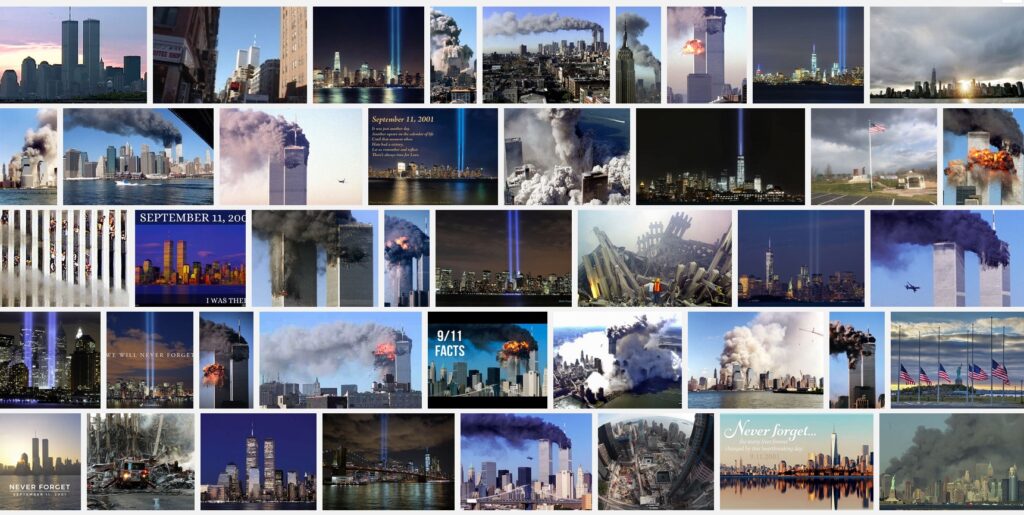
As yu’ll see below – the image above and below – the U.S. has been able to market itself as the innocent victim – which it isn’t. While countries and peoples who have been innocent victims and to a much larger extent do not have similar resources and control over the media narratives told worldwide.

We’ve heard a lot about “9/11” and that is only right, it was a terrible crime.

But why don’t you remember, equally well at least, “10/7” (US-led war on Afghanistan 2001) or “3/20” (US-led war on Iraq 2003) or “3/19” (NATO-led war on Libya 2011) or 4/7 (US bombing of Syria 2017 with military involvement beginning already 2011)?

Right! – these wars were not branded to create sympathy for victims. On the contrary.

•

The war on terror was wrong from Day One. It’s not a war on terrorism but on terrorists which is as smart as trying to fight all diseases by killing all patients.

And it’s a war fought without any consideration of the one big question: Why did they do it and why do they do it? Media and politics only asking: Who did it? How was it done? Where? How to respond? Never the Why question? Because that question would raise to issues: Could they have a point?  (not defending their methods but understanding their motivations) and did we ourselves do anything to provoke such feeling in other peoples and religions?

Without an intelligent, comprehensive diagnosis of 9/11, it could only go wrong. And it has. And it will.

The next problem was that ‘terrorism’ was suddenly defined by states as anything non-state that threatens society and states. Governments and the UN (which consists of them) conveniently omitted terrorism as a term for what states do and have done on a regular basis and on a much larger scale. Such as the nuclear balance of terror, a term that was delibreately taken out of the political vocabulary because it indicarted and important truth: that states practise terror.

About 400 people were killed annually and worldwide before 9/11 according to US State Department statistics – which, by the way, was discontinued stopped in 2004 when figures soared after the War On Terror gained momentum.

However, according to the 2015 Global Terror Index – the number is now 32,000 – and the far majority killed outside the West. So, the problem has increased exactly 80 times(!)

And the Western leaders who continue this war has no idea about how to stop it or do something more productive and intelligent. Primitive tit-for-tat and disproportional responses has substituted what was once called statesmanship.

And it was predictable that such an almost anti-intellectual approach would be a fiasco!

•

Many both inside and outside the U.S. came up with different diagnoses, prognoses and proposals for responses to the cruel attacks on Washington and New York. So did TFF Associates. Below you’ll find just a selection of articles in English (we also wrote in Scandinavian languages and spoke in radio and television interviews) – posted within the first three months after 9/11 and then later).

We make them available for those who care about the world, about terrorism and for those who also have the moral courage to ask: How come that small independent organisations often predict the future much better than huge “intelligence” agencies, state research institutes and private so-called think tanks with multi-billion dollar budgets?

The answer is found in the question: independence, free exploration and free thinking. The opposite of the group think and political correctness that characterise most state- and corporate-financed research.

And why did – and do – media listen to those who advocated a violent response and to the masters of successive wars on Afghanistan or “10/7″, on Iraq or “3/20″ and on Libya and Syria – and drone warfare?

Further, why did virtually none of the larger media listen to any of those of us who argued in favour of a political self-reflection and a response to 9/11 in accordance with international law, ethics and the common good worldwide?

And why are all the leaders of the global War On Terror that has brought unspeakable suffering to the world and killed so many innocent people still at large?


An image illustration

Finally an illustration of the 9/11 propaganda machine that – mistakenly – is supposed to be helpful to the West:

The picture on top of this article is what you get by using a search engine for “September 11 – images”.

Below is what you get when you search “October 7 – images” – the day the US started the war on Afghanistan.

Clearly, you are supposed to remember one and forget the other – and so too the wars on and destruction of Iraq, Libya and Syria. No sympathy for the victims there – of our wars – and no empathy with the asylum seekers and the refugees from these regions.


 Here is the selection of relevant TFF articles over the years:

Rocio Campos, September 12, 2001
Wisdom needed to avoid a bigger war

Jonathan Power, September 12, 2001
For the arrogance of power America now pays a terrible price

Daisaku Ikeda, TFF associate, September 16 & 17, 2001
Initial perspectives on the terror – a plea for nonviolence

Peter Jarman, September 17, 2001
The terrorist attacks in the USA. A personal view

David Krieger, September 20, 2001
Reflections on the terrorist attacks

Jonathan Power, September 20, 2001
Is it possible for America to say ‘Sorry’?

Jan Oberg & Jorgen Johansen, September 25, 2001
Constructive thoughts two weeks after September 11

Richard Falk, September 27, 2001
A just response

Jonathan Power, September 30, 2001
Terrorism cannot be defeated by terrorism

Chaiwat Satha-Anand, October 1, 2001
Understanding terror and making the right choice

Radmila Nakarada with Miroslav Pejulic, October 1, 2001
The tragedy of a tragedy – global terrorism and repressive globalisation

Jonathan Power, October 3, 2001
A sensible, less militaristic, way is possible

Jan Oberg, October 9, 2001
Sweden and September 11

Daisaku Ikeda, 18 November, 2001
A spiritual response to September 11

Evelin Lindner, December 12, 2001
The lessons of humiliation

Johan Galtung, 19 February, 2002 but written during autumn 2001
September 11: Diagnosis, Prognosis and Therapy

Johan Galtung and Dietrich Fischer, September 6, 2002
To end terrorism, end state terrorism

Jan Oberg, May 3, 2002
Three minutes silence for the dead in Afghanistan and three other peacemaking suggestions

Christian Harleman & Jan Oberg, June 7, 2002
A U.S. war against Iraq must be prevented now

Jan Oberg, April 2, 2003
Losing all three wars on Iraq

Jan Oberg, September 11, 2003
11 things to remember on September 11

Jan Oberg, September 10, 2006
September 11 Five Years: 9 problems, 11 solutions

Jan Oberg, February 26, 2015
Terrorism – small dot in the larger picture

We continue addressing these issue here at The Transnational, our homepage-magazine that was launched on january 1, 2018.

The Global War On Terror is self-defeating for the West

One – increasingly important – result of this war is the systematic undermining of democracy, human rights, freedom of expression etc. in the Western world – as well as an increase in all types of surveillance, monitoring and intrusions into our private lives and misuse of fearology as a main tool against one’s own population.

Scared people stop participating in their society and their democracy and turn to info-tainment and escapism.

Western taxpayers have financed this war now for 17 years. The only thing they got is a much dangerous and unfree world.

Perhaps it is time to do a mass boycott of tax money that goes to war in your country? And let those who want to continue the War on Terror do so on the basis of voluntary contributions via crowd-funding?

In the long run, the War On Terror is likely to be more self- than other-defeating.

We are living in what Chris Hedges has recently called the new illiteracy, the post-literate society in which large segments of citizen can no longer distinguish between lies and truth. It won’t make it easier to stop the madness of the War On Terror – or the Western build-up to war with Russia for that matter – which both Stephen Cohen and Michael Klare and even former MI-6 agent, Alistair Crooke believe the world could be heading for thanks predominantly to the over-militarization of NATO countries and their hubris policies.

And why do I mention the new Cold War here at the end?

Because there is a connection. After the Soviet invasion of Afghanistan in 1979, president Carter’s national security adviser Zbiegniew Brzezinski, got the great idea that the US should supply Stringer missiles to jihadists there and thus help them fight the Russians. So there is a connection at the beginning and today: the ongoing support by the West to some terrorist groups either directly or via allies such as Saudi Arabia, the Gulf States and Turkey.

To put it crudely:  that’s what Syria is also about and that is why there is only one Western mainstream narrative about that conflict and why that narrative has very very little to do with the much more complex reality. The West de facto supports terrorists – with propaganda, regime change policies, arms and ammunition, training etc. – under the narrative of fighting them.

One must therefore wonder how much of the War On Terror is actually a war on “our own” and what purpose, if any, that could possibly serve.

One of course would be to always conveniently have at hand a pretext for new bombings, occupations, secret forces and regime changes somewhere – in short a terrorism perpetuum mobile feeding on itself.

At least, that is, until the US Empire has vanished, NATO been closed down and the West accommodated to being a partner among equals in a future, more balanced and peaceful multi-polar world order.

May that day come sooner rather than later.

What about 3 minutes of silence for the victims of the Global War On Terror?

In short, the policies in the wake of 9/11 is the problem that we should address.

It’s time we wake up and see through 9/11, see through the fearological bluff it has been misused to create. The “re-action” to 9/11 is mega-terrorism and more harmful to the world – all of us – than whatever happened on 9/11 and whoever did it.

The event on 9/11 caused many to observe 3 minutes of silence. How many hours would we need in remembrance of the people killed in Afghanistan, Iraq, Libya and Syria and other places for, literally, not one good reason?

This is a revised version of TFF PressInfo 388 from 2016.

 

Peace & future researcher + ‌Art Photographer

Related Posts

Below are TFF-related media mentions, comments, videos and social media posts published elsewhere but not on this homepage. We happen to catch and list only a fraction. Regarding video comments and debates, we recommend that you go to the TFF Video Channel on Substack where many of them are reproduced. Jan Oberg is a contributor to China Daily – 52 million daily clicks – and Global Times, CGTN and CCTV (the national television), China Investment, Xinhua News Agency and several others. Articles and videos on these media very often multiply into countless Chinese (and Western media) that re-post them from these main media. Thanks to The China Academy, his analyses, interviews and comments are frequently posted on YouTube channels such as Thinkers Forum and Wave Media. These videos are often re-posted on Bilibili (China’s YouTube), the China Content Center on TikTok, and on the Chinese edition of TikTok, Douyin.com. This means reaching hundreds of millions of viewers worldwide over a year. While there are too many to catch on all these...
Jan Oberg TFF director October 13, 2026 According to Alfred Nobel’s will, the Nobel Peace Prize shall be awarded: ”to the person who has done the most or best to advance fellowship among nations, the abolition or reduction of standing armies, and the establishment and promotion of peace congresses.” Further down, he also expresses how the prize for the “champions of peace” shall be decided: “that for champions of peace by a committee of five persons to be selected by the Norwegian Storting. Alfred Nobel’s will is remarkably short and clear. But few seem to have read it. Nobel did not say that the committee itself should consist of members of parliament. He entrusted the Storting with appointing five persons. In principle, it could have selected diplomats, mediators, peace researchers, conflict-resolution specialists, or other individuals with recognised expertise in matters of peace from around the world. Instead, the Storting gradually...
The Quest for Humane Survival Richard Falk Professor emeritus, Princeton UniversityTFF Associate since 1986October 12, 2026 After decades of teaching and writing about international law in academic frameworks that were not institutionally situated within law school environments—at Princeton and the University of California, Santa Barbara—I found myself most receptive to the TWAIL outlook. It has been especially illuminating in clarifying the extent to which international law evolved as a dialogical critique of Europe’s efforts to legitimize its colonial undertakings. In particular, TWAIL has exposed how international law has functioned to legalize the subjugation of Third World peoples, securing conditions for exploitative investment and trade relations, the coercive enforcement of public debts, and an ideology of cultural superiority. TWAIL’s exposure of these economic legacies of colonialism has influenced my understanding of the history and development of international law, broadly conceived, as an ideological project of the Western sub-system of the world...

Recent Articles

Below are TFF-related media mentions, comments, videos and social media posts published elsewhere but not on this homepage. We happen to catch and list only a fraction. Regarding video comments and debates, we recommend that you go to the TFF Video Channel on Substack where many of them are reproduced. Jan Oberg is a contributor to China Daily – 52 million daily clicks – and Global Times, CGTN and CCTV (the national television), China Investment, Xinhua News Agency and several others. Articles and videos on these media very often multiply into countless Chinese (and Western media) that re-post them from these main media. Thanks to The China Academy, his analyses, interviews and comments are frequently posted on YouTube channels such as Thinkers Forum and Wave Media. These videos are often re-posted on Bilibili (China’s YouTube), the China Content Center on TikTok, and on the Chinese edition of TikTok, Douyin.com. This means reaching hundreds of millions of viewers worldwide over a year. While there are too many to catch on all these...
Jan Oberg TFF director October 13, 2026 According to Alfred Nobel’s will, the Nobel Peace Prize shall be awarded: ”to the person who has done the most or best to advance fellowship among nations, the abolition or reduction of standing armies, and the establishment and promotion of peace congresses.” Further down, he also expresses how the prize for the “champions of peace” shall be decided: “that for champions of peace by a committee of five persons to be selected by the Norwegian Storting. Alfred Nobel’s will is remarkably short and clear. But few seem to have read it. Nobel did not say that the committee itself should consist of members of parliament. He entrusted the Storting with appointing five persons. In principle, it could have selected diplomats, mediators, peace researchers, conflict-resolution specialists, or other individuals with recognised expertise in matters of peace from around the world. Instead, the Storting gradually...
The Quest for Humane Survival Richard Falk Professor emeritus, Princeton UniversityTFF Associate since 1986October 12, 2026 After decades of teaching and writing about international law in academic frameworks that were not institutionally situated within law school environments—at Princeton and the University of California, Santa Barbara—I found myself most receptive to the TWAIL outlook. It has been especially illuminating in clarifying the extent to which international law evolved as a dialogical critique of Europe’s efforts to legitimize its colonial undertakings. In particular, TWAIL has exposed how international law has functioned to legalize the subjugation of Third World peoples, securing conditions for exploitative investment and trade relations, the coercive enforcement of public debts, and an ideology of cultural superiority. TWAIL’s exposure of these economic legacies of colonialism has influenced my understanding of the history and development of international law, broadly conceived, as an ideological project of the Western sub-system of the world...

TFF on Substack

Discover and subscribe to more peace materials on TFF Substack

Most Popular

Below are TFF-related media mentions, comments, videos and social media posts published elsewhere but not on this homepage. We happen to catch and list only a fraction. Regarding video comments and debates, we recommend that you go to the TFF Video Channel on Substack where many of them are reproduced. Jan Oberg is a contributor to China Daily – 52 million daily clicks – and Global Times, CGTN and CCTV (the national television), China Investment, Xinhua News Agency and several others. Articles and videos on these media very often multiply into countless Chinese (and Western media) that re-post them from these main media. Thanks to The China Academy, his analyses, interviews and comments are frequently posted on YouTube channels such as Thinkers Forum and Wave Media. These videos are often re-posted on Bilibili (China’s YouTube), the China Content Center on TikTok, and on the Chinese edition of TikTok, Douyin.com. This means reaching hundreds of millions of viewers worldwide over a year. While there are too many to catch on all these...
Jan Oberg TFF director October 13, 2026 According to Alfred Nobel’s will, the Nobel Peace Prize shall be awarded: ”to the person who has done the most or best to advance fellowship among nations, the abolition or reduction of standing armies, and the establishment and promotion of peace congresses.” Further down, he also expresses how the prize for the “champions of peace” shall be decided: “that for champions of peace by a committee of five persons to be selected by the Norwegian Storting. Alfred Nobel’s will is remarkably short and clear. But few seem to have read it. Nobel did not say that the committee itself should consist of members of parliament. He entrusted the Storting with appointing five persons. In principle, it could have selected diplomats, mediators, peace researchers, conflict-resolution specialists, or other individuals with recognised expertise in matters of peace from around the world. Instead, the Storting gradually...
The Quest for Humane Survival Richard Falk Professor emeritus, Princeton UniversityTFF Associate since 1986October 12, 2026 After decades of teaching and writing about international law in academic frameworks that were not institutionally situated within law school environments—at Princeton and the University of California, Santa Barbara—I found myself most receptive to the TWAIL outlook. It has been especially illuminating in clarifying the extent to which international law evolved as a dialogical critique of Europe’s efforts to legitimize its colonial undertakings. In particular, TWAIL has exposed how international law has functioned to legalize the subjugation of Third World peoples, securing conditions for exploitative investment and trade relations, the coercive enforcement of public debts, and an ideology of cultural superiority. TWAIL’s exposure of these economic legacies of colonialism has influenced my understanding of the history and development of international law, broadly conceived, as an ideological project of the Western sub-system of the world...
Read More
girl-5894831_1280
Below are TFF-related media mentions, comments, videos and social media posts published elsewhere but not on this homepage. We happen to catch and list only a fraction. Regarding video comments and debates, we recommend that you go to the TFF Video Channel on Substack where many of them are reproduced. Jan Oberg is a contributor to China Daily – 52 million daily clicks – and Global Times, CGTN and CCTV (the national television), China Investment, Xinhua News Agency and several others. Articles and videos on these media very often multiply into countless Chinese (and Western media) that re-post them from these main media. Thanks to The China Academy, his analyses, interviews and comments are frequently posted on YouTube channels such as Thinkers Forum and Wave Media. These videos are often re-posted on Bilibili (China’s YouTube), the China Content Center on TikTok, and on the Chinese edition of TikTok, Douyin.com. This means reaching hundreds of millions of viewers worldwide over a year. While there are too many to catch on all these...
Nobel-Prize-Plaque
Jan Oberg TFF director October 13, 2026 According to Alfred Nobel’s will, the Nobel Peace Prize shall be awarded: ”to the person who has done the most or best to advance fellowship among nations, the abolition or reduction of standing armies, and the establishment and promotion of peace congresses.” Further down, he also expresses how the prize for the “champions of peace” shall be decided: “that for champions of peace by a committee of five persons to be selected by the Norwegian Storting. Alfred Nobel’s will is remarkably short and clear. But few seem to have read it. Nobel did not say that the committee itself should consist of members of parliament. He entrusted the Storting with appointing five persons. In principle, it could have selected diplomats, mediators, peace researchers, conflict-resolution specialists, or other individuals with recognised expertise in matters of peace from around the world. Instead, the Storting gradually...
law-419057_1280
The Quest for Humane Survival Richard Falk Professor emeritus, Princeton UniversityTFF Associate since 1986October 12, 2026 After decades of teaching and writing about international law in academic frameworks that were not institutionally situated within law school environments—at Princeton and the University of California, Santa Barbara—I found myself most receptive to the TWAIL outlook. It has been especially illuminating in clarifying the extent to which international law evolved as a dialogical critique of Europe’s efforts to legitimize its colonial undertakings. In particular, TWAIL has exposed how international law has functioned to legalize the subjugation of Third World peoples, securing conditions for exploitative investment and trade relations, the coercive enforcement of public debts, and an ideology of cultural superiority. TWAIL’s exposure of these economic legacies of colonialism has influenced my understanding of the history and development of international law, broadly conceived, as an ideological project of the Western sub-system of the world...
images-2
Advocates of nuclear disarmament are regularly dismissed by the champions of nuclear deterrence as naïve and unrealistic, utopian or even irresponsible. Yet this ‘doctrine’ of deterrence, regarded by France as the ‘cornerstone’ of its national security, is based on quasi-religious beliefs, a theory that cannot be proven, risky gambles and fragile assumptions. So much so that one might legitimately ask which side the ‘Care Bears’ are on. Marc FinaudVice-President of Initiatives for Nuclear Disarmament (IDN) October 9, 2026 This article was originally published on Pressenza When it comes to these things being treated as religious concepts, look here. Idealists and realists It was Hubert Védrine, François Mitterrand’s former Foreign Minister, who repeatedly coined the phrase: ‘Europeans are a sort of Care Bears who don’t realise they’re living in Jurassic Park’. He applies this reference to the cartoon for well-behaved children not only to what he regards as weakness or idealism...
8824b09f-33a5-43f9-9fd0-550f28cda24d_1536x1024
What the West Borrowed from Asia and What It Left Behind Jan Krikke October 8, 2026 The article was originally published here In the late 1960s, the musical Hair announced that the Age of Aquarius was dawning. Its opening anthem promised a transformation of human consciousness: an era of peace, harmony and understanding. Half a century later, a familiar echo of that promise is a meditation app offered by your employer. You can find it in the same list of benefits as the pension plan and the gym discount. How did a spiritual revolution become an employee benefit? The answer lies in the history of the movement known as New Age: where it came from, what it borrowed from Asia, and why the meaning of what it borrowed changed in the process. Two definitions will help. New Age is a loose label for a wide range of spiritual practices and...
Screenshot 2026-10-04 210142
Small and different + among the 10% most active + 9,000 texts + 150 Associates + 60 000 a day — and a stubborn belief that peace is smarter and must be secured by peaceful means. In 2026, the Transnational Foundation for Peace and Future Research (TFF) turns 40. On Monday, October 5, 2026, a new TFF homepage will go live — a new gateway to more than 9,000 articles, analyses, research papers and other contributions produced over four decades of independent peace research. But this is not simply a new website. For four decades, TFF has worked from a simple conviction: peace is smarter than militarism and can be brought about by peaceful means. This is not merely an aspiration. It is the principle expressed in the UN Charter and the Gandhian tradition that has guided our work from the beginning. TFF is a research-based, independent and people-financed foundation....





