
The US Syria “Strategy” – Recipe For Continued Disaster Even For The US

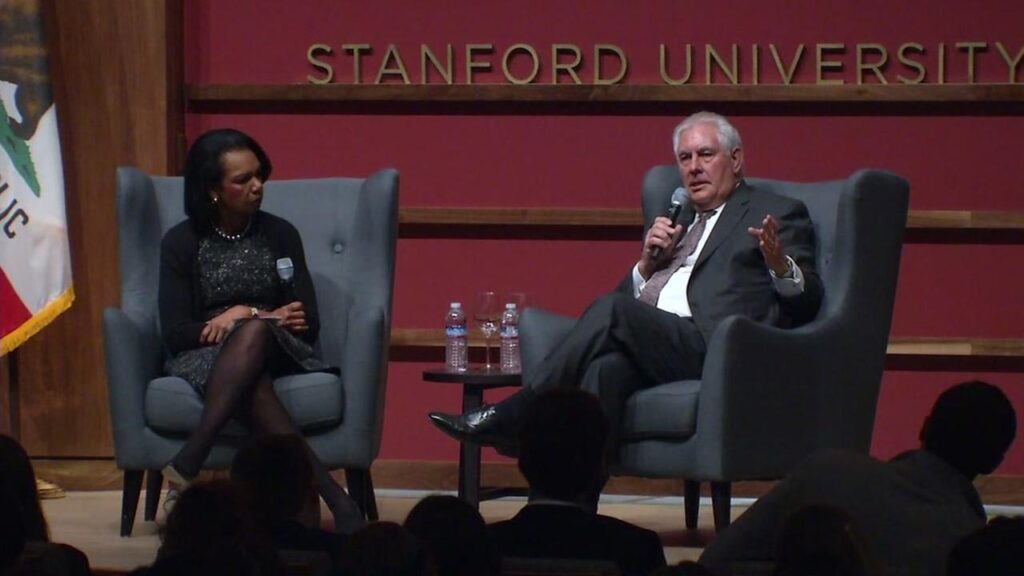
Most media covering the speech that US Secretary of State, Rex Tillerson, gave at the Hoover Institution on January 17, 2018 merely points out that he said that the United States would stay in Syria – open-ended – in the future and until President Bashar al-Assad has left the scene. Read the full speech here.

Reuters even twists it all to mean that the US is now more patient about Assad’s removal.

Before I continue it is a significant sign of the Western crisis, including moral and legal decay, that it raises few eyebrows – and none in NATO circles – that a top official of the leader of the Western world:

a) expresses no regrets about anything done so far in this conflict or in the larger Middle East,

b) states clearly that it will continue what must in legal terms be characterized as foreign military aggression and presence on the territory of a legal state member of the UN,

c) that it will work for regime change (there too) and

d) will make various kinds of aid dependent on Assad’s demise. Remember it is one of the largest post-1945 humanitarian crises – in the category of, say, Vietnam, Cambodia, Iraq and Yemen – all of which have, by no coincidence, US and allied warfare as their main feature.

•

Irrespective of what we may think of Syria, this is little but a full-scale assault on international law and the normative system embedded in the UN Charter that has taken decades of hard work to build, a fundamental cornerstone of the management and civilizational development of the world order system.

Seen in comparison with the other attempts at undermining the UN – which began in the 1990s in Bosnia-Herzegovina – this should be a cause of deep concern among people in the truly civilizational corners of our world.

And it can’t be sold to the world under the headline of a Responsibility to Protect. But it does provoke the question: Shouldn’t there be a Responsibility to Protest – even among those allies that Tillerson seems to take for granted are all lining up behind the US (and perhaps they are)?

If there are anyone who can talk the US to some sense these days, it must be allies and friends predominantly in NATO and the EU. But will they?

•

Although held at Stanford University – and therefore supposed to contain some kind of decent academic-intellectual analysis – Tillerson’s presentation is from such perspectives incredibly poor.

Although he says that he will give “a broad historical and political context”, there is neither broadness, nor history nor context. Indeed, just a few words later he starts out in this manner which offers the framework for the rest of what he says:

“For nearly 50 years, the Syrian people have suffered under the dictatorship of Hafez al-Assad and his son Bashar al-Assad. The nature of the Assad regime, like that of its sponsor Iran, is malignant. It has promoted state terror. It has empowered groups that kill American soldiers, such as al-Qaida. It has backed Hizballah and Hamas. And it has violently suppressed political opposition…” and on an on it goes.

If this is the best history, context and analysis of what the underlying conflicts and the reasons for all the violence in Syria are that the United States of America’s top foreign policy official can muster you may ask at least two questions: What is so terribly deficient, narrow-minded and self-serving about US academia in this field? Or is that academic world actually excellent but not listened to at all in decision-making circles and why did he make that speech at a university?

I don’t know what the answer is, perhaps it is a combination of the two? But as a professor in peace and conflict studies I would ask an undergraduate student making writing such a piece of history and conflict analysis to read a couple of books more and come back to me with a revised paper. I would not let that student pass the exam.

Interestingly, the transcript of the speech reveals that the audience had no chance to ask questions or otherwise debate with the speaker. After Tillerson’s speech there is only a conversation between him and former foreign secretary, Condoleezza Rice. That’s unusual at a university where free debate should reign.

•

Secondly, there is nothing that indicates that Tillerson has a grasp on how his “strategy” for Syria relates to a more comprehensive policy for the Middle East region as a whole.

He doesn’t mention – for understandable reasons, you may say – that the US also has some other policies and goals for its future presence in Syria such as building permanent bases – in a kind of base race with Russia – and supporting Kurdish forces in the Syrian side of the border to Turkey – the second largest military power in NATO that is of course furious and calls it a terrorist army that it is ready to fight.

It will only push Turkey closer to Russia and eventually and predictably Turkey will turn its back completely on Europe and leave NATO.

We’ve of course seen it all before. It’s about bases (like, say, Kosovo), about control of resources (like, say, Iraq), about regime change (like, say Saddam Hussein and Moamar Khadafi) and it’s about the exceptionalist belief that God’s own country has God’s mandate to create US Imperial peace everywhere – no matter how many times it has already gone madly wrong and no matter how many innocent people are killed and wounded in the process.

He also does not mention that the US under the Trump administration has chosen to promote and support the new fundamentalist Islamist-Zionist team, Saudi-Arabia and Israel, supported by the Gulf States, to gang up against the Iran that is seen as a huge threat to the US, the world and the region. But which – unfortunately for that view – isn’t.

It is conspicuous in that this otherwise totally split and in-fighting administration/Deep State is united in basically in one thing: hating Iran. Iran is also about the only issue where President Trump holds the same views while he was in the campaign as he does now he is in the White House.

Furthermore, the Trump administration is doing nothing but undermining the welfare of the Iranian people (and supporting the hardliners and corrupt sectors) by means of the sanctions that are still in function through financial mechanisms. And coming up repeatedly with nonsensical perceptions of the country and permanent threat à la all options are on the table.

That is going to go madly wrong too, sooner or later.

•

Much can be said about Tillerson’s speech. If it wasn’t coming out of the world’s strongest military power – but now losing on all other power scales – nobody would bother to read it. But you should! (Or see it below on video which also reveals how ritualistic the whole event is from the intro by the Hoover president and onwards).

Heartbreakingly, it spells prolonged hell for fellow human beings in Syria and – open-ended – troubles for Iran and its people.

It’s peace-and-military stability philosophy is a fake as fake can be. Peace means war, open-ended war.

And permit me a small digression: We no longer need to take serious – actually, we never did – the US accusation directed at Russia that it meddles into the affairs of other countries. What is this if not meddling?

Finally, can anything good be said about it?

Probably only that this type of policy will eventually become the famous nail in the US Empire’s coffin. Thereafter, both the US Republic and the world will be a much better place.

But wouldn’t it be so much better for all of us if that piece of history could unfold in a peaceful, intellectually honest and moral manner instead of open-ended warfare to the end?


Recommended readings on this plan

The day after this was published the New York Times carried this editorial.

On January 23, an Opinion piece “A Syria plan that breaks the law” was published, authored by Cory A. Booker and Oona A. Hathaway in which it is argued that this plan violates both the US Constitution and international law.

The Hill, on January 23, 2018, published an excellent analysis by Stephen Kinzer.

Patrick Cockburn in The Independent.

Peace & future researcher + ‌Art Photographer

2 Responses

Related Posts

Below are TFF-related media mentions, comments, videos and social media posts published elsewhere but not on this homepage. We happen to catch and list only a fraction. Regarding video comments and debates, we recommend that you go to the TFF Video Channel on Substack where many of them are reproduced. Jan Oberg is a contributor to China Daily – 52 million daily clicks – and Global Times, CGTN and CCTV (the national television), China Investment, Xinhua News Agency and several others. Articles and videos on these media very often multiply into countless Chinese (and Western media) that re-post them from these main media. Thanks to The China Academy, his analyses, interviews and comments are frequently posted on YouTube channels such as Thinkers Forum and Wave Media. These videos are often re-posted on Bilibili (China’s YouTube), the China Content Center on TikTok, and on the Chinese edition of TikTok, Douyin.com. This means reaching hundreds of millions of viewers worldwide over a year. While there are too many to catch on all these...
Jan Oberg TFF director October 13, 2026 According to Alfred Nobel’s will, the Nobel Peace Prize shall be awarded: ”to the person who has done the most or best to advance fellowship among nations, the abolition or reduction of standing armies, and the establishment and promotion of peace congresses.” Further down, he also expresses how the prize for the “champions of peace” shall be decided: “that for champions of peace by a committee of five persons to be selected by the Norwegian Storting. Alfred Nobel’s will is remarkably short and clear. But few seem to have read it. Nobel did not say that the committee itself should consist of members of parliament. He entrusted the Storting with appointing five persons. In principle, it could have selected diplomats, mediators, peace researchers, conflict-resolution specialists, or other individuals with recognised expertise in matters of peace from around the world. Instead, the Storting gradually...
The Quest for Humane Survival Richard Falk Professor emeritus, Princeton UniversityTFF Associate since 1986October 12, 2026 After decades of teaching and writing about international law in academic frameworks that were not institutionally situated within law school environments—at Princeton and the University of California, Santa Barbara—I found myself most receptive to the TWAIL outlook. It has been especially illuminating in clarifying the extent to which international law evolved as a dialogical critique of Europe’s efforts to legitimize its colonial undertakings. In particular, TWAIL has exposed how international law has functioned to legalize the subjugation of Third World peoples, securing conditions for exploitative investment and trade relations, the coercive enforcement of public debts, and an ideology of cultural superiority. TWAIL’s exposure of these economic legacies of colonialism has influenced my understanding of the history and development of international law, broadly conceived, as an ideological project of the Western sub-system of the world...

Recent Articles

Below are TFF-related media mentions, comments, videos and social media posts published elsewhere but not on this homepage. We happen to catch and list only a fraction. Regarding video comments and debates, we recommend that you go to the TFF Video Channel on Substack where many of them are reproduced. Jan Oberg is a contributor to China Daily – 52 million daily clicks – and Global Times, CGTN and CCTV (the national television), China Investment, Xinhua News Agency and several others. Articles and videos on these media very often multiply into countless Chinese (and Western media) that re-post them from these main media. Thanks to The China Academy, his analyses, interviews and comments are frequently posted on YouTube channels such as Thinkers Forum and Wave Media. These videos are often re-posted on Bilibili (China’s YouTube), the China Content Center on TikTok, and on the Chinese edition of TikTok, Douyin.com. This means reaching hundreds of millions of viewers worldwide over a year. While there are too many to catch on all these...
Jan Oberg TFF director October 13, 2026 According to Alfred Nobel’s will, the Nobel Peace Prize shall be awarded: ”to the person who has done the most or best to advance fellowship among nations, the abolition or reduction of standing armies, and the establishment and promotion of peace congresses.” Further down, he also expresses how the prize for the “champions of peace” shall be decided: “that for champions of peace by a committee of five persons to be selected by the Norwegian Storting. Alfred Nobel’s will is remarkably short and clear. But few seem to have read it. Nobel did not say that the committee itself should consist of members of parliament. He entrusted the Storting with appointing five persons. In principle, it could have selected diplomats, mediators, peace researchers, conflict-resolution specialists, or other individuals with recognised expertise in matters of peace from around the world. Instead, the Storting gradually...
The Quest for Humane Survival Richard Falk Professor emeritus, Princeton UniversityTFF Associate since 1986October 12, 2026 After decades of teaching and writing about international law in academic frameworks that were not institutionally situated within law school environments—at Princeton and the University of California, Santa Barbara—I found myself most receptive to the TWAIL outlook. It has been especially illuminating in clarifying the extent to which international law evolved as a dialogical critique of Europe’s efforts to legitimize its colonial undertakings. In particular, TWAIL has exposed how international law has functioned to legalize the subjugation of Third World peoples, securing conditions for exploitative investment and trade relations, the coercive enforcement of public debts, and an ideology of cultural superiority. TWAIL’s exposure of these economic legacies of colonialism has influenced my understanding of the history and development of international law, broadly conceived, as an ideological project of the Western sub-system of the world...

TFF on Substack

Discover and subscribe to more peace materials on TFF Substack

Most Popular

Below are TFF-related media mentions, comments, videos and social media posts published elsewhere but not on this homepage. We happen to catch and list only a fraction. Regarding video comments and debates, we recommend that you go to the TFF Video Channel on Substack where many of them are reproduced. Jan Oberg is a contributor to China Daily – 52 million daily clicks – and Global Times, CGTN and CCTV (the national television), China Investment, Xinhua News Agency and several others. Articles and videos on these media very often multiply into countless Chinese (and Western media) that re-post them from these main media. Thanks to The China Academy, his analyses, interviews and comments are frequently posted on YouTube channels such as Thinkers Forum and Wave Media. These videos are often re-posted on Bilibili (China’s YouTube), the China Content Center on TikTok, and on the Chinese edition of TikTok, Douyin.com. This means reaching hundreds of millions of viewers worldwide over a year. While there are too many to catch on all these...
Jan Oberg TFF director October 13, 2026 According to Alfred Nobel’s will, the Nobel Peace Prize shall be awarded: ”to the person who has done the most or best to advance fellowship among nations, the abolition or reduction of standing armies, and the establishment and promotion of peace congresses.” Further down, he also expresses how the prize for the “champions of peace” shall be decided: “that for champions of peace by a committee of five persons to be selected by the Norwegian Storting. Alfred Nobel’s will is remarkably short and clear. But few seem to have read it. Nobel did not say that the committee itself should consist of members of parliament. He entrusted the Storting with appointing five persons. In principle, it could have selected diplomats, mediators, peace researchers, conflict-resolution specialists, or other individuals with recognised expertise in matters of peace from around the world. Instead, the Storting gradually...
The Quest for Humane Survival Richard Falk Professor emeritus, Princeton UniversityTFF Associate since 1986October 12, 2026 After decades of teaching and writing about international law in academic frameworks that were not institutionally situated within law school environments—at Princeton and the University of California, Santa Barbara—I found myself most receptive to the TWAIL outlook. It has been especially illuminating in clarifying the extent to which international law evolved as a dialogical critique of Europe’s efforts to legitimize its colonial undertakings. In particular, TWAIL has exposed how international law has functioned to legalize the subjugation of Third World peoples, securing conditions for exploitative investment and trade relations, the coercive enforcement of public debts, and an ideology of cultural superiority. TWAIL’s exposure of these economic legacies of colonialism has influenced my understanding of the history and development of international law, broadly conceived, as an ideological project of the Western sub-system of the world...
Read More
girl-5894831_1280
Below are TFF-related media mentions, comments, videos and social media posts published elsewhere but not on this homepage. We happen to catch and list only a fraction. Regarding video comments and debates, we recommend that you go to the TFF Video Channel on Substack where many of them are reproduced. Jan Oberg is a contributor to China Daily – 52 million daily clicks – and Global Times, CGTN and CCTV (the national television), China Investment, Xinhua News Agency and several others. Articles and videos on these media very often multiply into countless Chinese (and Western media) that re-post them from these main media. Thanks to The China Academy, his analyses, interviews and comments are frequently posted on YouTube channels such as Thinkers Forum and Wave Media. These videos are often re-posted on Bilibili (China’s YouTube), the China Content Center on TikTok, and on the Chinese edition of TikTok, Douyin.com. This means reaching hundreds of millions of viewers worldwide over a year. While there are too many to catch on all these...
Nobel-Prize-Plaque
Jan Oberg TFF director October 13, 2026 According to Alfred Nobel’s will, the Nobel Peace Prize shall be awarded: ”to the person who has done the most or best to advance fellowship among nations, the abolition or reduction of standing armies, and the establishment and promotion of peace congresses.” Further down, he also expresses how the prize for the “champions of peace” shall be decided: “that for champions of peace by a committee of five persons to be selected by the Norwegian Storting. Alfred Nobel’s will is remarkably short and clear. But few seem to have read it. Nobel did not say that the committee itself should consist of members of parliament. He entrusted the Storting with appointing five persons. In principle, it could have selected diplomats, mediators, peace researchers, conflict-resolution specialists, or other individuals with recognised expertise in matters of peace from around the world. Instead, the Storting gradually...
law-419057_1280
The Quest for Humane Survival Richard Falk Professor emeritus, Princeton UniversityTFF Associate since 1986October 12, 2026 After decades of teaching and writing about international law in academic frameworks that were not institutionally situated within law school environments—at Princeton and the University of California, Santa Barbara—I found myself most receptive to the TWAIL outlook. It has been especially illuminating in clarifying the extent to which international law evolved as a dialogical critique of Europe’s efforts to legitimize its colonial undertakings. In particular, TWAIL has exposed how international law has functioned to legalize the subjugation of Third World peoples, securing conditions for exploitative investment and trade relations, the coercive enforcement of public debts, and an ideology of cultural superiority. TWAIL’s exposure of these economic legacies of colonialism has influenced my understanding of the history and development of international law, broadly conceived, as an ideological project of the Western sub-system of the world...
images-2
Advocates of nuclear disarmament are regularly dismissed by the champions of nuclear deterrence as naïve and unrealistic, utopian or even irresponsible. Yet this ‘doctrine’ of deterrence, regarded by France as the ‘cornerstone’ of its national security, is based on quasi-religious beliefs, a theory that cannot be proven, risky gambles and fragile assumptions. So much so that one might legitimately ask which side the ‘Care Bears’ are on. Marc FinaudVice-President of Initiatives for Nuclear Disarmament (IDN) October 9, 2026 This article was originally published on Pressenza When it comes to these things being treated as religious concepts, look here. Idealists and realists It was Hubert Védrine, François Mitterrand’s former Foreign Minister, who repeatedly coined the phrase: ‘Europeans are a sort of Care Bears who don’t realise they’re living in Jurassic Park’. He applies this reference to the cartoon for well-behaved children not only to what he regards as weakness or idealism...
8824b09f-33a5-43f9-9fd0-550f28cda24d_1536x1024
What the West Borrowed from Asia and What It Left Behind Jan Krikke October 8, 2026 The article was originally published here In the late 1960s, the musical Hair announced that the Age of Aquarius was dawning. Its opening anthem promised a transformation of human consciousness: an era of peace, harmony and understanding. Half a century later, a familiar echo of that promise is a meditation app offered by your employer. You can find it in the same list of benefits as the pension plan and the gym discount. How did a spiritual revolution become an employee benefit? The answer lies in the history of the movement known as New Age: where it came from, what it borrowed from Asia, and why the meaning of what it borrowed changed in the process. Two definitions will help. New Age is a loose label for a wide range of spiritual practices and...
Screenshot 2026-10-04 210142
Small and different + among the 10% most active + 9,000 texts + 150 Associates + 60 000 a day — and a stubborn belief that peace is smarter and must be secured by peaceful means. In 2026, the Transnational Foundation for Peace and Future Research (TFF) turns 40. On Monday, October 5, 2026, a new TFF homepage will go live — a new gateway to more than 9,000 articles, analyses, research papers and other contributions produced over four decades of independent peace research. But this is not simply a new website. For four decades, TFF has worked from a simple conviction: peace is smarter than militarism and can be brought about by peaceful means. This is not merely an aspiration. It is the principle expressed in the UN Charter and the Gandhian tradition that has guided our work from the beginning. TFF is a research-based, independent and people-financed foundation....





