History

Category

Year

Author / Contributor

Region

Sort by

Showing 1-10 of 154 stories

1_naples_1994_
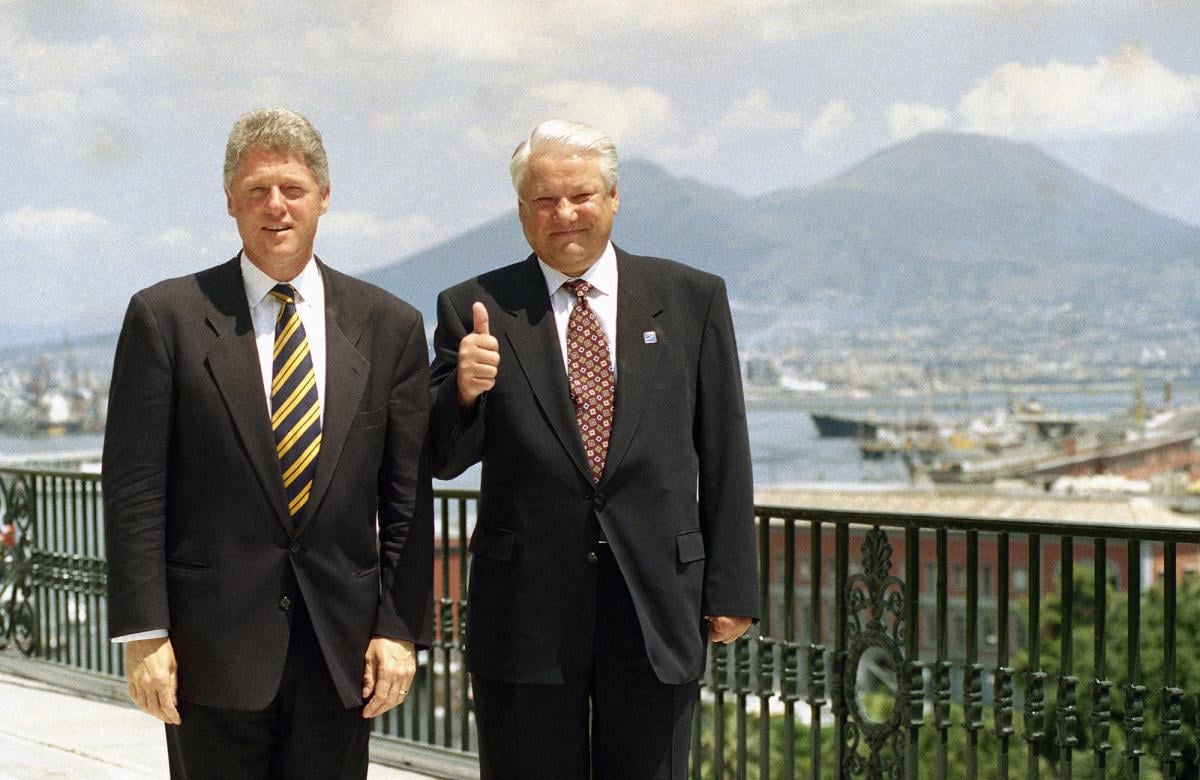
Clinton and Yeltsin in Naples, July 10, 1994.  Dormant Vesuvius is in the background.  (Eruption wouldn’t happen until Budapest).  Source:  Inosmi.ru Declassified documents show security assurances against NATO expansion to Soviet leaders from Baker, Bush, Genscher, Kohl, Gates, Mitterrand, Thatcher, Hurd, Major, and Woerner Slavic Studies Panel Addresses “Who Promised What to Whom on NATO Expansion?” By Svetlana Savranskaya and Tom Blanton (Compiled and edited) January 7, 2022 Washington, D.C., November 24, 2021 – The biggest train wreck on the track to NATO expansion in the 1990s – Boris Yeltsin’s “cold peace” blow up at Bill Clinton in Budapest in December 1994 – was the result of “combustible” domestic politics in both the U.S. and Russia, and contradictions in the Clinton attempt to have his cake both ways, expanding NATO and partnering with Russia at the same time, according to newly declassified U.S. documents published today by the National Security Archive....
pinkerism
I’m old enough to remember when you couldn’t do a speaking event related to war and peace without being asked numerous reasonable and not so reasonable questions about 9/11 (each accompanied by a stack of DVDs and flyers presented to you as a revelation from on high). There was a long period when you could count on the inevitable question about “peak oil.” Originally published at Worldbeyondwar.org I’ve been around enough to know that you can’t talk to peace-oriented people without a question about creating a Department of Peace, or to non-peace-oriented people without a question about good humanitarian wars against irrational foreigners who can’t be reasoned with, or to any group at all in the United States and some other countries without “What about Hitler?,” or to any self-selected audience at a peace-related event without the question about why the other people in the room are disproportionately old, white,...
yellow-peril
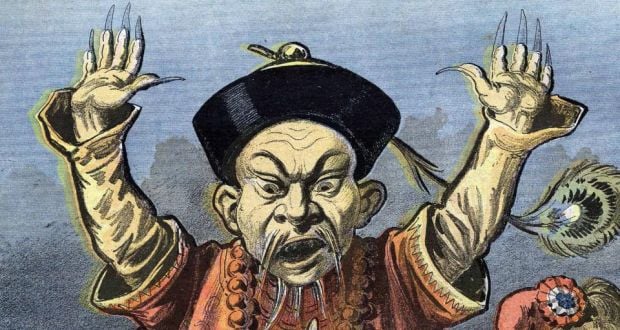
By Leung Wing-Fai November 16, 2021 Review: Fascination mixed with fear is how many in the West culturally construct the East Apocalyptic pollution, “Asian” flu, unfettered economic growth, boot camps for internet addiction, hacker attacks on western businesses and governments:– there is no shortage of fascination mixed with fear directed towards the culturally constructed East. Yellow Peril! An Archive of Anti-Asian Fear distils and presents a collection of accounts, images and essays related to this fear. The phrase yellow peril (sometimes yellow terror or yellow spectre), coined by Kaiser Wilhelm II of Germany, in the 1880s, after a dream in which he saw the Buddha riding a dragon threatening to invade Europe, blends western anxieties about sex, racist fears of the alien other, and the Spenglerian belief that the West will become outnumbered and enslaved by the East. These fears became increasingly reinscribed as ideology through popular cultural products. In the late...
Afghanistan2
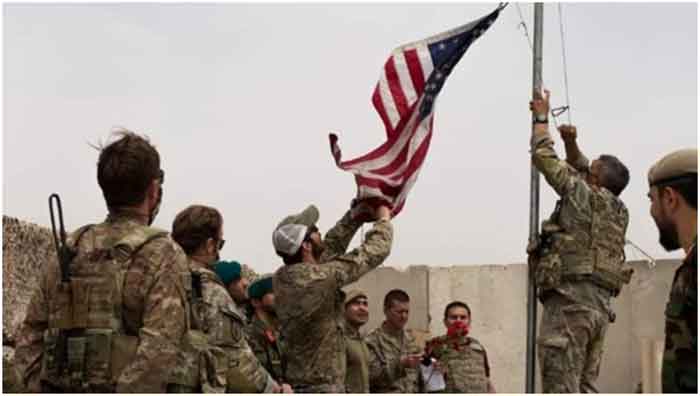
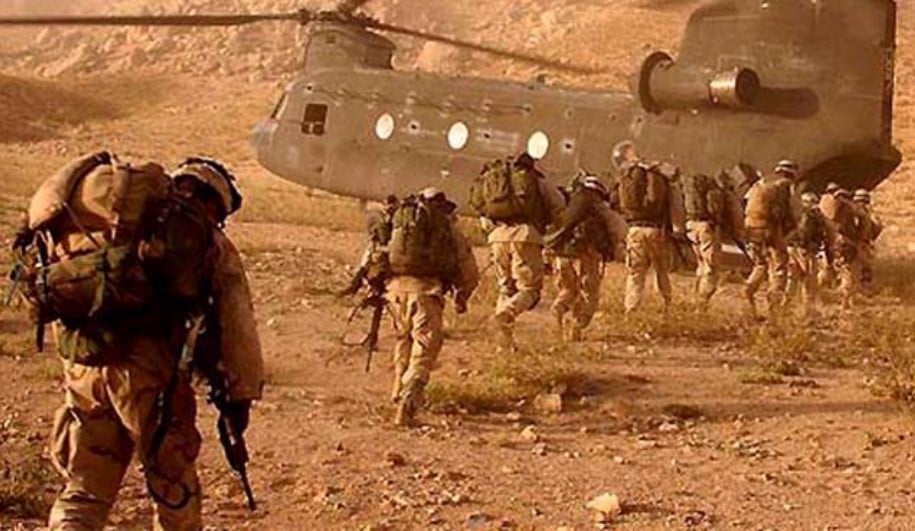
Handover ceremony at Camp Anthonic, from US Army to Afghan Special Forces, Helmand province, Afghanistan, May 2, 2021. Tom Engelhardt October 27, 2021 They weren’t kidding when they called Afghanistan the “graveyard of empires.” Indeed, that cemetery has just taken another imperial body. And it wasn’t pretty, was it? Not that anyone should be surprised. Even after 20 years of preparation, a burial never is. In fact, the shock and awe(fulness) in Kabul and Washington over these last weeks shouldn’t have been surprising, given our history. After all, we were the ones who prepared the ground and dug the grave for the previous interment in that very cemetery. Originally published at Countercurrents That, of course, took place between 1979 and 1989 when Washington had no hesitation about using the most extreme Islamists — arming, funding, training, and advising them — to ensure that one more imperial carcass, that of the Soviet Union, would be buried...

9341b8f4-7c18-11e7-83c9-6be3df13972a_972x_173110
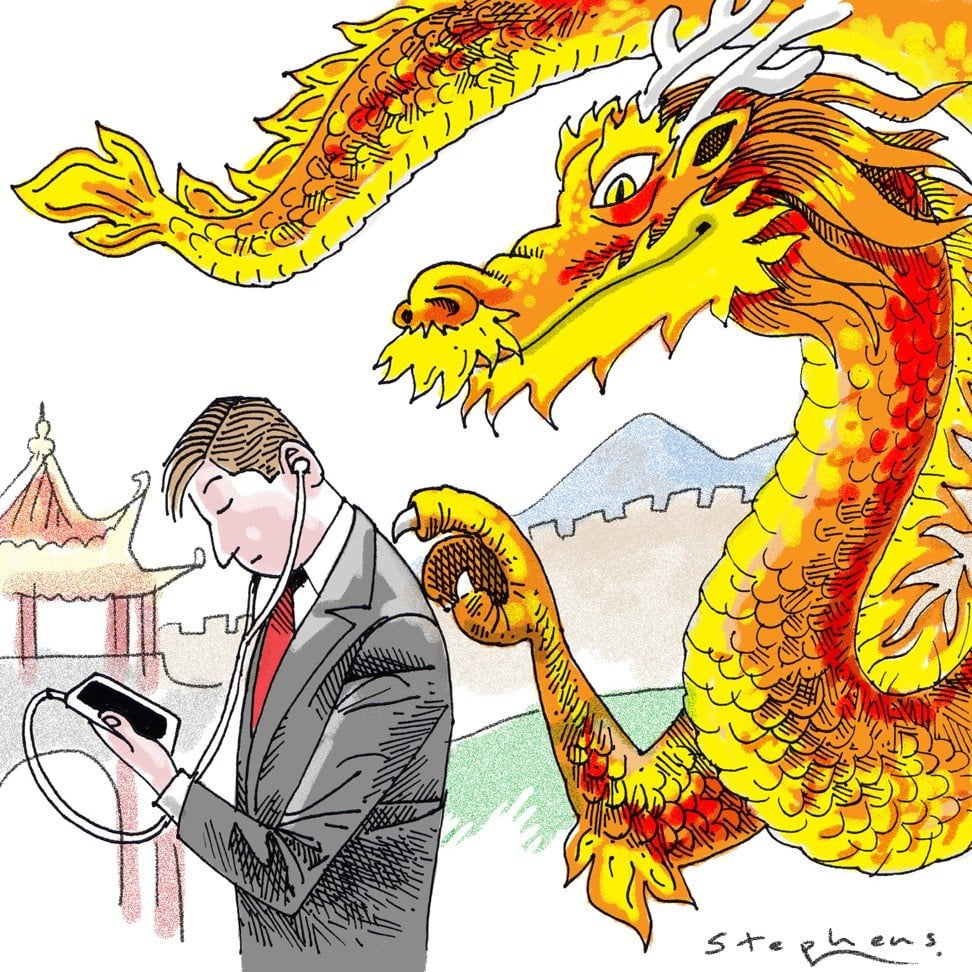
It is dispiriting and indeed alarming to see how ignorant the West is about China. Illustration: Craig Stephens In 2017, shortly before his death, Jean-Pierre Lehmann said that the country’s centrality in our 21st-century world makes it imperative that outsiders understand what is shaping its views and decisions, and Hong Kong could do more to facilitate such learning Jean-Pierre Lehmann October 29, 2021 Far from ushering in a “new world order”, so far the 21st century has been marked by turbulent uncertainties. There are very few things on which a consensus could arise – even on the most critical issues. For example, will there be war, or not, and, if so, between who? There is, however, one thing that seems incontestable: in stark contrast to the 19th and 20th centuries, when China was a peripheral passive actor in global affairs, in the 21st century its role is and will be...
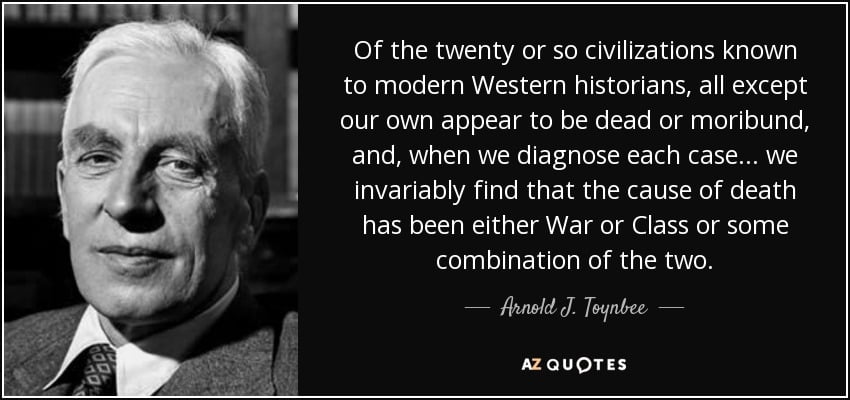
quote-of-the-twenty-or-so-civilizations-known-to-modern-western-historians-all-except-our-arnold-j-toynbee-71-41-43
Translation of the Introduction to the New Edition of Arnold Toynbee’s Civilisation on Trial, translated into Persian by Farhang Jahanpour Farhang Jahanpour October 28, 2021 More than 45 years have passed since the publication of my translation of “Civilisation on Trial” by Arnold Toynbee (1889-1975) – read the entire book in English here. When that translation was first published by Isfahan University Press in 1976 it was warmly received, and in a short time, more than half of the copies of the first printing had been sold. Unfortunately, a short time after its publication, with the start of the growing political tensions and clashes that led to the Islamic Revolution, the book was caught up in the revolutionary maelstrom. Since then, the book has never been republished. However, more than 45 years later, in view of the importance of the book and its relevance regarding some of the latest political...
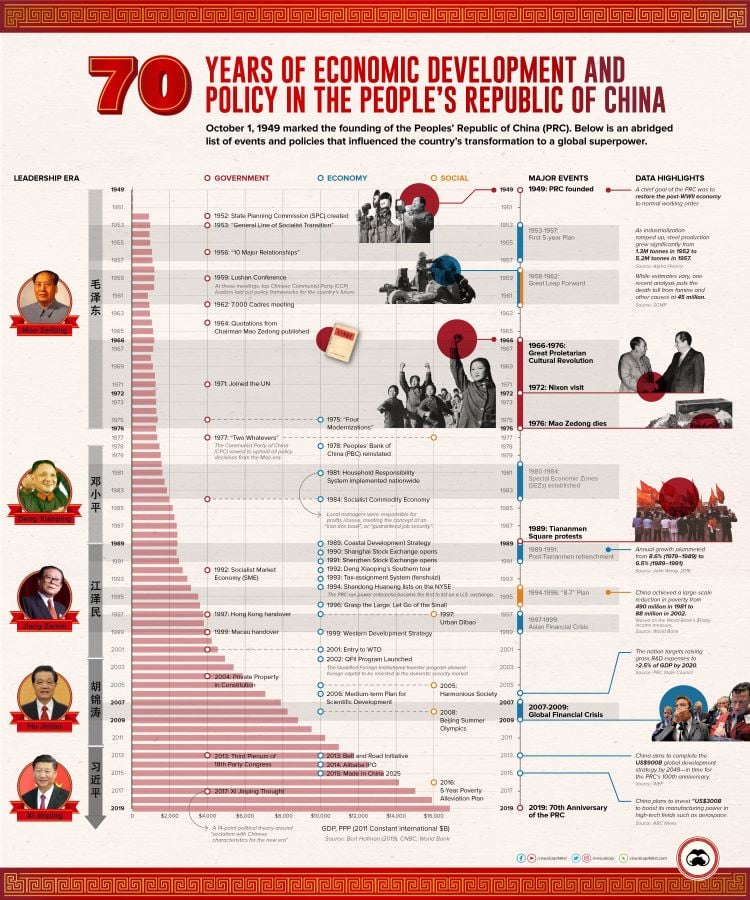
China_70_years-1500-2
View a high-resolution version of this graphic here. Iman Ghosh October 21, 2021 Chart: 70 Years of China’s Economic Growth From agrarian economy to global superpower in half a century – China’s transformation has been an economic success story unlike any other. Today, China is the world’s second largest economy, making up 16% of $86 trillion global GDP in nominal terms. If you adjust numbers for purchasing power parity (PPP), the Chinese economy has already been the world’s largest since 2014. The upward trajectory over the last 70 years has been filled with watershed moments, strategic directives, and shocking tragedies — and all of this can be traced back to the founding of the People’s Republic of China (PRC) on October 1st, 1949. Originally published in 2019 at Visualcapitalist.com How the PRC Came to Be The Chinese Civil War (1927–1949) between the Republic of China (ROC) and the Communist Party of China (CPC) caused a fractal...
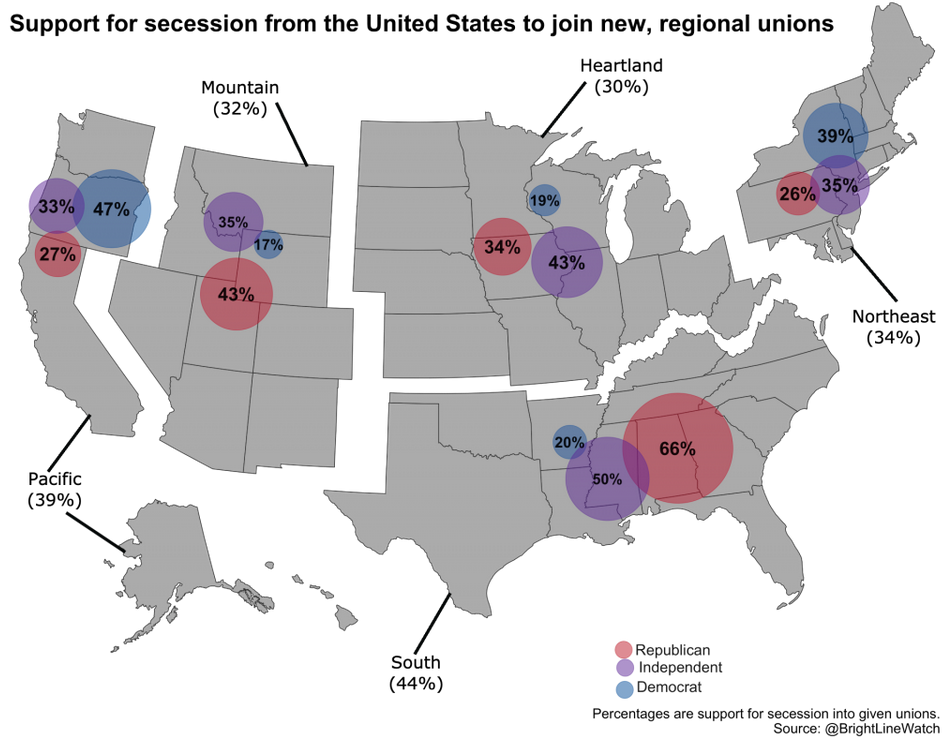
1_Rle4-AtatA3X2T81EMc5mw
Bright Line Watch polling results by region. Question: “Would you support or oppose [your state] seceding from the United States to join a new union with [list of states in new union]?” This article was originally published on July 16, 2021 Andrew Tanner October 9, 2021 Since 2016, I have watched America’s slow march over a cliff with a mix of fascination and horror. But the results of recent polls by Bright Line Watch have provided the first hard and frighteningly conclusive evidence that Americans are moving fast down the road I predicted—towards a national divorce. I have unfortunately been right about almost every major development in America since Trump won the Republican Party nomination in 2016. Originally published at gen.medium.com Like many observers, I didn’t take Trump’s campaign seriously at first. His first attempt at a campaign in 2012 collapsed before the first primary. The second defied every rule I had learned...
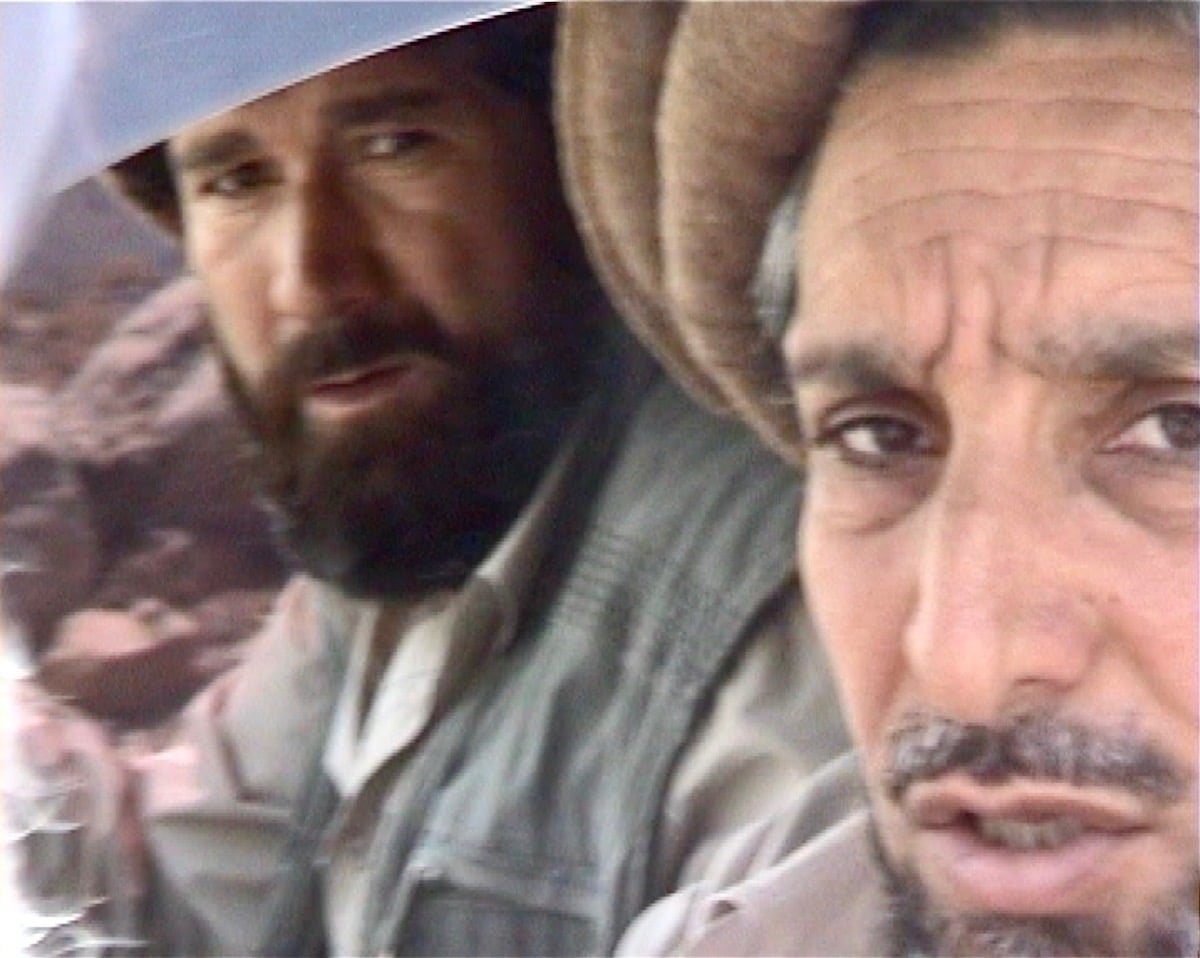
Mashood
Massoud leaving Bazarak in the Panjshir after our interview in August 2001, roughly three weeks before his assassination. Photo: Pepe Escobar We may never know the full contours of the whole riddle inside an enigma when it comes to 9/11 and related issues Pepe Escobar September 13, 2021 It’s impossible not to start with the latest tremor in a series of stunning geopolitical earthquakes.  Exactly 20 years after 9/11 and the subsequent onset of the Global War on Terror (GWOT), the Taliban will hold a ceremony in Kabul to celebrate their victory in that misguided Forever War. Four key exponents of Eurasia integration – China, Russia, Iran and Pakistan – as well as Turkey and Qatar, will be officially represented, witnessing the official return of the Islamic Emirate of Afghanistan. As blowbacks go, this one is nothing short of intergalactic. Originally published at Asia Times The plot thickens when we...
us-army
U.S. Army NATO, the United States and its vassal-states in Afghanistan Håkan Wiberg †2010 Former TFF Board member and Associate 9 september, 2021 AS FAR BACK as it is possible to trace the history of what is now Afghanistan, it has alternately been invaded — by among others the Median, Persian, Mongol, British and U.S. empires — and served as the base of expanding regional powers. The history of modern Afghanistan begins in 1747, with the coronation of Ahmed Abdali of the Durrani clan. Re-published online at Nordic News Network British expansion in India soon presented Afghanistan with a new threat — which became a reality in 1839 with the first large-scale British invasion. Shortly thereafter came the Russian expansion into Central Asia, leading to the “Great Game” between the two empires for control of the region. Afghanistan was drawn into minor clashes and some major wars with both of...
R2103B_DU
Rana Mitter and Elsbeth Johnson August 23, 2021 Many people have wrongly assumed that political freedom would follow new economic freedoms in China and that its economic growth would have to be built on the same foundations as in the West. The authors suggest that those assumptions are rooted in three essentially false beliefs about modern China: (1) Economics and democracy are two sides of the same coin; (2) authoritarian political systems can’t be legitimate; and (3) the Chinese live, work, and invest like Westerners. But at every point since 1949 the Chinese Communist Party—central to the institutions, society, and daily experiences that shape all Chinese people—has stressed the importance of Chinese history and of Marxist-Leninist doctrine. Until Western companies and politicians understand this and revise their views, they will continue to get China wrong. Originally appeared in the May-June 2021 Harvard Business Review here When we first traveled to China, in the early...
TaliTeaching
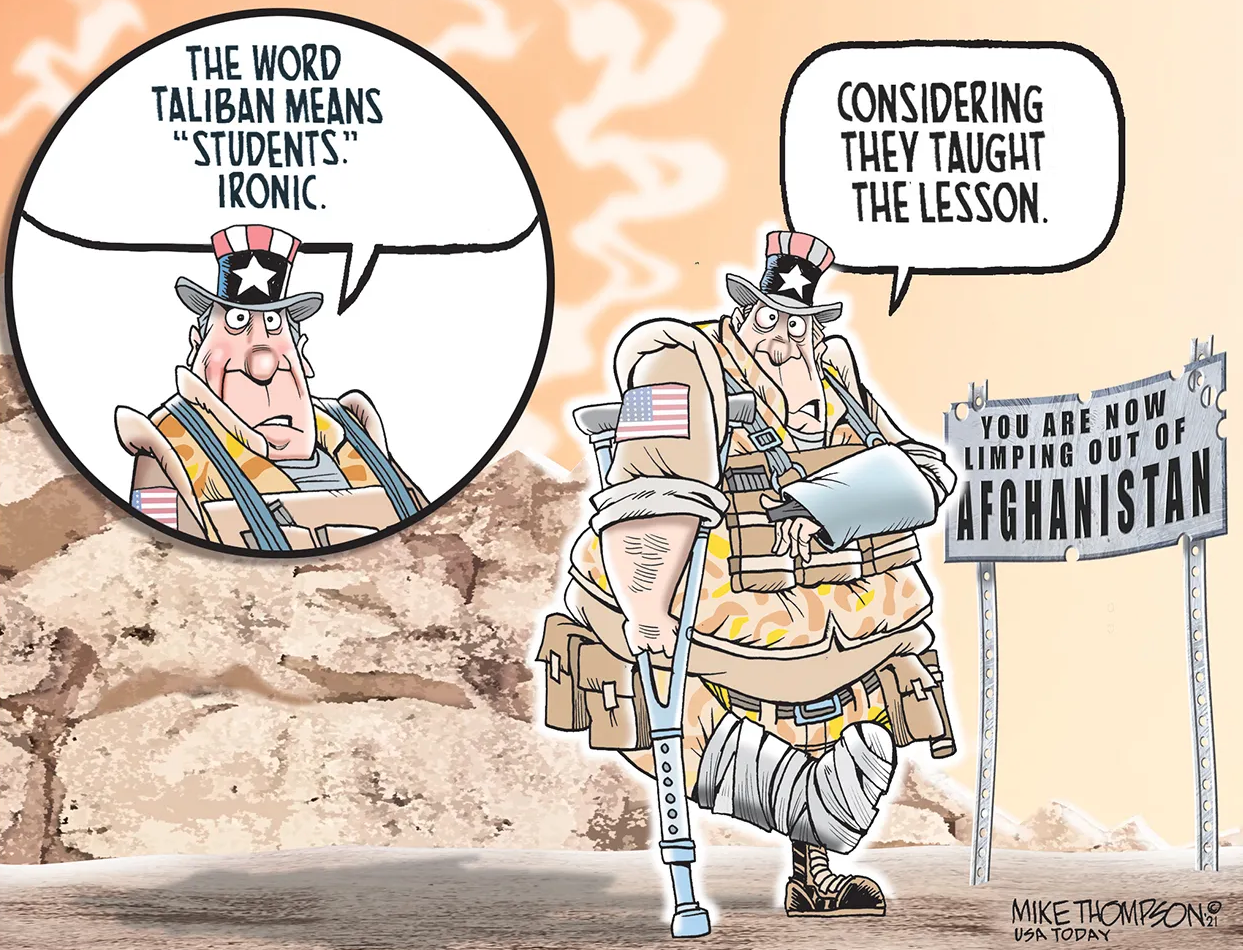
, in Washington and New York, everybody talked about who could have done it, how they did it and with what means. The only thing never brought to the fore was: WHY would somebody want to do something like 9/11 to the United States of America? By not asking the Why question, the US could stand as the innocent victim of cataclysmic violence. It would not have to do any soul searching and therefore no change of its global militarist policy. 9/11 was not a response to US foreign policy – but it needed a response. The world felt sympathy for the American suffering – much more so than for the suffering and deaths in other countries around the world. The fact is that the 9/11 attack targeted the US’ global finance-capital (World Trade Center), its global military (Pentagon) and its political (White House, however not hit) centres – not...
Categories

Year

Author / Contributor

Region