
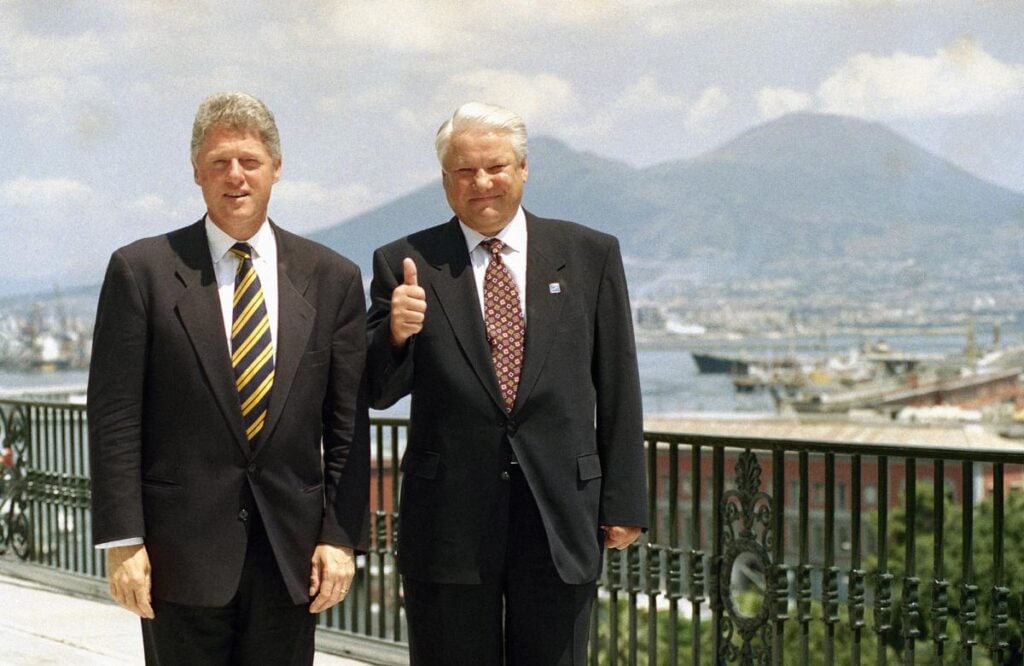
Clinton and Yeltsin in Naples, July 10, 1994.  Dormant Vesuvius is in the background.  (Eruption wouldn’t happen until Budapest).  Source:  Inosmi.ru

Declassified documents show security assurances against NATO expansion to Soviet leaders from Baker, Bush, Genscher, Kohl, Gates, Mitterrand, Thatcher, Hurd, Major, and Woerner

Slavic Studies Panel Addresses “Who Promised What to Whom on NATO Expansion?”

By Svetlana Savranskaya and Tom Blanton (Compiled and edited)

January 7, 2022

Washington, D.C., November 24, 2021 – The biggest train wreck on the track to NATO expansion in the 1990s – Boris Yeltsin’s “cold peace” blow up at Bill Clinton in Budapest in December 1994 – was the result of “combustible” domestic politics in both the U.S. and Russia, and contradictions in the Clinton attempt to have his cake both ways, expanding NATO and partnering with Russia at the same time, according to newly declassified U.S. documents published today by the National Security Archive.

The Yeltsin eruption on December 5, 1994, made the top of the front page of the New York Times the next day, with the Russian president’s accusation (in front of Clinton and other heads of state gathered for a summit of the Conference on Security and Cooperation in Europe, CSCE) that the “domineering” U.S. was “trying to split [the] continent again” through NATO expansion.

Originally published by the National Security Archive at Georg Washington University

The angry tone of Yeltsin’s speech echoed years later in his successor Vladimir Putin’s famous 2007 speech at the Munich security conference, though by then the list of Russian grievances went well beyond NATO expansion to such unilateral U.S. actions as withdrawal from the Anti-Ballistic Missile Treaty and the invasion of Iraq.

The new documents, the result of a Freedom of Information Act lawsuit by the National Security Archive, include a series of revelatory “Bill-Boris” letters in the summer and fall of 1994, and the previously secret memcon of the presidents’ one-on-one at the Washington summit in September 1994.

Clinton kept assuring Yeltsin any NATO enlargement would be slow, with no surprises, building a Europe that was inclusive, not exclusive, and in “partnership” with Russia. In a phone call on July 5, 1994, Clinton told Yeltsin “I would like us to focus on the Partnership for Peace program” not NATO.

At the same time, however, “policy entrepreneurs” in Washington were revving up the bureaucratic process for more rapid NATO enlargement than expected either by Moscow or the Pentagon,[1] which was committed to the Partnership for Peace as the main venue for security integration of Europe, not least because it could include Russia and Ukraine.[2]

The new documents include insightful cables from U.S. Ambassador to Moscow Thomas Pickering, explaining Yeltsin’s new hard-line at Budapest as the result of multiple factors. Not least, Pickering pointed to “strong domestic opposition across the [Russian] political spectrum to early NATO expansion,” criticism of Yeltsin and his foreign minister, Andrei Kozyrev, as too “compliant to the West,” and the growing conviction in Moscow that U.S. domestic politics – the pro-expansion Republicans’ sweep of the Congressional mid-term elections in November 1994 – would tilt U.S. policy away from taking Russia’s concerns into account.

Pickering was perhaps too diplomatic because there was plenty of blame to go around on the U.S. side. Clinton wrote in his memoir, “Budapest was embarrassing, a rare moment when people on both sides dropped the ball….”[3] Actually, the drops were almost all in Washington. White House schedulers led by chief of staff Leon Panetta tried to prevent Clinton from even going to Budapest by constraining his window there to eight hours, which meant no time for a one-on-one with Yeltsin. 

Clinton himself thought he was doing Yeltsin a big favor by even coming and expected good press from the substantial reduction in nuclear arsenals that would result from the signing of the Budapest memorandum on security assurances for Ukraine (violated by Russia in 2014).

National Security Adviser Tony Lake gave Clinton a prepared text that “was all yin and no yang – sure to please the Central Europeans and enthusiasts for enlargement, but equally sure to drive the Russians nuts….” The author of that phrase, Deputy Secretary of State Strobe Talbott, wasn’t even in Budapest, paying attention to the Haiti crisis instead (“never again” he later wrote, would he miss a Yeltsin meeting).[4]

The new documents include a previously secret National Security Council memo from Senior Director for Russia Nicholas Burns to Talbott, so sensitive that Burns had it delivered by courier, describing Clinton’s reaction to Budapest as “really pissed off” and reporting “the President did not want to be used any more as a prop by Yeltsin.”

At the same time, Burns stressed, “we need to separate our understandable anger on the tone of the debate with [sic] Russia’s substantive concerns which we must take seriously.” Similarly, the Pickering cables recommended using Vice President Al Gore’s previously scheduled December trip to Moscow for meetings with Prime Minister Victor Chernomyrdin to also meet with Yeltsin, calm down the discussion, and get back on a “workable track.”

Mending fences would include Gore’s description to Yeltsin of the parallel NATO and U.S.-Russia tracks as spaceships docking simultaneously and very carefully,[5] and Gore and then Clinton assuring the Russians (but not in writing, as Kozyrev kept asking for) that no NATO action on new members would happen before the 1995 Duma elections or the 1996 presidential elections in Russia.

The final assurance was Clinton’s agreement (despite Russia’s brutal Chechen war and multiple domestic pressures) to come to Moscow in May 1995 for the 50th anniversary celebrations of the victory over Hitler. In Moscow, Yeltsin berated Clinton about NATO expansion, seeing “nothing but humiliation” for Russia: “For me to agree to the borders of NATO expanding towards those of Russia – that would constitute a betrayal on my part of the Russian people.”

But Yeltsin also saw Clinton would do whatever he could to ensure Yeltsin’s re-election in 1996, and that mattered the most to him. Only after that Moscow summit would Yeltsin order Kozyrev to sign Russia up for the Partnership for Peace.

The new documents only reached the public domain as the result of a Freedom of Information lawsuit by the National Security Archive against the State Department, seeking the retired files of Strobe Talbott. Thanks to excellent representation by noted FOIA attorney David Sobel, State set up a schedule of regular releases to the Archive over the past three years.

The full corpus of thousands of pages covering the entire 1990s will appear next year in the award-winning series published by ProQuest, the Digital National Security Archive, which won Choice Magazine’s designation as an “Outstanding Academic Title 2018.”

The Archive also benefited from State’s assignment of veteran reviewer Geoffrey Chapman to the task of assessing the Talbott documents for declassification. Chapman ranks among the most thorough, expert, and professional declassifiers in the U.S. government.

For the notes in this article and 18 documents, please consult the original here.

Originally published by the National Security Archive at George Washington University

Please help TFF remain truly independent by contributing if you benefited from this article

Note
For more links concerning the Ukraine conflict, please see Better World Link – which is a very useful link resource on numerous other issues too.

Related Posts

The agreement is catastrophic both because of what it says and what it doesn’t mention. It reduces further the major asset of security policies: Freedom of action. Jan Oberg TFF director September 25, 2026 A couple of hours before the agreement was signed on September 22, 2026, I published the following 13 hypotheses about what it would most likely contain on TFF Substack (in English). I was wrong on only the first point. Contrary to what Trump had written on his Truth Social platform, it does not appear to come into force immediately. In fact, it turned out to be worse than even I had anticipated. After these hypotheses now come a number of reflections in light of what the agreement actually contains, and does not contain, as well as the way in which it has generally been presented by major media outlets and by the public-service broadcaster DR. My...
A friendly quarrel while we agree that the US sanctions are a weapon of mass destruction and kill more people than wars do. And that we must talk much more about sanctions than we have so far. Jan Oberg, TFF director March 16, 2026 John Mearsheimer recently stated that U.S. sanctions murdered around 38 million people between 1971 and 2021 – see the video below. It is a dramatic figure, and it has spread quickly because it captures, in one sentence, the enormous human cost of modern sanctions. I share his concern about the destructive effects of economic coercion. But the specific number he cites — and the way he attributes it — deserves a friendly academic clarification. The figure comes from a 2023 Lancet Global Health article estimating the mortality effects of unilateral U.S. and EU sanctions over the past half‑century. This is the first point where Mearsheimer’s shorthand diverges from the text: the study...
The MSC’s closed groupthink militarism offers only one prescription — more weapons — even as record military expenditures, squeezed from taxpayers in economic crisis, destroy diplomacy and drive escalation to the highest war risks in decades. Jan Oberg TFF director February 13, 2026 From Dialogue Forum to Militarised Ritual For decades, the Munich Security Conference (MSC) – which opened today and runs till Sunday – was one of the few places where adversaries could meet without theatrics. Founded in 1963 as the Wehrkundetagung, it served as a discreet Cold War dialogue forum between NATO and the Warsaw Pact. Even at moments of high tension, Soviet and later Russian representatives were present, and Munich allowed uncomfortable messages to be delivered directly rather than through press releases or military manoeuvres. That era has vanished. The MSC has become something entirely different: a €13–20 million annual gathering of a closed Western security elite, a polished meeting...

Recent Articles

Tony Robinson October 4, 2026 Violence is easy to recognise when someone is being beaten, shot or killed. It becomes more difficult when nobody is holding a weapon. Poverty, discrimination, exploitation and repression can restrict a human life just as effectively, although they do so in very different ways and with very different consequences. Simply adding more categories to an ever-growing list of forms of violence does not really solve the problem. The more interesting question is what all these different situations have in common and why it makes sense to describe them using the same word. Human beings do not simply react to what happens around them. They remember the past, imagine things that do not yet exist, make plans and undertake projects. Workers organise because they imagine different working conditions; people migrate because they imagine another life somewhere else; social movements emerge because people refuse to accept the...
It’s a matter of principles, courage, vision and pulling together – while the militarist world is falling apart… Peter Langille October 3, 2026 “Here, then, is the problem which we present to you, stark and dreadful and inescapable: Shall we put an end to the human race; or shall mankind renounce war?”The Bertrand Russell—Albert Einstein Manifesto, July 9, 1955 ⁕ The forecast for what’s ahead is worrisome. The sharp rise in armed conflicts over the past three years is adding to what was already the highest level in over seventy years. Genocides, which should be prevented are supported. A shared climate emergency that jeopardises survival is ignored. Diverse polls now suggest that people are war-weary, worried and interested in a more effective United Nations. And, there are viable policy options for a more secure world! Yet governments are doubling-down, betting on more war and investing heavily. If current trends persist,...
Johan Galtung 1930-2024October 2015 Published here on October 3, 2026 Let us focus on Civilization for conflict analysis and remedies. Major forms of disorder use violence; war is state organized violence. The most belligerent states are the United States of America and Israel, both with civilization roots. National Evangelism, the US Protestant Christian civilization– more national than evangelical–justifies US warfare as exceptionalism of a people chosen by God, with a manifest destiny to run the world. Orthodox Judaism justifies Israeli warfare to conquer and expand from Nile to Euphrates as a religious right and duty to the Eternal One. The third most belligerent country, the UK, no longer believes it is God-chosen but chosen by the USA; not quite the same but something. But the root cause of global disorder lies in the Occident–with Islam–seeing itself as the single, universal civilization valid for all at all times, all others being...

TFF on Substack

Discover and subscribe to more peace materials on TFF Substack

Most Popular

Tony Robinson October 4, 2026 Violence is easy to recognise when someone is being beaten, shot or killed. It becomes more difficult when nobody is holding a weapon. Poverty, discrimination, exploitation and repression can restrict a human life just as effectively, although they do so in very different ways and with very different consequences. Simply adding more categories to an ever-growing list of forms of violence does not really solve the problem. The more interesting question is what all these different situations have in common and why it makes sense to describe them using the same word. Human beings do not simply react to what happens around them. They remember the past, imagine things that do not yet exist, make plans and undertake projects. Workers organise because they imagine different working conditions; people migrate because they imagine another life somewhere else; social movements emerge because people refuse to accept the...
It’s a matter of principles, courage, vision and pulling together – while the militarist world is falling apart… Peter Langille October 3, 2026 “Here, then, is the problem which we present to you, stark and dreadful and inescapable: Shall we put an end to the human race; or shall mankind renounce war?”The Bertrand Russell—Albert Einstein Manifesto, July 9, 1955 ⁕ The forecast for what’s ahead is worrisome. The sharp rise in armed conflicts over the past three years is adding to what was already the highest level in over seventy years. Genocides, which should be prevented are supported. A shared climate emergency that jeopardises survival is ignored. Diverse polls now suggest that people are war-weary, worried and interested in a more effective United Nations. And, there are viable policy options for a more secure world! Yet governments are doubling-down, betting on more war and investing heavily. If current trends persist,...
Johan Galtung 1930-2024October 2015 Published here on October 3, 2026 Let us focus on Civilization for conflict analysis and remedies. Major forms of disorder use violence; war is state organized violence. The most belligerent states are the United States of America and Israel, both with civilization roots. National Evangelism, the US Protestant Christian civilization– more national than evangelical–justifies US warfare as exceptionalism of a people chosen by God, with a manifest destiny to run the world. Orthodox Judaism justifies Israeli warfare to conquer and expand from Nile to Euphrates as a religious right and duty to the Eternal One. The third most belligerent country, the UK, no longer believes it is God-chosen but chosen by the USA; not quite the same but something. But the root cause of global disorder lies in the Occident–with Islam–seeing itself as the single, universal civilization valid for all at all times, all others being...
Read More
Living-Peace-Sign-Budapest-copy
Tony Robinson October 4, 2026 Violence is easy to recognise when someone is being beaten, shot or killed. It becomes more difficult when nobody is holding a weapon. Poverty, discrimination, exploitation and repression can restrict a human life just as effectively, although they do so in very different ways and with very different consequences. Simply adding more categories to an ever-growing list of forms of violence does not really solve the problem. The more interesting question is what all these different situations have in common and why it makes sense to describe them using the same word. Human beings do not simply react to what happens around them. They remember the past, imagine things that do not yet exist, make plans and undertake projects. Workers organise because they imagine different working conditions; people migrate because they imagine another life somewhere else; social movements emerge because people refuse to accept the...
b54a1f10-8c65-4f0b-9dd5-4abc0a7d04cc_2659x2659
It’s a matter of principles, courage, vision and pulling together – while the militarist world is falling apart… Peter Langille October 3, 2026 “Here, then, is the problem which we present to you, stark and dreadful and inescapable: Shall we put an end to the human race; or shall mankind renounce war?”The Bertrand Russell—Albert Einstein Manifesto, July 9, 1955 ⁕ The forecast for what’s ahead is worrisome. The sharp rise in armed conflicts over the past three years is adding to what was already the highest level in over seventy years. Genocides, which should be prevented are supported. A shared climate emergency that jeopardises survival is ignored. Diverse polls now suggest that people are war-weary, worried and interested in a more effective United Nations. And, there are viable policy options for a more secure world! Yet governments are doubling-down, betting on more war and investing heavily. If current trends persist,...
010
Johan Galtung 1930-2024October 2015 Published here on October 3, 2026 Let us focus on Civilization for conflict analysis and remedies. Major forms of disorder use violence; war is state organized violence. The most belligerent states are the United States of America and Israel, both with civilization roots. National Evangelism, the US Protestant Christian civilization– more national than evangelical–justifies US warfare as exceptionalism of a people chosen by God, with a manifest destiny to run the world. Orthodox Judaism justifies Israeli warfare to conquer and expand from Nile to Euphrates as a religious right and duty to the Eternal One. The third most belligerent country, the UK, no longer believes it is God-chosen but chosen by the USA; not quite the same but something. But the root cause of global disorder lies in the Occident–with Islam–seeing itself as the single, universal civilization valid for all at all times, all others being...
Screenshot 2026-10-02 011738
Jan ObergPhD, director, The Transnational Foundation for Peace and Future Research, TFFLund, Sweden October 2, 2026 This is my full original manuscript. The Chinese Academy of Social Science, CASS, makes two publications out if it. 1. China’s Five-year plan emphasized the capabilities of basic research and original innovation. It is regarded as the goal of the future social development, which, as required, should be significantly enhanced. Can you comment on the importance of original innovation in research and academic study? I believe it is easier to define “original innovation” in the natural sciences than in social sciences. The breaking points of what constitutes something new, or innovative, are not quite as sharp in the latter. But in both fields it is about opening up something that was closed, unseen, unexplored before – making manifest what was earlier latent. Innovations come in many forms and shapes – naming something that was not...
arctic-circle-map
The agreement is catastrophic both because of what it says and what it doesn’t mention. It reduces further the major asset of security policies: Freedom of action. Jan Oberg TFF director September 25, 2026 A couple of hours before the agreement was signed on September 22, 2026, I published the following 13 hypotheses about what it would most likely contain on TFF Substack (in English). I was wrong on only the first point. Contrary to what Trump had written on his Truth Social platform, it does not appear to come into force immediately. In fact, it turned out to be worse than even I had anticipated. After these hypotheses now come a number of reflections in light of what the agreement actually contains, and does not contain, as well as the way in which it has generally been presented by major media outlets and by the public-service broadcaster DR. My...
girl-5894831_1280
Below are TFF-related media mentions, comments, videos and social media posts published elsewhere but not on this homepage. We happen to catch and list only a fraction. Regarding video comments and debates, we recommend that you go to the TFF Video Channel on Substack where many of them are reproduced. Jan Oberg is a contributor to China Daily – 52 million daily clicks – and Global Times, CGTN and CCTV (the national television), China Investment, Xinhua News Agency and several others. Articles and videos on these media very often multiply into countless Chinese (and Western media) that re-post them from these main media. Thanks to The China Academy, his analyses, interviews and comments are frequently posted on YouTube channels such as Thinkers Forum and Wave Media. These videos are often re-posted on Bilibili (China’s YouTube), the China Content Center on TikTok, and on the Chinese edition of TikTok, Douyin.com. This means reaching hundreds of millions of viewers worldwide over a year. While there are too many to catch on all these...



