
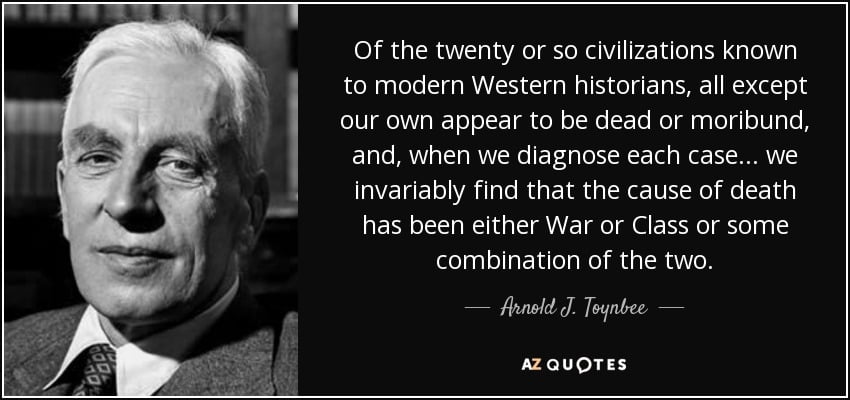
Translation of the Introduction to the New Edition of Arnold Toynbee’s Civilisation on Trial, translated into Persian by Farhang Jahanpour

October 28, 2021
More than 45 years have passed since the publication of my translation of “Civilisation on Trial” by Arnold Toynbee (1889-1975) – read the entire book in English here. When that translation was first published by Isfahan University Press in 1976 it was warmly received, and in a short time, more than half of the copies of the first printing had been sold.
Unfortunately, a short time after its publication, with the start of the growing political tensions and clashes that led to the Islamic Revolution, the book was caught up in the revolutionary maelstrom. Since then, the book has never been republished. However, more than 45 years later, in view of the importance of the book and its relevance regarding some of the latest political developments, some friends asked me if they could republish it online and put it at the disposal of the public free of charge so that the book can be accessed by those who are interested in its contents.
At the moment, in view of the very fast pace of developments and the lightning speed of change, we are grappling with a great deal of chaos and uncertainty. Under these circumstances, there seems to be a greater need for studying the changes that have taken place in the past few decades from a higher vantage point and with a wider perspective in order to make sense of some of those developments.
In recent times, we have seen the resurgence of powerful religious movements and the establishment of many governments that have based their legitimacy on various religious ideologies. They include the establishment of Israel as a Jewish state, the revival of Greek and Russian Orthodox Churches after seventy years of religious suppression under Communism, the establishment of avowedly Islamic governments in Iran, Pakistan, Saudi Arabia and many other Islamic countries, to Turkey’s new government distancing itself from Ataturk’s secularism and moving towards political Islam, the establishment of Hindu nationalism in India, and Buddhist nationalism in Myanmar.
All these developments seem to back Toynbee’s theories about the importance of religion, the defining role that it has played in the past, is still playing at present and may play in the future.
A short time after the publication of Toynbee’s book in 1948, as the world seemed to experience a period of relative and seemingly lasting stability under the domination of the two superpowers, many people dismissed Toynbee’s views and found them incompatible with the realities of a scientific and technological age. Therefore, books like Civilisation on Trial were regarded as remnants of a bygone age, totally out of step with a brave new world. However, as the result of some of the developments that I have referred to above, many people today are feeling more sympathetic towards Toynbee’s allegedly outdated views.

Toynbee believed in the pivotal role of religion in human societies. In his magisterial 12-volume book A Study of History (1934-1961), he examined the role of religion in past civilisations. He also believed that in the future more people would also turn to religion. He maintained that Christianity would play a pivotal role in shaping the future of human societies. He believed that all other great civilisations of the 20th century would be forced to react to the dominant position of the West based on a revitalised “Western Christianity”.
He regarded Russian Communism as the response of the Christian Orthodox Church to the West, China’s Maoism as the Buddhist response, and Mahatma Gandhi’s philosophy of satyagraha and ahimsa (soul force and non-violence) as the Hindu response to the West’s intellectual and political development.
Toynbee argued that Islam had not yet given an adequate response to the West, but he predicted that the Islamic world would provide a powerful response in the future.
The Islamic civilization
If Toynbee were alive today, without doubt, he would see the Islamic Revolution in Iran and the establishment of an Islamic Republic after 57 years of the secular governments of the Pahlavi monarchs as the response of Islam to Western civilisation. He might have also seen the rise of political Islam in a number of Islamic countries as examples of an Islamic response to the West.
However, he would have been horrified to see that Islam had given rise to a great civilisation that at its height had been ahead of Western civilisation and had established long periods of peace and stability under the Abbasid Caliphate, and later on under the Ottoman Empire in Turkey, the Safavid Empire in Iran and the Mughal Empire in India had degenerated to such an extent that some of the worst terrorist groups such as al-Qaeda, al-Shabab, Boko Haram and, worst of all, the so-called Islamic State in Iraq and Syria (ISIS), would carry out their atrocities in the name of Islam.
He would have certainly seen the divisions in the Islamic world and the rivalry and even military conflicts between many Sunni and Shi’a states and communities not as a sign of strength, but as a sign of weakness and decay. He would have seen the rise of a large number of military dictatorships in Islamic countries that have led to many devastating and destructive wars in Afghanistan, Iraq, Libya, Syria, Yemen, Somalia, etc, as the sign of the decline of what was once one of the great civilisations of the world.

The resurgence of the Taliban in Afghanistan after 20 years of Western occupation of that country following the horrendous events of 9/11 in New York and Washington is a very worrying development, especially for hard-pressed Afghan people, particularly women. After spending more than two trillion dollars, and having tens of thousands of Afghans and thousands of Western forces killed or wounded, the United States withdrew its forces and vacated its biggest base, the Bagram Air Base, in the dead of night as a defeated army.
The sudden collapse of the US-backed Afghan government is a clear sign of the failure of the US’s unending wars, on a par with the fall of Saigon on 30 April 1975. It shows that during the intervening half-century, US governments have not learned anything from their policy of reliance on military force.
The West helped to create, arm and support the Mujahedin fighters in Afghanistan in order to defeat the Soviet forces that had invaded that country in 1979. After the withdrawal of the Soviet forces in 1989 that was a major factor in the abrupt collapse of the Soviet Union the following year, the Mujahedin began fighting among themselves.
In order to stabilise Afghanistan and to help build gas pipelines from Turkmenistan to Karachi in Pakistan, the Americans, with the help of Pakistan, Saudi Arabia and the United Arab Emirates formed the Taliban who allegedly rushed to Afghanistan from their religious schools in Pakistan.
The United States and her European coalition partners initially managed to control Afghanistan through the Taliban, but they did not realise that they were playing with fire and that religious fanaticism would turn against them, as it did when the Taliban sheltered Usama bin Laden, the leader of Al-Qaeda, who carried out the atrocities against the US embassies in Kenya and Tanzania and eventually against the United States itself on 9/11.
Despite the deceptive statements of Taliban leaders after the withdrawal of US forces promising that they have learned their lessons from their past mistakes and have become more moderate, the young Taliban foot-soldiers who invaded various Afghan cities from villages are, if anything, more fanatical than their leaders in their devotion to their medieval ideology that has very little in common with true Islam.
With the re-emergence of the Taliban, all the gains of the past 20 years have been reversed and many Afghan women and girls will again have to bear the brunt of the Taliban’s reactionary beliefs. Also, once again, Afghanistan may provide shelter to new Islamic terrorist groups that wish to impose their harsh doctrine on Muslim masses and on the rest of the world, as though the world has stood still over the past 1,400 years.
Of course, Toynbee would have made a big mistake if he regarded militarism, radicalism, fundamentalism and terrorism as the only reactions of the Islamic world to the West, because although such movements adopt the name of Islam they have nothing in common with true Islam that preaches peace, tolerance, friendship, justice, compassion and cooperation.
Even under these adverse conditions, many movements have arisen in Islamic countries that provide a humane, mystical, modern, tolerant and progressive interpretation of Islam. There is no doubt that if Islam wishes to appeal to more and more people in the world or even to maintain the loyalty of its own followers it has to rely on such progressive movements and readings of Islam, rather than on harsh, fanatical and intolerant interpretations.
Toynbee would have seen other global trends as the dominant Western civilisation on trial
If Toynbee were alive today, he would have been horrified not only by what is happening in the Islamic world, but he would also have been even more horrified by many negative and worrying developments throughout the world. He would have seen the alarming growth of materialism and militarism in “the Christian West”, and the development of surveillance police states, the growth of fake news, and the rise of the post-truth world.
If we look at the world as a whole, we will see that it is in the most critical state that it has ever been since the end of the Second World War. After a large number of devastating wars in Afghanistan, Iraq, Libya, Somalia, Syria, Yemen, and repeated clashes between Israelis and the Palestinians, the situation in all those countries is now worse than ever. Some right-wing Neo-Conservative politicians in the West even wish to add Iran to the list of those failed states.
In addition to these never-ending wars, the competition between the West and the East has also intensified. After the collapse of communism and the dismemberment of the Soviet bloc and the emergence of many independent states in Eastern Europe, Central Asia and the Caucasus, the hostility between Russia and the West has not subsided. The West has practically surrounded Russia with many military bases and has imposed many sanctions on that country. In turn, Russia has responded to those measures by adopting a more hostile approach towards the West by strengthening its military capabilities and annexing Crimea.
The establishment of the European Union promised an era of peace and stability between the former powers in Europe that had waged the two devastating World Wars. However, there are signs of strain even in the EU, and with Brexit, Britain that was one of the leading members of the bloc has left the union and there are rumblings of discontent among some other EU members.
In addition to the continued hostility with Russia, a new Cold War has started between the West and China which is advancing to become the world’s number one economy in the near future. There is an intense economic, cultural, technological, political and military rivalry between the United States and China. China’s policies regarding the incorporation of Hong Kong and Taiwan into the mainland, and the occupation of parts of Tibet, Nepal and Mongolia, as well as some South China Sea islands, have given rise to military clashes between the West and China, as well as between India and China.

In addition to all those political and military conflicts, the world has been gripped by a deadly pandemic that has already afflicted more than 240 million people throughout the world, with nearly four and a half million dead. Meanwhile, with more than 620,000 deaths, the United States that is the most medically advanced country in the world has recorded the highest numbers of Covid-19 patients and deaths.
On top of all those problems, Climate Change and global warming threaten the future of the entire human race. With devastating fires in the United States, Turkey, Greece, Algeria and even in Siberia, with unprecedented floods in Europe and China, and with terrible droughts in the Middle East, Africa and other parts of the world, climate change is threatening the future of all societies. With the rapid melting of the ice caps in the North and South Poles, the sea level is rising to such an extent that it will submerge many low-lying areas of the world, forcing millions of people out of their homes.
Massive environmental problems, droughts, crop failures and food and water shortages will lead to instability and conflict and will create millions of refugees who will be forced to go to other countries in order to escape starvation and death. This will add to the already high level of homelessness and growing prejudice against immigrants and refugees in the West.
To add to all these natural and man-made disasters, the world is also facing the possibility of nuclear annihilation. There are already nine nuclear powers in the world, with more than 13,890 nuclear warheads between them. The United States and Russia possess over 91% of all those weapons. Only two small bombs dropped at the end of the Second World War on Hiroshima and Nagasaki vaporised the two cities and killed between 129,000 and 226,000 people. It is estimated that if there is a nuclear war between the superpowers human life on this planet will cease to exist.
Despite this appalling prospect, all nuclear powers are spending hundreds of billions of dollars modernising their nuclear weapons and making them more deadly. The nuclear scientists who monitor the so-called “Doomsday Clock”, which was set up after the Second World War during the period of growing tension between the West and the Soviet Union, have set the hands of that clock at 100 seconds before midnight, which has been unprecedented since the setting up of the clock in 1947. This means that the whole world is dangerously close to the moment of human annihilation.
All of this means that the entire world is in a state of turmoil and the pace of this turmoil is accelerating. It seems that all the existing international organisations and political ideologies are incapable of finding a cure for the dreadful situation that the world – humanity – is facing.

Optimism in spite of all: We need the broad macro perspective plus deep-thinking to find answers
Maybe the answer to all these calamities and challenges must go beyond the usual political and materialistic mechanisms, and maybe once again mankind is in need of a new spiritual and intellectual revival.
Faced with this situation, no partial solution is adequate, and no nation, religion, culture or civilisation on its own will be able to cope with the enormity of these challenges.
Whether we agree with Toynbee’s view of history or not, it will be beneficial to cast a new look at the analyses and prescriptions of that deep-thinking and visionary historian and to see whether there are any lessons we can learn from him that can throw some light on our predicament. We must make use of any idea that may take us back from the edge of the precipice.
One major lesson that humanity must learn is that today’s problems are universal and their remedies must be universal and collective too. We need to make use of the best religious, philosophical and scientific insights and achievements of all Eastern and Western cultures. Today’s global problems require global remedies. Not only do religious, political and national divisions not help us achieve universal peace, on the contrary, they will impede our search for a way out.
In the same way that old religions and ideologies have helped us cope with the problems of the past and overcome them, today a united, comprehensive, universal effort is needed to cope with contemporary global problems.
Today, all of us are in the same boat. If it sinks, all of us will sink with it.
Human history has shown us that, despite all their divisions, human beings have been able to work for a common cause at critical times. Had it not been for this urge to move forward and unite in order to overcome the problems, the human race would have ceased to exist a long time ago.
With this confidence in the inherent goodness and oneness of humanity, we can face our daunting problems with hope, optimism and a renewed vigour to create unity in diversity and save mankind from inevitable collapse and extinction in the absence of unity and solidarity.
Far from losing hope, with new enthusiasm, energy and dedication we must put the dark days behind us and move towards the dawn of a new day for the whole of mankind.
This requires a universal renaissance and a new global vision.
September 2021

Notes
• The editor has added a few links to the original version of this text to help readers better understand what Arnold Toynbee and his monumental macro-historical research is all about.
• When it comes to China’s policies, please see also two studies from TFF – “The Xinjiang Genocide Determination As Agenda” and “Behind The Smokescreen – An Analysis of the West’s Destructive China Cold War Agenda And Why It Must Stop,” both from 2021.
• If you want to read more about Toynbee and many other macro-historian, we suggest Johan Galtung and Sohail Inayatullah, eds., “Macrohistory And Macrohistorians. Perspectives on Individual, Social and Civilizational Change,” 1997 which you can download as PDF for only US$ 15 here.






5 Responses
Your historical insight is great until it comes to 9/11. Claiming that Osama bin Laden was the mastermind behind the 9/11-atrocities is completely wrong. It’s the American government’s official conspiracy theory that Osama bin Laden and Al-Qaeda attacked the USA that day. This is however a lie and has been proven so by many intellectual organisations the last 15 Years. This I can document in contrary to the American government that cannot prove its accusations. I don’t believe religion can help us. Truth must always be rated higher than religion. As Gandhi said “There is no god higher than truth”. I believe the greatest threat in the world comes from the power elite. They are controlling us through the mainstreammedia (which they own). We are controlled by the propaganda; our own Western propaganda. The only solution to this captivity is to fight back. And the first condition to do so is getting the truth from free and independant media. We must fight for the fundamental civil rights and our crumbling democracies and fight against the increasing surveillance and control. As Gandhi also said “If it weren’t for Christians, I’d be a Christian”:-) We already know how to behave properly towards each other. We knew how before the religions were created.
Thank you psjessen for your comment. I too agree with most of what you say and your excellent quotations from Gandhi, with the exception of your comments about 9/11. Setting out Toynbee’s views about religion does not mean that I agree with them. In my long introduction to the first edition of the book, I have challenged his views about religion. He is certainly right about the historical importance of religion in nearly all societies. Even in our own time, it seems that the reports about the demise of religion have been exaggerated and in fact were based on wishful thinking, as we see from the rise of militant and nationalistic religions in many countries, in both East and West. As you can see from my introduction to the new release of the book, I have also stressed my confidence in “the inherent goodness and oneness of humanity”. This is why I have pointed out that we “requires a universal renaissance and a new global vision.” This is clearly different from following any of traditional religions. Any solution to our current predicament must come from our own intellectual, artistic and spiritual resources, rather than through divine intervention. Regarding 9/11, I have read extensively the accounts and arguments of those who doubt that it was carried out by Osama bin Laden, but I am not persuaded by their arguments. Ben Laden clearly praised the attack although he did not admit personal responsibility for it. However, he was certainly responsible for a number of previous attacks on US embassies and military installations. Clearly, there are some major inconsistencies in the official account of what happened, especially in the collapse of the third building, but this does not mean that the whole account is based on a lie. The best I can say is that we have to keep an open mind about it, because the issue is not completely closed. More information may come to light that will shed more light on who was behind it, but as things stand the responsibility of Al Qaeda seems to be beyond doubt.
Dear Farhang Jahanpour. When you point out the significance religion has to humanity I can agree. The problems arise when the power elite uses religion to create hatred between people and nations. New religions are definitely welcome! And if a new religion could make us humans more humble towards nature it would be amazing. Love and peace:-) Regarding 9/11, I’m afraid you might be trapped in Western propaganda. Let me try, in the following, to explain. Has Osama bin Laden ever been trialed and convictet? I’m not aware of it. But he has been accused for many atrocities. However you are innocent until you are convicted and this should be a matter of course in any society governed by the rule of law. Any jerk can be tempted to admit a crime because it somehow gives him credit, but it’s no proof. You admit that there are some major inconsistencies in the official 9/11 account; oh yes, there certainly is; that is putting it very mildly… and then you bend of. More light will come. No, certainly not. No more light will come because the denial in the Western culture driven by capitalism and propaganda is so massive. Take the Kennedy murders and Martin Luther King murder in the 60’ies; all information is there. Just like the 9/11 false flag attacks. All information is there. But you, and the majority, prefer to look away. Why? Because of fear. No one likes to stand out as a crazy conspiracy theorist which is quite understandable. You have your career and family to think of. And you really begin to stand out when you spend time absorbing more and more knowledge from independent journalists because your brainwashed fellow human beings are relying only on the corporate owned media propaganda which has immense power. But if you dare open your eyes, get information from alternative media, read books, it becomes clear that the official stories are lies. Every war is planned by the power elite (including the MIMAK, the banksters etc.) justified by lies. So, has the stories about the boogieman Osama bin Laden and al-Qaeda, repeated in infinity, formed your without-doubt-perception? Let me suggest this link for more information about the creation of al-Qaeda and the story about Osama bin Laden: https://www.corbettreport.com/alqaeda/ And, as an appetizer, I can suggest for more knowledge on 9/11 questioned by David A. Hughes “9/11 Truth and the Silence of the IR Discipline”. I could keep on… Kind regards Peter
Dear Peter, Thank you for your detailed rejoinder to my earlier comment in response to yours. Again, there is a lot in your response that I agree with. I believe that old religions catered to a bygone age and cannot address humanity’s current concerns. As it has been said, “we have become scientific giants and remained spiritual dwarfs.” This is why we need a new spiritual insight which is in keeping with our modern understanding of the world, but whether we need a new religion or not is a different matter. As someone who worked for more than 20 years with the media I am well aware of its power on the minds of its targeted audiences. You just have to see the reactions of intelligent and even well-informed people in different parts of the world to a certain event to see how different they are, mainly because their reactions have been influenced by their media. As to the issue of 9/11 and different views regarding it, I like to call a halt by falling back on the English saying “Let’s agree to disagree”. It is the most civilised and respectful attitude to take. When Muslims debate a contentious issue and can’t agree, they end by saying “God only knows the truth.” As someone who is very fond of literature, I like Rumi’s wisdom best: Out beyond ideas of wrongdoing and rightdoing, there is a field. I will meet you there. When the soul lies down in that grass, the world is too full to talk about language, ideas, even the phrase each other doesn’t make any sense. Best, Farhang
Dear Farhang, yes indeed, we’ll leave it for now and thank you for your insight. Kind regards Peter