
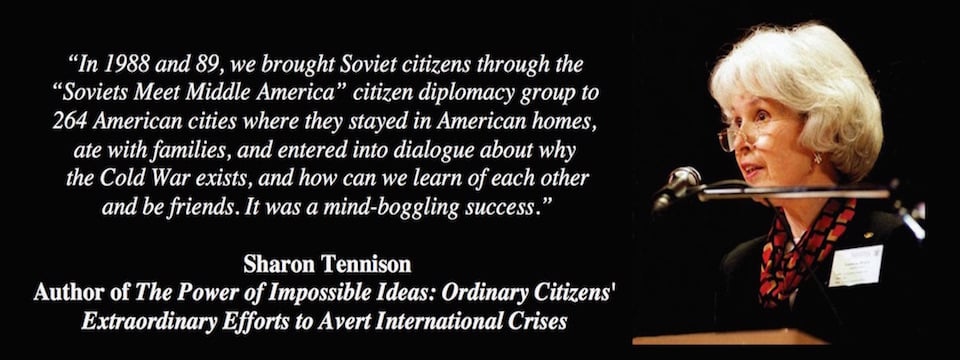
By Sharon Tennison
February 7, 2018
Friends and colleagues,
As the Ukraine situation has worsened, unconscionable misinformation and hype is being poured on Russia and Vladimir Putin.
Journalists and pundits must scour the Internet and thesauruses to come up with fiendish new epithets to describe both.
Wherever I make presentations across America, the first question ominously asked during Q&A is always, “What about Putin?”.
It’s time to share my thoughts which follow:
Putin obviously has his faults and makes mistakes. Based on my earlier experience with him, and the experiences of trusted people, including U.S. officials who have worked closely with him over a period of years, Putin most likely is a straight, reliable and exceptionally inventive man.
He is obviously a long-term thinker and planner and has proven to be an excellent analyst and strategist. He is a leader who can quietly work toward his goals under mounds of accusations and myths that have been steadily leveled at him since he became Russia’s second president.
I’ve stood by silently watching the demonization of Putin grow since it began in the early 2000’s –– I pondered on computer my thoughts and concerns, hoping eventually to include them in a book (which was published in 2011).
The book explains my observations more thoroughly than this article. Like others who have had direct experience with this little known man, I’ve tried to no avail to avoid being labeled a “Putin apologist”.
If one is even neutral about him, they are considered “soft on Putin” by pundits, news hounds and average citizens who get their news from CNN, Fox and MSNBC.
I don’t pretend to be an expert, just a program developer in the USSR and Russia for the past 30 years. But during this time, I have had far more direct, on-ground contact with Russians of all stripes across 11 time zones than any of the Western reporters or for that matter any of Washington’s officials.
I’ve been in country long enough to ponder Russian history and culture deeply, to study their psychology and conditioning, and to understand the marked differences between American and Russian mentalities which so complicate our political relations with their leaders.
As with personalities in a family or a civic club or in a city hall, it takes understanding and compromise to be able to create workable relationships when basic conditionings are different. Washington has been notoriously disinterested in understanding these differences and attempting to meet Russia halfway.
In addition to my personal experience with Putin, I’ve had discussions with numerous American officials and U.S. businessmen who have had years of experience working with him – I believe it is safe to say that none would describe him as “brutal” or “thuggish”, or the other slanderous adjectives and nouns that are repeatedly used in western media.
I met Putin years before he ever dreamed of being president of Russia, as did many of us working in St. Petersburg during the 1990’s.
Since all of the slander started, I’ve become nearly obsessed with understanding his character. I think I’ve read every major speech he has given (including the full texts of his annual hours-long telephone “talk-ins” with Russian citizens).
I’ve been trying to ascertain whether he has changed for the worse since being elevated to the presidency, or whether he is a straight character cast into a role he never anticipated – and is using sheer wits to try to do the best he can to deal with Washington under extremely difficult circumstances.
If the latter is the case, and I think it is, he should get high marks for his performance over the past 14 years. It’s not by accident that Forbes declared him the most Powerful Leader of 2013, replacing Obama who was given the title for 2012.
The following is my one personal experience with Putin.
The year was 1992:
It was two years after the implosion of communism; the place was St. Petersburg. For years I had been creating programs to open up relations between the two countries and hopefully to help Soviet people to get beyond their entrenched top-down mentalities.
A new program possibility emerged in my head. Since I expected it might require a signature from the Marienskii City Hall, an appointment was made. My friend Volodya Shestakov and I showed up at a side door entrance to the Marienskii building. We found ourselves in a small, dull brown office, facing a rather trim nondescript man in a brown suit. He inquired about my reason for coming in. After scanning the proposal I provided, he began asking intelligent questions.
After each of my answers, he asked the next relevant question. I became aware that this interviewer was different from other Soviet bureaucrats who always seemed to fall into chummy conversations with foreigners with hopes of obtaining bribes in exchange for the Americans’ requests. CCI stood on the principle that we would never, never give bribes. This bureaucrat was open, inquiring, and impersonal in demeanor.
After more than an hour of careful questions and answers, he quietly explained that he had tried hard to determine if the proposal was legal, then said that unfortunately at the time it was not. A few good words about the proposal were uttered. That was all.
He simply and kindly showed us to the door. Out on the sidewalk, I said to my colleague, “Volodya, this is the first time we have ever dealt with a Soviet bureaucrat who didn’t ask us for a trip to the U.S. or something valuable!”
I remember looking at his business card in the sunlight – it read Vladimir Vladimirovich Putin.
December 31, 1999:
With no warning, at the turn of the year, President Boris Yeltsin made the announcement to the world that from the next day forward he was vacating his office and leaving Russia in the hands of an unknown Vladimir Putin. On hearing the news, I thought surely not the Putin I remembered – he could never lead Russia.
The next day a New York Times article included a photo. Yes, it was the same Putin I’d met years ago! I was shocked and dismayed, telling friends, “This is a disaster for Russia, I’ve spent time with this guy, he is too introverted and too intelligent – he will never be able to relate to Russia’s masses.”
Further, I lamented: “For Russia to get up off of its knees, two things must happen: 1) The arrogant young oligarchs have to be removed by force from the Kremlin, and 2) A way must be found to remove the regional bosses (governors) from their fiefdoms across Russia’s 89 regions”.
It was clear to me that the man in the brown suit would never have the instincts or guts to tackle Russia’s overriding twin challenges.
February 2000:
Almost immediately Putin began putting Russia’s oligarchs on edge. In February a question about the oligarchs came up; he clarified with a question and his answer: “What should be the relationship with the so-called oligarchs? The same as anyone else. The same as the owner of a small bakery or a shoe repair shop.”
This was the first signal that the tycoons would no longer be able to flaunt government regulations or count on special access in the Kremlin. It also made the West’s capitalists nervous. After all, these oligarchs were wealthy untouchable businessmen – good capitalists, never mind that they got their enterprises illegally and were putting their profits in offshore banks.
Four months later Putin called a meeting with the oligarchs and gave them his deal: They could keep their illegally-gained, wealth-producing Soviet enterprises and they would not be nationalized …. IF taxes were paid on their revenues and if they personally stayed out of politics.
This was the first of Putin’s “elegant solutions” to the near impossible challenges facing the new Russia. But the deal also put Putin in the cross hairs with U.S. media and officials who then began to champion the oligarchs, particularly Mikhail Khodorkovsky. The latter became highly political, didn’t pay taxes, and, prior to being apprehended and jailed, was in the process of selling a major portion of Russia’s largest private oil company, Yukos Oil, to Exxon Mobil.
Unfortunately, to U.S. media and governing structures, Khodorkovsky became a martyr (and remains so up to today).
March 2000:
I arrived in St. Petersburg. A Russian friend (a psychologist) since 1983 came for our usual visit. My first question was, “Lena, what do you think about your new president?” She laughed and retorted, “Volodya! I went to school with him!”
She began to describe Putin as a quiet youngster, poor, fond of martial arts, who stood up for kids being bullied on the playgrounds. She remembered him as a patriotic youth who applied for the KGB prematurely after graduating secondary school (they sent him away and told him to get an education). He went to law school, later reapplied and was accepted.
I must have grimaced at this, because Lena said, “Sharon, in those days we all admired the KGB and believed that those who worked there were patriots and were keeping the country safe. We thought it was natural for Volodya to choose this career.” My next question was, “What do you think he will do with Yeltsin’s criminals in the Kremlin?” Putting on her psychologist hat, she pondered and replied, “If left to his normal behaviors, he will watch them for a while to be sure what is going on, then he will throw up some flares to let them know that he is watching. If they don’t respond, he will address them personally, then if the behaviors don’t change – some will be in prison in a couple of years.”
I congratulated her via email when her predictions began to show up in real time.
Throughout the 2000’s:
St. Petersburg’s many CCI alumni were being interviewed to determine how the PEP business training program was working and how we could make the U.S. experience more valuable for their new small businesses. Most believed that the program had been enormously important, even life changing.
Last, each was asked, “So what do you think of your new president?” None responded negatively, even though at that time entrepreneurs hated Russia’s bureaucrats. Most answered similarly, “Putin registered my business a few years ago”.
Next question, “So, how much did it cost you?” To a person they replied, “Putin didn’t charge anything”. One said, “We went to Putin’s desk because the others providing registrations at the Marienskii were getting ‘rich on their seats.'”
Late 2000:
Into Putin’s first year as Russia’s president, U.S. officials seemed to me to be suspect that he would be antithetical to America’s interests – his every move was called into question in American media. I couldn’t understand why and was chronicling these happenings in my computer and newsletters.
Year 2001:
Jack Gosnell (former USCG) explained his relationship with Putin when the latter was deputy mayor of St. Petersburg. The two of them worked closely to create joint ventures and other ways to promote relations between the two countries. Jack related that Putin was always straight up, courteous and helpful.
When Putin’s wife, Ludmila, was in a severe auto accident, Jack took the liberty (before informing Putin) to arrange hospitalization and airline travel for her to get medical care in Finland.
When Jack told Putin, he reported that the latter was overcome by the generous offer, but ended saying that he couldn’t accept this favor, that Ludmila would have to recover in a Russian hospital. She did – although medical care in Russia was abominably bad in the 1990’s.
A senior CSIS officer I was friends with in the 2000’s worked closely with Putin on a number of joint ventures during the 1990’s. He reported that he had no dealings with Putin that were questionable, that he respected him and believed he was getting an undeserved dour reputation from U.S. media. Matter of fact, he closed the door at CSIS when we started talking about Putin. I guessed his comments wouldn’t be acceptable if others were listening.
Another former U.S. official who will go unidentified, also reported working closely with Putin, saying there was never any hint of bribery, pressuring, nothing but respectable behaviors and helpfulness.
I had two encounters in 2013 with State Department officials regarding Putin:
At the first one, I felt free to ask the question I had previously yearned to get answered: “When did Putin become unacceptable to Washington officials and why?”
Without hesitating the answer came back: “The knives were drawn when it was announced that Putin would be the next president.” I questioned WHY?
The answer: “I could never find out why – maybe because he was KGB.” I offered that Bush #1, was head of the CIA.
The reply was, “That would have made no difference, he was our guy.”
The second was a former State Department official with whom I recently shared a radio interview on Russia. Afterward when we were chatting, I remarked, “You might be interested to know that I’ve collected experiences of Putin from numerous people, some over a period of years, and they all say they had no negative experiences with Putin and there was no evidence of taking bribes.”
He firmly replied, “No one has ever been able to come up with a bribery charge against Putin.”
From 2001 up to today, I’ve watched the negative U.S. media mounting against Putin – even accusations of assassinations, poisonings, and comparing him to Hitler. No one yet has come up with any concrete evidence for these allegations.
During this time, I’ve traveled throughout Russia several times every year, and have watched the country slowly change under Putin’s watch. Taxes were lowered, inflation lessened, and laws slowly put in place. Schools and hospitals began improving. Small businesses were growing, agriculture was showing improvement, and stores were becoming stocked with food.
Alcohol challenges were less obvious, smoking was banned from buildings, and life expectancy began increasing. Highways were being laid across the country, new rails and modern trains appeared even in far out places, and the banking industry was becoming dependable.
Russia was beginning to look like a decent country –– certainly not where Russians hoped it to be long term, but improving incrementally for the first time in their memories.
My 2013/14 Trips to Russia:
In addition to St. Petersburg and Moscow, in September I traveled out to the Ural Mountains, spent time in Ekaterinburg, Chelyabinsk and Perm. We traveled between cities via autos and rail – the fields and forests look healthy, small towns sport new paint and construction.
Today’s Russians look like Americans (we get the same clothing from China). Old concrete Khrushchev block houses are giving way to new multi-story private residential complexes which are lovely. High-rise business centers, fine hotels and great restaurants are now common place – and ordinary Russians frequent these places. Two and three story private homes rim these Russian cities far from Moscow.
We visited new museums, municipal buildings and huge super markets. Streets are in good repair, highways are new and well marked now, service stations looks like those dotting American highways.
In January I went to Novosibirsk out in Siberia where similar new architecture was noted. Streets were kept navigable with constant snowplowing, modern lighting kept the city bright all night, lots of new traffic lights (with seconds counting down to light change) have appeared.
It is astounding to me how much progress Russia has made in the past 14 years since an unknown man with no experience walked into Russia’s presidency and took over a country that was flat on its belly.
So why do our leaders and media demean and demonize Putin and Russia???
Like Lady Macbeth, do they protest too much?
Psychologists tell us that people (and countries?) project off on others what they don’t want to face in themselves. Others carry our “shadow” when we refuse to own it. We confer on others the very traits that we are horrified to acknowledge in ourselves.
Could this be why we constantly find fault with Putin and Russia?
Could it be that we project on to Putin the sins of ourselves and our leaders?
Could it be that we condemn Russia’s corruption, acting like the corruption within our corporate world doesn’t exist?
Could it be that we condemn their human rights and LGBT issues, not facing the fact that we haven’t solved our own?
Could it be that we accuse Russia of “reconstituting the USSR”––because of what we do to remain the world’s “hegemon”?
Could it be that we project nationalist behaviors on Russia, because that is what we have become and we don’t want to face it?
Could it be that we project warmongering off on Russia, because of what we have done over the past several administrations?
•
Some of you were around Putin in the earlier years. Please share your opinions, pro and con …. confidentiality will be assured. It’s important to develop a composite picture of this demonized leader and get the record straight.
I’m quite sure that 99% of those who excoriate him in mainstream media have had no personal contact with him at all. They write articles on hearsay, rumors and fabrication, or they read scripts others have written on their teleprompters.
This is how our nation gets its “news”, such as it is.
There is a well known code of ethics among us: Is it the Truth, Is it Fair, Does it build Friendship and Goodwill, and Will it be Beneficial for All Concerned?
It seems to me that if our nation’s leaders would commit to using these four principles in international relations, the world would operate in a completely different manner, and human beings across this planet would live in better conditions than they do today.
As always your comments will be appreciated. Please resend this report to as many friends and colleagues as possible.
Sharon Tennison






6 Responses
This is excellent and credible information and agrees with my overall “picture” V.V.Putin. I hate the western harmonized propaganda against him and recognized the main reason is the interests of the MIC, who needs bad guys i.e. the one North Korea and Basher Assad for growing their dirty business. Cynically, the totally corrupt Saudies and the war criminals in control of the Promised Land are the best fiends of the US in the ME! Unfortunately, the American people know close to nothing about world history – and politics and are systematically kept in the dark, so they can be governed/manipulated easily. I am German, and if I had a say in German foreign politic, I would have Germany leave NATO, build a strong axis Paris – Berlin – Moscow and a united European defense system, perhaps even including Russia. Best regards, OHA
This is a very interesting and personal down-to-earth description of Putin, A counterpoint to Gessen. Deserves to be sared and read widely -IT IS FAR FROM BEING FAKE NEWS WRITTEN BY A THROLL.
Many thanks, Hans. This is an interesting idea for the future of Europe – and I would add, a non-military conflict-resolution mechanism and a much stronger OSCE couple with a European effective branch of the UN. We could do it much much better ourselves – although I am not tooo optimistic about the EU’s ability to stand and think on its own vis-a-vis the US. But the day the US Empire has fallen, we’ll have to. Thanks! – Jan
Thanks Erik – yes of course. And of course Gessen is the darling of Western media these days. No, Sharon is a very genuine person with a hugely impressive experience and sound judgement. Please help spread it yourself. Thanks – Jan
Thank you for a serious description. As I see it from real politics, it looks like Mr. Putin is not driven by personal desire for power. But he’s trying to do a serious effort to bring peace. For people and countries It’s not very easy because power worldwide is not about peace. And Russia also has to protect itself from Western politics/economic interests. And from its own moneymen.
Anyone who has followed Putin’s statements and speeches for even a short time will understand the veracity of this article. And indeed, if one cares to think for one moment about the true nature of those who demonize him, such as Johnson, H. Clinton, Obama and Biden most recently, it will be evident that they are finding faults in Putin which are clearly their own. The more temperate attitude of a person like Macron should also indicate something about the character of his Russian adversary. Thank you for your testimony, if I may call it that, Sharon. To be shared widely…