
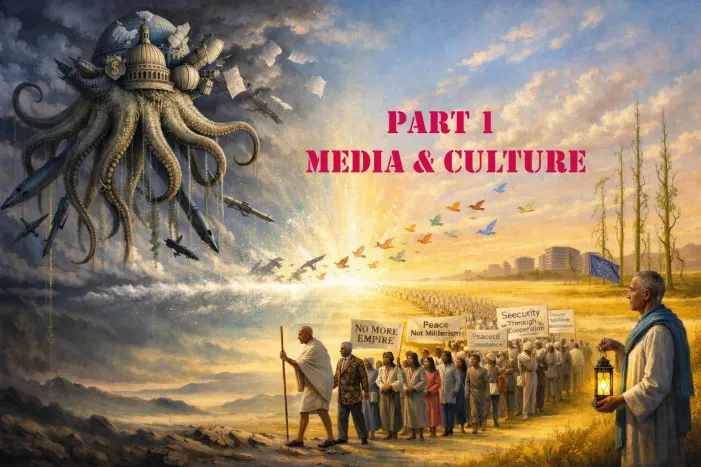
Resist and Build Alternatives to the Trump Regime Now: Part 1

PART 1 — Media, Culture and Information Sovereignty

By Jan Oberg
TFF co-founder and director

January 20, 2026

This is the first of four TFF-created idea portfolios designed to curb the global reach of the United States and, in both the short and long term, help catalyse a worldwide nonviolent resistance to what many observers describe as the Trump administration’s uniquely confrontational, destructive and world-threatening policies.

These portfolios outline what governments and citizens across the world can do through dynamic diplomacy, creative initiatives, and strictly nonviolent means.

They are typical TFF works in that we do not only tell what the problem is and how bad it will go – as 90+% of all commentators, experts and scholars do – we tell what we think can be done, inviting you to think of what you think you can do.

It seems painfully clear to me that the current political dynamics in Washington increasingly resemble the most dangerous pattern that ended in 1945 and was supposed to never happen again.

If that assessment holds, then passivity is no longer an option. A coordinated, global, nonviolent mobilisation is essential — not least because nonviolence is the one type of power and language a heavily militarised superpower is least prepared to counter.

All power rests on others accepting and carrying out its orders. Even the strongest leader in the world cannot round up criminals or fight wars with his own hands. Power is always dependent – dependent on someone who finds it legitimate, and do the dirty job on the strongman’s order. If young people were not brainwashed to accept warfare, there would be no wars. This is why nonviolence can be extremely effective and make an overarmed country look morally weak. That’s what Gandhi taught the world when using this theory to rid India not of the British as people but of the British Empire’s dominance structure.

The global mobilisation suggested here and in the coming thematic peace idea portfolios would also allow the rest of the world to deprive Trump of setting the international agenda. When Trump says something crazy, geopolitical experts, the media and the rest of the world, it seems, scrutinise his words in minute detail and waste all the time and energy that should be devoted to constructive alternatives and action. 

If all this sounds “unrealistic,” consider the alternative: a world in which Trump’s Personal Occidental Empire is allowed to take shape — one that intimidates, coerces, and disregards established norms, continuing unchecked for the next three years as it has begun.

The proposals in this first portfolio are not limited to preventing the attempted acquisition of Greenland, though Greenland naturally occupies a central place here. Many fear that, without meaningful global resistance, such an acquisition could be carried out with little more than verbal protest from the international community — emboldening further unilateral ventures.

Think also of the so-called Gaza Peace Board that does not even mention Gaza. It is a cynical vehicle for establishing a new, personalised global “peace” structure intended to replace the United Nations with Trump himself as lifetime leader and the man who appoints his successor. Further, it is built on money, deals, and favours.

Only fools believe this is anything but Empire-building disguised as peace-making. Beyond any doubt, it is world-threatening.

It should now be evident that the ability to shape global perceptions — to persuade people of the inherent benevolence of U.S. power and of the current administration in particular — relies heavily on information dominance: narratives, propaganda, disinformation, and outright falsehoods. The Greenland argument, framed as a defensive move against China’s and Russia’s intention to take it, is one such example. It is also a psycho-political projection of the US/Trump’s own dark sides.

For these reasons, curbing U.S. information power is essential, as is countering its cultural and intellectual influence platforms. Therefore, this first Nonviolent U.S. Resistance Portfolio focuses on these domains. The suceeding portfolios will address additional forms of power that must be challenged and replaced through peaceful, principled means.

A. Media Transparency & Accountability Measures

These don’t censor anything, they expose dependency and deception and aim at creating an alternative global information and media structure after the US monopoly.

Immediate Measures (within a week)

Mandatory disclosure labels 
Every news story must state the origin of its primary source (AP, Reuters, AFP, NYT, etc.). This alone would shock audiences into seeing how much comes from U.S. pipelines.

Publish a “Media Dependency Index” 
A weekly ranking of outlets by percentage of U.S.-sourced content.

Announce parliamentary hearings 
Transparent, non-accusatory hearings on foreign influence in national media ecosystems.

Longer-Term Measures

European or Global South–Europe newswire alliance 
A structural alternative to U.S. news dominance.

Media Sovereignty Observatory 
A permanent body tracking narrative dependency and foreign influence.

Open source, federated news distribution systems 
Infrastructure that reduces reliance on U.S. platforms and algorithms. Boycott or at least reduce your reliance on US media platforms that censor and de-rank even peace voices and voices critical of the US, NATO, interventionism and genocide. That is – Google, Google-owned YouTube, Facebook, LinkedIn, X and more.

B. Diversification of Global News Inputs

Plurality of sources is the alternative to narrative dominance. Stop following mainstream Western media and follow non-Western media. The Internet is a wonderful invention. Spend 75% of your media time on non-Western media online or you will be fooled about what the world actually looks like.

Immediate Measures (within a week)

Emergency subscription packages to non-U.S. news agencies 
AFP, Kyodo, Al Jazeera, African newswires, Chinese and Russian media — instant diversification. Use the internet and see everybody else’s much more open-minded news coverage, editorials and discussions.

Temporary European Arctic Correspondent Network 
Reporters in Nuuk, Reykjavik, Tromsø to counter U.S. framing of Greenland.

Partnerships with Greenlandic media 
Ensures that Greenlandic voices define Greenland’s story and are heard worldwide.

Longer-Term Measures

Permanent European Arctic Desk 
A sustained reporting presence across the Arctic region. It may be more important to have them there in the future than all over the West itself.

Support for Indigenous media networks 
Strengthening local voices across the Arctic and beyond.

Cross-regional multilingual reporting hubs 
Shared editorial teams linking Europe, Africa, Asia, and Latin America.

C. Citizens’ Media Resistance

Citizens can shift the media ecosystem faster than governments.

Immediate Measures (within a week)

Boycott outlets with >40% U.S. newswire dependency 
A voluntary, global, nonviolent pressure tool.

“Switch Off America Week” 
A symbolic week where citizens consume only non-U.S. news.

Crowdsourced monitoring of U.S. narrative dominance 
Publicly track how often outlets rely on U.S. sources (and tell you they are free, diverse and public service…

Longer-Term Measures

Global media literacy networks 
Teaching citizens how narratives are constructed and by whom. And use existing non-Western ones.

Public Sphere Charter 
A global commitment to pluralistic information flows.

Global public-interest search engine 
A non-corporate, non-U.S. alternative for accessing information.

D. Cultural & Academic Sovereignty

Cultural exchange must be mutual, not a one-way projection of power and a de facto grooming of pro-US personalities and murky associations.

Immediate Measures (within a week)

Pause new academic partnerships with U.S. institutions 
A cooling-off period to reassess influence.

Suspend U.S.–EU cultural festivals and cultural cooperation 
A symbolic but powerful signal of recalibration. Of course, you can enjoy the incredible works of US cultural workers over time, but stop formalised cooperation.

Prioritise Indigenous Greenlandic cultural voices.
Shift the cultural centre of gravity toward those directly affected.

Longer-Term Measures

EU–Global South academic networks 
Diversifying knowledge production beyond U.S. institutions. Send your students to up-and-coming countries, not to the declining US. Stop filling you university reading lists with US literature; these books silently convey only a US perspective on the world.

European Arctic Cultural Institute 
A hub for Greenlandic and Arctic cultural expression.

Ethical guidelines for cultural diplomacy 
Ensuring reciprocity and preventing one-way influence.

E. Public Sphere & Civil Society Mobilisation

Nonviolent resistance begins with public consciousness and challenges military arrogance with countermeasures that set a constructive agenda.

Immediate Measures (within a week)

Global demonstrations at U.S. embassies 
A peaceful, visible expression of global resistance: Enough is more than enough, Trump!

“Greenland Solidarity Week” 
Events in 100+ cities to raise awareness.

People’s Tribunal on violations of international law 
A moral forum documenting actions and giving voice to the affected.

Longer-Term Measures

Documentary series (“Greenland And Arctic Reality Check”) 
A sustained narrative counter-campaign.

Global civil society coalitions 
Networks linking NGOs, Indigenous groups, and peace organisations, for instanced the global movement against US bases in 130 countries.

World Forum on Nonviolent Power 
A permanent platform for developing peaceful resistance strategies. There is a desperate need for solution-oriented thinking and global peace visions, for pro-peace and not just anti-war.

PART 1 SUMMARY

Media and cultural sovereignty are the foundations of nonviolent resistance. Massive, immediate actions worldwide can disrupt narrative dominance within days; long-term measures build a pluralistic global information order in which no single state monopolises the definition of reality for the rest of the world.

◆

Introduction: How Governments and Citizens Can Stop the Trump Regime’s World-Threatening Designs

Part 1 – Media, Culture and Information Sovereignty
Part 2 – Diplomacy, Law and Nonviolent Power

Part 3 – Economics, trade and financial sovereignty

Peace & future researcher + ‌Art Photographer

Related Posts

Tony Robinson October 4, 2026 Violence is easy to recognise when someone is being beaten, shot or killed. It becomes more difficult when nobody is holding a weapon. Poverty, discrimination, exploitation and repression can restrict a human life just as effectively, although they do so in very different ways and with very different consequences. Simply adding more categories to an ever-growing list of forms of violence does not really solve the problem. The more interesting question is what all these different situations have in common and why it makes sense to describe them using the same word. Human beings do not simply react to what happens around them. They remember the past, imagine things that do not yet exist, make plans and undertake projects. Workers organise because they imagine different working conditions; people migrate because they imagine another life somewhere else; social movements emerge because people refuse to accept the...
It’s a matter of principles, courage, vision and pulling together – while the militarist world is falling apart… Peter Langille October 3, 2026 “Here, then, is the problem which we present to you, stark and dreadful and inescapable: Shall we put an end to the human race; or shall mankind renounce war?”The Bertrand Russell—Albert Einstein Manifesto, July 9, 1955 ⁕ The forecast for what’s ahead is worrisome. The sharp rise in armed conflicts over the past three years is adding to what was already the highest level in over seventy years. Genocides, which should be prevented are supported. A shared climate emergency that jeopardises survival is ignored. Diverse polls now suggest that people are war-weary, worried and interested in a more effective United Nations. And, there are viable policy options for a more secure world! Yet governments are doubling-down, betting on more war and investing heavily. If current trends persist,...
Johan Galtung 1930-2024October 2015 Published here on October 3, 2026 Let us focus on Civilization for conflict analysis and remedies. Major forms of disorder use violence; war is state organized violence. The most belligerent states are the United States of America and Israel, both with civilization roots. National Evangelism, the US Protestant Christian civilization– more national than evangelical–justifies US warfare as exceptionalism of a people chosen by God, with a manifest destiny to run the world. Orthodox Judaism justifies Israeli warfare to conquer and expand from Nile to Euphrates as a religious right and duty to the Eternal One. The third most belligerent country, the UK, no longer believes it is God-chosen but chosen by the USA; not quite the same but something. But the root cause of global disorder lies in the Occident–with Islam–seeing itself as the single, universal civilization valid for all at all times, all others being...

Recent Articles

Tony Robinson October 4, 2026 Violence is easy to recognise when someone is being beaten, shot or killed. It becomes more difficult when nobody is holding a weapon. Poverty, discrimination, exploitation and repression can restrict a human life just as effectively, although they do so in very different ways and with very different consequences. Simply adding more categories to an ever-growing list of forms of violence does not really solve the problem. The more interesting question is what all these different situations have in common and why it makes sense to describe them using the same word. Human beings do not simply react to what happens around them. They remember the past, imagine things that do not yet exist, make plans and undertake projects. Workers organise because they imagine different working conditions; people migrate because they imagine another life somewhere else; social movements emerge because people refuse to accept the...
It’s a matter of principles, courage, vision and pulling together – while the militarist world is falling apart… Peter Langille October 3, 2026 “Here, then, is the problem which we present to you, stark and dreadful and inescapable: Shall we put an end to the human race; or shall mankind renounce war?”The Bertrand Russell—Albert Einstein Manifesto, July 9, 1955 ⁕ The forecast for what’s ahead is worrisome. The sharp rise in armed conflicts over the past three years is adding to what was already the highest level in over seventy years. Genocides, which should be prevented are supported. A shared climate emergency that jeopardises survival is ignored. Diverse polls now suggest that people are war-weary, worried and interested in a more effective United Nations. And, there are viable policy options for a more secure world! Yet governments are doubling-down, betting on more war and investing heavily. If current trends persist,...
Johan Galtung 1930-2024October 2015 Published here on October 3, 2026 Let us focus on Civilization for conflict analysis and remedies. Major forms of disorder use violence; war is state organized violence. The most belligerent states are the United States of America and Israel, both with civilization roots. National Evangelism, the US Protestant Christian civilization– more national than evangelical–justifies US warfare as exceptionalism of a people chosen by God, with a manifest destiny to run the world. Orthodox Judaism justifies Israeli warfare to conquer and expand from Nile to Euphrates as a religious right and duty to the Eternal One. The third most belligerent country, the UK, no longer believes it is God-chosen but chosen by the USA; not quite the same but something. But the root cause of global disorder lies in the Occident–with Islam–seeing itself as the single, universal civilization valid for all at all times, all others being...

TFF on Substack

Discover and subscribe to more peace materials on TFF Substack

Most Popular

Tony Robinson October 4, 2026 Violence is easy to recognise when someone is being beaten, shot or killed. It becomes more difficult when nobody is holding a weapon. Poverty, discrimination, exploitation and repression can restrict a human life just as effectively, although they do so in very different ways and with very different consequences. Simply adding more categories to an ever-growing list of forms of violence does not really solve the problem. The more interesting question is what all these different situations have in common and why it makes sense to describe them using the same word. Human beings do not simply react to what happens around them. They remember the past, imagine things that do not yet exist, make plans and undertake projects. Workers organise because they imagine different working conditions; people migrate because they imagine another life somewhere else; social movements emerge because people refuse to accept the...
It’s a matter of principles, courage, vision and pulling together – while the militarist world is falling apart… Peter Langille October 3, 2026 “Here, then, is the problem which we present to you, stark and dreadful and inescapable: Shall we put an end to the human race; or shall mankind renounce war?”The Bertrand Russell—Albert Einstein Manifesto, July 9, 1955 ⁕ The forecast for what’s ahead is worrisome. The sharp rise in armed conflicts over the past three years is adding to what was already the highest level in over seventy years. Genocides, which should be prevented are supported. A shared climate emergency that jeopardises survival is ignored. Diverse polls now suggest that people are war-weary, worried and interested in a more effective United Nations. And, there are viable policy options for a more secure world! Yet governments are doubling-down, betting on more war and investing heavily. If current trends persist,...
Johan Galtung 1930-2024October 2015 Published here on October 3, 2026 Let us focus on Civilization for conflict analysis and remedies. Major forms of disorder use violence; war is state organized violence. The most belligerent states are the United States of America and Israel, both with civilization roots. National Evangelism, the US Protestant Christian civilization– more national than evangelical–justifies US warfare as exceptionalism of a people chosen by God, with a manifest destiny to run the world. Orthodox Judaism justifies Israeli warfare to conquer and expand from Nile to Euphrates as a religious right and duty to the Eternal One. The third most belligerent country, the UK, no longer believes it is God-chosen but chosen by the USA; not quite the same but something. But the root cause of global disorder lies in the Occident–with Islam–seeing itself as the single, universal civilization valid for all at all times, all others being...
Read More
Living-Peace-Sign-Budapest-copy
Tony Robinson October 4, 2026 Violence is easy to recognise when someone is being beaten, shot or killed. It becomes more difficult when nobody is holding a weapon. Poverty, discrimination, exploitation and repression can restrict a human life just as effectively, although they do so in very different ways and with very different consequences. Simply adding more categories to an ever-growing list of forms of violence does not really solve the problem. The more interesting question is what all these different situations have in common and why it makes sense to describe them using the same word. Human beings do not simply react to what happens around them. They remember the past, imagine things that do not yet exist, make plans and undertake projects. Workers organise because they imagine different working conditions; people migrate because they imagine another life somewhere else; social movements emerge because people refuse to accept the...
b54a1f10-8c65-4f0b-9dd5-4abc0a7d04cc_2659x2659
It’s a matter of principles, courage, vision and pulling together – while the militarist world is falling apart… Peter Langille October 3, 2026 “Here, then, is the problem which we present to you, stark and dreadful and inescapable: Shall we put an end to the human race; or shall mankind renounce war?”The Bertrand Russell—Albert Einstein Manifesto, July 9, 1955 ⁕ The forecast for what’s ahead is worrisome. The sharp rise in armed conflicts over the past three years is adding to what was already the highest level in over seventy years. Genocides, which should be prevented are supported. A shared climate emergency that jeopardises survival is ignored. Diverse polls now suggest that people are war-weary, worried and interested in a more effective United Nations. And, there are viable policy options for a more secure world! Yet governments are doubling-down, betting on more war and investing heavily. If current trends persist,...
010
Johan Galtung 1930-2024October 2015 Published here on October 3, 2026 Let us focus on Civilization for conflict analysis and remedies. Major forms of disorder use violence; war is state organized violence. The most belligerent states are the United States of America and Israel, both with civilization roots. National Evangelism, the US Protestant Christian civilization– more national than evangelical–justifies US warfare as exceptionalism of a people chosen by God, with a manifest destiny to run the world. Orthodox Judaism justifies Israeli warfare to conquer and expand from Nile to Euphrates as a religious right and duty to the Eternal One. The third most belligerent country, the UK, no longer believes it is God-chosen but chosen by the USA; not quite the same but something. But the root cause of global disorder lies in the Occident–with Islam–seeing itself as the single, universal civilization valid for all at all times, all others being...
Screenshot 2026-10-02 011738
Jan ObergPhD, director, The Transnational Foundation for Peace and Future Research, TFFLund, Sweden October 2, 2026 This is my full original manuscript. The Chinese Academy of Social Science, CASS, makes two publications out if it. 1. China’s Five-year plan emphasized the capabilities of basic research and original innovation. It is regarded as the goal of the future social development, which, as required, should be significantly enhanced. Can you comment on the importance of original innovation in research and academic study? I believe it is easier to define “original innovation” in the natural sciences than in social sciences. The breaking points of what constitutes something new, or innovative, are not quite as sharp in the latter. But in both fields it is about opening up something that was closed, unseen, unexplored before – making manifest what was earlier latent. Innovations come in many forms and shapes – naming something that was not...
arctic-circle-map
The agreement is catastrophic both because of what it says and what it doesn’t mention. It reduces further the major asset of security policies: Freedom of action. Jan Oberg TFF director September 25, 2026 A couple of hours before the agreement was signed on September 22, 2026, I published the following 13 hypotheses about what it would most likely contain on TFF Substack (in English). I was wrong on only the first point. Contrary to what Trump had written on his Truth Social platform, it does not appear to come into force immediately. In fact, it turned out to be worse than even I had anticipated. After these hypotheses now come a number of reflections in light of what the agreement actually contains, and does not contain, as well as the way in which it has generally been presented by major media outlets and by the public-service broadcaster DR. My...
girl-5894831_1280
Below are TFF-related media mentions, comments, videos and social media posts published elsewhere but not on this homepage. We happen to catch and list only a fraction. Regarding video comments and debates, we recommend that you go to the TFF Video Channel on Substack where many of them are reproduced. Jan Oberg is a contributor to China Daily – 52 million daily clicks – and Global Times, CGTN and CCTV (the national television), China Investment, Xinhua News Agency and several others. Articles and videos on these media very often multiply into countless Chinese (and Western media) that re-post them from these main media. Thanks to The China Academy, his analyses, interviews and comments are frequently posted on YouTube channels such as Thinkers Forum and Wave Media. These videos are often re-posted on Bilibili (China’s YouTube), the China Content Center on TikTok, and on the Chinese edition of TikTok, Douyin.com. This means reaching hundreds of millions of viewers worldwide over a year. While there are too many to catch on all these...





