
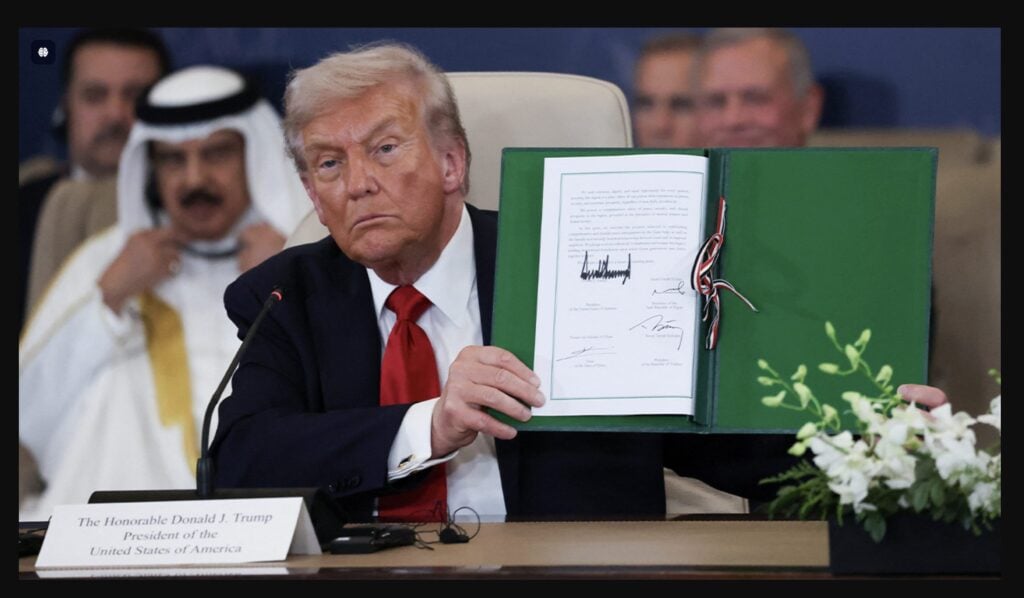
The Trump Regime’s “Peace Board” Is Another Brick in His Personal Occidental Empire

His Gaza proposal reveals a far larger and world-threatening project. It’s a bid to replace the UN — and this MAGAlomania must be stopped now. See my warning at the end.

Jan Oberg, TFF director

January 18, 2026

There are moments in political life when the surface events are so loud, so chaotic, so distracting that they obscure the deeper shift taking place beneath them. We focus on the headlines, the personalities, the daily provocations — and miss the architecture being built in the background.

But every once in a while, a document appears, a proposal emerges, or a pattern becomes visible enough that it forces us to stop, step back, and look at the larger design.

Trump’s so‑called Gaza “Board of Peace” is one of those moments.

It is not the outburst of an impulsive leader. It is not a one‑off improvisation. It is a window into a political project that has been unfolding for years — a project that treats institutions as disposable, alliances as leverage, and entire regions as assets in a personal geopolitical domain.

A project that is no longer hiding its contours. A project that now speaks openly in the language of authority, hierarchy, and replacement.

The charter of Donald Trump’s proposed “Board of Peace,” revealed by Haaretz on January 17, 2026, is not a Gaza policy. It is not even a Middle East policy. It is the latest — and clearest — expression of a long‑running project that has defined Trump’s political style for years: the construction of what I describe as a Personal Occidental Empire, a sphere of influence built not on institutions or alliances but on personal (narcissist) authority, loyalty networks, and transactional dependency.

The Gaza initiative is simply the newest brick in that architecture.

According to Haaretz, the charter was quietly sent to around 60 heads of state. Yet the document itself does not mention Gaza at all. Instead, it claims a sweeping mandate to “restore dependable and lawful governance and secure enduring peace in areas affected or threatened by conflict,” and — in a phrase that should alarm every democratic government — to do so “in place of other organizations.”

This is not a reconstruction committee. It is a claim to global jurisdiction, but only over the parts of the world Trump considers within his reach.

This logic is not new. It is the same logic that drove his attempts to buy Greenland, pressure Canada, threaten Mexico with military action, make himself a Viceroy in Venezuela, and reshape NATO into a loyalty‑based protection racket.

These were not random provocations. They were early signals of a worldview in which Western states and territories are not partners but assets — components of a personal geopolitical domain.

Trump’s charter makes the architecture explicit. It opens with a denunciation of existing international structures, calling for “a more nimble and effective international peace‑building body” and urging the world to abandon “institutions that have too often failed.” This is not the language of reform. It is the language of replacement — a hallmark of Trump’s broader governing style, in which established institutions are treated as obstacles to be bypassed, hollowed out, or supplanted by leader‑controlled alternatives.

But the most revealing feature of the charter is its structure of authority.

As Haaretz reports, the chairmanship is not tied to the U.S. presidency, not subject to elections, and not limited by term. It simply states: “Donald J. Trump shall serve as inaugural Chairman of the Board of Peace.” From that point on, the document reads like the constitution of a personal dominion.

Trump alone would invite or expel member states, appoint or dismiss the executive board, veto decisions at will, create or dissolve subsidiary bodies, interpret the charter, and even dissolve the entire organisation. He would also designate his own successor.

This is not multilateralism. It is not even unilateralism. It is personal rule — the defining feature of Trump’s broader political project.

Membership rules reinforce the pattern. While most states would serve three‑year terms, Haaretz notes that countries contributing more than $1 billion in the first year would be exempt from term limits. In other words: pay enough, and you can stay indefinitely — as long as the chairman approves. This is not sovereign equal cooperation; it is a transactional hierarchy, entirely consistent with Trump’s long‑standing preference for loyalty networks and personal dependency.

And crucially: this empire is selective. Trump is not trying to build a universal body. He is not trying to include Russia, China, Iran, or any state that would resist personal subordination. His empire is Western, Atlantic, and strategically convenient — a sphere of influence composed of states he believes he can bend, pressure, or purchase. And regions where he can build his United States of Autarchy if and when the world has turned its back on him and the US

Seen through this lens, the Gaza “peace” board is not an aberration. It is a continuation. It reflects the same logic that shaped his approach to Greenland, Canada, Mexico, Venezuela, NATO, and Europe. The charter simply makes the architecture visible: a system in which institutions are not independent actors but instruments of his personal authority, exercised in 100% defiance of laws, norms and normal respect for others.

What the Gaza “peace” board exposes is not a sudden improvisation but the underlying architecture of a political project that has been unfolding for years.

The pattern is unmistakable: a leader who treats institutions as disposable, alliances as leverage, and entire regions as assets in a personal geopolitical domain. It is the logic of a Personal Occidental Empire — a sphere of influence defined not by shared values or collective security but by proximity to one man’s authority.

This could never become a new United Nations. It is not even an alternative multilateralism. It is an empire without a fixed territory but with all the familiar features: hierarchy, dependency, loyalty, and the steady erosion of institutional constraints.

The Gaza charter simply strips away the last remaining ambiguity. It shows, in black and white, a system in which global authority is concentrated in the hands of a single individual, insulated from elections, oversight, or constitutional limits. It reveals a worldview in which international governance is not a shared responsibility but a personal prerogative. And it demonstrates how easily the language of “peace” can be repurposed to legitimise structures of power that have nothing to do with peace at all.

And here is where most geo-political commentators have understood so little:

The old disciplines can no longer explain what we are living through; only psychology/psychiatry, theology, philosophy — and perhaps the inspiration from (science) fiction and the Theatre of the Absurd — may be able to help.

•

My warning

We are not reliving the 1930s, and I thoroughly disagree with all the geopolitical experts who predict World War 3. They have no theory behind that claim, but merely vent their own frustrations, deprive people of hope and the will to act, and make it impossible to discuss solutions and visions of a better future for humanity.

If this is the direction of the coming years, then the international system is not facing a policy disagreement or a diplomatic rupture. It is facing the emergence of a personalised, extra‑state authority structure that seeks to reorder Western politics around the will of a single leader and tendentially confront everybody else, friends and foes.

That said, some of the structural pressures that once led to global conflict are re‑emerging in new forms – and, no, Trump does not appear yet in military uniform, albeit now with a golden fighter aircraft as a lapel pin. Western militarism is as rampant as it is destructive for the West itself.

The lesson of history is to act before such pressures become irreversible. Or we shall again conclude that the only thing we can learn from history is that we learn nothing from it.

The question is no longer whether this project exists. The question is whether anyone will recognise it in time — and whether the world is prepared to confront the dangers it poses.

In the next few weeks, TFF will publish four Idea Portfolios with many ideas for diplomatic and other nonviolent actions to stop the Trump Regime’s Personal Occidental Empire-building. Remain seized of the matter.

Recommended info

The full text of Trump’s Board of Peace Charter

TFF Board member Pascal Lottaz guides you through Trump’s plan on his Neutrality Studies Channel.

Wikipedia

The White House

Thalif Deen
Is the US Board of Peace Aimed at Undermining the UN?

Alfred de Zayas and others on Rumble
Trump’s Board of Peace: Can one man reshape global order? 
Peace & future researcher + ‌Art Photographer

Related Posts

It’s a matter of principles, courage, vision and pulling together – while the militarist world is falling apart… Peter Langille October 3, 2026 “Here, then, is the problem which we present to you, stark and dreadful and inescapable: Shall we put an end to the human race; or shall mankind renounce war?”The Bertrand Russell—Albert Einstein Manifesto, July 9, 1955 ⁕ The forecast for what’s ahead is worrisome. The sharp rise in armed conflicts over the past three years is adding to what was already the highest level in over seventy years. Genocides, which should be prevented are supported. A shared climate emergency that jeopardises survival is ignored. Diverse polls now suggest that people are war-weary, worried and interested in a more effective United Nations. And, there are viable policy options for a more secure world! Yet governments are doubling-down, betting on more war and investing heavily. If current trends persist,...
Johan Galtung 1930-2024October 2015 Published here on October 3, 2026 Let us focus on Civilization for conflict analysis and remedies. Major forms of disorder use violence; war is state organized violence. The most belligerent states are the United States of America and Israel, both with civilization roots. National Evangelism, the US Protestant Christian civilization– more national than evangelical–justifies US warfare as exceptionalism of a people chosen by God, with a manifest destiny to run the world. Orthodox Judaism justifies Israeli warfare to conquer and expand from Nile to Euphrates as a religious right and duty to the Eternal One. The third most belligerent country, the UK, no longer believes it is God-chosen but chosen by the USA; not quite the same but something. But the root cause of global disorder lies in the Occident–with Islam–seeing itself as the single, universal civilization valid for all at all times, all others being...
How Oxford University Press allowed a personality‑driven narrative to masquerade as scholarship. Jan Oberg, dr hc, TFF director This article has also been published on TFF Substack where more readers react and withdraw their interviews from the project. A Special Issue in a scholarly journal is not an ordinary publication. It is a collective, curated […]

Recent Articles

Tony Robinson October 4, 2026 Violence is easy to recognise when someone is being beaten, shot or killed. It becomes more difficult when nobody is holding a weapon. Poverty, discrimination, exploitation and repression can restrict a human life just as effectively, although they do so in very different ways and with very different consequences. Simply adding more categories to an ever-growing list of forms of violence does not really solve the problem. The more interesting question is what all these different situations have in common and why it makes sense to describe them using the same word. Human beings do not simply react to what happens around them. They remember the past, imagine things that do not yet exist, make plans and undertake projects. Workers organise because they imagine different working conditions; people migrate because they imagine another life somewhere else; social movements emerge because people refuse to accept the...
It’s a matter of principles, courage, vision and pulling together – while the militarist world is falling apart… Peter Langille October 3, 2026 “Here, then, is the problem which we present to you, stark and dreadful and inescapable: Shall we put an end to the human race; or shall mankind renounce war?”The Bertrand Russell—Albert Einstein Manifesto, July 9, 1955 ⁕ The forecast for what’s ahead is worrisome. The sharp rise in armed conflicts over the past three years is adding to what was already the highest level in over seventy years. Genocides, which should be prevented are supported. A shared climate emergency that jeopardises survival is ignored. Diverse polls now suggest that people are war-weary, worried and interested in a more effective United Nations. And, there are viable policy options for a more secure world! Yet governments are doubling-down, betting on more war and investing heavily. If current trends persist,...
Johan Galtung 1930-2024October 2015 Published here on October 3, 2026 Let us focus on Civilization for conflict analysis and remedies. Major forms of disorder use violence; war is state organized violence. The most belligerent states are the United States of America and Israel, both with civilization roots. National Evangelism, the US Protestant Christian civilization– more national than evangelical–justifies US warfare as exceptionalism of a people chosen by God, with a manifest destiny to run the world. Orthodox Judaism justifies Israeli warfare to conquer and expand from Nile to Euphrates as a religious right and duty to the Eternal One. The third most belligerent country, the UK, no longer believes it is God-chosen but chosen by the USA; not quite the same but something. But the root cause of global disorder lies in the Occident–with Islam–seeing itself as the single, universal civilization valid for all at all times, all others being...

TFF on Substack

Discover and subscribe to more peace materials on TFF Substack

Most Popular

Tony Robinson October 4, 2026 Violence is easy to recognise when someone is being beaten, shot or killed. It becomes more difficult when nobody is holding a weapon. Poverty, discrimination, exploitation and repression can restrict a human life just as effectively, although they do so in very different ways and with very different consequences. Simply adding more categories to an ever-growing list of forms of violence does not really solve the problem. The more interesting question is what all these different situations have in common and why it makes sense to describe them using the same word. Human beings do not simply react to what happens around them. They remember the past, imagine things that do not yet exist, make plans and undertake projects. Workers organise because they imagine different working conditions; people migrate because they imagine another life somewhere else; social movements emerge because people refuse to accept the...
It’s a matter of principles, courage, vision and pulling together – while the militarist world is falling apart… Peter Langille October 3, 2026 “Here, then, is the problem which we present to you, stark and dreadful and inescapable: Shall we put an end to the human race; or shall mankind renounce war?”The Bertrand Russell—Albert Einstein Manifesto, July 9, 1955 ⁕ The forecast for what’s ahead is worrisome. The sharp rise in armed conflicts over the past three years is adding to what was already the highest level in over seventy years. Genocides, which should be prevented are supported. A shared climate emergency that jeopardises survival is ignored. Diverse polls now suggest that people are war-weary, worried and interested in a more effective United Nations. And, there are viable policy options for a more secure world! Yet governments are doubling-down, betting on more war and investing heavily. If current trends persist,...
Johan Galtung 1930-2024October 2015 Published here on October 3, 2026 Let us focus on Civilization for conflict analysis and remedies. Major forms of disorder use violence; war is state organized violence. The most belligerent states are the United States of America and Israel, both with civilization roots. National Evangelism, the US Protestant Christian civilization– more national than evangelical–justifies US warfare as exceptionalism of a people chosen by God, with a manifest destiny to run the world. Orthodox Judaism justifies Israeli warfare to conquer and expand from Nile to Euphrates as a religious right and duty to the Eternal One. The third most belligerent country, the UK, no longer believes it is God-chosen but chosen by the USA; not quite the same but something. But the root cause of global disorder lies in the Occident–with Islam–seeing itself as the single, universal civilization valid for all at all times, all others being...
Read More
Living-Peace-Sign-Budapest-copy
Tony Robinson October 4, 2026 Violence is easy to recognise when someone is being beaten, shot or killed. It becomes more difficult when nobody is holding a weapon. Poverty, discrimination, exploitation and repression can restrict a human life just as effectively, although they do so in very different ways and with very different consequences. Simply adding more categories to an ever-growing list of forms of violence does not really solve the problem. The more interesting question is what all these different situations have in common and why it makes sense to describe them using the same word. Human beings do not simply react to what happens around them. They remember the past, imagine things that do not yet exist, make plans and undertake projects. Workers organise because they imagine different working conditions; people migrate because they imagine another life somewhere else; social movements emerge because people refuse to accept the...
b54a1f10-8c65-4f0b-9dd5-4abc0a7d04cc_2659x2659
It’s a matter of principles, courage, vision and pulling together – while the militarist world is falling apart… Peter Langille October 3, 2026 “Here, then, is the problem which we present to you, stark and dreadful and inescapable: Shall we put an end to the human race; or shall mankind renounce war?”The Bertrand Russell—Albert Einstein Manifesto, July 9, 1955 ⁕ The forecast for what’s ahead is worrisome. The sharp rise in armed conflicts over the past three years is adding to what was already the highest level in over seventy years. Genocides, which should be prevented are supported. A shared climate emergency that jeopardises survival is ignored. Diverse polls now suggest that people are war-weary, worried and interested in a more effective United Nations. And, there are viable policy options for a more secure world! Yet governments are doubling-down, betting on more war and investing heavily. If current trends persist,...
010
Johan Galtung 1930-2024October 2015 Published here on October 3, 2026 Let us focus on Civilization for conflict analysis and remedies. Major forms of disorder use violence; war is state organized violence. The most belligerent states are the United States of America and Israel, both with civilization roots. National Evangelism, the US Protestant Christian civilization– more national than evangelical–justifies US warfare as exceptionalism of a people chosen by God, with a manifest destiny to run the world. Orthodox Judaism justifies Israeli warfare to conquer and expand from Nile to Euphrates as a religious right and duty to the Eternal One. The third most belligerent country, the UK, no longer believes it is God-chosen but chosen by the USA; not quite the same but something. But the root cause of global disorder lies in the Occident–with Islam–seeing itself as the single, universal civilization valid for all at all times, all others being...
Screenshot 2026-10-02 011738
Jan ObergPhD, director, The Transnational Foundation for Peace and Future Research, TFFLund, Sweden October 2, 2026 This is my full original manuscript. The Chinese Academy of Social Science, CASS, makes two publications out if it. 1. China’s Five-year plan emphasized the capabilities of basic research and original innovation. It is regarded as the goal of the future social development, which, as required, should be significantly enhanced. Can you comment on the importance of original innovation in research and academic study? I believe it is easier to define “original innovation” in the natural sciences than in social sciences. The breaking points of what constitutes something new, or innovative, are not quite as sharp in the latter. But in both fields it is about opening up something that was closed, unseen, unexplored before – making manifest what was earlier latent. Innovations come in many forms and shapes – naming something that was not...
arctic-circle-map
The agreement is catastrophic both because of what it says and what it doesn’t mention. It reduces further the major asset of security policies: Freedom of action. Jan Oberg TFF director September 25, 2026 A couple of hours before the agreement was signed on September 22, 2026, I published the following 13 hypotheses about what it would most likely contain on TFF Substack (in English). I was wrong on only the first point. Contrary to what Trump had written on his Truth Social platform, it does not appear to come into force immediately. In fact, it turned out to be worse than even I had anticipated. After these hypotheses now come a number of reflections in light of what the agreement actually contains, and does not contain, as well as the way in which it has generally been presented by major media outlets and by the public-service broadcaster DR. My...
girl-5894831_1280
Below are TFF-related media mentions, comments, videos and social media posts published elsewhere but not on this homepage. We happen to catch and list only a fraction. Regarding video comments and debates, we recommend that you go to the TFF Video Channel on Substack where many of them are reproduced. Jan Oberg is a contributor to China Daily – 52 million daily clicks – and Global Times, CGTN and CCTV (the national television), China Investment, Xinhua News Agency and several others. Articles and videos on these media very often multiply into countless Chinese (and Western media) that re-post them from these main media. Thanks to The China Academy, his analyses, interviews and comments are frequently posted on YouTube channels such as Thinkers Forum and Wave Media. These videos are often re-posted on Bilibili (China’s YouTube), the China Content Center on TikTok, and on the Chinese edition of TikTok, Douyin.com. This means reaching hundreds of millions of viewers worldwide over a year. While there are too many to catch on all these...





