
The what, when, where of nuclear danger – and the good news about dispelling it.

 
In the past couple of weeks, the details of the new United States nuclear posture have been published, Trump has delivered a belligerent state-of-the-union address and, most significant of all, the authoritative Bulletin of the Atomic Scientists has moved the minute hand of the Doomsday Clock to two minutes to midnight.

Originally published at openDemocracy


This is the closest the clock has been to “doomsday” since the US and Soviet Union started testing immensely destructive H-bombs in the early 1950s. Now, after thirty years of an apparent easing of nuclear tensions since the end of the cold war, fear of nuclear war is real and pressing.

In recent months I’ve written some specific pieces on the nuclear issue for openDemocracy, mostly related to North Korea (see, for example, “Trump vs Kim Jong-un: nuclear war by 2019?” [12 October 2017], and “What are the chances of a nuclear nightmare?” [11 January 2018]); and for Oxford Research Group, mostly on UK weapons, US developments and first use (see Limited Nuclear Wars – Myth and Reality [29 August 2017], and Nuclear Posture Review: Sliding Towards Nuclear War? [30 January 2018]).

But what of the larger, yet immediate, context? In light of these publications, several people have suggested that a short guide to current nuclear arsenals would be useful. So here it is, in four parts. It starts with a quick scan of nuclear history; lists today’s nuclear arsenals; outlines the good news (there really is some) and the bad; and ends with where to go next for reliable information (there’s plenty around). And to underline: notwithstanding all the worries, there is still room for optimism.


A quick history

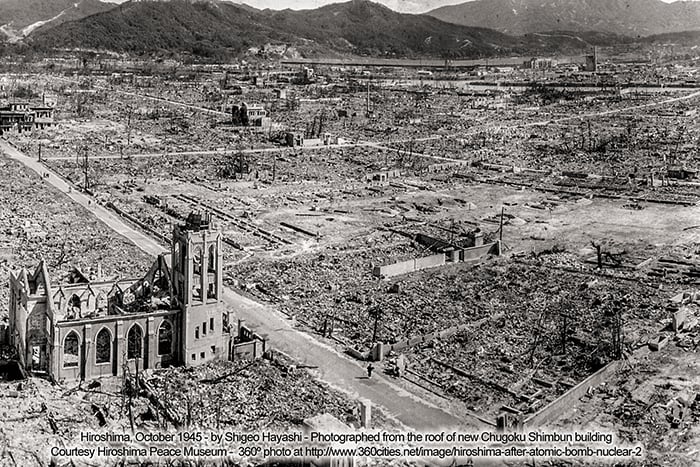
The atom bomb was developed in the United States-led Manhattan Project which peaked with the first test in July 1945 followed by the dropping of bombs on Hiroshima (6 August) and Nagasaki (9 August). By later standards these were small bombs exploding with a force below 20 kilotons, but together they killed more than 200,000 people. A kiloton equals 1,000 tons of TNT – but current weapons may be a megaton or more in destructive force (1,000,000 tons of TNT).

After Hiroshima and Nagasaki, the US soon set up a nuclear production-line. American planes could have destroyed two Japanese cities each month (though many were already flattened by intense conventional bombardment). In the event, Japan surrendered on 15 August. But a production-line was established anyway as the cold war loomed. As early as 1948, the US had a nuclear arsenal of fifty weapons.

This is the closest the clock has been to “doomsday” since the US and Soviet Union started testing immensely destructive H-bombs in the early 1950s.

The Soviet Union meanwhile developed its own atom bomb, testing its first in 1949. Both states went on to develop and test the H-bomb (aka thermonuclear or fusion bomb). There followed an extraordinary nuclear arms race involving free-fall bombs, land-based and submarine-launched ballistic-missiles, nuclear-armed torpedoes, anti-aircraft missiles, air-to-air missiles, artillery-shells, and even miniature backpack nuclear landmines.

Other countries got in on the act: the United Kingdom built its first bomb in 1952, France followed in 1960, China in 1964, and Israel later that decade. India tested what it tastefully called a “peaceful nuclear device” in 1974, Pakistan’s first test was in 1998, and North Korea’s in 2006.

The east-west nuclear arms race lasted from the early 1950s to the end of the 1980s, and was almost unbelievable in its intensity. In most areas of weaponry the US led the way, with the Soviet Union subsequently catching up. By the mid-1980s world nuclear arsenals peaked at over 60,000, the vast majority American and Soviet. Most were far more powerful than the Hiroshima and Nagasaki bombs.

But the extraordinary range of tactical weapons refutes the idea that nuclear policy was all about deterrence through mutually-assured destruction (MAD) using massively powerful strategic weapons. In reality, actually fighting a nuclear war has a history that dates from Hiroshima and continues strongly to today.


Nagasaki, 20 minutes after the bombing in 1945. Flickr/Semilla Luz. CC-BY-2.0.


Where are we now?

There was a substantial scaling down in the 1990s, some of it by agreement but much more done unilaterally. Most of the US and Russian (ex-Soviet) nuclear stockpiles were allowed to wither during the decade, although that still left many thousands. The Stockholm International Peace Research Institute (SIPRI) says there are currently about 15,000 warheads in the worldwide nuclear arsenals, with individual states as follows:

  • * United States,  6,800
  • * Russia, 7,000
  • * United Kingdom, 215
  • * France, 300
  • * China, 270
  • * Israel, 80
  • * India, 130
  • * Pakistan, 140
  • * North Korea, 15

Some of these weapons are in reserve and others are in storage, waiting to be dismantled. The United States, for example, has 1,393 warheads on strategic-delivery systems, made up of intercontinental ballistic missiles, submarine-launched ballistic missiles, and long-range bombers; 4,018 stockpiled, many of them tactical nuclear weapons readily available for use, and 2,880 “retired” nuclear warheads pending disassembly. The proportions for Russia are broadly similar. If nuclear strategy was all about the ability to destroy the major cities of a country then twenty or thirty would be more than enough. So “overkill” remains the order of the day.

Most analysts believe the US systems are more accurate and reliable. But they also recognise that because Russia’s conventional forces are relatively weak, it would be tempted to use nuclear weapons early if a conflict with Nato broke out. This was certainly the policy within in the 1970s-80s when the Soviet Union had much larger conventional forces in Europe.


The good news

With around 10,000 nuclear warheads deployed or stockpiled for use, and more talk of “limited nuclear wars”, it is worth remembering that there are positives too. After all, only eight United Nations member-states have nuclear weapons, while 185 don’t. Moreover, a number of states decided against developing nuclear weapons in the past after thinking seriously about it. They include Sweden, Switzerland, Brazil and Argentina. South Africa had nuclear weapons but dismantled its small stock at the end of the apartheid era (see “A nuclear world: eight-and-a-half rogue states“, 13 January 2017). In the 1980s, many analysts (including me) thought that there would have been more nuclear-armed states by now.

It is also worth remembering that many states are members of nuclear-free zones, including signatories to four international treaties covering large parts of the world:

  • * Treaty of Tlatelolco (Latin America and the Caribbean), 1967
  • * Treaty of Rarotonga (south Pacific), 1985
  • * Treaty of Bangkok (southeast Asia), 1995
  • * Treaty of Pelindaba (Africa), 1996

In view of this it is hardly surprising that over fifty states have signed up to the new Treaty on the Prohibition of Nuclear Weapons, a UN initiative which was adopted in July 2017 and opened for signature only in September.


The bad news

A recap: why is it even necessary to write articles like this, nearly thirty years after the end of the cold war and in light of the good news just cited? Here are three reasons.

There is a need for much more discussion about and opposition to the belief that having the ability to kill tens of millions of people makes for a sane “defence” policy.

First, all the eight nuclear-weapons states are intent on keeping their nuclear arsenalsand are involved in modernising them or their delivery systems. None has even the slightest intention of signing up to, or even vaguely supporting, the Treaty on the Prohibition of Nuclear Weapons – although that document has widespread international support.

Second, tensions between Nato and Russia are increasing, and there is real fear of a nuclear confrontation between North Korea and the United States, especially under the latter’s present leadership.

Third, and perhaps most important of all, is the serious talk of small-scale use of nuclear weapons. Such a catastrophic step would break a nuclear taboo that has held, despite many crises, mistakes and false alarms, since 9 August 1945.

That is why the issue is so important – and why there is a need for much more discussion about and opposition to the belief that having the ability to kill tens of millions of people makes for a sane “defence” policy. But in raising the issue, it’s always useful to remember the good news too. There are other ways forward, out of the nuclear danger and into a safer world, and plenty of people believe in them.


Originally published at openDemocracy


Further information

If you want to know more about things nuclear, then here is a brief personal selection of sources – from a much larger range:

* SIPRI is an excellent resource, not least its Yearbook: Armaments, Disarmament and International Security

* Probably the best informed sources on nuclear weapons are Hans Kristensen and Robert Norris, both at the Federation of American Scientists with frequent articles in the Bulletin of the Atomic Scientists

* Patricia Lewis, research director for international security at Chatham House, is with her team doing some interesting work on issues of nuclear safety and crisis instability

* Nuclear Information Service is a well-informed source, particularly on UK nuclear matters

* British American Security Information Council (Basic),   is also  useful on UK nuclear weapons, not least the US connection

* Rebecca Johnson’s Acronym Institute for Disarmament Diplomacy has valuable information on nuclear arms control –

* There are all too few independent academic analysts in the UK, but Nick Ritchie at the University of York is always worth reading

* Finally, and if you are a real glutton for punishment, see if you can dig out a copy of a book that Malcolm Dando and I wrote for CND nearly in 1984: The Death of Deterrence: Consequences of the New Nuclear Arms Race. It cost £1.95 then and should be even cheaper now!


About the author

Paul Rogers is professor in the department of peace studies at Bradford University, northern England. He is openDemocracy’s international security adviser, and has been writing a weekly column on global security since 28 September 2001; he also writes a monthly briefing for the Oxford Research Group.

His latest book is Irregular War: ISIS and the New Threat from the Margins (IB Tauris, 2016), which follows Why We’re Losing the War on Terror (Polity, 2007), and Losing Control: Global Security in the 21st Century (Pluto Press, 3rd edition, 2010).

He is on Twitter at: @ProfPRogers

A lecture by Paul Rogers, delivered to the Food Systems Academy in late 2014, provides an overview of the analysis that underpins his openDemocracy column. The lecture – “The crucial century, 1945-2045: transforming food systems in a global context” – focuses on the central place of food systems in human security worldwide. Paul argues that food is the pivot of humanity’s next great transition. It can be accessed here

One Response

  1. It is amazing how easily most of us ignore this dangerous escalation that could put an end to human civilisation. It is time to take note and do something about it, at least to protest, before it is too late

Related Posts

This is not another geopolitical commentary on the Arctic. It is a visionary peace proposal that can save the region from militarised rivalry and ecological ruin. A blueprint for shared security, sustainable development, and human dignity — benefitting Greenland, the Arctic, and the rest of us. Jan Oberg TFF director Lund, Sweden, February 17, 2026 I. Four Principles for a New Arctic Vision The Arctic is often framed as a cold arena of rivalry — a place where great powers test each other’s resolve. But this worldview is outdated, unimaginative, and ultimately self‑defeating. The Arctic is not a vacuum waiting to be militarised; it is a living region, a climate stabiliser, and a cultural homeland whose future will shape the future of humanity. If we begin from that understanding, a far more rational Arctic order becomes possible — one that is peaceful, cooperative, and centred on the people who actually live there. This vision rests...
Jan Oberg June 19, 2025 Does she think we are idiots? Does Denmark’s foreign policy establishment? I am a Danish citizen, and this fraudulent speech with a gross lie through omission is morally and politically unacceptable. H. E. Ambassador, Christina Markus Lassen, spoke at the UN Security Council’s urgent meeting caused by Israel’s attack on Iran. Read her short – shocking – speech here. She is an experienced Danish diplomat, partly educated in the US (of course), and has been her country’s ambassador to Syria, where she collaborated with the US (the famous Mr Ford!), France, and the UK to shape a “Western approach” – to changing the government of Bashar al-Assad, one must assume. Perversely as hard to believe, she does not mention that Israel has attacked Iran! No, she starts with the US/Israeli mantra – they are both major nuclear powers, of course – that Iran shall never...
We’ve seen it repeatedly: You invent a pretext based on deliberate lies, fake news, exaggerations or a false flag operation which serves to construct a story that country or leader X is a threat to “us” which legitimates that we do a ‘preemptive’ strike against that – obviously invented – threat to eliminate it. Mainstream media’s task is to propagate the ploy, not to ask questions or reveal the lie. Take Serbia’s ‘genocide’ in Kosovo, Afghanistan’s responsibility for 9/11, Saddam’s possession of nukes in Iraq, Assad’s use of chemical weapons against the Syrians, Gaddafi’s ‘mass murder’ in Bengazi, Russia’s planning to occupy and administer not only Ukraine but also a series of European countries thereafter, Hamas’ attack on Israel – that Israel knew everything about before it happened – and now you have the blatant lie about Iran’s being just about to become a nuclear weapons power. Basic facts about...

Recent Articles

Tony Robinson October 4, 2026 Violence is easy to recognise when someone is being beaten, shot or killed. It becomes more difficult when nobody is holding a weapon. Poverty, discrimination, exploitation and repression can restrict a human life just as effectively, although they do so in very different ways and with very different consequences. Simply adding more categories to an ever-growing list of forms of violence does not really solve the problem. The more interesting question is what all these different situations have in common and why it makes sense to describe them using the same word. Human beings do not simply react to what happens around them. They remember the past, imagine things that do not yet exist, make plans and undertake projects. Workers organise because they imagine different working conditions; people migrate because they imagine another life somewhere else; social movements emerge because people refuse to accept the...
It’s a matter of principles, courage, vision and pulling together – while the militarist world is falling apart… Peter Langille October 3, 2026 “Here, then, is the problem which we present to you, stark and dreadful and inescapable: Shall we put an end to the human race; or shall mankind renounce war?”The Bertrand Russell—Albert Einstein Manifesto, July 9, 1955 ⁕ The forecast for what’s ahead is worrisome. The sharp rise in armed conflicts over the past three years is adding to what was already the highest level in over seventy years. Genocides, which should be prevented are supported. A shared climate emergency that jeopardises survival is ignored. Diverse polls now suggest that people are war-weary, worried and interested in a more effective United Nations. And, there are viable policy options for a more secure world! Yet governments are doubling-down, betting on more war and investing heavily. If current trends persist,...
Johan Galtung 1930-2024October 2015 Published here on October 3, 2026 Let us focus on Civilization for conflict analysis and remedies. Major forms of disorder use violence; war is state organized violence. The most belligerent states are the United States of America and Israel, both with civilization roots. National Evangelism, the US Protestant Christian civilization– more national than evangelical–justifies US warfare as exceptionalism of a people chosen by God, with a manifest destiny to run the world. Orthodox Judaism justifies Israeli warfare to conquer and expand from Nile to Euphrates as a religious right and duty to the Eternal One. The third most belligerent country, the UK, no longer believes it is God-chosen but chosen by the USA; not quite the same but something. But the root cause of global disorder lies in the Occident–with Islam–seeing itself as the single, universal civilization valid for all at all times, all others being...

TFF on Substack

Discover and subscribe to more peace materials on TFF Substack

Most Popular

Tony Robinson October 4, 2026 Violence is easy to recognise when someone is being beaten, shot or killed. It becomes more difficult when nobody is holding a weapon. Poverty, discrimination, exploitation and repression can restrict a human life just as effectively, although they do so in very different ways and with very different consequences. Simply adding more categories to an ever-growing list of forms of violence does not really solve the problem. The more interesting question is what all these different situations have in common and why it makes sense to describe them using the same word. Human beings do not simply react to what happens around them. They remember the past, imagine things that do not yet exist, make plans and undertake projects. Workers organise because they imagine different working conditions; people migrate because they imagine another life somewhere else; social movements emerge because people refuse to accept the...
It’s a matter of principles, courage, vision and pulling together – while the militarist world is falling apart… Peter Langille October 3, 2026 “Here, then, is the problem which we present to you, stark and dreadful and inescapable: Shall we put an end to the human race; or shall mankind renounce war?”The Bertrand Russell—Albert Einstein Manifesto, July 9, 1955 ⁕ The forecast for what’s ahead is worrisome. The sharp rise in armed conflicts over the past three years is adding to what was already the highest level in over seventy years. Genocides, which should be prevented are supported. A shared climate emergency that jeopardises survival is ignored. Diverse polls now suggest that people are war-weary, worried and interested in a more effective United Nations. And, there are viable policy options for a more secure world! Yet governments are doubling-down, betting on more war and investing heavily. If current trends persist,...
Johan Galtung 1930-2024October 2015 Published here on October 3, 2026 Let us focus on Civilization for conflict analysis and remedies. Major forms of disorder use violence; war is state organized violence. The most belligerent states are the United States of America and Israel, both with civilization roots. National Evangelism, the US Protestant Christian civilization– more national than evangelical–justifies US warfare as exceptionalism of a people chosen by God, with a manifest destiny to run the world. Orthodox Judaism justifies Israeli warfare to conquer and expand from Nile to Euphrates as a religious right and duty to the Eternal One. The third most belligerent country, the UK, no longer believes it is God-chosen but chosen by the USA; not quite the same but something. But the root cause of global disorder lies in the Occident–with Islam–seeing itself as the single, universal civilization valid for all at all times, all others being...
Read More
Living-Peace-Sign-Budapest-copy
Tony Robinson October 4, 2026 Violence is easy to recognise when someone is being beaten, shot or killed. It becomes more difficult when nobody is holding a weapon. Poverty, discrimination, exploitation and repression can restrict a human life just as effectively, although they do so in very different ways and with very different consequences. Simply adding more categories to an ever-growing list of forms of violence does not really solve the problem. The more interesting question is what all these different situations have in common and why it makes sense to describe them using the same word. Human beings do not simply react to what happens around them. They remember the past, imagine things that do not yet exist, make plans and undertake projects. Workers organise because they imagine different working conditions; people migrate because they imagine another life somewhere else; social movements emerge because people refuse to accept the...
b54a1f10-8c65-4f0b-9dd5-4abc0a7d04cc_2659x2659
It’s a matter of principles, courage, vision and pulling together – while the militarist world is falling apart… Peter Langille October 3, 2026 “Here, then, is the problem which we present to you, stark and dreadful and inescapable: Shall we put an end to the human race; or shall mankind renounce war?”The Bertrand Russell—Albert Einstein Manifesto, July 9, 1955 ⁕ The forecast for what’s ahead is worrisome. The sharp rise in armed conflicts over the past three years is adding to what was already the highest level in over seventy years. Genocides, which should be prevented are supported. A shared climate emergency that jeopardises survival is ignored. Diverse polls now suggest that people are war-weary, worried and interested in a more effective United Nations. And, there are viable policy options for a more secure world! Yet governments are doubling-down, betting on more war and investing heavily. If current trends persist,...
010
Johan Galtung 1930-2024October 2015 Published here on October 3, 2026 Let us focus on Civilization for conflict analysis and remedies. Major forms of disorder use violence; war is state organized violence. The most belligerent states are the United States of America and Israel, both with civilization roots. National Evangelism, the US Protestant Christian civilization– more national than evangelical–justifies US warfare as exceptionalism of a people chosen by God, with a manifest destiny to run the world. Orthodox Judaism justifies Israeli warfare to conquer and expand from Nile to Euphrates as a religious right and duty to the Eternal One. The third most belligerent country, the UK, no longer believes it is God-chosen but chosen by the USA; not quite the same but something. But the root cause of global disorder lies in the Occident–with Islam–seeing itself as the single, universal civilization valid for all at all times, all others being...
Screenshot 2026-10-02 011738
Jan ObergPhD, director, The Transnational Foundation for Peace and Future Research, TFFLund, Sweden October 2, 2026 This is my full original manuscript. The Chinese Academy of Social Science, CASS, makes two publications out if it. 1. China’s Five-year plan emphasized the capabilities of basic research and original innovation. It is regarded as the goal of the future social development, which, as required, should be significantly enhanced. Can you comment on the importance of original innovation in research and academic study? I believe it is easier to define “original innovation” in the natural sciences than in social sciences. The breaking points of what constitutes something new, or innovative, are not quite as sharp in the latter. But in both fields it is about opening up something that was closed, unseen, unexplored before – making manifest what was earlier latent. Innovations come in many forms and shapes – naming something that was not...
arctic-circle-map
The agreement is catastrophic both because of what it says and what it doesn’t mention. It reduces further the major asset of security policies: Freedom of action. Jan Oberg TFF director September 25, 2026 A couple of hours before the agreement was signed on September 22, 2026, I published the following 13 hypotheses about what it would most likely contain on TFF Substack (in English). I was wrong on only the first point. Contrary to what Trump had written on his Truth Social platform, it does not appear to come into force immediately. In fact, it turned out to be worse than even I had anticipated. After these hypotheses now come a number of reflections in light of what the agreement actually contains, and does not contain, as well as the way in which it has generally been presented by major media outlets and by the public-service broadcaster DR. My...
girl-5894831_1280
Below are TFF-related media mentions, comments, videos and social media posts published elsewhere but not on this homepage. We happen to catch and list only a fraction. Regarding video comments and debates, we recommend that you go to the TFF Video Channel on Substack where many of them are reproduced. Jan Oberg is a contributor to China Daily – 52 million daily clicks – and Global Times, CGTN and CCTV (the national television), China Investment, Xinhua News Agency and several others. Articles and videos on these media very often multiply into countless Chinese (and Western media) that re-post them from these main media. Thanks to The China Academy, his analyses, interviews and comments are frequently posted on YouTube channels such as Thinkers Forum and Wave Media. These videos are often re-posted on Bilibili (China’s YouTube), the China Content Center on TikTok, and on the Chinese edition of TikTok, Douyin.com. This means reaching hundreds of millions of viewers worldwide over a year. While there are too many to catch on all these...



