
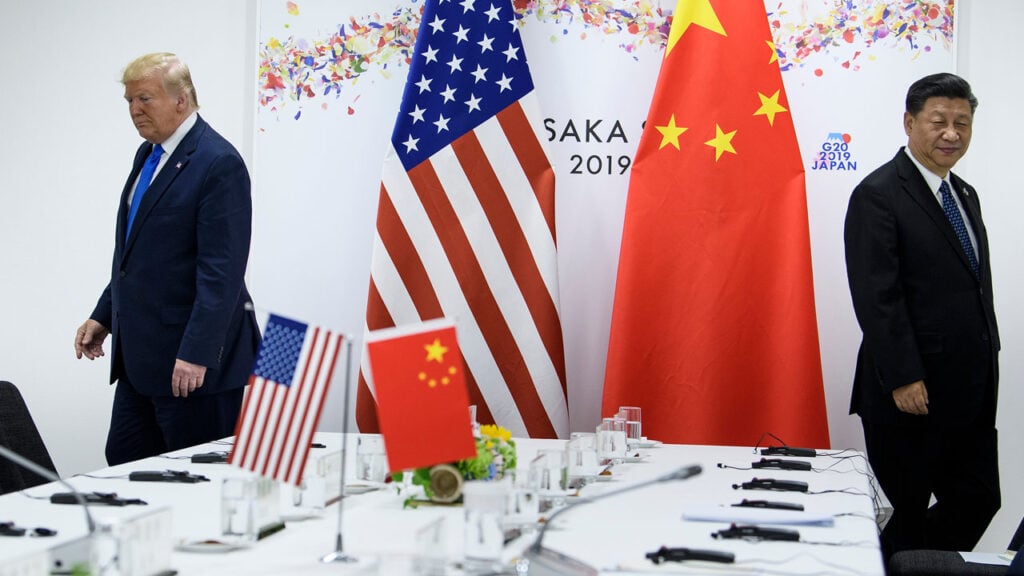
China has learned from its own rich history and is applying those lessons to re-emerge as a major 21st century power
May 20, 2020
Pepe Escobar
With hybrid warfare 2.0 against China reaching fever pitch, the New Silk Roads, or Belt and Road Initiative, will continue to be demonized 24/7 as the proverbial evil communist plot for economic and geopolitical domination of the “free” world, boosted by a sinister disinformation campaign.
It’s idle to discuss with simpletons. In the interest of an informed debate, what matters is to find the deeper roots of Beijing’s strategy – what the Chinese learned from their own rich history and how they are applying these lessons as a re-emerging major power in the young 21st century.
Originally published by Asia Times on May 11, 2020, here
Let’s start with how East and West used to position themselves at the center of the world.
The first Chinese historic-geographic encyclopedia, the 2nd century B.C. Classic of the Mountains and the Seas, tells us the world was what was under the sun (tienhia). Composed of “mountains and seas” (shanhai), the world was laid out between “four seas” (shihai). There’s only one thing that does not change: the center. And its name is “Middle Kingdom” (Zhongguo), that is, China.
Of course, the Europeans, in the 16th century, discovering that the earth was round, turned Chinese centrality upside down. But actually not that much (see, for instance, this 21st century Sinocentric map published in 2013).

The principle of a huge continent surrounded by seas, the “exterior ocean,” seems to have derived from Buddhist cosmology, in which the world is described as a “four-petal lotus.” But the Sinocentric spirit was powerful enough to discard and prevail over every cosmogony that might have contradicted it, such as the Buddhist, which placed India at the center.
Now compare Ancient Greece. Its center, based on reconstituted maps by Hippocrates and Herodotus, is a composite in the Aegean Sea, featuring the Delphi-Delos-Ionia triad. The major split between East and West goes back to the Roman empire in the 3rd century. And it starts with Diocletian, who made it all about geopolitics.
Here’s the sequence: In 293, he installs a tetrarchy, with two Augustuses and two Caesars, and four prefectures. Maximian Augustus is charged to defend the West (Occidens), with the “prefecture of Italy” having Milan as capital. Diocletian charges himself to defend the East (Oriens), with the “prefecture of Orient” having Nicomedia as capital.
Political religion is added to this new politico-military complex. Diocletian starts the Christian dioceses (dioikesis, in Greek, after his name), twelve in total. There is already a diocese of the Orient – basically the Levant and northern Egypt.
There’s no diocese of the Occident. But there is a diocese of Asia: basically the Western part of Mediterranean Turkey nowadays, heir to the ancient Roman provinces in Asia. That’s quite interesting: the Orient is placed east of Asia.
The historical center, Rome, is just a symbol. There’s no more center; in fact, the center is slouching towards the Orient. Nicomedia, Diocletian’s capital, is quickly replaced by neighbor Byzantium under Constantine and rechristened as Constantinople: he wants to turn it into “the new Rome.”
When the Western Roman empire falls in 476, the empire of the Orient remains.
Officially, it will become the Byzantine empire only in the year 732, while the Holy Roman Empire – which, as we know, was neither holy, nor Roman, nor an empire – resurrects with Charlemagne in 800. From Charlemagne onwards, the Occident regards itself as “Europe,” and vice-versa: the historical center and the engine of this vast geographical space, which will eventually reach and incorporate the Americas.
Superstar admiral Zheng He
We’re still immersed in a – literally – oceanic debate among historians about the myriad reasons and the context that led everyone and his neighbor to frenetically take to the seas starting in the late 15th century – from Columbus and Vasco da Gama to Magellan.
But the West usually forgets about the true pioneer: iconic Admiral Zheng He, original name Ma He, a eunuch and Muslim Hui from Yunnan province.
His father and grandfather had been pilgrims to Mecca. Zheng He grew up speaking Mandarin and Arabic and learning a lot about geography. When he was 13, he was placed in the house of a Ming prince, Zhu Di, member of the new dynasty that came to power in 1387.
Educated as a diplomat and warrior, Zheng He converted to Buddhism under his new name, although he always remained faithful to Islam. After all, as I saw for myself when I visited Hui communities in 1997 when branching out from the Silk Road, on my way to Labrang monastery in Xiahe, Hui Islam is a fascinating syncretism incorporating Buddhism, the Tao and Confucianism.
Zhu Di brought down the Emperor in 1402 and took the name Yong Le. A year later he had already commissioned Zheng He as admiral, and ordered him to supervise the construction of a large fleet to explore the seas around China. Or, to be more precise, the “Occidental ocean” (Xiyang): that is, the Indian Ocean.
Thus from 1405 to 1433, roughly three decades, Zheng He led seven expeditions across the seas all the way to Arabia and Eastern Africa, leaving from Nanjing in the Yangtze and benefiting from monsoon winds. They hit Champa, Borneo, Java, Malacca, Sumatra, Ceylon, Calicut, Hormuz, Aden, Jeddah/Mecca, Mogadiscio and the Eastern African coast south of the Equator.
Those were real armadas, sometimes with over 200 ships, including the 72 main ones, carrying as many as 30,000 men and vast amounts of precious merchandise for trade: silk, porcelain, silver, cotton, leather products, iron utensils. The leading vessel of the first expedition, with Zheng He as captain, was 140 meters long, 50 meters wide and carrying over 500 men.
This was the original Maritime Silk Road, now revived in the 21st century. And it was coupled with another extension of the overland Silk Road: after all the dreaded Mongols were in retreat, there were new allies all the way to Transoxiana, the Chinese managed to strike a peace deal with the successor of Tamerlane. So the Silk Roads were booming again. The Ming court sent diplomats all over Asia – Tibet, Nepal, Bengal, even Japan.
The main objective of pioneering Chinese seafaring has always puzzled Western historians. Essentially, it was a diplomatic, commercial and military mix. It was important to have Chinese suzerainty recognized – and materialized via the payment of a tribute. But most of all this was about trade; no wonder the ships had special cabins for merchants.
The armada was designated as the Treasury Fleet – but denoting more a prestige operation than a vehicle for capturing riches. Yong Le was strong on soft power and economics – as he took control of overseas trade by imposing an imperial monopoly over all transactions. So in the end this was a clever, comprehensive application of the Chinese tributary system – in the commercial, diplomatic and cultural spheres.
Yong Le was in fact following the instructions of his predecessor Hongwu, the founder of the Ming (“Lights”) dynasty. Legend rules that Hongwu ordered that one billion trees should be planted in the Nanjing region to supply the building of a navy.
Then there was the transfer of the capital from Nanjing to Beijing in 1421, and the construction of the Forbidden City. That cost a lot of money. As much as the naval expeditions were expensive, their profits, of course, were useful.
Yong Le wanted to establish Chinese – and pan-Asian – stability via a true Pax Sinica. That was not imposed by force but rather by diplomacy, coupled with a subtle demonstration of power. The Armada was the aircraft carrier of the time, with cannons on sight – but rarely used – and practicing “freedom of navigation”.
What the emperor wanted was allied local rulers, and for that he used intrigue and commerce rather than shock and awe via battles and massacres. For instance, Zheng He proclaimed Chinese suzerainty over Sumatra, Cochin and Ceylon. He privileged equitable commerce. So this was never a colonization process.
On the contrary: before each expedition, as its planning proceeded, emissaries from countries to be visited were invited to the Ming court and treated, well, royally.
Plundering Europeans
Now compare that with the European colonization led a decade later by the Portuguese across these same lands and these same seas. Between (a little) carrot and (a lot of) stick, the Europeans drove commerce mostly via massacres and forced conversions. Trading posts were soon turned into forts and military installations, something that Zheng He’s expeditions never attempted.
In fact Zheng He left so many good memories that he was divinized under his Chinese name, San Bao, which means “Three Treasures,” in such places in Southeast Asia as Malacca and Siam’s Ayutthaya.
What can only be described as Judeo-Christian sadomasochism focused on imposing suffering as virtue, the only path to reach Paradise. Zheng He would never have considered that his sailors – and the populations he made contact with – had to pay this price.
So why did it all end, and so suddenly? Essentially Yong Le run out of money because of his grandiose imperial adventures. The Grand Canal – linking the Yellow River and the Yangtze basins – cost a fortune. Same for building the Forbidden City. The revenue from the expeditions was not enough.
And just as the Forbidden City was inaugurated, it caught fire in May 1421. Bad omen. According to tradition, this means disharmony between Heaven and the sovereign, a development outside of the astral norm. Confucians used it to blame the eunuch councilors, very close to the merchants and the cosmopolitan elites around the emperor. On top of it, the southern borders were restless and the Mongol threat never really went away.
The new Ming emperor, Zhu Gaozhi, laid down the law: “China’s territory produces all goods in abundance; so why should we buy abroad trinkets without any interest?”
His successor Zhu Zanji was even more radical. Up to 1452, a series of imperial edicts prohibited foreign trade and overseas travel. Every infraction was considered piracy punished by death. Worse, studying foreign languages was banished, as was the teaching of Chinese to foreigners.
Zheng He died (in early 1433? 1435?) in true character, in the middle of the sea, north of Java, as he was returning from the seventh, and last, expedition. The documents and the charts used for the expeditions were destroyed, as well as the ships.
So the Ming ditched naval power and re-embraced old agrarian Confucianism, which privileges agriculture over trade, the earth over the seas, and the center over foreign lands.
No more naval retreat
The takeaway is that the formidable naval tributary system put in place by Yong Le and Zheng He was a victim of excess – too much state spending, peasant turbulence – as well as its own success.
In less than a century, from the Zheng He expeditions to the Ming retreat, this turned out to be a massive game changer in history and geopolitics, prefiguring what would happen immediately afterwards in the long 16th century: the era when Europe started and eventually managed to rule the world.
One image is stark. While Zheng He’s lieutenants were sailing the eastern coast of Africa all the way to the south, in 1433, the Portuguese expeditions were just starting their adventures in the Atlantic, also sailing south, little by little, along the Western coast of Africa. The mythical Cape Bojador was conquered in 1434.
After the seven Ming expeditions crisscrossed Southeast Asia and the Indian Ocean from 1403 for nearly three decades, only half a century later Bartolomeu Dias would conquer the Cape of Good Hope, in 1488, and Vasco da Gama would arrive in Goa in 1498.
Imagine a historical “what if?”: the Chinese and the Portuguese bumping into each other in Swahili land. After all, in 1417 it was the turn of Hong Bao, the Muslim eunuch who was Zheng He’s lieutenant; and in 1498 it was Vasco da Gama’s turn, guided by the “Lion of the Sea” Ibn Majid, his legendary Arab master navigator.
The Ming were not obsessed with gold and spices. For them, trade should be based on equitable exchange, under the framework of the tribute. As Joseph Needham conclusively proved in works such as Science and Civilization in China, the Europeans wanted Asian products way more than Orientals wanted European products, “and the only way to pay for them was gold.”
For the Portuguese, the “discovered” lands were all potential colonization territory. And for that the few colonizers needed slaves. For the Chinese, slavery amounted to domestic chores at best. For the Europeans, it was all about the massive exploitation of a workforce in the fields and in mines, especially concerning black populations in Africa.
In Asia, in contrast to Chinese diplomacy, the Europeans went for massacre. Via torture and mutilations, Vasco da Gama and other Portuguese colonizers deployed a real war of terror against civilian populations.
This absolutely major structural difference is at the root of the world- system and the geo-historical organization of our world, as analyzed by crack geographers such as Christian Grataloup and Paul Pelletier. Asian nations did not have to manage – or to suffer – the painful repercussions of slavery.
So in the space of only a few decades the Chinese abdicated from closer relations with Southeast Asia, India and Eastern Africa. The Ming fleet was destroyed. China abandoned overseas trade and retreated unto itself to focus on agriculture.
Once again: the direct connection between the Chinese naval retreat and the European colonial expansion is capable of explaining the development process of the two “worlds” – the West and the Chinese center – since the 15th century.
At the end of the 15th century, there were no Chinese architects left capable of building large ships. Development of weaponry also had been abandoned. In just a few decades, crucially, the Sinified world lost its vast technological advance over the West. It got weaker. And later it would pay a huge price, symbolized in the Chinese unconsciousness by the “century of humiliation.”
All of the above explains quite a few things.
How Xi Jinping and the current leadership did their homework. Why China won’t pull a Ming remix and retreat again. Why and how the overland Silk Road and the Maritime Silk Road are being revived. How there won’t be any more humiliations.
And most of all, why the West – especially the American empire – absolutely refuses to admit the new course of history.
If you found this analysis enlightening, then please appreciate it and TFF for bringing it…
Pepe Escobar
We would like to warmly recommend many other analyses by the author – some of which you will find here on Asia Times. And more about Escobar on Facebook & Google.






One Response
I think the article missed 300 hundred years relations between China and Spain in the Philippines. The so-called Manila galleon made this trip once or two times a year without interruption during more than 300 years. Another quite interesting exchange took place between the Jesuits, representative of the Pope and Spain in Beijing, and China