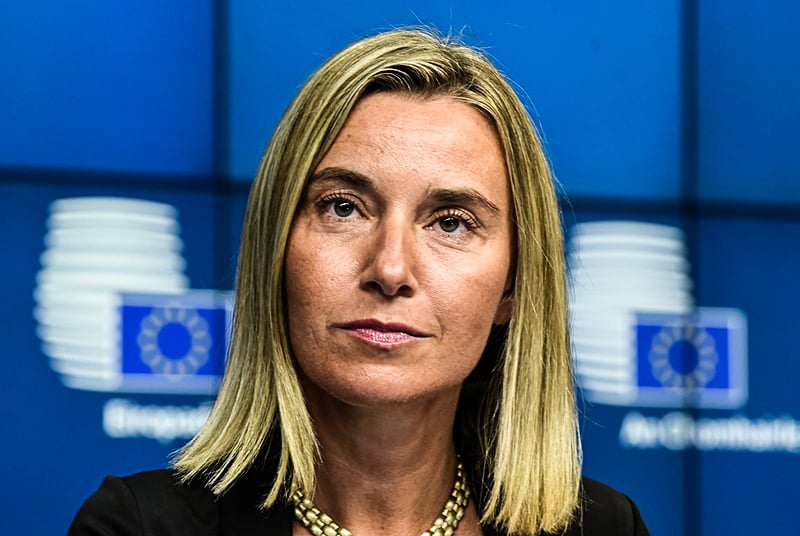
Photo: The European Union’s High Representative for Foreign Affairs and Security Policy Federica Mogherini


By Peter Jenkins

January 13, 2018

• It is with some reluctance that I write about President Donald Trump’s latest statement on Iran, because the statement is so full of half-truths, untruths, and logical fallacies that it is bad for one’s blood pressure to have to dwell on it for any length of time.

I will try to limit damage to my constitution by focussing on just a few of the statement’s most disturbing features.

The statement reveals a shocking attitude towards the European allies of the United States. For months these allies have been telling the Trump administration that the July 2015 Joint Comprehensive Plan of Action (JCPOA) is a satisfactory and useful nuclear non-proliferation instrument, and that they attach the highest importance to preserving it.

President Trump’s statement does not just ignore what his European allies have been saying. It threatens these allies with the very outcome they want to avoid—the demise of the JCPOA—if they decline or fail to bend to the President’s will:

Today, I am waiving the application of certain nuclear sanctions, but only in order to secure our European allies’ agreement to fix the terrible flaws of the Iran nuclear deal. This is a last chance. In the absence of such an agreement, the United States will not again waive sanctions in order to stay in the Iran nuclear deal. And if at any time I judge that such an agreement is not within reach, I will withdraw from the deal immediately.

This is an extraordinary way to treat long-standing allies. It amounts to putting a metaphorical gun to their heads. If the criminal underworld is paying attention, it will surely elect President Trump gangster-of-the-month. German Chancellor Angela Merkel was right: the time has come for Europe to wean itself from the United States.

Equally shocking, but less surprising because, alas, we have grown accustomed to this tendency, is a disregard for the sovereign rights of states and for the legally binding international treaties and UN resolutions that limit those rights.

Iran has a sovereign right to possess the means to enrich uranium. Currently that right is limited in two ways. The Nuclear Non-Proliferation Treaty (NPT) binds Iran to using enrichment technology solely for peaceful purposes and in conformity with a nuclear safeguards agreement. UN Security Council resolution 2231 endorses tight limits on Iran’s enrichment capacity, and production of enriched uranium, until the start of 2031.

Iran also has a sovereign right to develop and possess missiles for the purpose of delivering conventional (non-nuclear) warheads. There are no international treaty restrictions on this right. UNSC resolution 2231 “calls upon” Iran not to develop missiles that would be capable of delivering nuclear pay-loads but does not legally bind Iran in this respect. (So, contrary to President Trump’s claim, Iran’s missile tests and related activities are not “illicit” or violations of any UN resolution.)

It follows that President Trump has no right to dictate limits or restrictions over and beyond those just described. Instead, if he and his advisers believe that the sunset clauses of the JCPOA (certain restrictions on Iran’s enrichment right lapse between 2026 and 2031) and Iranian missiles threaten international peace and security, they must convene the UN Security Council and submit for the Council’s consideration a resolution that would give legally binding effect to the restrictions and prohibitions they consider necessary.

That is how the Trump administration ought to proceed. The probability of it doing so is close to zero, however. Even this administration is capable of perceiving that the Council would decline to adopt any such resolution.

Why? In 2018 there is no evidence that an expansion of Iran’s enrichment capacity after 2030 (if it takes place) will threaten international peace and security—or that Iranian possession of short- and medium-range missiles poses any more of a threat than their possession by Saudi Arabia, Israel, Pakistan, India, South Korea, and Brazil, to name but a few. Only after the International Atomic Energy Agency has concluded a root-and-branch investigation into the totality of Iran’s nuclear program, and produced findings, can the Council reasonably form a view on whether some kind of successor to the JCPOA (and/or missile restrictions) is needed to head off a threat to peace and security.

A third feature of the statement is the damage that it will do to the international standing of the United States.

Many states will be worried about the statement’s implications for the law-based international order to which they are attached. The last thing they want is a world in which the president of the United States feels entitled to form a posse and go after whomever he chooses.

They will also be worried that this statement suggests that President Trump is a man possessed by demons. One of those demons is his hatred of President Barack Obama. Trump’s desire to destroy one of Obama’s achievements is obvious from the statement.

Less obvious is President Trump’s faith in what he hears from those he has chosen to befriend. Anyone looking for a summary of the anti-Iranian propaganda churned out in recent years by Israel, Saudi Arabia, and associated Washington think-tanks need look no further than this statement. To the rest of the world this suggests that it is idle to look to the current White House for balanced, objective, rational analyses of international situations. That is disquieting.

The hope now must be that Europe, Russia, and China, with the backing of most of the world, can persuade Iran to scorn the US provocation that now seems inevitable: US withdrawal from the JCPOA and the re-introduction of US nuclear-related sanctions.

 

avatar

Peter Jenkins

Peter Jenkins was a British career diplomat for 33 years, following studies at the Universities of Cambridge and Harvard. He served in Vienna (twice), Washington, Paris, Brasilia and Geneva. He specialized in global economic and security issues. His last assignment (2001-06) was that of UK Ambassador to the IAEA and UN (Vienna). Since 2006 he has represented the Renewable Energy and Energy Efficiency Partnership, advised the Director of IIASA and set up a partnership, The Ambassador Partnership llp, with former diplomatic colleagues, to offer the corporate sector dispute resolution and solutions to cross-border problems. He was an associate fellow of the Geneva Centre for Security Policy from 2010 to 2012. He writes and speaks on nuclear and trade policy issues.

Related Posts

PART 2 — Diplomacy, Law and Nonviolent Power By Jan ObergTFF co-founder and director January 26, 2026 This is the second of four TFF-created idea portfolios designed to curb the global reach of the United States and, in both the short and long term, help catalyse a worldwide nonviolent resistance to what many observers describe as the Trump administration’s uniquely confrontational, destructive and world-threatening policies. These portfolios outline what governments and citizens across the world can do through dynamic diplomacy, creative initiatives, and strictly nonviolent means. They are typical TFF works in that we do not only tell what the problem is and how bad it will go – as 90+% of all commentators, experts and scholars do – we tell what we think can be done, inviting you to think of what you think you can do. It seems painfully clear to me that the current political dynamics in Washington increasingly resemble the most dangerous...
PART 1 — Media, Culture and Information Sovereignty By Jan ObergTFF co-founder and director January 20, 2026 This is the first of four TFF-created idea portfolios designed to curb the global reach of the United States and, in both the short and long term, help catalyse a worldwide nonviolent resistance to what many observers describe as the Trump administration’s uniquely confrontational, destructive and world-threatening policies. These portfolios outline what governments and citizens across the world can do through dynamic diplomacy, creative initiatives, and strictly nonviolent means. They are typical TFF works in that we do not only tell what the problem is and how bad it will go – as 90+% of all commentators, experts and scholars do – we tell what we think can be done, inviting you to think of what you think you can do. It seems painfully clear to me that the current political dynamics in Washington increasingly resemble the most...
Introduction to TFF’s forthcoming four Idea Portfolios of Diplomatic and Nonviolent Resistance By TFF’s Board & FoundersPascal Lottaz, Biljana Vankovska, Annette Schiffmann, Christina Spannar & Jan Oberg January 19, 2026 “America, you are too arrogant.” — Martin Luther King Jr. Over the course of Trump’s first term and now a year into his second, the world has witnessed a consistent pattern of actions that challenge the basic long-standing norms of international cooperation, weaken multilateral institutions, and ignore the global norms and legal frameworks established by the UN Charter. During these years, we have witnessed military operations in Iran, Syria and Ukraine without UN authorisation; the killing of Iranian General Qassem Soleimani; repeated strikes across the Middle East; and the launch of tariff wars against allies and competitors alike. We have seen a renewed emphasis on nuclearism and zero interest in arms control and disarmament negotiations. Pentagon is now The Department...

Recent Articles

Serious but also a lot of laughs and positive energy. Because peace is also about conviviality and enchantment… Jan Oberg, TFF director November 16, 2026 This is a long (129 minutes) conversation with me. We cover very many, also personal, issues that makes a somewhat unusual media event. I am very grateful to Flemming Blicher for giving me this opportunity. I can’t remember any channel or editor who spent as much time as he did preparing it – including also asking me to answer a series of pre-interview questions, which are now posted under the conversation. If you sympathise with its content, please share it. Watch it here
A Message from Jan Oberg November 6, 2026 Over the past fifty years, I have devoted roughly 175,000 hours to research and public education for a more peaceful world: thinking, researching, writing, organising, publishing, debating, maintaining websites, corresponding, reaching out, leading a foundation, work in conflict and war zones, professorships, teaching courses and giving public lectures and doing media work. In short, ten hours a day, seven days a week, for half a century. The focus was on international political peace – analysing and trying to stop wars, address underlying conflicts and making alternative peace plans – at the desk and on the ground. Important as that has been and remains, it is only one kind of peace and it is now in a tragic militarist state compared with what it could have been.  Lately, however, I have found myself thinking about a concept from economics as well as everyday...
Photo above: Carl Fredrik Reuterswärd’s Non-Violence outside UN Headquarters in New York. Kirill Levin, CC BY-NC-SA 2. Jan Oberg November 3, 2026 I am happy to be published in Horizons which is produced by the Center for International Relations and Sustainable Development, CIRSD, in Belgrade. My contribution brings out a radical re-thinking of what concepts such as defence, security, deterrence – and peace – may mean if we want to create a more peaceful world. It also summarises a few things I have been working with the last few decades. Please read it here Og her er den på dansk, takket være Johnny Baltzersens lynhurtige oversættelse

TFF on Substack

Discover and subscribe to more peace materials on TFF Substack

Most Popular

Serious but also a lot of laughs and positive energy. Because peace is also about conviviality and enchantment… Jan Oberg, TFF director November 16, 2026 This is a long (129 minutes) conversation with me. We cover very many, also personal, issues that makes a somewhat unusual media event. I am very grateful to Flemming Blicher for giving me this opportunity. I can’t remember any channel or editor who spent as much time as he did preparing it – including also asking me to answer a series of pre-interview questions, which are now posted under the conversation. If you sympathise with its content, please share it. Watch it here
A Message from Jan Oberg November 6, 2026 Over the past fifty years, I have devoted roughly 175,000 hours to research and public education for a more peaceful world: thinking, researching, writing, organising, publishing, debating, maintaining websites, corresponding, reaching out, leading a foundation, work in conflict and war zones, professorships, teaching courses and giving public lectures and doing media work. In short, ten hours a day, seven days a week, for half a century. The focus was on international political peace – analysing and trying to stop wars, address underlying conflicts and making alternative peace plans – at the desk and on the ground. Important as that has been and remains, it is only one kind of peace and it is now in a tragic militarist state compared with what it could have been.  Lately, however, I have found myself thinking about a concept from economics as well as everyday...
Photo above: Carl Fredrik Reuterswärd’s Non-Violence outside UN Headquarters in New York. Kirill Levin, CC BY-NC-SA 2. Jan Oberg November 3, 2026 I am happy to be published in Horizons which is produced by the Center for International Relations and Sustainable Development, CIRSD, in Belgrade. My contribution brings out a radical re-thinking of what concepts such as defence, security, deterrence – and peace – may mean if we want to create a more peaceful world. It also summarises a few things I have been working with the last few decades. Please read it here Og her er den på dansk, takket være Johnny Baltzersens lynhurtige oversættelse
Read More
Screenshot 2026-11-10 174455
Serious but also a lot of laughs and positive energy. Because peace is also about conviviality and enchantment… Jan Oberg, TFF director November 16, 2026 This is a long (129 minutes) conversation with me. We cover very many, also personal, issues that makes a somewhat unusual media event. I am very grateful to Flemming Blicher for giving me this opportunity. I can’t remember any channel or editor who spent as much time as he did preparing it – including also asking me to answer a series of pre-interview questions, which are now posted under the conversation. If you sympathise with its content, please share it. Watch it here
AbstractVision_2017_#1_800 (kopia)
A Message from Jan Oberg November 6, 2026 Over the past fifty years, I have devoted roughly 175,000 hours to research and public education for a more peaceful world: thinking, researching, writing, organising, publishing, debating, maintaining websites, corresponding, reaching out, leading a foundation, work in conflict and war zones, professorships, teaching courses and giving public lectures and doing media work. In short, ten hours a day, seven days a week, for half a century. The focus was on international political peace – analysing and trying to stop wars, address underlying conflicts and making alternative peace plans – at the desk and on the ground. Important as that has been and remains, it is only one kind of peace and it is now in a tragic militarist state compared with what it could have been.  Lately, however, I have found myself thinking about a concept from economics as well as everyday...
knotted gun
Photo above: Carl Fredrik Reuterswärd’s Non-Violence outside UN Headquarters in New York. Kirill Levin, CC BY-NC-SA 2. Jan Oberg November 3, 2026 I am happy to be published in Horizons which is produced by the Center for International Relations and Sustainable Development, CIRSD, in Belgrade. My contribution brings out a radical re-thinking of what concepts such as defence, security, deterrence – and peace – may mean if we want to create a more peaceful world. It also summarises a few things I have been working with the last few decades. Please read it here Og her er den på dansk, takket være Johnny Baltzersens lynhurtige oversættelse
TFFPortfolioVign
UNITE-tillid, DREAM-velstand og andre konstruktive komponenter Normally we publish articles in English here. But this is a translation of a very important TFF document that should reach as many as possible in Denmark since this country’s government has been one of the most hardline in Europe and, up till now at least, has refused to use diplomacy and, instead, spent tremendous sums on arming Ukraine with the express goal of defeating Russia. Thus this – unique – article is in Danish. Vi er Johnny Baltzersen og hans Fælles Sikkerhed – Fælles Fremtid på Substack overmåde taknemmelige for at have oversat og publiceret TFF’s 2025-portfølje for fredsidéer med henblik på Ukraines fremtid. Vi håber den nu kan nå mange flere danskere – som også vil sprede den og skabe debat – nu den danske regerings og folketingspartiernes politik på dette område siden 2022 står nu – forudsigeligt – ved vejs ende....
JoGSS-Silent
Jan Oberg TFF director October 28, 2026 Exactly one month has now passed since I published my criticism of the introduction to the special issue on Johan Galtung published by the Journal of Global Security Studies, JoGSS, and of Tor Egil Førland’s chapter about Galtung which serves as a preview to his forthcoming biography of Galtung to be published by PRIO. See the original on The Transnational here and the same article on TFF Substack with many general and critical comments and, in particular, the people who decided to withdraw from the biography project in protest. The special issue itself was extraordinary. It was devoted to the intellectual legacy of one of the founders of peace research and contained a number of strong assessments of his personality, scholarship, intellectual trajectory, and public role. Such assessments are, of course, entirely legitimate. No scholar is beyond criticism, and neither was Johan Galtung....
Screenshot 2026-10-26 115647
An aspect of Iran’s culture and civilisation you’ve probably never heard about. Don’t be surprised if the US and Israel also try to bomb them. Jan ObergTFF director October 26, 2026 Today – under the “USraeli” threat of new “annihilating” bombings – opens the 7th International Conference on Peace and Conflict Resolution at Tehran’s University. As far as I can tell, this is the only permanent, advanced peace research institution in West Asia/the Middle East. Perhaps more countries in that region could be inspired? I mean, how many military “security” institutes and military academies do they have? Many peace research institutes and university departments have been established since the 1950s in the West. They are now all under attack; some have closed down, some have gone mainstream, yet others kept the name but do nothing to research peace and disseminate results or advice; instead, they cooperate with militarism’s platforms such...