
Trita Parsi: Why non-Western countries tend to see Russia’s war very, very differently

Trita Parsi

April 18, 2022

The West appears blind to its own hypocrisy and narrow interests in calling for a rules-based order.

Ukrainian President Volodymyr Zelenskyy has been nothing short of brilliant in his outreach to Western audiences. The overwhelming Western support for Ukraine is due not only to the brutality of Russia’s illegal invasion, but also to the astuteness and charisma with which Zelenskyy has made Ukraine’s case for aid.

But as effective as Zelenskyy has been in drumming up Western support, Ukraine’s message has been far less compelling to audiences in the Global South, where many countries have declined to join Western campaigns to sanction Russia’s economy and isolate it diplomatically. This was vividly clear at the Doha Forum last month in Qatar, where Zelenskyy and Ukrainian Deputy Foreign Minister Emine Dzhaparova were given a big platform.

A powerful communicator in her own right, Dzhaparova — a Muslim Tatar from Crimea — played on themes favored by Western leaders: This war is ultimately not about Ukraine but about the survival of the “international rules-based order.” President Joe Biden and European leaders have repeatedly framed the conflict in these terms, as well.

But therein lies the disconnect with much of the Global South.

Originally published by MSNBC on April 12, 2022

In conversations with diplomats and analysts from across Africa, Asia, the Middle East and Latin America, it was evident to me that these countries largely sympathize with the plight of the Ukrainian people and view Russia as the aggressor. But Western demands that they make costly sacrifices by cutting off economic ties with Russia to uphold a “rules-based order” have begotten an allergic reaction. That order hasn’t been rules-based; instead, it has allowed the U.S. to violate international law with impunity.

The West’s messaging on Ukraine has taken its tone-deafness to a whole new level, and it is unlikely to win over the support of countries that have often experienced the worse sides of the international order.

The countries that have bucked Western calls for aid and diplomatic unity that have received the most attention are Saudi Arabia and the United Arab Emirates. In a sharp break from Washington, they have furthered their economic and political embrace of Russia while rebuffing Biden’s request to lower oil prices by pumping more oil. The UAE refused to denounce Russia’s invasion at the U.N. Security Council, and while its de facto leader, Mohammed bin Zayed, refused a phone call with Biden, he ordered his foreign minister to travel to Russia to strengthen their ties.

The concerns of Riyadh and Abu Dhabi differ sharply from those of most of the broader Global South and are rooted primarily in their deteriorating ties with Washington over the U.S. disinclination to go to war on their behalf against Iran and its allies. One Saudi diplomat has described Saudi-U.S. tensions as “the end of the road for us and Biden, but maybe the U.S. also.”

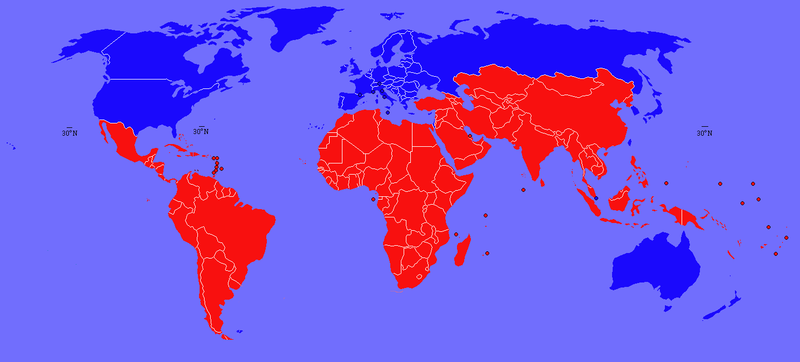
For the rest of the Global South, various local and broader structural factors have contributed to a hesitance to support the isolation of Russia. South American powers such as Brazil and Mexico, African heavyweights South Africa and Ethiopia and Asian rising power India are all in the majority in their regions in their refusal to sanction Russia.

•

India’s relations with Russia go back to the Cold War, when the Soviet Union vetoed numerous U.N. Security Council resolutions about Kashmir in India’s behalf. Russia remains one of India’s leading arms suppliers to this day. The same is true for many African countries. According to the Stockholm International Peace Research Institute, 18 percent of all Russian arms sales went to Africa from 2016 to 2020. African dependence on Russian and Ukrainian wheat and fertilizers is even greater — a quarter of African countries get a third of their wheat from Russia and Ukraine. Egypt knows the significance of this all too well. Rising Russian and Ukrainian grain prices in the months before the Arab spring in 2011 played a crucial role in setting the stage for the regionwide protests.

But the broader Global South’s dependence on or vulnerability to Russia doesn’t tell the whole story. Many of these states also see flagrant hypocrisy in framing the Ukraine war in terms of the survival of the rules-based order. From their vantage point, no other country or bloc has undermined international law, norms or the rules-based order more than the U.S. and the West.

There is no scarcity of examples.

In recent years, America undercut the rules-based order when Donald Trump withdrew from the U.N. Human Rights Council over its criticism of Israel’s treatment of Palestinians and the World Health Organization amid the Covid pandemic, and he sanctioned senior officials of the International Criminal Court for seeking to investigate American war crimes in Afghanistan. (The Biden administration is calling for the court to investigate Russian war crimes in Ukraine.)

It doesn’t help that many of these countries perceive themselves as having been at the receiving end of American unilateralism and recklessness.

There is also the blatant illegality of the George W. Bush administration’s invasion of Iraq, the Obama administration’s regime-change intervention in Libya, the U.S. and the U.K.’s ongoing support for the Saudi war in Yemen (which has left 13 million people at risk of starvation) and the celebration of armed Ukrainian resistance against Russian invaders while not only condemning Palestinian resistance against Israeli occupation, but also outlawing nonviolent economic opposition to that decades-long occupation. And then there is the “global war on terror,” which has destabilized much of the Middle East and North Africa while killing more than twice as many people as the terrorists themselves have murdered since the Sept. 11 attacks.

In fact, even though the U.S. played an instrumental role in establishing the rules and norms of the post-World War II order, it almost immediately began breaking them. During his two terms, President Dwight D. Eisenhower authorized no fewer than 104 covert operations, which included overthrowing governments and arming regional revolts.

But now the U.S. is demanding that countries in the Global South make massive and costly sacrifices — with little regard for their vulnerabilities and security needs — to save an order the U.S. itself has been at the forefront of eroding. To return to an order in which the U.S. can continue to act outside international law is equivalent to asking the Global South to make unbearable sacrifices to uphold American exceptionalism.

Moreover, it doesn’t help that many of these countries perceive themselves as having been on the receiving end of American unilateralism and recklessness. NATO, for instance, isn’t held in high regard in large parts of Africa because of its military intervention in Libya, which left a path of death and destruction in the Sahel. Defending his country’s neutral stance, Ugandan President Yoweri Museveni told reporters last month that the West “destroyed” Libya while spreading terrorism beyond its border.

•

The damaging consequences of American interventionism play a significant role in the calculations of countries across the Global South. Most of them seek close relations with the U.S. But because of U.S. unilateralism, they desire options to find counterweights against U.S. power when needed. The emergence of a multipolar system provides countries of the Global South with a degree of protection against American adventurism, while they largely see Russia’s military intervention in Ukraine as a European affair that doesn’t change the larger global picture, in which balancing options against the U.S. rather than Russia are sought after.

As former Indian national security adviser Shivshankar Menon writes, most Asian capitals regard the conflict as a war “over the European security order — not an epochal global conflagration.” Getting entangled in that regional conflict makes little sense for many in the Global South — and certainly not for the sake of restoring a flawed order that gave undue advantage to the West. Indeed, the glee with which some Western analysts view the Ukrainian war as a “strategic opportunity” to reignite a Cold War between democracies and autocracies — scholars Michael Beckley and Hal Brands went so far as to say that Putin has “inadvertently done the United States and its allies a tremendous favor” by creating this window — appears to only further push away the broader Global South.

For Ukraine, the support of the Global South may ultimately not be a high priority. But for the U.S., there’s an important lesson here. Had it pursued a more restrained foreign policy in the past few decades, it might have found it far easier to rally the global community to its side against the aggression of another nuclear power.

Please support TFF’s work for peace through research and public education. We are all-volunteer, people-financed and do not accept money from governments or corporations. In other words, one of the very last free research think tanks in this world – and for a noble purpose: Peace by peaceful – intelligent – means. Thanks!

About Trita Parsi
The author

Trita Parsi is the executive vice president of the Quincy Institute and the author of “Losing an Enemy — Obama, Iran and the Triumph of Diplomacy.”
His personal homepage is here.


3 Responses

  1. Great sumarizing article on th U.S. hypocrisy which is even worse than you state for example regarding the 9/11 terrorist attacks; the U.S. staged these terrorist attacks as so many others before and after. It’s evident that the military industrial complex (MIMAC – the Military Industrial Media Academic Complex) is behind US foreign policy and US presidents (and other officials in and outside the US) not complying to the military dictatorship are murdered. The US is not a democracy, it’s a technocracy ruled by oligarchs.

  2. Great sumarizing article on th U.S. hypocrisy which is even worse than stated here. Take for example the 9/11 terrorist attacks; the U.S. staged these terrorist attacks as so many others before and after. It’s evident that the military industrial complex (MIMAC – the Military Industrial Media Academic Complex) is dictating US foreign policy. US presidents (and other officials in and outside the US) not complying to the military dictatorship are murdered. The US is not a democracy, it’s a technocracy ruled by oligarchs.

Related Posts

Jan Oberg, TFF director April 9, 2026 I was recently invited to have a good, long talk about the world – and, of course, about peace too – with Boris Malagurski on his Weight of Chains Channel on YouTube. It was a real joy and seems to have been greatly appreciated by the viewers too. Mr Malagurski and I shall of course be grateful if you share this conversation in your circles – of course, only if you like what you see and hear 😉☮️ And remember that this one – like hundreds of others with TFF Associates – can be enjoyed at our TFF Video Collection.
This is not another geopolitical commentary on the Arctic. It is a visionary peace proposal that can save the region from militarised rivalry and ecological ruin. A blueprint for shared security, sustainable development, and human dignity — benefitting Greenland, the Arctic, and the rest of us. Jan Oberg TFF director Lund, Sweden, February 17, 2026 I. Four Principles for a New Arctic Vision The Arctic is often framed as a cold arena of rivalry — a place where great powers test each other’s resolve. But this worldview is outdated, unimaginative, and ultimately self‑defeating. The Arctic is not a vacuum waiting to be militarised; it is a living region, a climate stabiliser, and a cultural homeland whose future will shape the future of humanity. If we begin from that understanding, a far more rational Arctic order becomes possible — one that is peaceful, cooperative, and centred on the people who actually live there. This vision rests...
PART 2 — Diplomacy, Law and Nonviolent Power By Jan ObergTFF co-founder and director January 26, 2026 This is the second of four TFF-created idea portfolios designed to curb the global reach of the United States and, in both the short and long term, help catalyse a worldwide nonviolent resistance to what many observers describe as the Trump administration’s uniquely confrontational, destructive and world-threatening policies. These portfolios outline what governments and citizens across the world can do through dynamic diplomacy, creative initiatives, and strictly nonviolent means. They are typical TFF works in that we do not only tell what the problem is and how bad it will go – as 90+% of all commentators, experts and scholars do – we tell what we think can be done, inviting you to think of what you think you can do. It seems painfully clear to me that the current political dynamics in Washington increasingly resemble the most dangerous...

Recent Articles

Tony Robinson October 4, 2026 Violence is easy to recognise when someone is being beaten, shot or killed. It becomes more difficult when nobody is holding a weapon. Poverty, discrimination, exploitation and repression can restrict a human life just as effectively, although they do so in very different ways and with very different consequences. Simply adding more categories to an ever-growing list of forms of violence does not really solve the problem. The more interesting question is what all these different situations have in common and why it makes sense to describe them using the same word. Human beings do not simply react to what happens around them. They remember the past, imagine things that do not yet exist, make plans and undertake projects. Workers organise because they imagine different working conditions; people migrate because they imagine another life somewhere else; social movements emerge because people refuse to accept the...
It’s a matter of principles, courage, vision and pulling together – while the militarist world is falling apart… Peter Langille October 3, 2026 “Here, then, is the problem which we present to you, stark and dreadful and inescapable: Shall we put an end to the human race; or shall mankind renounce war?”The Bertrand Russell—Albert Einstein Manifesto, July 9, 1955 ⁕ The forecast for what’s ahead is worrisome. The sharp rise in armed conflicts over the past three years is adding to what was already the highest level in over seventy years. Genocides, which should be prevented are supported. A shared climate emergency that jeopardises survival is ignored. Diverse polls now suggest that people are war-weary, worried and interested in a more effective United Nations. And, there are viable policy options for a more secure world! Yet governments are doubling-down, betting on more war and investing heavily. If current trends persist,...
Johan Galtung 1930-2024October 2015 Published here on October 3, 2026 Let us focus on Civilization for conflict analysis and remedies. Major forms of disorder use violence; war is state organized violence. The most belligerent states are the United States of America and Israel, both with civilization roots. National Evangelism, the US Protestant Christian civilization– more national than evangelical–justifies US warfare as exceptionalism of a people chosen by God, with a manifest destiny to run the world. Orthodox Judaism justifies Israeli warfare to conquer and expand from Nile to Euphrates as a religious right and duty to the Eternal One. The third most belligerent country, the UK, no longer believes it is God-chosen but chosen by the USA; not quite the same but something. But the root cause of global disorder lies in the Occident–with Islam–seeing itself as the single, universal civilization valid for all at all times, all others being...

TFF on Substack

Discover and subscribe to more peace materials on TFF Substack

Most Popular

Tony Robinson October 4, 2026 Violence is easy to recognise when someone is being beaten, shot or killed. It becomes more difficult when nobody is holding a weapon. Poverty, discrimination, exploitation and repression can restrict a human life just as effectively, although they do so in very different ways and with very different consequences. Simply adding more categories to an ever-growing list of forms of violence does not really solve the problem. The more interesting question is what all these different situations have in common and why it makes sense to describe them using the same word. Human beings do not simply react to what happens around them. They remember the past, imagine things that do not yet exist, make plans and undertake projects. Workers organise because they imagine different working conditions; people migrate because they imagine another life somewhere else; social movements emerge because people refuse to accept the...
It’s a matter of principles, courage, vision and pulling together – while the militarist world is falling apart… Peter Langille October 3, 2026 “Here, then, is the problem which we present to you, stark and dreadful and inescapable: Shall we put an end to the human race; or shall mankind renounce war?”The Bertrand Russell—Albert Einstein Manifesto, July 9, 1955 ⁕ The forecast for what’s ahead is worrisome. The sharp rise in armed conflicts over the past three years is adding to what was already the highest level in over seventy years. Genocides, which should be prevented are supported. A shared climate emergency that jeopardises survival is ignored. Diverse polls now suggest that people are war-weary, worried and interested in a more effective United Nations. And, there are viable policy options for a more secure world! Yet governments are doubling-down, betting on more war and investing heavily. If current trends persist,...
Johan Galtung 1930-2024October 2015 Published here on October 3, 2026 Let us focus on Civilization for conflict analysis and remedies. Major forms of disorder use violence; war is state organized violence. The most belligerent states are the United States of America and Israel, both with civilization roots. National Evangelism, the US Protestant Christian civilization– more national than evangelical–justifies US warfare as exceptionalism of a people chosen by God, with a manifest destiny to run the world. Orthodox Judaism justifies Israeli warfare to conquer and expand from Nile to Euphrates as a religious right and duty to the Eternal One. The third most belligerent country, the UK, no longer believes it is God-chosen but chosen by the USA; not quite the same but something. But the root cause of global disorder lies in the Occident–with Islam–seeing itself as the single, universal civilization valid for all at all times, all others being...
Read More
Living-Peace-Sign-Budapest-copy
Tony Robinson October 4, 2026 Violence is easy to recognise when someone is being beaten, shot or killed. It becomes more difficult when nobody is holding a weapon. Poverty, discrimination, exploitation and repression can restrict a human life just as effectively, although they do so in very different ways and with very different consequences. Simply adding more categories to an ever-growing list of forms of violence does not really solve the problem. The more interesting question is what all these different situations have in common and why it makes sense to describe them using the same word. Human beings do not simply react to what happens around them. They remember the past, imagine things that do not yet exist, make plans and undertake projects. Workers organise because they imagine different working conditions; people migrate because they imagine another life somewhere else; social movements emerge because people refuse to accept the...
b54a1f10-8c65-4f0b-9dd5-4abc0a7d04cc_2659x2659
It’s a matter of principles, courage, vision and pulling together – while the militarist world is falling apart… Peter Langille October 3, 2026 “Here, then, is the problem which we present to you, stark and dreadful and inescapable: Shall we put an end to the human race; or shall mankind renounce war?”The Bertrand Russell—Albert Einstein Manifesto, July 9, 1955 ⁕ The forecast for what’s ahead is worrisome. The sharp rise in armed conflicts over the past three years is adding to what was already the highest level in over seventy years. Genocides, which should be prevented are supported. A shared climate emergency that jeopardises survival is ignored. Diverse polls now suggest that people are war-weary, worried and interested in a more effective United Nations. And, there are viable policy options for a more secure world! Yet governments are doubling-down, betting on more war and investing heavily. If current trends persist,...
010
Johan Galtung 1930-2024October 2015 Published here on October 3, 2026 Let us focus on Civilization for conflict analysis and remedies. Major forms of disorder use violence; war is state organized violence. The most belligerent states are the United States of America and Israel, both with civilization roots. National Evangelism, the US Protestant Christian civilization– more national than evangelical–justifies US warfare as exceptionalism of a people chosen by God, with a manifest destiny to run the world. Orthodox Judaism justifies Israeli warfare to conquer and expand from Nile to Euphrates as a religious right and duty to the Eternal One. The third most belligerent country, the UK, no longer believes it is God-chosen but chosen by the USA; not quite the same but something. But the root cause of global disorder lies in the Occident–with Islam–seeing itself as the single, universal civilization valid for all at all times, all others being...
Screenshot 2026-10-02 011738
Jan ObergPhD, director, The Transnational Foundation for Peace and Future Research, TFFLund, Sweden October 2, 2026 This is my full original manuscript. The Chinese Academy of Social Science, CASS, makes two publications out if it. 1. China’s Five-year plan emphasized the capabilities of basic research and original innovation. It is regarded as the goal of the future social development, which, as required, should be significantly enhanced. Can you comment on the importance of original innovation in research and academic study? I believe it is easier to define “original innovation” in the natural sciences than in social sciences. The breaking points of what constitutes something new, or innovative, are not quite as sharp in the latter. But in both fields it is about opening up something that was closed, unseen, unexplored before – making manifest what was earlier latent. Innovations come in many forms and shapes – naming something that was not...
arctic-circle-map
The agreement is catastrophic both because of what it says and what it doesn’t mention. It reduces further the major asset of security policies: Freedom of action. Jan Oberg TFF director September 25, 2026 A couple of hours before the agreement was signed on September 22, 2026, I published the following 13 hypotheses about what it would most likely contain on TFF Substack (in English). I was wrong on only the first point. Contrary to what Trump had written on his Truth Social platform, it does not appear to come into force immediately. In fact, it turned out to be worse than even I had anticipated. After these hypotheses now come a number of reflections in light of what the agreement actually contains, and does not contain, as well as the way in which it has generally been presented by major media outlets and by the public-service broadcaster DR. My...
girl-5894831_1280
Below are TFF-related media mentions, comments, videos and social media posts published elsewhere but not on this homepage. We happen to catch and list only a fraction. Regarding video comments and debates, we recommend that you go to the TFF Video Channel on Substack where many of them are reproduced. Jan Oberg is a contributor to China Daily – 52 million daily clicks – and Global Times, CGTN and CCTV (the national television), China Investment, Xinhua News Agency and several others. Articles and videos on these media very often multiply into countless Chinese (and Western media) that re-post them from these main media. Thanks to The China Academy, his analyses, interviews and comments are frequently posted on YouTube channels such as Thinkers Forum and Wave Media. These videos are often re-posted on Bilibili (China’s YouTube), the China Content Center on TikTok, and on the Chinese edition of TikTok, Douyin.com. This means reaching hundreds of millions of viewers worldwide over a year. While there are too many to catch on all these...



