
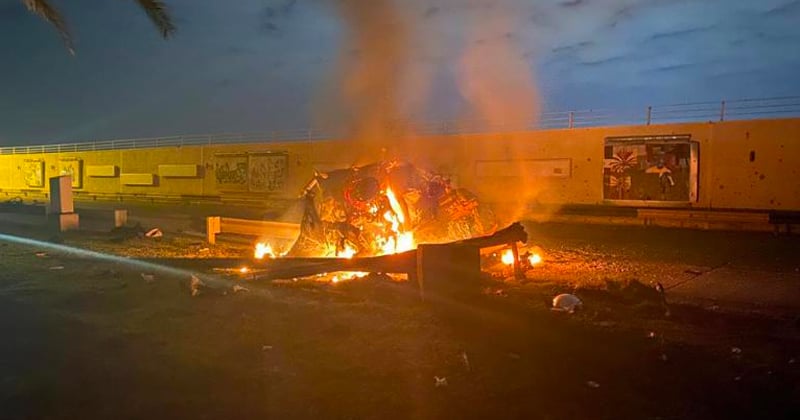
The Suleimani assassination: Not a retaliation but an act of war

By Chas Freeman

January 4, 2020

This was not a retaliation, as claimed, but the pre-planned exploitation of a pretext to assassinate a foreign official designated as an enemy as well as the commander of an Iraqi militia hostile to the United States.

It was an act of war that will inevitably evoke reprisal. Iran has already promised that it will exact “savage” retribution for the murder of a senior official of its government by the United States.

Major General Qasim Suleimani was the equivalent of the U.S. national security adviser or the commanders of CENTCOM, SOCOM, and SOCCENT. All are now potential Iranian targets.

In Iraq itself, the followers of Abu Mahdi (Al Muhandis) in Kataeb Hezbollah will seek their own revenge. The fact that they are part of the Iraqi national security establishment and armed forces is not irrelevant.

The Iraqi government, already under pressure to expel U.S. forces from their country, may now find it politically impossible not to do so. Kataeb Hezbollah is likely to be joined in its campaign against U.S. forces and officials in Iraq by other patriotic militias, including some historically hostile to both it and Iran.

The Iranian government seldom makes decisions in haste. It is the heir to one of the world’s longest and greatest traditions of politico-military statecraft. It will make considered judgments as it calculates the appropriate asymmetric responses. If Tehran miscalculates, which is a very real possibility, the now open but low-intensity warfare between the United States and Iran will escalate.

Those who, like Israeli Prime Minister Netanyahu and former U.S..national security adviser John Bolton, have long sought a war with Iran will get one. So will everyone else.

It is hard to avoid the conclusion that the timing of the attack was dictated by the turmoil in American domestic politics.

It was preceded by three air strikes on elements of Kataeb Hezbollah for the death of a civilian contractor in Kirkuk. None of these air strikes was anywhere near Kirkuk. They bore the marks of a pre-planned operation looking for a pretext to launch.

Just so with the assassination of General Suleimani and Commander Abu Mahdi (whose sobriquet is “Al Muhandis / the Engineer”). The charge that these two were planning attacks on American soldiers and officials could equally well be leveled at U.S. Secretary of Defense Mark Esper, Secretary of State Mike Pompeo, White House officials, and U.S. military commanders at all echelons.

At what time have such officials on both the Iranian and American sides not been planning such attacks?

No concrete evidence has been put forward to justify preemptive defense againt an imminent attack on the United States.

The assassinations seem intended to appease neoconservative critics of President Trump as vacillating and weak in his response to Iranian ripostes to his policy of maximum pressure on Iran. They provide a welcome distraction from the pending impeachment proceedings and appeal to the bloodthirsty instincts of the president’s most ardent supporters. They prepare the way for Mike Pompeo to offset his lack of diplomatic accomplishments with a demonstration of his ruthlessness to the “conservative” voters of Kansas, where he intends to run for the Senate.

In the new constitutional order in the United States, in which the separation of powers has been replaced by the separation of parties, the attack was politically expedient despite its blatant violation of the clear language of the U.S. Constitution.

The attack thus represents an extrajudicial execution that marks a further departure from constitutional government and the rule of law in the United States.

In foreign policy terms, this attack makes no sense at all. It is not a deterrent to Iran so much as a provocation. It pushes Iraq further into the arms of Iran and invites the humiliating expulsion of U.S. forces from Iraq.

It makes every American in Iraq a target for murder or hostage taking. It demonstrates to the world the overt amorality of U.S. policy and the indifference of the United States to the constraints of international law and comity, especially when the object of American hostility is Muslim.

It is a strategy-free move, equivalent to beginning a game of chess with only an opening move in mind. It is thus a reminder to the word of the witless hubris and violence with which the United States now conducts its international relations.

Americans, once the most prominent proponents of international law as the regulator of relations between nations, have now fully validated the law of the jungle. We are now likely to experience it.”

Chas W. Freeman

The author

Chas W. Freeman has a very long and varied career as U.S. diplomat. Here is who he is and here is his blog. The above article has been reproduced from the blog of another brilliant U.S. diplomat, James Matlock.


4 Responses

  1. In the course of the centuries, various ethnic groups that had been the enemies of the Roman Empire gradually became mercenaries on its payroll, then associates, to finally ended up occupying positions of power in different parts of the Empire. This, in my view, is common knowledge, but my understanding of those times does not stretch to the vocabulary applied to such a reality, and to whether words might specifically have been manipulated in order to satisfy the needs of the rulings classes. In the modern version of the Roman Empire, which most people tend to identify with the USA, words are purposefully thrown about to mean everything and their opposite. That the author of this article should not be immune is quite understandable, as he seems to be one that regrets that “his” Empire has taken one wrong turn too many. I, personally, am sick and tired (to use a worn-out clichéd expression) of seeing, all over the net, MERCENARIES being called “contractors” — in other words, KILLERS being morphed into benign capitalistic entrepreneurs.

  2. Thank you for posting this thoughtful article here. I have the impression that the author really knows what he’s talking about in contrast to the higher echelons of the current US administration. When governments plan to go to war or to use military force, they usually lie. Particularly since operation “Desert Storm” in 1991, it seems that facts do matter less and less to justify “military strikes”. More important than facts and evidence are impression management and media manipulation. Somebody who brags in public that, as CIA director, “we lied, we cheated, we stole,” is the current secretary of state of the United States. How can anybody trust such a person or such a government? The assassinations “provide a welcome distraction from the pending impeachment proceedings and appeal to the bloodthirsty instincts of the president’s most ardent supporters.” This is very plausible. Ironically Donald Trump tweeted on November 30, 2011, “In order to get elected, @BarackObama will start a war with Iran.” There are good reasons to be of the opinion that the extrajudicial killings not only violated the US Constitution, but also international law. The author is a little bit vague at the end, however. I would like to know the period of time when Americans were “the most prominent proponents of international law”.

  3. Dear Marc Herbermann – many thanks for your thoughtful comment. I agree with you that it is, indeed, no longer possible to trust what the people in US government circles tell us – the President setting the standards as low as can be when it comes to truth. As for your question about when the US was a prominent proponent of international law, I was also a bit surprised – because Chasman is so experienced over so long a time. But he does use the word proponent and doesn’t say that the US actually adhered to international law. I would like to believe that the US had greater respect for the UN Charter and other international law earlier. Today – that is, particularly after 1989 – it simply doesn’t bother about it and violates it any time it needs, believing it is an exceptional(ist) state. The same applies to human rights. Strangely – but very welcome – Xi Jinping of China and the Chinese foreign policy establishment mention international law and the UN in about every speech. So does Russia, albeit to a lesser extent. – Kind regards, Jan Oberg

  4. The US has been obsessed with the ME since at least Truman. The claim is that it has to do with oil. Not really; the US can always buy oil on spot and futures markets, without having to maintain massive military bases in the ME — just like most everyone else. Another claim is that this obsession is a noble endeavor to ensure the safety of Israel, which is invariably portrayed as the only Democracy in the ME. The depth of cynicism of Americans who make this statement with a straight face is beyond totally awesome. cheers

Related Posts

PART 2 — Diplomacy, Law and Nonviolent Power By Jan ObergTFF co-founder and director January 26, 2026 This is the second of four TFF-created idea portfolios designed to curb the global reach of the United States and, in both the short and long term, help catalyse a worldwide nonviolent resistance to what many observers describe as the Trump administration’s uniquely confrontational, destructive and world-threatening policies. These portfolios outline what governments and citizens across the world can do through dynamic diplomacy, creative initiatives, and strictly nonviolent means. They are typical TFF works in that we do not only tell what the problem is and how bad it will go – as 90+% of all commentators, experts and scholars do – we tell what we think can be done, inviting you to think of what you think you can do. It seems painfully clear to me that the current political dynamics in Washington increasingly resemble the most dangerous...
PART 1 — Media, Culture and Information Sovereignty By Jan ObergTFF co-founder and director January 20, 2026 This is the first of four TFF-created idea portfolios designed to curb the global reach of the United States and, in both the short and long term, help catalyse a worldwide nonviolent resistance to what many observers describe as the Trump administration’s uniquely confrontational, destructive and world-threatening policies. These portfolios outline what governments and citizens across the world can do through dynamic diplomacy, creative initiatives, and strictly nonviolent means. They are typical TFF works in that we do not only tell what the problem is and how bad it will go – as 90+% of all commentators, experts and scholars do – we tell what we think can be done, inviting you to think of what you think you can do. It seems painfully clear to me that the current political dynamics in Washington increasingly resemble the most...
Introduction to TFF’s forthcoming four Idea Portfolios of Diplomatic and Nonviolent Resistance By TFF’s Board & FoundersPascal Lottaz, Biljana Vankovska, Annette Schiffmann, Christina Spannar & Jan Oberg January 19, 2026 “America, you are too arrogant.” — Martin Luther King Jr. Over the course of Trump’s first term and now a year into his second, the world has witnessed a consistent pattern of actions that challenge the basic long-standing norms of international cooperation, weaken multilateral institutions, and ignore the global norms and legal frameworks established by the UN Charter. During these years, we have witnessed military operations in Iran, Syria and Ukraine without UN authorisation; the killing of Iranian General Qassem Soleimani; repeated strikes across the Middle East; and the launch of tariff wars against allies and competitors alike. We have seen a renewed emphasis on nuclearism and zero interest in arms control and disarmament negotiations. Pentagon is now The Department...

Recent Articles

Tony Robinson October 4, 2026 Violence is easy to recognise when someone is being beaten, shot or killed. It becomes more difficult when nobody is holding a weapon. Poverty, discrimination, exploitation and repression can restrict a human life just as effectively, although they do so in very different ways and with very different consequences. Simply adding more categories to an ever-growing list of forms of violence does not really solve the problem. The more interesting question is what all these different situations have in common and why it makes sense to describe them using the same word. Human beings do not simply react to what happens around them. They remember the past, imagine things that do not yet exist, make plans and undertake projects. Workers organise because they imagine different working conditions; people migrate because they imagine another life somewhere else; social movements emerge because people refuse to accept the...
It’s a matter of principles, courage, vision and pulling together – while the militarist world is falling apart… Peter Langille October 3, 2026 “Here, then, is the problem which we present to you, stark and dreadful and inescapable: Shall we put an end to the human race; or shall mankind renounce war?”The Bertrand Russell—Albert Einstein Manifesto, July 9, 1955 ⁕ The forecast for what’s ahead is worrisome. The sharp rise in armed conflicts over the past three years is adding to what was already the highest level in over seventy years. Genocides, which should be prevented are supported. A shared climate emergency that jeopardises survival is ignored. Diverse polls now suggest that people are war-weary, worried and interested in a more effective United Nations. And, there are viable policy options for a more secure world! Yet governments are doubling-down, betting on more war and investing heavily. If current trends persist,...
Johan Galtung 1930-2024October 2015 Published here on October 3, 2026 Let us focus on Civilization for conflict analysis and remedies. Major forms of disorder use violence; war is state organized violence. The most belligerent states are the United States of America and Israel, both with civilization roots. National Evangelism, the US Protestant Christian civilization– more national than evangelical–justifies US warfare as exceptionalism of a people chosen by God, with a manifest destiny to run the world. Orthodox Judaism justifies Israeli warfare to conquer and expand from Nile to Euphrates as a religious right and duty to the Eternal One. The third most belligerent country, the UK, no longer believes it is God-chosen but chosen by the USA; not quite the same but something. But the root cause of global disorder lies in the Occident–with Islam–seeing itself as the single, universal civilization valid for all at all times, all others being...

TFF on Substack

Discover and subscribe to more peace materials on TFF Substack

Most Popular

Tony Robinson October 4, 2026 Violence is easy to recognise when someone is being beaten, shot or killed. It becomes more difficult when nobody is holding a weapon. Poverty, discrimination, exploitation and repression can restrict a human life just as effectively, although they do so in very different ways and with very different consequences. Simply adding more categories to an ever-growing list of forms of violence does not really solve the problem. The more interesting question is what all these different situations have in common and why it makes sense to describe them using the same word. Human beings do not simply react to what happens around them. They remember the past, imagine things that do not yet exist, make plans and undertake projects. Workers organise because they imagine different working conditions; people migrate because they imagine another life somewhere else; social movements emerge because people refuse to accept the...
It’s a matter of principles, courage, vision and pulling together – while the militarist world is falling apart… Peter Langille October 3, 2026 “Here, then, is the problem which we present to you, stark and dreadful and inescapable: Shall we put an end to the human race; or shall mankind renounce war?”The Bertrand Russell—Albert Einstein Manifesto, July 9, 1955 ⁕ The forecast for what’s ahead is worrisome. The sharp rise in armed conflicts over the past three years is adding to what was already the highest level in over seventy years. Genocides, which should be prevented are supported. A shared climate emergency that jeopardises survival is ignored. Diverse polls now suggest that people are war-weary, worried and interested in a more effective United Nations. And, there are viable policy options for a more secure world! Yet governments are doubling-down, betting on more war and investing heavily. If current trends persist,...
Johan Galtung 1930-2024October 2015 Published here on October 3, 2026 Let us focus on Civilization for conflict analysis and remedies. Major forms of disorder use violence; war is state organized violence. The most belligerent states are the United States of America and Israel, both with civilization roots. National Evangelism, the US Protestant Christian civilization– more national than evangelical–justifies US warfare as exceptionalism of a people chosen by God, with a manifest destiny to run the world. Orthodox Judaism justifies Israeli warfare to conquer and expand from Nile to Euphrates as a religious right and duty to the Eternal One. The third most belligerent country, the UK, no longer believes it is God-chosen but chosen by the USA; not quite the same but something. But the root cause of global disorder lies in the Occident–with Islam–seeing itself as the single, universal civilization valid for all at all times, all others being...
Read More
Living-Peace-Sign-Budapest-copy
Tony Robinson October 4, 2026 Violence is easy to recognise when someone is being beaten, shot or killed. It becomes more difficult when nobody is holding a weapon. Poverty, discrimination, exploitation and repression can restrict a human life just as effectively, although they do so in very different ways and with very different consequences. Simply adding more categories to an ever-growing list of forms of violence does not really solve the problem. The more interesting question is what all these different situations have in common and why it makes sense to describe them using the same word. Human beings do not simply react to what happens around them. They remember the past, imagine things that do not yet exist, make plans and undertake projects. Workers organise because they imagine different working conditions; people migrate because they imagine another life somewhere else; social movements emerge because people refuse to accept the...
b54a1f10-8c65-4f0b-9dd5-4abc0a7d04cc_2659x2659
It’s a matter of principles, courage, vision and pulling together – while the militarist world is falling apart… Peter Langille October 3, 2026 “Here, then, is the problem which we present to you, stark and dreadful and inescapable: Shall we put an end to the human race; or shall mankind renounce war?”The Bertrand Russell—Albert Einstein Manifesto, July 9, 1955 ⁕ The forecast for what’s ahead is worrisome. The sharp rise in armed conflicts over the past three years is adding to what was already the highest level in over seventy years. Genocides, which should be prevented are supported. A shared climate emergency that jeopardises survival is ignored. Diverse polls now suggest that people are war-weary, worried and interested in a more effective United Nations. And, there are viable policy options for a more secure world! Yet governments are doubling-down, betting on more war and investing heavily. If current trends persist,...
010
Johan Galtung 1930-2024October 2015 Published here on October 3, 2026 Let us focus on Civilization for conflict analysis and remedies. Major forms of disorder use violence; war is state organized violence. The most belligerent states are the United States of America and Israel, both with civilization roots. National Evangelism, the US Protestant Christian civilization– more national than evangelical–justifies US warfare as exceptionalism of a people chosen by God, with a manifest destiny to run the world. Orthodox Judaism justifies Israeli warfare to conquer and expand from Nile to Euphrates as a religious right and duty to the Eternal One. The third most belligerent country, the UK, no longer believes it is God-chosen but chosen by the USA; not quite the same but something. But the root cause of global disorder lies in the Occident–with Islam–seeing itself as the single, universal civilization valid for all at all times, all others being...
Screenshot 2026-10-02 011738
Jan ObergPhD, director, The Transnational Foundation for Peace and Future Research, TFFLund, Sweden October 2, 2026 This is my full original manuscript. The Chinese Academy of Social Science, CASS, makes two publications out if it. 1. China’s Five-year plan emphasized the capabilities of basic research and original innovation. It is regarded as the goal of the future social development, which, as required, should be significantly enhanced. Can you comment on the importance of original innovation in research and academic study? I believe it is easier to define “original innovation” in the natural sciences than in social sciences. The breaking points of what constitutes something new, or innovative, are not quite as sharp in the latter. But in both fields it is about opening up something that was closed, unseen, unexplored before – making manifest what was earlier latent. Innovations come in many forms and shapes – naming something that was not...
arctic-circle-map
The agreement is catastrophic both because of what it says and what it doesn’t mention. It reduces further the major asset of security policies: Freedom of action. Jan Oberg TFF director September 25, 2026 A couple of hours before the agreement was signed on September 22, 2026, I published the following 13 hypotheses about what it would most likely contain on TFF Substack (in English). I was wrong on only the first point. Contrary to what Trump had written on his Truth Social platform, it does not appear to come into force immediately. In fact, it turned out to be worse than even I had anticipated. After these hypotheses now come a number of reflections in light of what the agreement actually contains, and does not contain, as well as the way in which it has generally been presented by major media outlets and by the public-service broadcaster DR. My...
girl-5894831_1280
Below are TFF-related media mentions, comments, videos and social media posts published elsewhere but not on this homepage. We happen to catch and list only a fraction. Regarding video comments and debates, we recommend that you go to the TFF Video Channel on Substack where many of them are reproduced. Jan Oberg is a contributor to China Daily – 52 million daily clicks – and Global Times, CGTN and CCTV (the national television), China Investment, Xinhua News Agency and several others. Articles and videos on these media very often multiply into countless Chinese (and Western media) that re-post them from these main media. Thanks to The China Academy, his analyses, interviews and comments are frequently posted on YouTube channels such as Thinkers Forum and Wave Media. These videos are often re-posted on Bilibili (China’s YouTube), the China Content Center on TikTok, and on the Chinese edition of TikTok, Douyin.com. This means reaching hundreds of millions of viewers worldwide over a year. While there are too many to catch on all these...



