
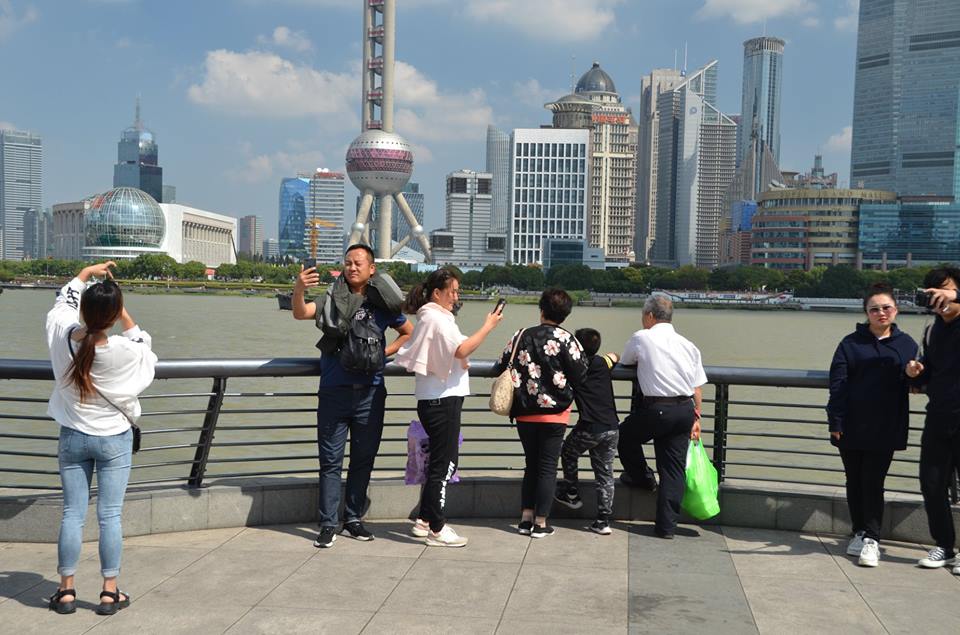
Photo from Shanghai by Jan Oberg 2018


By Cecily Liu in London from China Daily

October 22, 2018

Esteemed author says nation’s development model can be a blueprint for emerging economies

China’s rapid growth since the reform and opening-up process began in 1978 has not only been an economic miracle for the nation, but it has also offered a new development model for other emerging economies, said Martin Jacques, author of the global bestseller When China Rules the World.

In doing so, China has proved the inaccuracy of the previous consensus that the Western model of development was the only path to success.

Effectively, Jacques said, China has inspired other emerging countries to explore development paths that are suitable for their own situations.

Originally published by chinadaily.com

“The achievements of China’s reform and opening-up are very simple: one, the transformation of China; two, the transformation of the world,” said the 73-year-old from his apartment in London’s Hampstead, where piles of books and notes on China lay scattered across his desk, bookshelves and the floor.

Jacques is one of Britain’s best-known Sinologists. Born in 1945 in Coventry, he had a decadeslong distinguished career in journalism before becoming an author.

He first rose to prominence as editor of Marxism Today, a position he held for 14 years from the late 1970s. He turned the publication from an obscure left-wing political magazine to one containing views from across the political spectrum.

Jacques then went on to be deputy editor of The Independent in the mid-1990s and now combines being a high-profile columnist with lecturing around the world.

But what really made him world famous was his 2009 book When China Rules the World, which has been translated into 15 languages and has sold 350,000 copies. His 2010 TED Salon speech in London on understanding the rise of China has received more than 2.7 million views on YouTube.
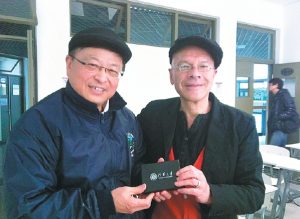
Jacques poses with professor Yan Xuetong, dean of the Institute of International Relations, Tsinghua University, in 2011. Photo credit China Daily

His book correctly predicted China’s ascent to global leadership, at a time when the trend was not so obvious. More precisely, it predicted that by 2027, China’s economy would be bigger than that of the United States. His book also argued that China’s governance system was an effective alternative to Western liberal democracy and represented a new form of modernity.

Jacques argued against the prevailing consensus that China’s development model would become more like that of the West as it grew economically. Time has proved him right – China has cemented its economic strength internationally without becoming a mirror image of the West.

In addition, China is now using its international influence to lead on multilateral issues, such as globalization, climate change and global governance, in its own unique way. In order to share its development experiences with other emerging economies and improve global trade links, China has championed the Belt and Road Initiative and the Asian Infrastructure Investment Bank.

“China is going to be a very different kind of great power,” he said. “The Belt and Road is a powerful example of China trying to find a new relationship (that can benefit both China and other countries). This notion is very different from Western colonial thinking.”

The AIIB, which focuses on financing infrastructure projects in Asia, represents the interests of more than 80 member countries through a pluralistic approach. The BRI, which aims to improve trade and connectivity between Asia, Africa and Europe through infrastructure investment, has also attracted keen participation from public-and private-sector players globally.

In Jacques’ view, these exciting initiatives, supported by China’s economic strength, challenge the post-Cold War mentality that divided the world into the West and the rest.

For many, the fall of the Berlin Wall in 1989 and the disintegration of the Soviet Union in 1991 proved that socialist countries could not make sufficient economic progress without adopting the development model of the West.

“That was the great and final victory of the West,” Jacques said. “It’s strange now to think that. And if you look back now, it’s obvious, in my view, that 1978 was a far more important year in world history than 1989 or 1991.”

But China’s economic success proved that such progress can be made while the government maintains an important role in guiding the country’s direction.

“We must always remember that only about 15 percent of the world’s population lives in the developed world, which is essentially the West plus Japan,” he said. “Eighty-five percent of the world’s population lives in the developing world. Until quite recently, the world was still a Western world. China’s rise gave the developing world an alternative place to look, for development, for inspiration.”

If you are always with someone of the same culture you are an insider and never looking from the outside.

Additionally, the fact China grew from being a poor, developing country to a strong economic power means it has accumulated significant lessons and experiences that could be applicable to other developing countries today.

“China is a developing country and can understand the problems of development in a totally different way,” he said. “The United States cannot relate to (the developing world) in the way that China can.”

Although Jacques is now a firm advocate of China’s incredible potential, he admits to having been somewhat ignorant of the East until 1993, when he visited China, Singapore, and Malaysia for a holiday.

In China, he saw construction cranes working round the clock, roads streaming with trucks and carts, and women balancing goods on the ends of bamboo poles.

“It absolutely seized my mind,” he said. “Guangdong province was a sort of huge building site with land being cleared as far as you could see. So many people were in motion along the road. It was so obvious this was a huge, important historical moment I was watching.”

From there, Jacques has watched China transform on his subsequent trips.

“When you go to any city in China now, you see a modern city,” he said. “Living standards have clearly been transformed.”

While on holiday in 1993, he met his wife, Malaysian-Indian lawyer Harinder Veriah, on the island of Tioman, off the east coast of Malaysia. Veriah, who died in 2000, inspired Jacques to understand more about Asia, and made him more determined to write a book that explained his discoveries to the world.

“She taught me to see the world from a non-Western perspective,” he said. “If you are always with someone of the same culture you are an insider and never looking from the outside. She helped me see my country from an outsider’s perspective.”

In the years that followed, Jacques frequently traveled to China and other East Asian countries to research his book. When he started, the book’s working title was “The End of the Western World”. But gradually, as he worked on it, he realized that the book had to be primarily about China, which led to its new title, When China Rules the World.

Looking back, he stressed the crucial role of China’s reform and opening-up policies in shaping the country’s economic achievements and its global influence.

In particular, he marvels at pioneering leader Deng Xiaoping, who is credited with turning China’s planned economy into a market-driven one and for strengthening China’s exchange efforts with the world.

He praised Deng’s courage in the way he “fired the starting gun” for China’s transformation at a moment of significant change in Chinese society.

In particular, Deng transformed the world’s understanding of a socialist country. Instead of following the inward-looking model of the Soviet Union, Deng advocated an unprecedented outward approach.

“Deng Xiaoping said, ‘We want to be a part of the world, we have to learn from the rest of the world, we must be open to the rest of the world,'” Jacques said. “That is fantastic. Now, we can see how important Deng is as a socialist thinker, who is also a global thinker, a leader for everyone.”

For Jacques, Deng’s remarks exhibit tremendous confidence, something that is impressive, considering China was then a poor country.

“The idea that you can measure against the rest of the world, and be willing to learn straight away, it’s a confident attitude,” he said.

China’s recent history details a success story. In 1978, the size of China’s economy was just one-40th of that of the US, but during the past 40 years, China’s GDP has grown by an average of about 9.5 percent a year. By 2017, the size of China’s economy had grown to more than three-fifths that of the US, according to International Monetary Fund estimates.

During the past four decades, China has also succeeded in lifting more than 740 million people out of poverty.

Jacques said he feels confident that China will continue to develop. He said its GDP growth rate may drop to a more sustainable level over the long term, but its development will increasingly focus on innovation and quality growth.

He recalled that when he first published When China Rules the World, one question he was often asked at author talks was how China could break free from the need to imitate advanced economies’ technology, and what would happen if the country reached the point where it was inventing its own technology.

“I never hear that question anymore, because the answer is clear with the transformation of the technology companies in China,” Jacques said.

For instance, in the second quarter of this year, China’s Huawei overtook Apple to become the world’s second-largest smartphone seller.

In the pioneering sector of mobile payments, China has emerged as the biggest market, worth 40.36 trillion yuan ($5.90 trillion) in the first quarter of this year. Its two biggest payment companies, WeChat Pay and Alipay, now have 900 million and 500 million active users respectively. These numbers eclipse Apple Pay’s 127 million active users.

Accompanying these technology innovations is China’s rapidly strengthening intellectual property system and its soaring number of patent registrations. Chinese companies’ filings with the European Patent Office in 2017 were up 16.6 percent year-on-year, compared with the global average of 3.9 percent.

This year, for the first time, Huawei topped the EPO’s league table by number of patents filed by a single company, ahead of Siemens and LG.

While China’s development path shows a rosy picture full of excitement, Jacques also warns that one challenge China will encounter in the future is the antagonism it will attract from Western countries fearful of being challenged.

Equally, the novelty of China-proposed initiatives such as the BRI could lead to questions and doubts. US President Donald Trump’s moves to instigate a large-scale trade confrontation with China this year is evidence of the sort of external pressure China must learn to face, he said.

The trade dispute, which started this year, has seen the US slap tariffs on billions of dollars of Chinese imports, and China doing the same in retaliation. Many companies have already been negatively impacted, including US companies that rely on the supply chain in China.

Jacques said he feels that the attitude in the US under Trump is based on a recognition that China has been successful, and that the antagonism US administration has expressed toward China has, in a sense, spoken of the success of China.

“As China has risen, its relationship with the US has become more difficult,” Jacques said. “For the US, it’s one thing to look relatively benignly on China when it’s well behind, but when China is not well behind, but is a competitor who has an alternative view of the world, then that’s a different game.”

He said that as China experiences rapid transformation and gains global influence, it must find its own new position in the world and ensure that other countries are comfortable with it.

“China has got to find a way of dealing with it,” he said. “By and large, I think it’s succeeding in doing it, but it’s not a simple matter.”

Originally published at chinadaily.com


Martin Jacques Biography
Author of When China Rules the World 
BORN:
1945 in Coventry, England
Education
1957-64:King Henry VIII School, Coventry
1968: Manchester University,BA in economics (first class honors)
1976: King’s College, Cambridge, PhDCAREER:
1965-90: Executive committee member,Communist Party of Great Britain
1969-71: Tutor in economic history,King’s College, Cambridge
1971-77: Editor of Marxism Today
1993: Editor and founder of London-basedthink tank Demos
1994-96: Deputy editor of The Independent
2003-08: Visiting fellow, London School ofEconomics Asian Research Center
2009: Author of When China Rules the World
2010-11: Bosch public policy fellow at theTransatlantic Academy, Washington
2013-present: Senior fellow at the Departmentof Politics and International Studies, CambridgeUniversity
2016-present: Visiting professor, Tsinghua University, Beijing.


One Response

  1. Modern cities..economic growth..isn’t this just a copy of the failing western elite? Unjust but still the whole planet will suffer from the restriction that there is just one planet and we have cause 5 out of 9 planeyary boundaries to overshoot. There are no such thing as “green growth” of gdp. “. He said its GDP growth rate may drop to a more sustainable level over the long term,”. And there are no such thing as sustainable exponential growth. Ann

Related Posts

Jan Oberg, TFF director April 9, 2026 I was recently invited to have a good, long talk about the world – and, of course, about peace too – with Boris Malagurski on his Weight of Chains Channel on YouTube. It was a real joy and seems to have been greatly appreciated by the viewers too. Mr Malagurski and I shall of course be grateful if you share this conversation in your circles – of course, only if you like what you see and hear 😉☮️ And remember that this one – like hundreds of others with TFF Associates – can be enjoyed at our TFF Video Collection.
A friendly quarrel while we agree that the US sanctions are a weapon of mass destruction and kill more people than wars do. And that we must talk much more about sanctions than we have so far. Jan Oberg, TFF director March 16, 2026 John Mearsheimer recently stated that U.S. sanctions murdered around 38 million people between 1971 and 2021 – see the video below. It is a dramatic figure, and it has spread quickly because it captures, in one sentence, the enormous human cost of modern sanctions. I share his concern about the destructive effects of economic coercion. But the specific number he cites — and the way he attributes it — deserves a friendly academic clarification. The figure comes from a 2023 Lancet Global Health article estimating the mortality effects of unilateral U.S. and EU sanctions over the past half‑century. This is the first point where Mearsheimer’s shorthand diverges from the text: the study...
This is not another geopolitical commentary on the Arctic. It is a visionary peace proposal that can save the region from militarised rivalry and ecological ruin. A blueprint for shared security, sustainable development, and human dignity — benefitting Greenland, the Arctic, and the rest of us. Jan Oberg TFF director Lund, Sweden, February 17, 2026 I. Four Principles for a New Arctic Vision The Arctic is often framed as a cold arena of rivalry — a place where great powers test each other’s resolve. But this worldview is outdated, unimaginative, and ultimately self‑defeating. The Arctic is not a vacuum waiting to be militarised; it is a living region, a climate stabiliser, and a cultural homeland whose future will shape the future of humanity. If we begin from that understanding, a far more rational Arctic order becomes possible — one that is peaceful, cooperative, and centred on the people who actually live there. This vision rests...

Recent Articles

Tony Robinson October 4, 2026 Violence is easy to recognise when someone is being beaten, shot or killed. It becomes more difficult when nobody is holding a weapon. Poverty, discrimination, exploitation and repression can restrict a human life just as effectively, although they do so in very different ways and with very different consequences. Simply adding more categories to an ever-growing list of forms of violence does not really solve the problem. The more interesting question is what all these different situations have in common and why it makes sense to describe them using the same word. Human beings do not simply react to what happens around them. They remember the past, imagine things that do not yet exist, make plans and undertake projects. Workers organise because they imagine different working conditions; people migrate because they imagine another life somewhere else; social movements emerge because people refuse to accept the...
It’s a matter of principles, courage, vision and pulling together – while the militarist world is falling apart… Peter Langille October 3, 2026 “Here, then, is the problem which we present to you, stark and dreadful and inescapable: Shall we put an end to the human race; or shall mankind renounce war?”The Bertrand Russell—Albert Einstein Manifesto, July 9, 1955 ⁕ The forecast for what’s ahead is worrisome. The sharp rise in armed conflicts over the past three years is adding to what was already the highest level in over seventy years. Genocides, which should be prevented are supported. A shared climate emergency that jeopardises survival is ignored. Diverse polls now suggest that people are war-weary, worried and interested in a more effective United Nations. And, there are viable policy options for a more secure world! Yet governments are doubling-down, betting on more war and investing heavily. If current trends persist,...
Johan Galtung 1930-2024October 2015 Published here on October 3, 2026 Let us focus on Civilization for conflict analysis and remedies. Major forms of disorder use violence; war is state organized violence. The most belligerent states are the United States of America and Israel, both with civilization roots. National Evangelism, the US Protestant Christian civilization– more national than evangelical–justifies US warfare as exceptionalism of a people chosen by God, with a manifest destiny to run the world. Orthodox Judaism justifies Israeli warfare to conquer and expand from Nile to Euphrates as a religious right and duty to the Eternal One. The third most belligerent country, the UK, no longer believes it is God-chosen but chosen by the USA; not quite the same but something. But the root cause of global disorder lies in the Occident–with Islam–seeing itself as the single, universal civilization valid for all at all times, all others being...

TFF on Substack

Discover and subscribe to more peace materials on TFF Substack

Most Popular

Tony Robinson October 4, 2026 Violence is easy to recognise when someone is being beaten, shot or killed. It becomes more difficult when nobody is holding a weapon. Poverty, discrimination, exploitation and repression can restrict a human life just as effectively, although they do so in very different ways and with very different consequences. Simply adding more categories to an ever-growing list of forms of violence does not really solve the problem. The more interesting question is what all these different situations have in common and why it makes sense to describe them using the same word. Human beings do not simply react to what happens around them. They remember the past, imagine things that do not yet exist, make plans and undertake projects. Workers organise because they imagine different working conditions; people migrate because they imagine another life somewhere else; social movements emerge because people refuse to accept the...
It’s a matter of principles, courage, vision and pulling together – while the militarist world is falling apart… Peter Langille October 3, 2026 “Here, then, is the problem which we present to you, stark and dreadful and inescapable: Shall we put an end to the human race; or shall mankind renounce war?”The Bertrand Russell—Albert Einstein Manifesto, July 9, 1955 ⁕ The forecast for what’s ahead is worrisome. The sharp rise in armed conflicts over the past three years is adding to what was already the highest level in over seventy years. Genocides, which should be prevented are supported. A shared climate emergency that jeopardises survival is ignored. Diverse polls now suggest that people are war-weary, worried and interested in a more effective United Nations. And, there are viable policy options for a more secure world! Yet governments are doubling-down, betting on more war and investing heavily. If current trends persist,...
Johan Galtung 1930-2024October 2015 Published here on October 3, 2026 Let us focus on Civilization for conflict analysis and remedies. Major forms of disorder use violence; war is state organized violence. The most belligerent states are the United States of America and Israel, both with civilization roots. National Evangelism, the US Protestant Christian civilization– more national than evangelical–justifies US warfare as exceptionalism of a people chosen by God, with a manifest destiny to run the world. Orthodox Judaism justifies Israeli warfare to conquer and expand from Nile to Euphrates as a religious right and duty to the Eternal One. The third most belligerent country, the UK, no longer believes it is God-chosen but chosen by the USA; not quite the same but something. But the root cause of global disorder lies in the Occident–with Islam–seeing itself as the single, universal civilization valid for all at all times, all others being...
Read More
Living-Peace-Sign-Budapest-copy
Tony Robinson October 4, 2026 Violence is easy to recognise when someone is being beaten, shot or killed. It becomes more difficult when nobody is holding a weapon. Poverty, discrimination, exploitation and repression can restrict a human life just as effectively, although they do so in very different ways and with very different consequences. Simply adding more categories to an ever-growing list of forms of violence does not really solve the problem. The more interesting question is what all these different situations have in common and why it makes sense to describe them using the same word. Human beings do not simply react to what happens around them. They remember the past, imagine things that do not yet exist, make plans and undertake projects. Workers organise because they imagine different working conditions; people migrate because they imagine another life somewhere else; social movements emerge because people refuse to accept the...
b54a1f10-8c65-4f0b-9dd5-4abc0a7d04cc_2659x2659
It’s a matter of principles, courage, vision and pulling together – while the militarist world is falling apart… Peter Langille October 3, 2026 “Here, then, is the problem which we present to you, stark and dreadful and inescapable: Shall we put an end to the human race; or shall mankind renounce war?”The Bertrand Russell—Albert Einstein Manifesto, July 9, 1955 ⁕ The forecast for what’s ahead is worrisome. The sharp rise in armed conflicts over the past three years is adding to what was already the highest level in over seventy years. Genocides, which should be prevented are supported. A shared climate emergency that jeopardises survival is ignored. Diverse polls now suggest that people are war-weary, worried and interested in a more effective United Nations. And, there are viable policy options for a more secure world! Yet governments are doubling-down, betting on more war and investing heavily. If current trends persist,...
010
Johan Galtung 1930-2024October 2015 Published here on October 3, 2026 Let us focus on Civilization for conflict analysis and remedies. Major forms of disorder use violence; war is state organized violence. The most belligerent states are the United States of America and Israel, both with civilization roots. National Evangelism, the US Protestant Christian civilization– more national than evangelical–justifies US warfare as exceptionalism of a people chosen by God, with a manifest destiny to run the world. Orthodox Judaism justifies Israeli warfare to conquer and expand from Nile to Euphrates as a religious right and duty to the Eternal One. The third most belligerent country, the UK, no longer believes it is God-chosen but chosen by the USA; not quite the same but something. But the root cause of global disorder lies in the Occident–with Islam–seeing itself as the single, universal civilization valid for all at all times, all others being...
Screenshot 2026-10-02 011738
Jan ObergPhD, director, The Transnational Foundation for Peace and Future Research, TFFLund, Sweden October 2, 2026 This is my full original manuscript. The Chinese Academy of Social Science, CASS, makes two publications out if it. 1. China’s Five-year plan emphasized the capabilities of basic research and original innovation. It is regarded as the goal of the future social development, which, as required, should be significantly enhanced. Can you comment on the importance of original innovation in research and academic study? I believe it is easier to define “original innovation” in the natural sciences than in social sciences. The breaking points of what constitutes something new, or innovative, are not quite as sharp in the latter. But in both fields it is about opening up something that was closed, unseen, unexplored before – making manifest what was earlier latent. Innovations come in many forms and shapes – naming something that was not...
arctic-circle-map
The agreement is catastrophic both because of what it says and what it doesn’t mention. It reduces further the major asset of security policies: Freedom of action. Jan Oberg TFF director September 25, 2026 A couple of hours before the agreement was signed on September 22, 2026, I published the following 13 hypotheses about what it would most likely contain on TFF Substack (in English). I was wrong on only the first point. Contrary to what Trump had written on his Truth Social platform, it does not appear to come into force immediately. In fact, it turned out to be worse than even I had anticipated. After these hypotheses now come a number of reflections in light of what the agreement actually contains, and does not contain, as well as the way in which it has generally been presented by major media outlets and by the public-service broadcaster DR. My...
girl-5894831_1280
Below are TFF-related media mentions, comments, videos and social media posts published elsewhere but not on this homepage. We happen to catch and list only a fraction. Regarding video comments and debates, we recommend that you go to the TFF Video Channel on Substack where many of them are reproduced. Jan Oberg is a contributor to China Daily – 52 million daily clicks – and Global Times, CGTN and CCTV (the national television), China Investment, Xinhua News Agency and several others. Articles and videos on these media very often multiply into countless Chinese (and Western media) that re-post them from these main media. Thanks to The China Academy, his analyses, interviews and comments are frequently posted on YouTube channels such as Thinkers Forum and Wave Media. These videos are often re-posted on Bilibili (China’s YouTube), the China Content Center on TikTok, and on the Chinese edition of TikTok, Douyin.com. This means reaching hundreds of millions of viewers worldwide over a year. While there are too many to catch on all these...



