By Robert E. Hunter

March 26, 2018

This past week could go down as the worst for the US role in the world since the misbegotten 2003 invasion of Iraq, whose tragic consequences still bedevil us. In both cases, the damage has been almost entirely self-inflicted, the result of abysmal judgment at the top of the US government, plus the failure of other institutions—Congress, the media—to do their proper jobs. The Trump administration kicked off round two of a trade war with China.

Concerns escalated about the role of Russia in US elections and possible links to President Donald Trump. The president sustained attacks on his efforts to deescalate tensions with Moscow. Secretary of State Rex Tillerson departed from Washington, which he called a “very mean-spirited town.”

Originally published by LobeLog here

Most dramatically, Trump this week chose John Bolton to be National Security Advisor. Bolton was, briefly, a couldn’t-get-confirmed-by-the-Senate ambassador to the United Nations.

This puts in place at the top of the government the most rigid ideologue ever to hold that position, a consistent advocate of the hardest of hard-right positions (especially in the Middle East), and a promoter of war in various parts of the world.

This appointment is not just an insult to the entire US national security profession.

It also reduces the number of people in government who can save the president from blundering into one or more disasters with consequences potentially rivaling those in Iraq. But even White House Chief of Staff General John Kelly and Secretary of Defense General Jim Mattis share Bolton’s view of Iran as the key source of instability in the Middle East.

Also, Senate willing, the Iran-as-Devil school will soon be strengthened by the current head of the CIA, Mike Pompeo, Trump’s nominee to replace Tillerson at the State Department.

Pompeo, yet another military man in the Trump cabinet, has publicly opposed the Iran nuclear deal that cut off Teheran’s path to the bomb and has consistently advocated hard-line positions elsewhere in the world.

These changes to the national security team mean that it’s now impossible for the United States to disentangle itself, even partially, from the mess in the Middle East, however much that could be in our national interest.

Indeed, it looks as though the Trump administration will be expanding the mess. Trump has to decide by May 12 whether to recertify that Iran is in compliance with the terms of the nuclear deal, as all US allies are pleading with him to do (it is in compliance, by all objective and non-US accounts).

Bolton and Pompeo will be pushing him to pull out of the agreement. And the person representing the United States in Geneva talks with allies who are desperate to deflect Trump from destroying the Iran nuclear deal is Brian Hook, a junior official with no senior-level experience in foreign affairs and whom no one believes speaks authoritatively for the U.S. president.

This changing of the guard from a hawkish to a superhawkish direction was compounded this week by the U.S. visit of the Saudi Arabian crown prince and effective ruler, Mohammad bin Salman (MbS). He came bearing major gifts in the form of hundreds of billions of dollars’ worth of arms purchases from the United States, promises of a massive investment relationship, and of course flattery for Trump himself.

MbS has also wooed those who want to believe that Saudi Arabia is no longer the leading sponsor of terrorism throughout the Islamic world and beyond (which it continues to be) and that it’s prepared to cozy up to Israel, given that both see Iran as enemy number one and care naught for the Palestinian people.

However, some of Israel’s friends in the US are beginning to fear that counting on the friendship and support of Saudi Arabia can be a fool’s bargain. Thus this week, Congresswoman Ileana Ros-Lehtinen, a strong supporter of Israel, expressed doubts about nuclear cooperation agreements with countries—meaning Saudi Arabia—that don’t “contain restrictions on the enrichment and reprocessing necessary for a nuclear weapon.”

And The Washington Post, an accurate mirror of Israeli opinion, reported that “…even in Jerusalem, [Bolton’s] return stirred some concern….Israel is likely to be at the sharp-end of any conflict with Iran, something Bolton has repeatedly floated.”

Until Mattis intervened personally on Capitol Hill, the Senate was prepared to pass legislation to stop US military aid to Saudi Arabia in its thinly disguised (“when in doubt, blame Iran”) aggression in Yemen.

According to key United Nations agencies, “The conflict in Yemen has created the worst humanitarian crisis in the world, a crisis which has engulfed the entire country.” Given what is happening in Syria and elsewhere in the region, that is saying something!

As part of his pushback against a possible congressional cutoff of US support for the Saudi war effort, Mattis publicly challenged the visiting Saudi crown prince to “accelerate the peace process in Yemen.” Meanwhile, however, US support for Saudi military actions continues.

Does all this mean war with Iran? Trump most likely would like to stop short of a direct military attack as opposed to all other forms of pressure he can muster.

Even MbS and Israeli Prime Minister Benjamin Netanyahu, champion fire-breather on the subject, probably don’t want to go as far as a major conflict with Iran because their countries, too, would suffer. But in the Middle East, things have a habit of getting out of hand.

Certainly, even without another war, the United States is moving further away from any attempt to reconcile divergent interests in the region in favor of abetting others as they throw more gasoline onto the fires.

Photo: U.S. Air Force photo by Airman 1st Class Brittain Crolley.

avatar


Robert E. Hunter

Robert E. Hunter served as US ambassador to NATO (1993-98) and on the National Security Council staff throughout the Carter administration, first as Director of West European Affairs and then as Director of Middle East Affairs. In the last-named role, he was the White House representative at the Autonomy Talks for the West Bank and Gaza and developer of the Carter Doctrine for the Persian Gulf. He was Senior Advisor to the RAND Corporation from 1998 to 2011, and Director of the Center for Transatlantic Security Studies at the National Defense University, 2011-2012. He served on the Pentagon’s Defense Policy Board and is a member of the American Academy of Diplomacy.


Related Posts

PART 2 — Diplomacy, Law and Nonviolent Power By Jan ObergTFF co-founder and director January 26, 2026 This is the second of four TFF-created idea portfolios designed to curb the global reach of the United States and, in both the short and long term, help catalyse a worldwide nonviolent resistance to what many observers describe as the Trump administration’s uniquely confrontational, destructive and world-threatening policies. These portfolios outline what governments and citizens across the world can do through dynamic diplomacy, creative initiatives, and strictly nonviolent means. They are typical TFF works in that we do not only tell what the problem is and how bad it will go – as 90+% of all commentators, experts and scholars do – we tell what we think can be done, inviting you to think of what you think you can do. It seems painfully clear to me that the current political dynamics in Washington increasingly resemble the most dangerous...
PART 1 — Media, Culture and Information Sovereignty By Jan ObergTFF co-founder and director January 20, 2026 This is the first of four TFF-created idea portfolios designed to curb the global reach of the United States and, in both the short and long term, help catalyse a worldwide nonviolent resistance to what many observers describe as the Trump administration’s uniquely confrontational, destructive and world-threatening policies. These portfolios outline what governments and citizens across the world can do through dynamic diplomacy, creative initiatives, and strictly nonviolent means. They are typical TFF works in that we do not only tell what the problem is and how bad it will go – as 90+% of all commentators, experts and scholars do – we tell what we think can be done, inviting you to think of what you think you can do. It seems painfully clear to me that the current political dynamics in Washington increasingly resemble the most...
Introduction to TFF’s forthcoming four Idea Portfolios of Diplomatic and Nonviolent Resistance By TFF’s Board & FoundersPascal Lottaz, Biljana Vankovska, Annette Schiffmann, Christina Spannar & Jan Oberg January 19, 2026 “America, you are too arrogant.” — Martin Luther King Jr. Over the course of Trump’s first term and now a year into his second, the world has witnessed a consistent pattern of actions that challenge the basic long-standing norms of international cooperation, weaken multilateral institutions, and ignore the global norms and legal frameworks established by the UN Charter. During these years, we have witnessed military operations in Iran, Syria and Ukraine without UN authorisation; the killing of Iranian General Qassem Soleimani; repeated strikes across the Middle East; and the launch of tariff wars against allies and competitors alike. We have seen a renewed emphasis on nuclearism and zero interest in arms control and disarmament negotiations. Pentagon is now The Department...

Recent Articles

Serious but also a lot of laughs and positive energy. Because peace is also about conviviality and enchantment… Jan Oberg, TFF director November 16, 2026 This is a long (129 minutes) conversation with me. We cover very many, also personal, issues that makes a somewhat unusual media event. I am very grateful to Flemming Blicher for giving me this opportunity. I can’t remember any channel or editor who spent as much time as he did preparing it – including also asking me to answer a series of pre-interview questions, which are now posted under the conversation. If you sympathise with its content, please share it. Watch it here
A Message from Jan Oberg November 6, 2026 Over the past fifty years, I have devoted roughly 175,000 hours to research and public education for a more peaceful world: thinking, researching, writing, organising, publishing, debating, maintaining websites, corresponding, reaching out, leading a foundation, work in conflict and war zones, professorships, teaching courses and giving public lectures and doing media work. In short, ten hours a day, seven days a week, for half a century. The focus was on international political peace – analysing and trying to stop wars, address underlying conflicts and making alternative peace plans – at the desk and on the ground. Important as that has been and remains, it is only one kind of peace and it is now in a tragic militarist state compared with what it could have been.  Lately, however, I have found myself thinking about a concept from economics as well as everyday...
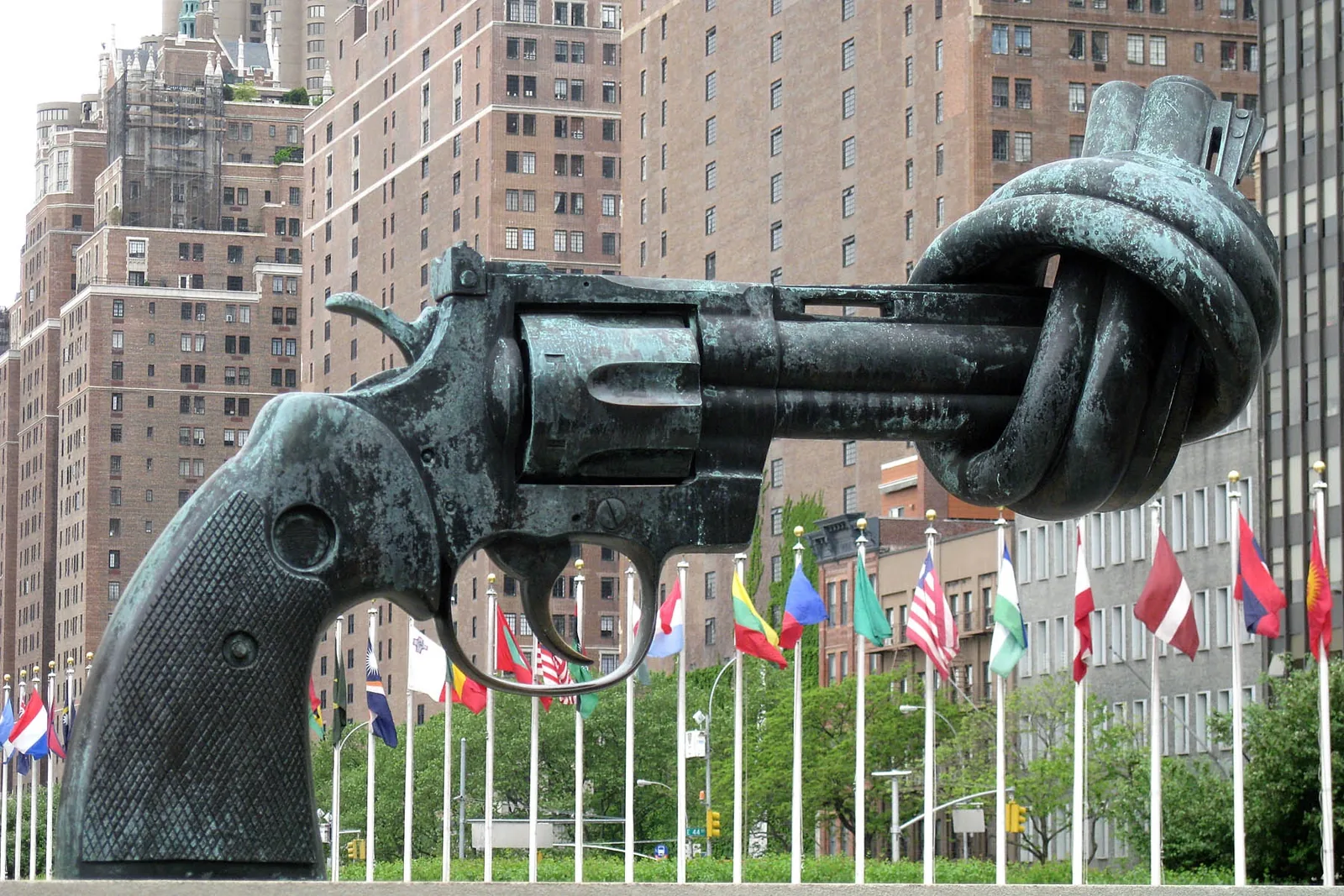
Photo above: Carl Fredrik Reuterswärd’s Non-Violence outside UN Headquarters in New York. Kirill Levin, CC BY-NC-SA 2. Jan Oberg November 3, 2026 I am happy to be published in Horizons which is produced by the Center for International Relations and Sustainable Development, CIRSD, in Belgrade. My contribution brings out a radical re-thinking of what concepts such as defence, security, deterrence – and peace – may mean if we want to create a more peaceful world. It also summarises a few things I have been working with the last few decades. Please read it here Og her er den på dansk, takket være Johnny Baltzersens lynhurtige oversættelse

TFF on Substack

Discover and subscribe to more peace materials on TFF Substack

Most Popular

Serious but also a lot of laughs and positive energy. Because peace is also about conviviality and enchantment… Jan Oberg, TFF director November 16, 2026 This is a long (129 minutes) conversation with me. We cover very many, also personal, issues that makes a somewhat unusual media event. I am very grateful to Flemming Blicher for giving me this opportunity. I can’t remember any channel or editor who spent as much time as he did preparing it – including also asking me to answer a series of pre-interview questions, which are now posted under the conversation. If you sympathise with its content, please share it. Watch it here
A Message from Jan Oberg November 6, 2026 Over the past fifty years, I have devoted roughly 175,000 hours to research and public education for a more peaceful world: thinking, researching, writing, organising, publishing, debating, maintaining websites, corresponding, reaching out, leading a foundation, work in conflict and war zones, professorships, teaching courses and giving public lectures and doing media work. In short, ten hours a day, seven days a week, for half a century. The focus was on international political peace – analysing and trying to stop wars, address underlying conflicts and making alternative peace plans – at the desk and on the ground. Important as that has been and remains, it is only one kind of peace and it is now in a tragic militarist state compared with what it could have been.  Lately, however, I have found myself thinking about a concept from economics as well as everyday...
Photo above: Carl Fredrik Reuterswärd’s Non-Violence outside UN Headquarters in New York. Kirill Levin, CC BY-NC-SA 2. Jan Oberg November 3, 2026 I am happy to be published in Horizons which is produced by the Center for International Relations and Sustainable Development, CIRSD, in Belgrade. My contribution brings out a radical re-thinking of what concepts such as defence, security, deterrence – and peace – may mean if we want to create a more peaceful world. It also summarises a few things I have been working with the last few decades. Please read it here Og her er den på dansk, takket være Johnny Baltzersens lynhurtige oversættelse
Read More
Screenshot 2026-11-10 174455
Serious but also a lot of laughs and positive energy. Because peace is also about conviviality and enchantment… Jan Oberg, TFF director November 16, 2026 This is a long (129 minutes) conversation with me. We cover very many, also personal, issues that makes a somewhat unusual media event. I am very grateful to Flemming Blicher for giving me this opportunity. I can’t remember any channel or editor who spent as much time as he did preparing it – including also asking me to answer a series of pre-interview questions, which are now posted under the conversation. If you sympathise with its content, please share it. Watch it here
AbstractVision_2017_#1_800 (kopia)
A Message from Jan Oberg November 6, 2026 Over the past fifty years, I have devoted roughly 175,000 hours to research and public education for a more peaceful world: thinking, researching, writing, organising, publishing, debating, maintaining websites, corresponding, reaching out, leading a foundation, work in conflict and war zones, professorships, teaching courses and giving public lectures and doing media work. In short, ten hours a day, seven days a week, for half a century. The focus was on international political peace – analysing and trying to stop wars, address underlying conflicts and making alternative peace plans – at the desk and on the ground. Important as that has been and remains, it is only one kind of peace and it is now in a tragic militarist state compared with what it could have been.  Lately, however, I have found myself thinking about a concept from economics as well as everyday...
knotted gun
Photo above: Carl Fredrik Reuterswärd’s Non-Violence outside UN Headquarters in New York. Kirill Levin, CC BY-NC-SA 2. Jan Oberg November 3, 2026 I am happy to be published in Horizons which is produced by the Center for International Relations and Sustainable Development, CIRSD, in Belgrade. My contribution brings out a radical re-thinking of what concepts such as defence, security, deterrence – and peace – may mean if we want to create a more peaceful world. It also summarises a few things I have been working with the last few decades. Please read it here Og her er den på dansk, takket være Johnny Baltzersens lynhurtige oversættelse
TFFPortfolioVign
UNITE-tillid, DREAM-velstand og andre konstruktive komponenter Normally we publish articles in English here. But this is a translation of a very important TFF document that should reach as many as possible in Denmark since this country’s government has been one of the most hardline in Europe and, up till now at least, has refused to use diplomacy and, instead, spent tremendous sums on arming Ukraine with the express goal of defeating Russia. Thus this – unique – article is in Danish. Vi er Johnny Baltzersen og hans Fælles Sikkerhed – Fælles Fremtid på Substack overmåde taknemmelige for at have oversat og publiceret TFF’s 2025-portfølje for fredsidéer med henblik på Ukraines fremtid. Vi håber den nu kan nå mange flere danskere – som også vil sprede den og skabe debat – nu den danske regerings og folketingspartiernes politik på dette område siden 2022 står nu – forudsigeligt – ved vejs ende....
JoGSS-Silent
Jan Oberg TFF director October 28, 2026 Exactly one month has now passed since I published my criticism of the introduction to the special issue on Johan Galtung published by the Journal of Global Security Studies, JoGSS, and of Tor Egil Førland’s chapter about Galtung which serves as a preview to his forthcoming biography of Galtung to be published by PRIO. See the original on The Transnational here and the same article on TFF Substack with many general and critical comments and, in particular, the people who decided to withdraw from the biography project in protest. The special issue itself was extraordinary. It was devoted to the intellectual legacy of one of the founders of peace research and contained a number of strong assessments of his personality, scholarship, intellectual trajectory, and public role. Such assessments are, of course, entirely legitimate. No scholar is beyond criticism, and neither was Johan Galtung....
Screenshot 2026-10-26 115647
An aspect of Iran’s culture and civilisation you’ve probably never heard about. Don’t be surprised if the US and Israel also try to bomb them. Jan ObergTFF director October 26, 2026 Today – under the “USraeli” threat of new “annihilating” bombings – opens the 7th International Conference on Peace and Conflict Resolution at Tehran’s University. As far as I can tell, this is the only permanent, advanced peace research institution in West Asia/the Middle East. Perhaps more countries in that region could be inspired? I mean, how many military “security” institutes and military academies do they have? Many peace research institutes and university departments have been established since the 1950s in the West. They are now all under attack; some have closed down, some have gone mainstream, yet others kept the name but do nothing to research peace and disseminate results or advice; instead, they cooperate with militarism’s platforms such...