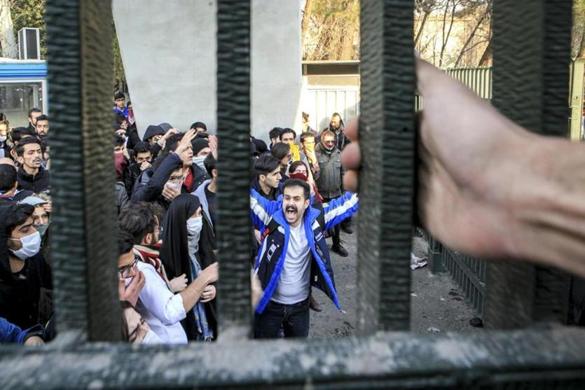
Don’t get too excited about the protests in Iran


By Stephen Kinzer

• Whenever trouble breaks out in Iran, adrenaline rushes through Washington. Hearts pound excitedly at the Pentagon, the CIA, the White House, and Congress. In recent weeks, reports of street protests in several Iranian cities have triggered this Pavlovian response. Once again, however, Americans who have spent decades hoping for an explosion in Iran are disappointed. “Regime change” is not imminent. More important, we should not wish for it. A sudden collapse of Iran’s governing system would be bad for us. It would set another Middle Eastern country aflame and feed the instability that breeds terror.

Via bostonglobe.com

Iran-haters — meaning most of official Washington — cackled in delight at news of the protests. President Trump said they showed that Iranians were “finally getting wise.” His ambassador to the United Nations, Nikki Haley, exulted that “the long-repressed Iranian people are now finding their voice.” Senator John McCain praised “the brave protesters who yearn for freedom.” None of these figures has been much of a defender of oppressed Middle Easterners. Concern for human rights is not what leads them to encourage upheaval in Iran. Their goal is to weaken America’s Middle East nemesis.

Leading figures in the Trump administration harbor extreme enmity for Iran. In a theatrical press conference last month, Haley stood in front of the body of a missile and a “kamikaze drone” that she said prove Iran is launching “direct military attacks” on pro-American forces. All three of the generals who are President Trump’s closest advisers served in the Middle East, where American and Iranian interests clash regularly. Defense Secretary James Mattis has famously listed America’s three greatest security threats in that region as “Iran, Iran, Iran.”

Anyone who believes this, and who sits at a pinnacle of power, might logically want to promote instability in Iran. That would be a mistake. If the United States is sending covert aid to the latest group of Iranian protesters, or considering doing so, it should stop.

Few peoples are as sensitive to foreign interference as the Iranians. In the 19th century Iran lost vast territories to Russia. Later the British brazenly looted Iran’s oil wealth. In 1953 US officials promoted a coup in which the country’s parliamentary democracy was overthrown. This history has left a residue of fierce independence. Iranians instinctively reject political movements that they see as tools of foreign power.

Few peoples are as sensitive to foreign interference as the Iranians. In the 19th century Iran lost vast territories to Russia. Later the British brazenly looted Iran’s oil wealth. In 1953 US officials promoted a coup in which the country’s parliamentary democracy was overthrown. This history has left a residue of fierce independence. Iranians instinctively reject political movements that they see as tools of foreign power.

Aid from the United States to any Iranian group would likely be uncovered. That would disqualify the recipient from further participation in Iranian public life. It would also highlight the hypocrisy of American outrage over Russian intervention in our own politics. American officials should not use this burst of protest in Iran as an excuse to intensify covert action there.

Via bostonglobe.com

Contrary to our wishful delusions, Iran is a fully functioning state. It is not careening toward the abyss of instability. Street protests there draw our attention precisely because they are rare. The grievances behind them are genuine, but they have no central leadership and offer no coherent alternative to the religious regime.

In any case, Iranians have watched American intervention devastate several Middle Eastern countries, including their own. They have demonstrated no desire for the kind of “regime change” that Washington begins imagining every time a rock is thrown in Tehran.

Iran is the strongest counterweight to American power in the Middle East. It limits our ability to impose our will. From Washington’s perspective, that makes it an enemy. In fact, however, no vital interest requires the United States to help shape Iran’s future.

History decrees that any Iranian government must be strongly nationalist and a vigilant defender of Shiite Muslims everywhere, so the idea that “regime change” would produce a more pro-American Iran is a fantasy. The security of the United States will not be seriously affected by the course of Iran’s domestic politics.

Nor, despite what Mattis and others have said, will our security be affected by the results of Iran’s jostling with other powers in its neighborhood. The role Iran ultimately plays in Syria, the nature of its ties to Lebanon, the scope of its influence in Yemen — these disputes will drag on interminably. There is no need for the United States to take sides in any of them. Doing so is a guarantee of perpetual engagement.

In 1980 President Carter proclaimed that any challenge to American dominance of the Persian Gulf would be considered “an assault on the vital interests of the United States of America.” He was driven by the global imperatives of his era. Much of America’s oil came through the Persian Gulf, and the West could not risk losing it to Soviet power.

Today there is no Soviet Union, and we no longer rely on Middle East oil. Yet although the basis for our policy has evaporated, the policy itself remains unchanged, a relic from a bygone age. We still insist on dominating the Persian Gulf. It is time to let go. Resisting the temptation to meddle in Iran after this month’s protests would be a good way to start.

Stephen Kinzer is a senior fellow at the Watson Institute for International and Public Affairs at Brown University. Follow him on Twitter @stephenkinzer.

Read more…


Photo
AP Students attend an anti-government protest at Tehran University in Iran on Dec. 30, 2017.
Related Posts

A friendly quarrel while we agree that the US sanctions are a weapon of mass destruction and kill more people than wars do. And that we must talk much more about sanctions than we have so far. Jan Oberg, TFF director March 16, 2026 John Mearsheimer recently stated that U.S. sanctions murdered around 38 million people between 1971 and 2021 – see the video below. It is a dramatic figure, and it has spread quickly because it captures, in one sentence, the enormous human cost of modern sanctions. I share his concern about the destructive effects of economic coercion. But the specific number he cites — and the way he attributes it — deserves a friendly academic clarification. The figure comes from a 2023 Lancet Global Health article estimating the mortality effects of unilateral U.S. and EU sanctions over the past half‑century. This is the first point where Mearsheimer’s shorthand diverges from the text: the study...
PART 2 — Diplomacy, Law and Nonviolent Power By Jan ObergTFF co-founder and director January 26, 2026 This is the second of four TFF-created idea portfolios designed to curb the global reach of the United States and, in both the short and long term, help catalyse a worldwide nonviolent resistance to what many observers describe as the Trump administration’s uniquely confrontational, destructive and world-threatening policies. These portfolios outline what governments and citizens across the world can do through dynamic diplomacy, creative initiatives, and strictly nonviolent means. They are typical TFF works in that we do not only tell what the problem is and how bad it will go – as 90+% of all commentators, experts and scholars do – we tell what we think can be done, inviting you to think of what you think you can do. It seems painfully clear to me that the current political dynamics in Washington increasingly resemble the most dangerous...
PART 1 — Media, Culture and Information Sovereignty By Jan ObergTFF co-founder and director January 20, 2026 This is the first of four TFF-created idea portfolios designed to curb the global reach of the United States and, in both the short and long term, help catalyse a worldwide nonviolent resistance to what many observers describe as the Trump administration’s uniquely confrontational, destructive and world-threatening policies. These portfolios outline what governments and citizens across the world can do through dynamic diplomacy, creative initiatives, and strictly nonviolent means. They are typical TFF works in that we do not only tell what the problem is and how bad it will go – as 90+% of all commentators, experts and scholars do – we tell what we think can be done, inviting you to think of what you think you can do. It seems painfully clear to me that the current political dynamics in Washington increasingly resemble the most...

Recent Articles

Serious but also a lot of laughs and positive energy. Because peace is also about conviviality and enchantment… Jan Oberg, TFF director November 16, 2026 This is a long (129 minutes) conversation with me. We cover very many, also personal, issues that makes a somewhat unusual media event. I am very grateful to Flemming Blicher for giving me this opportunity. I can’t remember any channel or editor who spent as much time as he did preparing it – including also asking me to answer a series of pre-interview questions, which are now posted under the conversation. If you sympathise with its content, please share it. Watch it here
A Message from Jan Oberg November 6, 2026 Over the past fifty years, I have devoted roughly 175,000 hours to research and public education for a more peaceful world: thinking, researching, writing, organising, publishing, debating, maintaining websites, corresponding, reaching out, leading a foundation, work in conflict and war zones, professorships, teaching courses and giving public lectures and doing media work. In short, ten hours a day, seven days a week, for half a century. The focus was on international political peace – analysing and trying to stop wars, address underlying conflicts and making alternative peace plans – at the desk and on the ground. Important as that has been and remains, it is only one kind of peace and it is now in a tragic militarist state compared with what it could have been.  Lately, however, I have found myself thinking about a concept from economics as well as everyday...
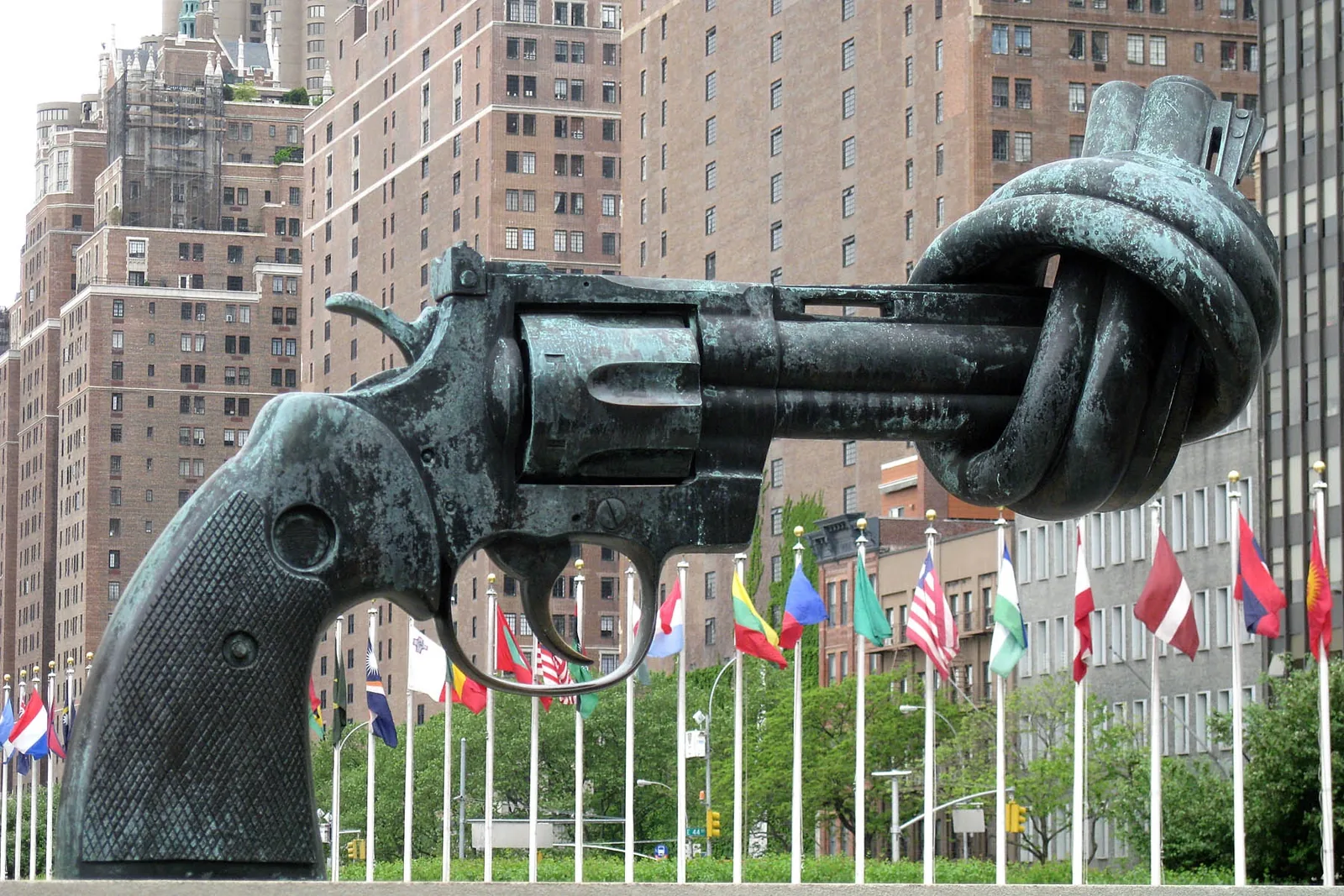
Photo above: Carl Fredrik Reuterswärd’s Non-Violence outside UN Headquarters in New York. Kirill Levin, CC BY-NC-SA 2. Jan Oberg November 3, 2026 I am happy to be published in Horizons which is produced by the Center for International Relations and Sustainable Development, CIRSD, in Belgrade. My contribution brings out a radical re-thinking of what concepts such as defence, security, deterrence – and peace – may mean if we want to create a more peaceful world. It also summarises a few things I have been working with the last few decades. Please read it here Og her er den på dansk, takket være Johnny Baltzersens lynhurtige oversættelse

TFF on Substack

Discover and subscribe to more peace materials on TFF Substack

Most Popular

Serious but also a lot of laughs and positive energy. Because peace is also about conviviality and enchantment… Jan Oberg, TFF director November 16, 2026 This is a long (129 minutes) conversation with me. We cover very many, also personal, issues that makes a somewhat unusual media event. I am very grateful to Flemming Blicher for giving me this opportunity. I can’t remember any channel or editor who spent as much time as he did preparing it – including also asking me to answer a series of pre-interview questions, which are now posted under the conversation. If you sympathise with its content, please share it. Watch it here
A Message from Jan Oberg November 6, 2026 Over the past fifty years, I have devoted roughly 175,000 hours to research and public education for a more peaceful world: thinking, researching, writing, organising, publishing, debating, maintaining websites, corresponding, reaching out, leading a foundation, work in conflict and war zones, professorships, teaching courses and giving public lectures and doing media work. In short, ten hours a day, seven days a week, for half a century. The focus was on international political peace – analysing and trying to stop wars, address underlying conflicts and making alternative peace plans – at the desk and on the ground. Important as that has been and remains, it is only one kind of peace and it is now in a tragic militarist state compared with what it could have been.  Lately, however, I have found myself thinking about a concept from economics as well as everyday...
Photo above: Carl Fredrik Reuterswärd’s Non-Violence outside UN Headquarters in New York. Kirill Levin, CC BY-NC-SA 2. Jan Oberg November 3, 2026 I am happy to be published in Horizons which is produced by the Center for International Relations and Sustainable Development, CIRSD, in Belgrade. My contribution brings out a radical re-thinking of what concepts such as defence, security, deterrence – and peace – may mean if we want to create a more peaceful world. It also summarises a few things I have been working with the last few decades. Please read it here Og her er den på dansk, takket være Johnny Baltzersens lynhurtige oversættelse
Read More
Screenshot 2026-11-10 174455
Serious but also a lot of laughs and positive energy. Because peace is also about conviviality and enchantment… Jan Oberg, TFF director November 16, 2026 This is a long (129 minutes) conversation with me. We cover very many, also personal, issues that makes a somewhat unusual media event. I am very grateful to Flemming Blicher for giving me this opportunity. I can’t remember any channel or editor who spent as much time as he did preparing it – including also asking me to answer a series of pre-interview questions, which are now posted under the conversation. If you sympathise with its content, please share it. Watch it here
AbstractVision_2017_#1_800 (kopia)
A Message from Jan Oberg November 6, 2026 Over the past fifty years, I have devoted roughly 175,000 hours to research and public education for a more peaceful world: thinking, researching, writing, organising, publishing, debating, maintaining websites, corresponding, reaching out, leading a foundation, work in conflict and war zones, professorships, teaching courses and giving public lectures and doing media work. In short, ten hours a day, seven days a week, for half a century. The focus was on international political peace – analysing and trying to stop wars, address underlying conflicts and making alternative peace plans – at the desk and on the ground. Important as that has been and remains, it is only one kind of peace and it is now in a tragic militarist state compared with what it could have been.  Lately, however, I have found myself thinking about a concept from economics as well as everyday...
knotted gun
Photo above: Carl Fredrik Reuterswärd’s Non-Violence outside UN Headquarters in New York. Kirill Levin, CC BY-NC-SA 2. Jan Oberg November 3, 2026 I am happy to be published in Horizons which is produced by the Center for International Relations and Sustainable Development, CIRSD, in Belgrade. My contribution brings out a radical re-thinking of what concepts such as defence, security, deterrence – and peace – may mean if we want to create a more peaceful world. It also summarises a few things I have been working with the last few decades. Please read it here Og her er den på dansk, takket være Johnny Baltzersens lynhurtige oversættelse
TFFPortfolioVign
UNITE-tillid, DREAM-velstand og andre konstruktive komponenter Normally we publish articles in English here. But this is a translation of a very important TFF document that should reach as many as possible in Denmark since this country’s government has been one of the most hardline in Europe and, up till now at least, has refused to use diplomacy and, instead, spent tremendous sums on arming Ukraine with the express goal of defeating Russia. Thus this – unique – article is in Danish. Vi er Johnny Baltzersen og hans Fælles Sikkerhed – Fælles Fremtid på Substack overmåde taknemmelige for at have oversat og publiceret TFF’s 2025-portfølje for fredsidéer med henblik på Ukraines fremtid. Vi håber den nu kan nå mange flere danskere – som også vil sprede den og skabe debat – nu den danske regerings og folketingspartiernes politik på dette område siden 2022 står nu – forudsigeligt – ved vejs ende....
JoGSS-Silent
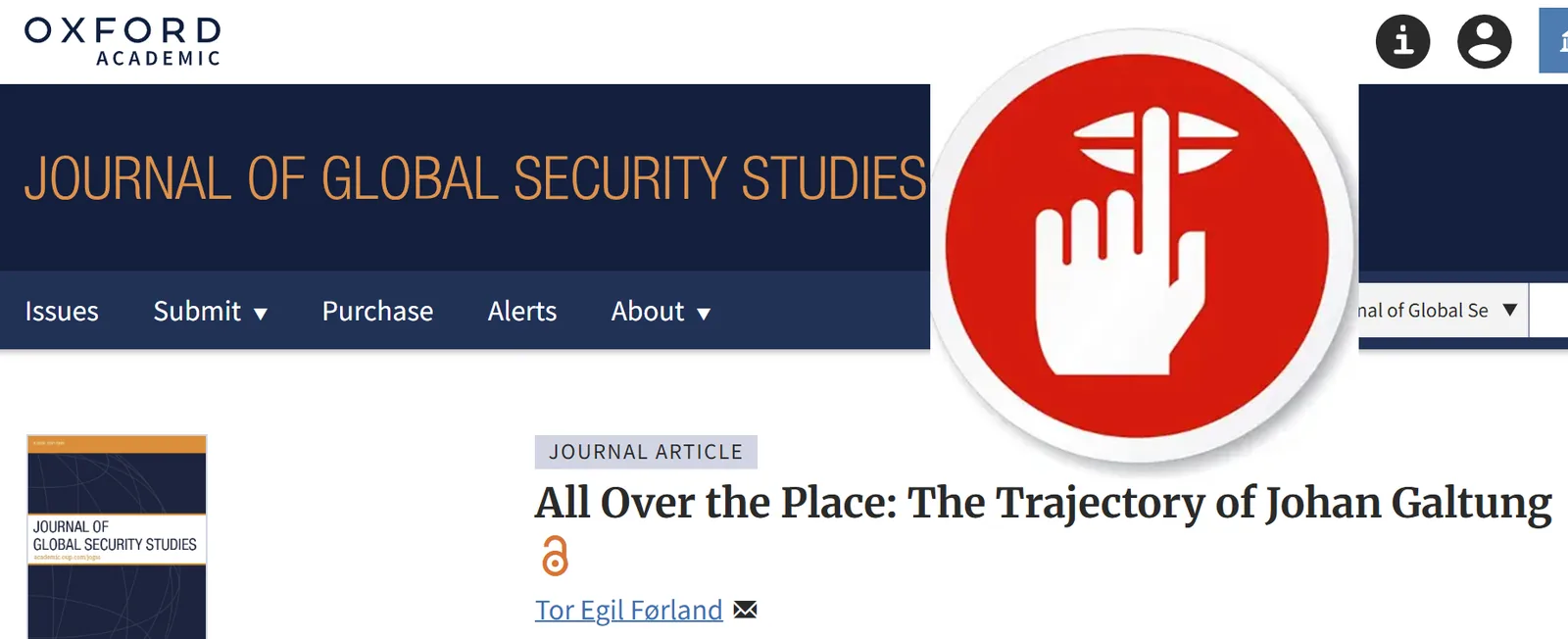
Jan Oberg TFF director October 28, 2026 Exactly one month has now passed since I published my criticism of the introduction to the special issue on Johan Galtung published by the Journal of Global Security Studies, JoGSS, and of Tor Egil Førland’s chapter about Galtung which serves as a preview to his forthcoming biography of Galtung to be published by PRIO. See the original on The Transnational here and the same article on TFF Substack with many general and critical comments and, in particular, the people who decided to withdraw from the biography project in protest. The special issue itself was extraordinary. It was devoted to the intellectual legacy of one of the founders of peace research and contained a number of strong assessments of his personality, scholarship, intellectual trajectory, and public role. Such assessments are, of course, entirely legitimate. No scholar is beyond criticism, and neither was Johan Galtung....
Screenshot 2026-10-26 115647
An aspect of Iran’s culture and civilisation you’ve probably never heard about. Don’t be surprised if the US and Israel also try to bomb them. Jan ObergTFF director October 26, 2026 Today – under the “USraeli” threat of new “annihilating” bombings – opens the 7th International Conference on Peace and Conflict Resolution at Tehran’s University. As far as I can tell, this is the only permanent, advanced peace research institution in West Asia/the Middle East. Perhaps more countries in that region could be inspired? I mean, how many military “security” institutes and military academies do they have? Many peace research institutes and university departments have been established since the 1950s in the West. They are now all under attack; some have closed down, some have gone mainstream, yet others kept the name but do nothing to research peace and disseminate results or advice; instead, they cooperate with militarism’s platforms such...