Nuclear

Category

Year

Author / Contributor

Region

Sort by

Showing 1-10 of 379 stories

USwaronIraq
By William Arkin January 29, 2020 Ten days before Donald J. Trump was elected president in 2016, the United States nuked Iran. The occasion: a nuclear war exercise held every year in late October. In the war game, after Iran sank an American aircraft carrier and employed chemical weapons against a Marine Corps force, the Middle East commander requested a nuclear strike, and a pair of B-2 stealth bombers, each loaded with a single nuclear bomb, stood by while the president deliberated. “Testing our forces through a range of challenging scenarios validates the safety, security, effectiveness and readiness of the strategic deterrent,” Adm. Cecil D. Haney, then the commander of U.S. Strategic Command, said as the exercise got underway. According to a government contractor who helped write the complex scenario leading up to the decision to use nuclear weapons, Global Thunder 17 (as the exercise was called because it took...
RichardFalk
By Richard Falk, TFF Associate Januar 22, 2020 Prefatory Note: The post below is a somewhat amplified version of an interview with C. J. Polychroniou, journalist and professor of political economy at West Chester University, which was published on January 7, 2020, in the online journal, Global Policy. As the interview was conducted in December 2019, it fails to address the various disruptive consequences of the assassination of Qasem Soleimani, including the violation of Iraqi sovereignty, Baghdad being the site of the drone attack, as well as the risks of war arising from an escalating tit-for-tat cycle of actions and reactions. Given growing tensions between the interconnectedness of the world and the state-centric character of international law, including contradictions between totalizing and disregarding territorial sovereignty, state-centric world order is being increasingly marginalized by geopolitical behaviour that both generates and suppresses transnational political violence. A normative crisis with structural implications exists,...

1-sgnDEjgU7f4-cv0V9d2DIg
If you appreciated this conversation with a leading TFF expert Farhang Jahanpour is a retired professor from the University of Isfahan and former part-time tutor at the University of Oxford, former TFF Board member and now TFF Associate. The Nuclear Non-Proliferation Treaty (NPT) that takes center stage in this conversation can be read here.
the-anti-nuclear-march-in-new-york-citys-central-park-june-12-1982-1024x689-1
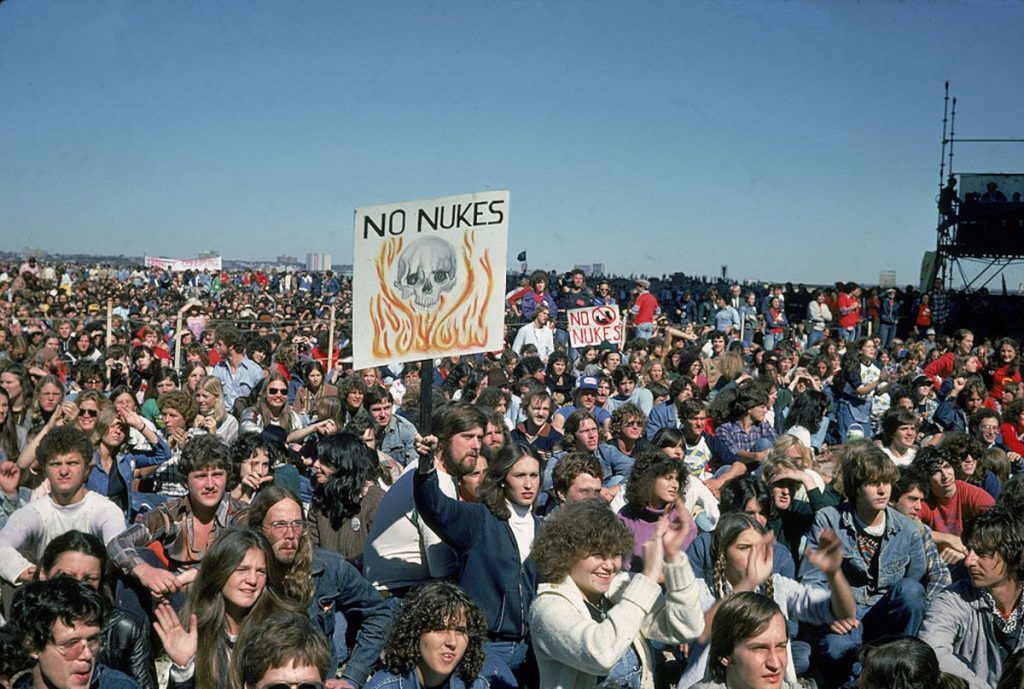
By Dr. Lawrence Wittner January 17, 2020 Although today’s public protests against nuclear weapons can’t compare to the major antinuclear upheavals of past decades, there are clear indications that most Americans reject the Trump administration’s nuclear weapons policies. Originally posted on History News Network on December 22, 2019 here Since entering office in 2017, the Trump administration has withdrawn the United States from the nuclear agreement with Iran, scrapped the Intermediate-Range Nuclear Forces (INF) Treaty with Russia, and apparently abandoned plans to renew the New START Treaty with Russia. After an overwhelming majority of the world’s nations agreed on a landmark UN Treaty on the Prohibitions of Nuclear Weapons in July 2017, the Trump administration quickly announced that it would never sign the treaty.  The only nuclear arms control measure that the Trump administration has pursued―an agreement by North Korea to abandon its nuclear weapons program―appears to have collapsed, at least in part because the Trump administration badly mishandled the negotiations. Moreover, the Trump...
ChatGPT Image 9 jun 2026, 11_11_33
The Europeans have not done well in countering President Donald Trump’s onslaught on Iran. When Trump unilaterally decided that the US should withdraw from the 2015 Iran Nuclear Deal, which committed Iran to winding down its nuclear research in return for the West, Russia and China (the latter two were also part of the deal) lifting sanctions which were crippling the Iranian economy, the Europeans huffed and puffed and then did little. The UN membership considered the 2015 deal to be very fair. The Security Council gave it unanimous support. Indeed, the US is now in breech of international law by opting out. But if the Europeans had had the guts when President Donald Trump announced the US withdrawal they would have pushed for debate on this issue at the Security Council and got the US condemned, even punished. Unfortunately, Trump had the Europeans’ guts for braces. After shouting loudly...
nato
Political NATO’s London Summit on December 3 and 4, 2019 displays the deep political crisis of the 70-year-old alliance: Only a dinner and a short meeting, no statement to be issued, quarrels among the leading military members, accusations, substantial differences on Syria and many other issues, the deepest-ever Transatlantic conflict and the usual issues of burden-sharing. Legal But the political dimension of NATO’s crisis is only one. There is also a legal crisis. You’ll recognize it if you care to read the NATO Treaty text – something academic and media people don’t generally seem to have done. They would then have noticed that the Alliance of 2019 consistently operates outside – indeed in violation of – its own goals, purposes and values. For instance, the UN Charter which should be NATO’s guideline has been violated on a permanent basis for decades – such as in its out-of-area bombings of Yugoslavia...
bofuq374gwgf
By Scott Ritter November 4, 2019 At a time when the credibility of the United States as either an unbiased actor or reliable ally lies in tatters, Russia has emerged as the one major power whose loyalty to its allies is unquestioned, and whose ability to serve as an honest broker between seemingly intractable opponents is unmatched. Originally posted on Truthdig.com on October 30, 2019 here If there is to be peace in Syria, it will be largely due to the patient efforts of Moscow employing deft negotiation, backed up as needed by military force, to shape conditions conducive for a political solution to a violent problem. If ever there was a primer for the art of diplomacy, the experience of Russia in Syria from 2011 to the present is it. Like the rest of the world, Russia was caught off guard by the so-called Arab Spring that swept through the Middle...
ChatGPT Image 9 jun 2026, 11_11_33
There’s a lot of end-of-the-world hyperbole around on climate change. So there should be. But it blankets out other important causes that are even more imminently important – wiping out malaria and sleeping sickness and introducing pure water supplies, sewerage systems and education for girls – all of which would save many more people than those likely to be hurt by global warning, at least this side of twenty-five years. Global warming, although very much apparent, is happening relatively slowly. Indeed, I feel like coining a slogan: “Kill mosquitoes today, save the icebergs tomorrow”. In fact the world has the resources to do both – a small portion of the money spent on arms would do it. So too would diverting the money spent on cat food, cosmetics, red meat and gas-guzzling SUVs (In the US they make up 60% of car sales.) Fading ever more into the background as...
Sitara-one-min
By Pressenza New York September 18, 2019 Originally posted on Pressenza New York’s website on September 09, 2019 here On this show we speak with Alice Slater about the historical process of nuclear weapon treaties and the relationship between the US and Russia. Alice is the UN NGO Representative of the Nuclear Age Peace Foundation, sits on the boards of World Beyond War, Nuclear Ban US, and the Global Network Against Weapons and Nuclear Power in Space, and is a member of the Global Council of Abolition 2000. She is on the NYC Working Group for the Nobel Prize-winning International Campaign to Abolish Nuclear Weapons (ICAN) ‘s campaign to promote the newly passed treaty to ban the bomb. Alice is a member of the NYC Bar Association and has written numerous articles and op-eds for Pressenza. Political actions you can take to ban the bomb and cut down the war...
shutterstock_714035503
By Kevin Cashman and Cavin Kharrazian Iranian foreign minister Mohammad Javad Zarif recently visited the Group of Seven (G7) at the invitation of French president Emmanuel Macron, in what was seen as an overture to the Trump administration to negotiate over sanctions that have plagued the Iranian economy. Back in 2018, after months of increasingly hostile rhetoric, the US government withdrew from the Joint Comprehensive Plan of Action (JCPOA), or “Iran Deal,” and imposed a “maximum pressure” campaign that included unilateral, economy-wide sanctions. The Iran Deal was an agreement that provided Iran relief from existing sanctions in exchange for limits on its enrichment of uranium, among other concessions. These sanctions hampered trade between the European Union, whose leaders have sought to salvage the Iran Deal. Originally posted on September 1, 2019, on the Center for Economic and Policy Research (CEPR) here When President Trump reimposed sanctions in November 2018, it cut off...
PTV
/07/31/the-law-against-aggression/”>illegal according to the Rome Statute. There is also the 1996 advisory opinion of the International Court of Justice to back up that assertion. The argument concerning terrorism has to do with the fact that it is a central element in any definition of the concept of terrorism that it implies a deliberate attempt to harm or kill innocent people – people who are not party to a conflict – in order to instill fear and achieve a political purpose. And there is no way nuclear weapons can be used without killing masses of innocent people. Therefore, they should have no place in a civilized society. https://www.youtube.com/watch?v=p-GftG4fThI
targeting_iran
The following statement on US warmongering in relation to Iran was prepared by Mark LeVine, Professor of History, University of California, Irvine and myself. Some of the early signatories are among the leading scholars in the field of Middle East Studies. Their names are listed below. It seeks to make two major arguments: First, that the unlawful threats and coercive moves made by the United States point toward a political disaster that would include the commission of the most serious of international crimes, that of aggression via threats and uses of force that do not constitute self-defense under international law; and Secondly, that it is essential to shift the relationship with Iran from one based on coercive to an approach resting on restorative diplomacy involving a deliberate reversal of American Foreign Policy with the overriding objective of normalization of relations between our two countries. Statement by leading Middle East/Islamic studies...
Categories

Year

Author / Contributor

Region