NATO’s 4th crises: The 2 per cent goal as defence illiteracy

Political

NATO’s London Summit on December 3 and 4, 2019 displays the deep political crisis of the 70-year-old alliance: Only a dinner and a short meeting, no statement to be issued, quarrels among the leading military members, accusations, substantial differences on Syria and many other issues, the deepest-ever Transatlantic conflict and the usual issues of burden-sharing.

Legal

But the political dimension of NATO’s crisis is only one. There is also a legal crisis. You’ll recognize it if you care to read the NATO Treaty text – something academic and media people don’t generally seem to have done. They would then have noticed that the Alliance of 2019 consistently operates outside – indeed in violation of – its own goals, purposes and values. For instance, the UN Charter which should be NATO’s guideline has been violated on a permanent basis for decades – such as in its out-of-area bombings of Yugoslavia with no UN mandate.

The contempt shown for international law in general and the UN Charter in particular is an integral part of NATO’s existential crisis.

Moral

And, third, there is a moral dimension to NATO’s crisis. Of course, no one talks about it.

It’s the simple fact that no war that individual NATO members states or NATO as NATO have engaged in can be termed anything but predictable fiascos when judged by the alliance’s own stated goals and criteria – just think of Vietnam, Yugoslavia, Afghanistan, Iraq, Libya, Syria… all crystal clear moral catastrophes causing unspeakable suffering, death and destruction to millions upon millions while achieving none of the stated goals that were set to explain and legitimize these wars such as creating democracy, respecting human rights, liberating women or stopping alleged genocides.

By now, the world should have been told enough lies about NATO’s benevolent motives, policies and actions for taxpaying citizens to mobilize resistance to it.

These three crises can all be related to the response of the Western world to the demise of the Soviet Union and the Warsaw Pact 30 years ago – i.e. to the choice to expand NATO and exploiting the weakness of Russia.

Intellectual

The last and perhaps most-hidden-of-all crisis is NATO’s intellectual crisis.

It’s now an alliance that operates in a kind of echo chamber with little, or no, sense of the realities of the world. It’s there for its own sake. When you listen to its Secretary-General – not only Stoltenberg but Fogh Rasmussen and earlier ones – you sense a level of creativity and intellectualism that reminds you of leaders who also happened to be Secretaries-General such as, say, Leonid Breznev.

Irrespective of some little objective analysis of the situation, NATO sings only one tune: There are new threats all the time, we must arm more, we need new and better weapons and we must, therefore, increase military expenditures.

And how is it legitimized?

By uttering mantras. No matter what NATO and its members choose to do, it is simply stated without a trace of argument or documentation that more money will increase four things: Defence, security, stability and peace. And be good for basic Western values such as freedom, democracy and peace.

How come – the small boy watching the Emperor would ask – that no matter what NATO has done the last 70 years, it is still maintaining that it needs more to create that defence, security, stability and peace?

What’s wrong with a system that keeps applying the same medicine decade after decade and gets further and further from achieving the stipulated goal?

Military expenditures in general – no balance and no reality check

NATO’s main enemy is supposed to be Russia. It doesn’t matter that Russia’s military expenditures are about 6-7 % of NATO’s total expenditures (29 countries). It doesn’t matter that NATO’s technical quality is superior. It doesn’t matter that Russia’s military expenditures are falling year-by-year – decreased to US $ 64 billion in 2018 from US $ 66 billion in 2017. It doesn’t matter that Russia’s military expenditures averaged only US $ 45 billion from 1992 until 2018.

Only? Yes, NATO’s total budget is US $ 1036 billion of which the US stands for 649.

And it doesn’t matter that the old Warsaw Pact budget were some 65-75% of NATO’s during the first Cold War and we were told back then that some kind of balance was good for stability and peace. Today we are told that the more superiority NATO has, the better it is for world peace.

In short, reality doesn’t matter anymore to NATO.

The 2 per cent goal

And this is where the 2 per cent of BNP comes into play and reveals just how deep NATO’s crisis is. But have you seen anybody questioning this 2 per cent goal as the philosophical nonsense – or forgery – it is?

It resembles the Theatre of the Absurd to tie military expenditures to the economic performance of a country. Imagine a person sets off 10 % of her/his income to buy food. Sudden he or she wins in a lottery or is catapulted into a job that yields a 5 times higher income. Should that person then also begin to eat 5 times more?

The 2 per cent goal is an absurdity, an indicator of defence illiteracy. People who take it serious – in politics, media and academia – obviously have never read a basic book about theories and concepts in the field of defence and security. Or about how one makes a professional analysis of what threatens a country.

If military expenditures are meant to secure a country’s future, do the threats that this country faces also vary according to its own GNP? Of course not! It is a bizarre assumption.

Decent knowledge-based defence policies should be decided on the basis of a comprehensive analysis of threats and contain dimensions such as:

What threatens our nation, our society now and along various time horizons? Which threats that we can imagine are so big that we can do nothing to meet them? Which are such that it is meaningful to set off this or that sum to feel reasonably safe? What threats seem so small or unlikely that we can ignore them?

What threats are most likely to go from latent to manifest? How do we prioritize among scarce resources when we have other needs and goals than feeling secure such as developing our economy, education, health, culture, etc.?

And, most importantly, two more consideration: What threats can be met with predominantly military means and which require basically civilian means? And how do we act today to prevent the perceived threats from becoming a reality that we have to face – how do we, within our means, prevent violence and reduce risks as much as possible.

All these questions should be possible to answer with the new mantra: Just always give the military 2 per cent of the GNP and everything will be fine?

The MIMAC

MIMAC is the Military-Industrial-Media-Academic Complex – the vested interests of small elites in symbiosis with governments which run on and benefit from bizarre standards like the 2 per cent goal.

One purpose of that goal is to make serious, empirical and relevant threat analysis irrelevant. It’s a perpetuum mobile – a way of securing that MIMAC always gets what it needs, no matter what the consequences are for thosee who pay it all, the citizens and their tax money.

Imagine that Russia disappeared from the earth tomorrow. And NATO would quickly find some other “enemy” by which to legitimate that it anyhow needs also 2 per cent of your BNP in the future. At least!

NATO Titanic
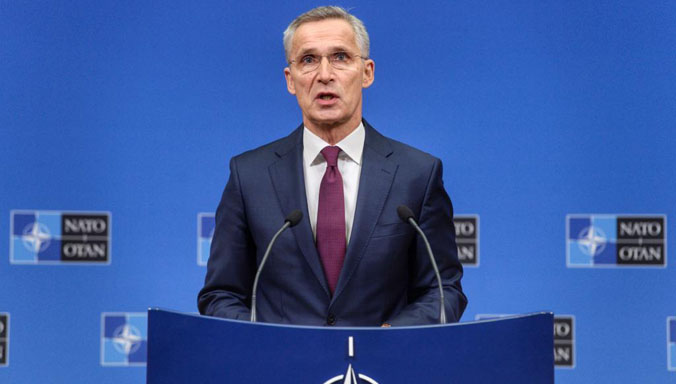
Secretary-General Jens Stoltenberg

It’s Secretary-General Jens Stoltenberg two days ago announced this mind-boggling news, swallowed by media as the most natural thing of the world in need of no questions – read it on NATO’s homepage:

“Ahead of the meeting of NATO Leaders in London to mark the Alliance’s 70th anniversary, Secretary General Jens Stoltenberg on Friday (29 November 2019) gave details of large increases in Allied defence spending. Mr. Stoltenberg announced that in 2019 defence spending across European Allies and Canada increased in real terms by 4.6 %, making this the fifth consecutive year of growth. He also revealed that by the end of 2020, those Allies will have invested $130 billion more since 2016. Based on the latest estimates, the accumulated increase in defence spending by the end of 2024 will be $400 billion. Mr. Stoltenberg said: “This is unprecedented progress and it is making NATO stronger.’ “

Read it carefully: NATO’s military expenditure increase 2016-2020 is US $ 130 billion – that is twice as much as Russia’s total annual budget!

There is only two words for it: Madness and irrationality. Madness in and of itself and madness when seen in the perspective of all the other problems humanity must urgently find funds to solve.

The total regular UN budget for the year 2016-17 was US $ 5.6 billion. That is, NATO countries spend 185 times more on the military than all the world does on the UN.

Do you find that sane and in accordance with the problems humanity need to solve? This author does not. I stand by the word madness. There exists no rational academic, empirical analysis and no theory that can explain NATO’s military expenditures as rational or in service of the common good of humankind.

•

The world’s strongest, nuclear alliance is a castle built on intellectual sinking sand. It’s a political, moral, legal and intellectual Titanic.

The only armament NATO needs is legal, moral and intellectual. And unless it now moves in this direction, it deserves to be dissolved.

The inverse proportion between its destructive power and its moral-intellectual power is – beyond any doubt – the largest single threat to humanity’s future.

This challenge is at least as serious and as urgent as is climate change.

Perhaps it is time to stop keeping NATO alive by taxpayers’ money and start a tax boycott in all NATO countries until it is dissolved or at least comes down to – say – one-tenth of its present wasteful military level? Not to speak of its bootprint destruction of the environment…

Peace & future researcher + ‌Art Photographer

3 Responses

  1. Mange tak, Ole – det er SÅ varmende når læserne ikke bare (måske) tænker det men også bruger tiden på at skrive det. Det er den slags bidrag TFF og jeg selv også kører videre på – skal du vide.

  2. The “leader of the free world” who is now in London for NATO’s lukewarm 70th anniversary celebrations is so toxic that the prime minister of the host country, Boris Johnson, who is in the middle of an election campaign has refused to have a one-on-one meeting with Trump. Surprise, surprise, Trump is not very popular with British voters! Johnson has urged Trump not to say anything about the election or about wishing to have the National Health Service (NHS) on the table for the post-Brexit trade talks. However, Trump could not help himself saying that Boris Johnson is a very capable person and will do a good job. He was so insistent about not wanting to have anything to do with the NHS that his remarks have backfired and have reminded people about the designs of US pharmaceuticals on the British Health Service. When this is the best that they can do to celebrate the anniversary of NATO, it is clear that it is not only “brain dead”, but on its death bed and hopefully will soon expire. Its only function is to manufacture crises and force NATO countries to spend 2% of their GDP (Trump said this morning that it should be 4%) mainly on buying US weapons in order to keep the US Military Industrial Complex going and maintaining the US’s domination over the other 28-member countries. It is odd that other countries are prepared to pay billions of dollars to enforce US’s domination over them!

Related Posts

Tony Robinson October 4, 2026 Violence is easy to recognise when someone is being beaten, shot or killed. It becomes more difficult when nobody is holding a weapon. Poverty, discrimination, exploitation and repression can restrict a human life just as effectively, although they do so in very different ways and with very different consequences. Simply adding more categories to an ever-growing list of forms of violence does not really solve the problem. The more interesting question is what all these different situations have in common and why it makes sense to describe them using the same word. Human beings do not simply react to what happens around them. They remember the past, imagine things that do not yet exist, make plans and undertake projects. Workers organise because they imagine different working conditions; people migrate because they imagine another life somewhere else; social movements emerge because people refuse to accept the...
Johan Galtung 1930-2024October 2015 Published here on October 3, 2026 Let us focus on Civilization for conflict analysis and remedies. Major forms of disorder use violence; war is state organized violence. The most belligerent states are the United States of America and Israel, both with civilization roots. National Evangelism, the US Protestant Christian civilization– more national than evangelical–justifies US warfare as exceptionalism of a people chosen by God, with a manifest destiny to run the world. Orthodox Judaism justifies Israeli warfare to conquer and expand from Nile to Euphrates as a religious right and duty to the Eternal One. The third most belligerent country, the UK, no longer believes it is God-chosen but chosen by the USA; not quite the same but something. But the root cause of global disorder lies in the Occident–with Islam–seeing itself as the single, universal civilization valid for all at all times, all others being...
Jan ObergPhD, director, The Transnational Foundation for Peace and Future Research, TFFLund, Sweden October 2, 2026 This is my full original manuscript. The Chinese Academy of Social Science, CASS, makes two publications out if it. 1. China’s Five-year plan emphasized the capabilities of basic research and original innovation. It is regarded as the goal of the future social development, which, as required, should be significantly enhanced. Can you comment on the importance of original innovation in research and academic study? I believe it is easier to define “original innovation” in the natural sciences than in social sciences. The breaking points of what constitutes something new, or innovative, are not quite as sharp in the latter. But in both fields it is about opening up something that was closed, unseen, unexplored before – making manifest what was earlier latent. Innovations come in many forms and shapes – naming something that was not...

Recent Articles

Tony Robinson October 4, 2026 Violence is easy to recognise when someone is being beaten, shot or killed. It becomes more difficult when nobody is holding a weapon. Poverty, discrimination, exploitation and repression can restrict a human life just as effectively, although they do so in very different ways and with very different consequences. Simply adding more categories to an ever-growing list of forms of violence does not really solve the problem. The more interesting question is what all these different situations have in common and why it makes sense to describe them using the same word. Human beings do not simply react to what happens around them. They remember the past, imagine things that do not yet exist, make plans and undertake projects. Workers organise because they imagine different working conditions; people migrate because they imagine another life somewhere else; social movements emerge because people refuse to accept the...
It’s a matter of principles, courage, vision and pulling together – while the militarist world is falling apart… Peter Langille October 3, 2026 “Here, then, is the problem which we present to you, stark and dreadful and inescapable: Shall we put an end to the human race; or shall mankind renounce war?”The Bertrand Russell—Albert Einstein Manifesto, July 9, 1955 ⁕ The forecast for what’s ahead is worrisome. The sharp rise in armed conflicts over the past three years is adding to what was already the highest level in over seventy years. Genocides, which should be prevented are supported. A shared climate emergency that jeopardises survival is ignored. Diverse polls now suggest that people are war-weary, worried and interested in a more effective United Nations. And, there are viable policy options for a more secure world! Yet governments are doubling-down, betting on more war and investing heavily. If current trends persist,...
Johan Galtung 1930-2024October 2015 Published here on October 3, 2026 Let us focus on Civilization for conflict analysis and remedies. Major forms of disorder use violence; war is state organized violence. The most belligerent states are the United States of America and Israel, both with civilization roots. National Evangelism, the US Protestant Christian civilization– more national than evangelical–justifies US warfare as exceptionalism of a people chosen by God, with a manifest destiny to run the world. Orthodox Judaism justifies Israeli warfare to conquer and expand from Nile to Euphrates as a religious right and duty to the Eternal One. The third most belligerent country, the UK, no longer believes it is God-chosen but chosen by the USA; not quite the same but something. But the root cause of global disorder lies in the Occident–with Islam–seeing itself as the single, universal civilization valid for all at all times, all others being...

TFF on Substack

Discover and subscribe to more peace materials on TFF Substack

Most Popular

Tony Robinson October 4, 2026 Violence is easy to recognise when someone is being beaten, shot or killed. It becomes more difficult when nobody is holding a weapon. Poverty, discrimination, exploitation and repression can restrict a human life just as effectively, although they do so in very different ways and with very different consequences. Simply adding more categories to an ever-growing list of forms of violence does not really solve the problem. The more interesting question is what all these different situations have in common and why it makes sense to describe them using the same word. Human beings do not simply react to what happens around them. They remember the past, imagine things that do not yet exist, make plans and undertake projects. Workers organise because they imagine different working conditions; people migrate because they imagine another life somewhere else; social movements emerge because people refuse to accept the...
It’s a matter of principles, courage, vision and pulling together – while the militarist world is falling apart… Peter Langille October 3, 2026 “Here, then, is the problem which we present to you, stark and dreadful and inescapable: Shall we put an end to the human race; or shall mankind renounce war?”The Bertrand Russell—Albert Einstein Manifesto, July 9, 1955 ⁕ The forecast for what’s ahead is worrisome. The sharp rise in armed conflicts over the past three years is adding to what was already the highest level in over seventy years. Genocides, which should be prevented are supported. A shared climate emergency that jeopardises survival is ignored. Diverse polls now suggest that people are war-weary, worried and interested in a more effective United Nations. And, there are viable policy options for a more secure world! Yet governments are doubling-down, betting on more war and investing heavily. If current trends persist,...
Johan Galtung 1930-2024October 2015 Published here on October 3, 2026 Let us focus on Civilization for conflict analysis and remedies. Major forms of disorder use violence; war is state organized violence. The most belligerent states are the United States of America and Israel, both with civilization roots. National Evangelism, the US Protestant Christian civilization– more national than evangelical–justifies US warfare as exceptionalism of a people chosen by God, with a manifest destiny to run the world. Orthodox Judaism justifies Israeli warfare to conquer and expand from Nile to Euphrates as a religious right and duty to the Eternal One. The third most belligerent country, the UK, no longer believes it is God-chosen but chosen by the USA; not quite the same but something. But the root cause of global disorder lies in the Occident–with Islam–seeing itself as the single, universal civilization valid for all at all times, all others being...
Read More
Living-Peace-Sign-Budapest-copy
Tony Robinson October 4, 2026 Violence is easy to recognise when someone is being beaten, shot or killed. It becomes more difficult when nobody is holding a weapon. Poverty, discrimination, exploitation and repression can restrict a human life just as effectively, although they do so in very different ways and with very different consequences. Simply adding more categories to an ever-growing list of forms of violence does not really solve the problem. The more interesting question is what all these different situations have in common and why it makes sense to describe them using the same word. Human beings do not simply react to what happens around them. They remember the past, imagine things that do not yet exist, make plans and undertake projects. Workers organise because they imagine different working conditions; people migrate because they imagine another life somewhere else; social movements emerge because people refuse to accept the...
b54a1f10-8c65-4f0b-9dd5-4abc0a7d04cc_2659x2659
It’s a matter of principles, courage, vision and pulling together – while the militarist world is falling apart… Peter Langille October 3, 2026 “Here, then, is the problem which we present to you, stark and dreadful and inescapable: Shall we put an end to the human race; or shall mankind renounce war?”The Bertrand Russell—Albert Einstein Manifesto, July 9, 1955 ⁕ The forecast for what’s ahead is worrisome. The sharp rise in armed conflicts over the past three years is adding to what was already the highest level in over seventy years. Genocides, which should be prevented are supported. A shared climate emergency that jeopardises survival is ignored. Diverse polls now suggest that people are war-weary, worried and interested in a more effective United Nations. And, there are viable policy options for a more secure world! Yet governments are doubling-down, betting on more war and investing heavily. If current trends persist,...
010
Johan Galtung 1930-2024October 2015 Published here on October 3, 2026 Let us focus on Civilization for conflict analysis and remedies. Major forms of disorder use violence; war is state organized violence. The most belligerent states are the United States of America and Israel, both with civilization roots. National Evangelism, the US Protestant Christian civilization– more national than evangelical–justifies US warfare as exceptionalism of a people chosen by God, with a manifest destiny to run the world. Orthodox Judaism justifies Israeli warfare to conquer and expand from Nile to Euphrates as a religious right and duty to the Eternal One. The third most belligerent country, the UK, no longer believes it is God-chosen but chosen by the USA; not quite the same but something. But the root cause of global disorder lies in the Occident–with Islam–seeing itself as the single, universal civilization valid for all at all times, all others being...
Screenshot 2026-10-02 011738
Jan ObergPhD, director, The Transnational Foundation for Peace and Future Research, TFFLund, Sweden October 2, 2026 This is my full original manuscript. The Chinese Academy of Social Science, CASS, makes two publications out if it. 1. China’s Five-year plan emphasized the capabilities of basic research and original innovation. It is regarded as the goal of the future social development, which, as required, should be significantly enhanced. Can you comment on the importance of original innovation in research and academic study? I believe it is easier to define “original innovation” in the natural sciences than in social sciences. The breaking points of what constitutes something new, or innovative, are not quite as sharp in the latter. But in both fields it is about opening up something that was closed, unseen, unexplored before – making manifest what was earlier latent. Innovations come in many forms and shapes – naming something that was not...
arctic-circle-map
The agreement is catastrophic both because of what it says and what it doesn’t mention. It reduces further the major asset of security policies: Freedom of action. Jan Oberg TFF director September 25, 2026 A couple of hours before the agreement was signed on September 22, 2026, I published the following 13 hypotheses about what it would most likely contain on TFF Substack (in English). I was wrong on only the first point. Contrary to what Trump had written on his Truth Social platform, it does not appear to come into force immediately. In fact, it turned out to be worse than even I had anticipated. After these hypotheses now come a number of reflections in light of what the agreement actually contains, and does not contain, as well as the way in which it has generally been presented by major media outlets and by the public-service broadcaster DR. My...
girl-5894831_1280
Below are TFF-related media mentions, comments, videos and social media posts published elsewhere but not on this homepage. We happen to catch and list only a fraction. Regarding video comments and debates, we recommend that you go to the TFF Video Channel on Substack where many of them are reproduced. Jan Oberg is a contributor to China Daily – 52 million daily clicks – and Global Times, CGTN and CCTV (the national television), China Investment, Xinhua News Agency and several others. Articles and videos on these media very often multiply into countless Chinese (and Western media) that re-post them from these main media. Thanks to The China Academy, his analyses, interviews and comments are frequently posted on YouTube channels such as Thinkers Forum and Wave Media. These videos are often re-posted on Bilibili (China’s YouTube), the China Content Center on TikTok, and on the Chinese edition of TikTok, Douyin.com. This means reaching hundreds of millions of viewers worldwide over a year. While there are too many to catch on all these...