
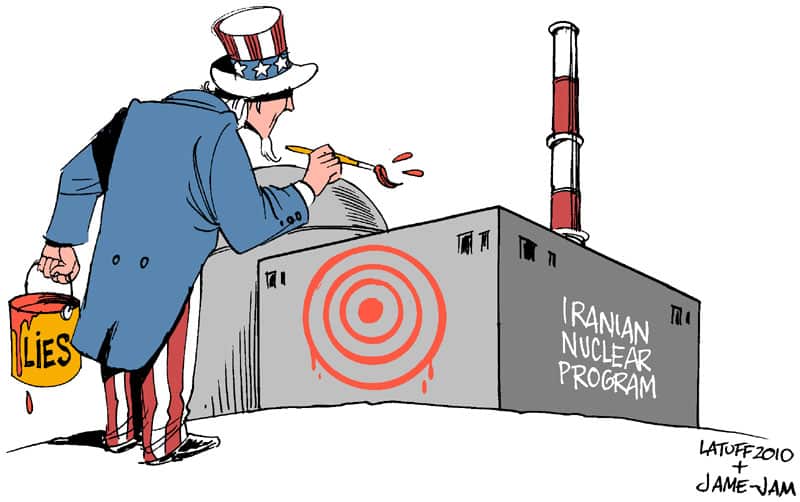
An American attack on Iran would be an unmitigated disaster for the US, Iran and the world

The following statement on US warmongering in relation to Iran was prepared by Mark LeVine, Professor of History, University of California, Irvine and myself. Some of the early signatories are among the leading scholars in the field of Middle East Studies. Their names are listed below.

It seeks to make two major arguments:

First, that the unlawful threats and coercive moves made by the United States point toward a political disaster that would include the commission of the most serious of international crimes, that of aggression via threats and uses of force that do not constitute self-defense under international law; and

Secondly, that it is essential to shift the relationship with Iran from one based on coercive to an approach resting on restorative diplomacy involving a deliberate reversal of American Foreign Policy with the overriding objective of normalization of relations between our two countries.

Statement by leading Middle East/Islamic studies scholars, June 22, 2019

We, the undersigned scholars of the Middle East and North Africa and broader Muslim world, call on President Trump immediately to pull back from the brink of a war with the Islamic Republic of Iran.

It is clear to us that the human, diplomatic, legal, political, and economic costs to both countries, the Persian Gulf and larger Middle East, the global economy and the global system of international humanitarian law of a US attack would be even more devastating than was the US invasion of Iraq sixteen years ago. 

We call upon the political leadership of the country, with a sense of urgency, not only to refrain from any further threats and uses of force against Iran, but also to put forward a new American diplomacy that takes steps to achieve a sustainable peace between our two countries and within the larger region.

We bring to the public’s attention the following points:

• The US-led Iraqi invasion, whose financial toll has exceeded $2 trillion in the US and at least that much in its adverse economic impact on the affected countries, led to the deaths of over 600,000 Iraqis, largely destroyed the Iraqi state and much of the country’s infrastructure, produced devastating immediate and long-term impact on the health of Iraqis and the environment, directly contributed to the rise of the Islamic State and its conquest and occupation and destruction of a huge swath of Iraq and neighboring countries (especially Syria), and produced a series of governments in the region which, even when there is a veneer of democracy, are incredibly corrupt and unable effectively to govern fractured societies, while continuing routinely to commit large scale human rights violations against their citizens.

• Like the Iraqi invasion before it, an attack on Iran under the present circumstances would be a clear violation of international law – a crime against peace, which is an international crime of the highest order, and delineated as such in the Nuremberg Judgement.

Indeed, absent a valid claim of self-defense any attack on Iran, never mind a full-scale invasion and occupation by the United States, would violate the core articles of the UN Charter (Articles 2(4), 33, 39 & 51) as well as the legal imperative to seek a peaceful settlement of all international disputes.

Such “breaches of the peace” are the most serious violations of international law a country can commit, and the US doing so again less than a generation after the Iraqi invasion would situate it outside the community of nations, making it widely regarded as a dangerous and destabilizing rogue actor whose behavior is the very opposite of the self-understanding and justifications of the Trump Administration for its actions.

In this regard the recent array of threats, sanctions, and provocations are themselves flagrant violations of international law even without any direct recourse to force; only self defense against a prior armed attack across as international border legally justifies a claim of self-defense.

Absent this, all threats, as well as uses of force, are considered severe violations of international law.

Particularly in the context of the United States’ unilateral withdrawal from the 2015 Joint Comprehensive Plan of Action, which verifiably halted the potential for Iran to pursue a nuclear weapons program, and the imposition of crippling economic sanctions against the government and people of Iran without a UN Security Council mandate, the present policy of increasing pressure on Iran and irresponsibly raising risks violent confrontation that could quickly escalate to an all-out war, coupled with the inflammatory discourse of regime change championed by National Security Advisor John Bolton and Secretary of State Mike Pompeo, constitute clear interference with Iranian sovereignty rights as well as with the inalienable right of self-determination enjoyed by the Iranian people.

As such, these policies are violations of international law and of the UN Charter, inherently destabilizing, and themselves pose unacceptable threat to peace.

Recent events have alarmed us, demonstrating how ill-defined policy goals, bellicose rhetoric, policies and brinkmanship, and operating outside the well-defined framework of international law can easily bring countries to the brink of mutual disaster.

The ongoing global impact of the Iraqi invasion (from the rise of ISIS to the aborted Arab Spring, greater support for authoritarian rulers, and the civil wars in Libya, Syria and Yemen and the massive wave of refugees these dynamics have caused) reminds us that the Middle East, and the world at large, cannot afford another major war in the region.

Such a conflict would undoubtedly lead to a horrific toll of dead and injured, major environmental destruction, large scale forced migration, world-wide recession, as well as producing other equally dangerous and unintended consequences.

Finally, we note here that the Trump Administration’s bellicose policies towards Iran are inseparable from its uncritical and unrestrained support of authoritarian and repressive policies across the region, from the ever-deepening Israeli occupation to the Saudi and UAE war in Yemen, the destruction of democracy in Egypt and the frustration of democratic aspirations of citizens across the Middle East and North Africa, all of which contribute to the immiseration and increasingly forced migration of millions of people across the region and the unjustified repression of their legitimate aspirations for freedom, justice, democracy and sustainable development.

We therefore call upon President Trump, first, to pull back from any thought of an unsanctioned attack; second, to rejoin and implement the 2015 nuclear agreement; third, to terminate the enhanced sanctions he continues to impose on Iran; and fourth, to enter into immediate and good faith negotiations towards a normalization of relations with the Islamic Republic.

Along with these immediate steps, we call for an honest appraisal of the costs of historic and current American policies in the Middle East and North Africa, and their reorientation towards support for freedom and democracy.

In the absence of these steps, we call on the US Congress to act swiftly and decisively to prevent the President from leading the United States into war, and call on our fellow academics, policymakers, diplomats, military officials, elected representatives, and concerned citizens to assert whatever pressure necessary to prevent the Administration from engaging in any kind of attack on Iran, or any other country, outside the bounds of international law and without the clear and explicit authorization of the UN Security Council.

Signed (partial list, as of June 21):

Beth Baron, Distinguished Professor, Director, Middle East and Middle Eastern American Center, Graduate Center, City University of New York, past President of the Middle East Studies Association

Joel Beinin, Donald J. McLachlan Professor of History and Professor of Middle East History, Emeritus Stanford University, past President of the Middle East Studies Association

Laurie A. Brand, Robert Grandford Wright Professor of International Relations and Middle East Studies University of Southern California, past President of the Middle East Studies Association

Charles E. Butterworth, Emeritus Professor, Department of Government & Politics, University of Maryland

Juan R. Cole, Richard P. Mitchell Collegiate Professor of History at the University of Michigan, past President of Middle East Studies Association

John Esposito, University Professor, Professor of Religion & International Affairs and Islamic Studies, Georgetown University, past President of the Middle East Studies Association and American Academy of Religion

Richard Falk, Professor of International Law Emeritus, Princeton University, former, UN Special Rapporteur on Human Rights in the Occupied Territories

Nader Hashemi, Professor of Middle East and Islamic Politics, Josef Korbel School of International Studies, University of Denver, Director of the Center for Middle East Studies

Suad Joseph, Professor of Anthropology and Women and Gender Studies at the University of California, Davis, past President of the Middle East Studies Association

Mark LeVine, Professor of History, UC Irvine, Chair, Program in Global Middle East Studies

Zachary Lockman, Professor of Middle Eastern and Islamic Studies, and History, past President of the Middle East Studies Association

Valentine M. Moghadam, Professor of Sociology and International Affairs, Northeastern University, past President of the Middle East Studies Association

Ahmad Sadri, Gorter Chair of Islamic World Studies, Professor of Sociology, Lake Forest College

Professor Falk became an adviser to TFF when it was established in 1985.

Related Posts

A Message from Jan Oberg November 6, 2026 Over the past fifty years, I have devoted roughly 175,000 hours to research and public education for a more peaceful world: thinking, researching, writing, organising, publishing, debating, maintaining websites, corresponding, reaching out, leading a foundation, work in conflict and war zones, professorships, teaching courses and giving public lectures and doing media work. In short, ten hours a day, seven days a week, for half a century. The focus was on international political peace – analysing and trying to stop wars, address underlying conflicts and making alternative peace plans – at the desk and on the ground. Important as that has been and remains, it is only one kind of peace and it is now in a tragic militarist state compared with what it could have been.  Lately, however, I have found myself thinking about a concept from economics as well as everyday...
Photo above: Carl Fredrik Reuterswärd’s Non-Violence outside UN Headquarters in New York. Kirill Levin, CC BY-NC-SA 2. Jan Oberg November 3, 2026 I am happy to be published in Horizons which is produced by the Center for International Relations and Sustainable Development, CIRSD, in Belgrade. My contribution brings out a radical re-thinking of what concepts such as defence, security, deterrence – and peace – may mean if we want to create a more peaceful world. It also summarises a few things I have been working with the last few decades. Please read it here Og her er den på dansk, takket være Johnny Baltzersens lynhurtige oversættelse
UNITE-tillid, DREAM-velstand og andre konstruktive komponenter Normally we publish articles in English here. But this is a translation of a very important TFF document that should reach as many as possible in Denmark since this country’s government has been one of the most hardline in Europe and, up till now at least, has refused to use diplomacy and, instead, spent tremendous sums on arming Ukraine with the express goal of defeating Russia. Thus this – unique – article is in Danish. Vi er Johnny Baltzersen og hans Fælles Sikkerhed – Fælles Fremtid på Substack overmåde taknemmelige for at have oversat og publiceret TFF’s 2025-portfølje for fredsidéer med henblik på Ukraines fremtid. Vi håber den nu kan nå mange flere danskere – som også vil sprede den og skabe debat – nu den danske regerings og folketingspartiernes politik på dette område siden 2022 står nu – forudsigeligt – ved vejs ende....

Recent Articles

A Message from Jan Oberg November 6, 2026 Over the past fifty years, I have devoted roughly 175,000 hours to research and public education for a more peaceful world: thinking, researching, writing, organising, publishing, debating, maintaining websites, corresponding, reaching out, leading a foundation, work in conflict and war zones, professorships, teaching courses and giving public lectures and doing media work. In short, ten hours a day, seven days a week, for half a century. The focus was on international political peace – analysing and trying to stop wars, address underlying conflicts and making alternative peace plans – at the desk and on the ground. Important as that has been and remains, it is only one kind of peace and it is now in a tragic militarist state compared with what it could have been.  Lately, however, I have found myself thinking about a concept from economics as well as everyday...
Photo above: Carl Fredrik Reuterswärd’s Non-Violence outside UN Headquarters in New York. Kirill Levin, CC BY-NC-SA 2. Jan Oberg November 3, 2026 I am happy to be published in Horizons which is produced by the Center for International Relations and Sustainable Development, CIRSD, in Belgrade. My contribution brings out a radical re-thinking of what concepts such as defence, security, deterrence – and peace – may mean if we want to create a more peaceful world. It also summarises a few things I have been working with the last few decades. Please read it here Og her er den på dansk, takket være Johnny Baltzersens lynhurtige oversættelse
UNITE-tillid, DREAM-velstand og andre konstruktive komponenter Normally we publish articles in English here. But this is a translation of a very important TFF document that should reach as many as possible in Denmark since this country’s government has been one of the most hardline in Europe and, up till now at least, has refused to use diplomacy and, instead, spent tremendous sums on arming Ukraine with the express goal of defeating Russia. Thus this – unique – article is in Danish. Vi er Johnny Baltzersen og hans Fælles Sikkerhed – Fælles Fremtid på Substack overmåde taknemmelige for at have oversat og publiceret TFF’s 2025-portfølje for fredsidéer med henblik på Ukraines fremtid. Vi håber den nu kan nå mange flere danskere – som også vil sprede den og skabe debat – nu den danske regerings og folketingspartiernes politik på dette område siden 2022 står nu – forudsigeligt – ved vejs ende....

TFF on Substack

Discover and subscribe to more peace materials on TFF Substack

Most Popular

A Message from Jan Oberg November 6, 2026 Over the past fifty years, I have devoted roughly 175,000 hours to research and public education for a more peaceful world: thinking, researching, writing, organising, publishing, debating, maintaining websites, corresponding, reaching out, leading a foundation, work in conflict and war zones, professorships, teaching courses and giving public lectures and doing media work. In short, ten hours a day, seven days a week, for half a century. The focus was on international political peace – analysing and trying to stop wars, address underlying conflicts and making alternative peace plans – at the desk and on the ground. Important as that has been and remains, it is only one kind of peace and it is now in a tragic militarist state compared with what it could have been.  Lately, however, I have found myself thinking about a concept from economics as well as everyday...
Photo above: Carl Fredrik Reuterswärd’s Non-Violence outside UN Headquarters in New York. Kirill Levin, CC BY-NC-SA 2. Jan Oberg November 3, 2026 I am happy to be published in Horizons which is produced by the Center for International Relations and Sustainable Development, CIRSD, in Belgrade. My contribution brings out a radical re-thinking of what concepts such as defence, security, deterrence – and peace – may mean if we want to create a more peaceful world. It also summarises a few things I have been working with the last few decades. Please read it here Og her er den på dansk, takket være Johnny Baltzersens lynhurtige oversættelse
UNITE-tillid, DREAM-velstand og andre konstruktive komponenter Normally we publish articles in English here. But this is a translation of a very important TFF document that should reach as many as possible in Denmark since this country’s government has been one of the most hardline in Europe and, up till now at least, has refused to use diplomacy and, instead, spent tremendous sums on arming Ukraine with the express goal of defeating Russia. Thus this – unique – article is in Danish. Vi er Johnny Baltzersen og hans Fælles Sikkerhed – Fælles Fremtid på Substack overmåde taknemmelige for at have oversat og publiceret TFF’s 2025-portfølje for fredsidéer med henblik på Ukraines fremtid. Vi håber den nu kan nå mange flere danskere – som også vil sprede den og skabe debat – nu den danske regerings og folketingspartiernes politik på dette område siden 2022 står nu – forudsigeligt – ved vejs ende....
Read More
AbstractVision_2017_#1_800 (kopia)
A Message from Jan Oberg November 6, 2026 Over the past fifty years, I have devoted roughly 175,000 hours to research and public education for a more peaceful world: thinking, researching, writing, organising, publishing, debating, maintaining websites, corresponding, reaching out, leading a foundation, work in conflict and war zones, professorships, teaching courses and giving public lectures and doing media work. In short, ten hours a day, seven days a week, for half a century. The focus was on international political peace – analysing and trying to stop wars, address underlying conflicts and making alternative peace plans – at the desk and on the ground. Important as that has been and remains, it is only one kind of peace and it is now in a tragic militarist state compared with what it could have been.  Lately, however, I have found myself thinking about a concept from economics as well as everyday...
knotted gun
Photo above: Carl Fredrik Reuterswärd’s Non-Violence outside UN Headquarters in New York. Kirill Levin, CC BY-NC-SA 2. Jan Oberg November 3, 2026 I am happy to be published in Horizons which is produced by the Center for International Relations and Sustainable Development, CIRSD, in Belgrade. My contribution brings out a radical re-thinking of what concepts such as defence, security, deterrence – and peace – may mean if we want to create a more peaceful world. It also summarises a few things I have been working with the last few decades. Please read it here Og her er den på dansk, takket være Johnny Baltzersens lynhurtige oversættelse
TFFPortfolioVign
UNITE-tillid, DREAM-velstand og andre konstruktive komponenter Normally we publish articles in English here. But this is a translation of a very important TFF document that should reach as many as possible in Denmark since this country’s government has been one of the most hardline in Europe and, up till now at least, has refused to use diplomacy and, instead, spent tremendous sums on arming Ukraine with the express goal of defeating Russia. Thus this – unique – article is in Danish. Vi er Johnny Baltzersen og hans Fælles Sikkerhed – Fælles Fremtid på Substack overmåde taknemmelige for at have oversat og publiceret TFF’s 2025-portfølje for fredsidéer med henblik på Ukraines fremtid. Vi håber den nu kan nå mange flere danskere – som også vil sprede den og skabe debat – nu den danske regerings og folketingspartiernes politik på dette område siden 2022 står nu – forudsigeligt – ved vejs ende....
JoGSS-Silent
Jan Oberg TFF director October 28, 2026 Exactly one month has now passed since I published my criticism of the introduction to the special issue on Johan Galtung published by the Journal of Global Security Studies, JoGSS, and of Tor Egil Førland’s chapter about Galtung which serves as a preview to his forthcoming biography of Galtung to be published by PRIO. See the original on The Transnational here and the same article on TFF Substack with many general and critical comments and, in particular, the people who decided to withdraw from the biography project in protest. The special issue itself was extraordinary. It was devoted to the intellectual legacy of one of the founders of peace research and contained a number of strong assessments of his personality, scholarship, intellectual trajectory, and public role. Such assessments are, of course, entirely legitimate. No scholar is beyond criticism, and neither was Johan Galtung....
Screenshot 2026-10-26 115647
An aspect of Iran’s culture and civilisation you’ve probably never heard about. Don’t be surprised if the US and Israel also try to bomb them. Jan ObergTFF director October 26, 2026 Today – under the “USraeli” threat of new “annihilating” bombings – opens the 7th International Conference on Peace and Conflict Resolution at Tehran’s University. As far as I can tell, this is the only permanent, advanced peace research institution in West Asia/the Middle East. Perhaps more countries in that region could be inspired? I mean, how many military “security” institutes and military academies do they have? Many peace research institutes and university departments have been established since the 1950s in the West. They are now all under attack; some have closed down, some have gone mainstream, yet others kept the name but do nothing to research peace and disseminate results or advice; instead, they cooperate with militarism’s platforms such...
Screenshot 2026-10-15 141837
Let’s discuss using AI to create peace – in contrast to boring geopolitics devoid of creative healing and visions. Jan Oberg TFF director October 15, 2026 I asked VEED to create a short video exemplifying how peace is preferable to war, then chose the lady as a template. Simple as that. In less than a minute, it produced this video, which any peace-loving person would appreciate. The only problem is that human intelligence (HI), at least the one that exists among Western decision-makers, isn’t half as moral or smart as AI. I have used AI to dialogue about peace and peace plans, creative conflict resolution and visions of a better future for humankind. It so happens that I am having more stimulating, intelligent, creative and moral discussions with AI than I could possibly have with any EU or NATO leader today. Yes, AI has very problematic and dangerous aspects; used...





