Civilization and philosophy

Category

Year

Author / Contributor

Region

Sort by

Showing 1-10 of 23 stories

pszh1ddtu2881
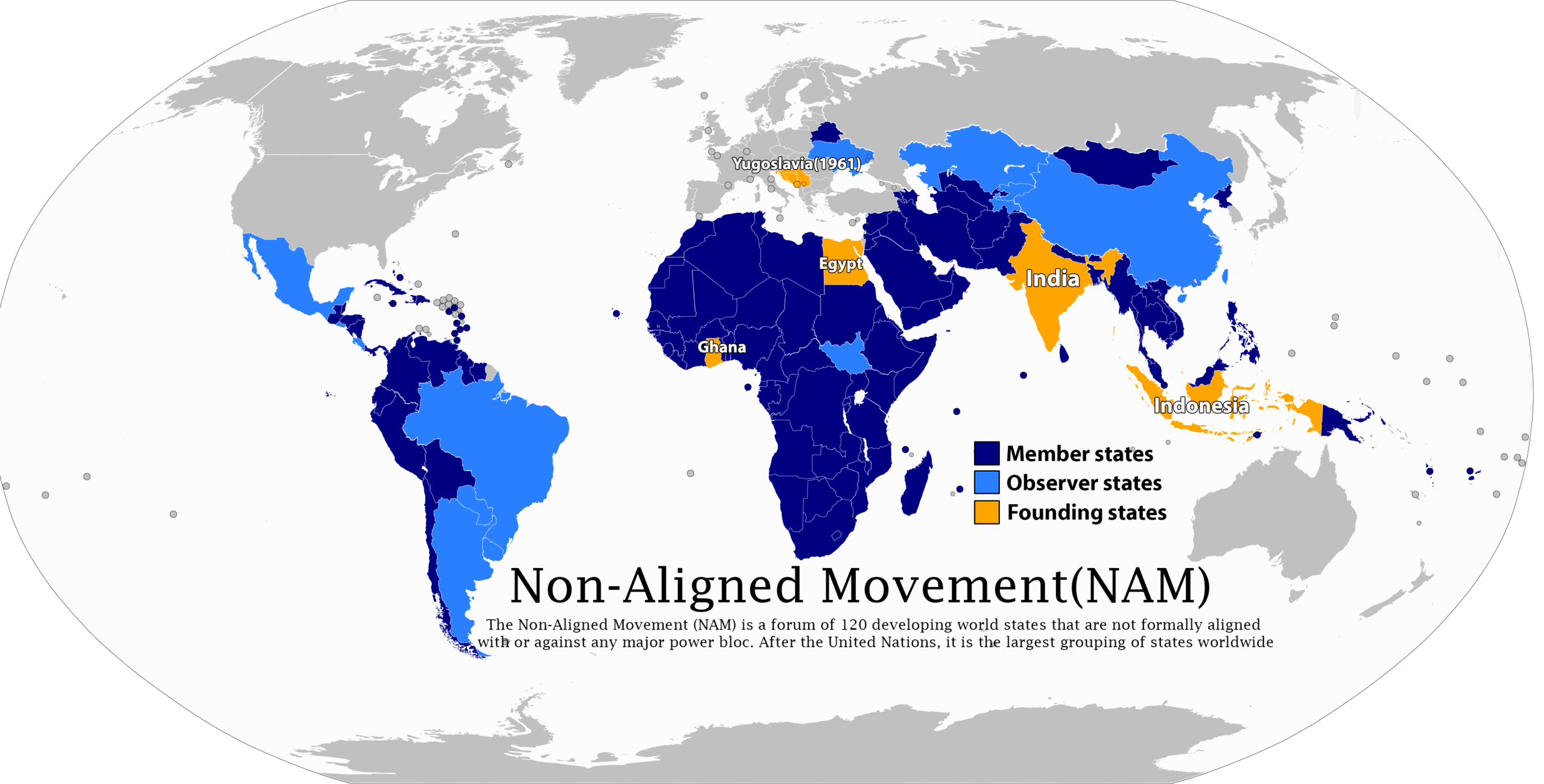
J. Natasha Gooneratne* August 10, 2023 This article explores the discourse of the Ukraine crisis from the perspective of the Non-Aligned Movement (NAM), recalling some of the movement’s focal pillars that find their roots in the cultural and historical makeup of its member states. It looks at recent efforts of NAM members within the context of peace talks and bilateral relations and further presents a reflection on why NAM members are better equipped to create progressive conditions within that space. Lastly, it explores why such efforts are often misconstrued by Western governments and media. A few weeks ago, 7 African leaders (heads of state of South Africa, Senegal, Zambia, Comoros and Egypt, alongside top officials from the Republic of Congo and Uganda) travelled to Russia and Ukraine, in what can thus far be described as the largest collective push toward brokering even a semblance of peace talks in over 16...
Symmetry_of_Diplomacy-1125x630-1
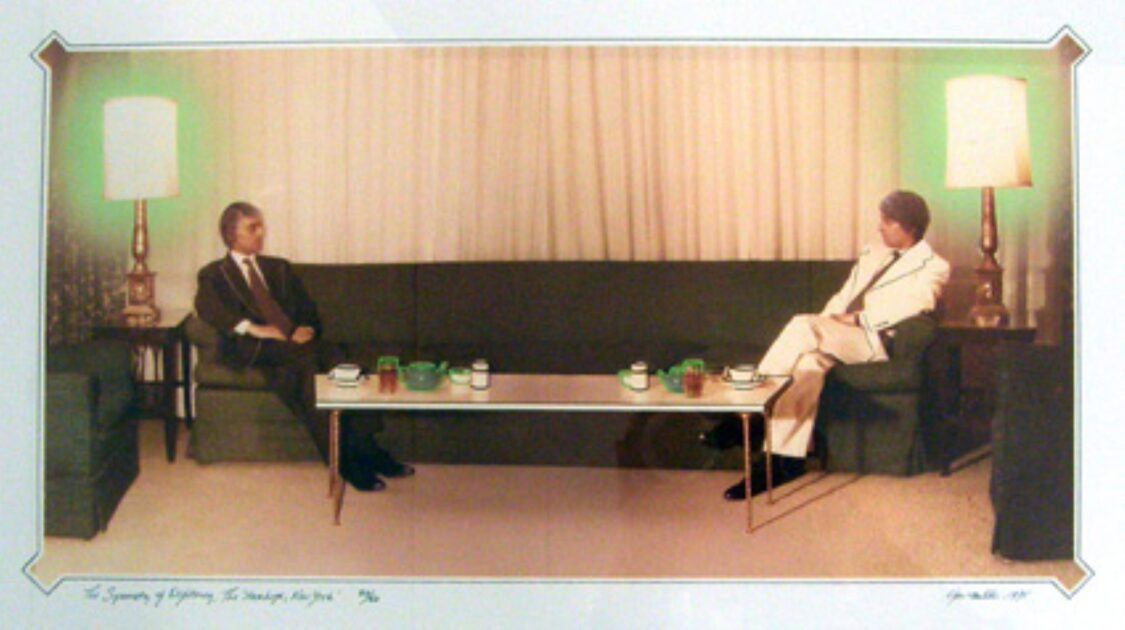
Ger van Elk, Symmetry of Diplomacy, 1975, Groninger Museum   Alfred de Zayas   July 31, 2023   The blaming game has always been counter-productive. In the UN Human Rights Council, the practice is known as “naming and shaming”, as if the States engaging in “naming” would possess a higher moral authority over those “named”, and as if the assignment of blame could possibly contribute to an atmosphere conducive to dialogue and compromise.   Originally published at CounterPunch on July 25, 2023   Those who assign the blame would do better to look for root causes and, in any event, do some sweeping at their doorsteps, as China has told the US on repeated occasions[1]. I recall once the Chinese Ambassador saying in jest that he would send a couple hundred mirrors to the White House. This also reflects an idiom attributed to Confucius (551-479 BC) that “all will follow...
cherry-laithang-NmPpz1jA_JE-unsplash
Photo by Cherry Laithang on Unsplash Maria Popova August 3, 2023 “This is an extraordinary time full of vital, transformative movements that could not be foreseen. It’s also a nightmarish time. Full engagement requires the ability to perceive both.” “There is no love of life without despair of life,” wrote Albert Camus — a man who in the midst of World War II, perhaps the darkest period in human history, saw grounds for luminous hope and issued a remarkable clarion call for humanity to rise to its highest potential on those grounds. It was his way of honoring the same duality that artist Maira Kalman would capture nearly a century later in her marvelous meditation on the pursuit of happiness, where she observed: “We hope. We despair. We hope. We despair. That is what governs us. We have a bipolar system.” In my own reflections on hope, cynicism, and the stories we tell ourselves, I’ve considered...
ChinaInvest-Peace-1
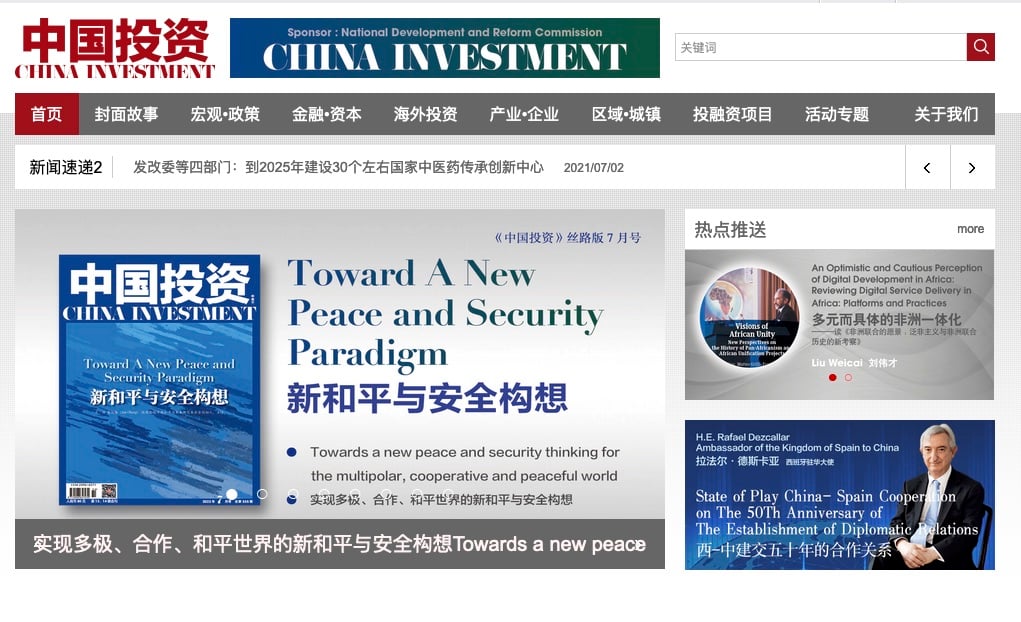
A major peace publishing event across cultures: The cover story of the esteemed “China Investment” Magazine’s July 2023 edition Jan Oberg July 23, 2023 Can you imagine a leading economics, finance and investment magazine in the Western world publishing a 30 A4-page (10 000 words) article about the future peace and security world order – a thinkpiece consisting merely of concepts, theories, visions and philosophical aspects of the theme? I can’t. They would not see it as meaningful to include perspectives on peace, nonviolence, security and related matters. But they’d probably gladly publish articles about military corporations, profits and the like. But in China, they see the value of such holistic thinking between interrelated dimensions of society – and of the world – as it really is. Economics is not only about economic things; it takes place in a framework that influences it – past, present and future. In contrast,...
adobestock-nuclear-explosion-2000x900-1
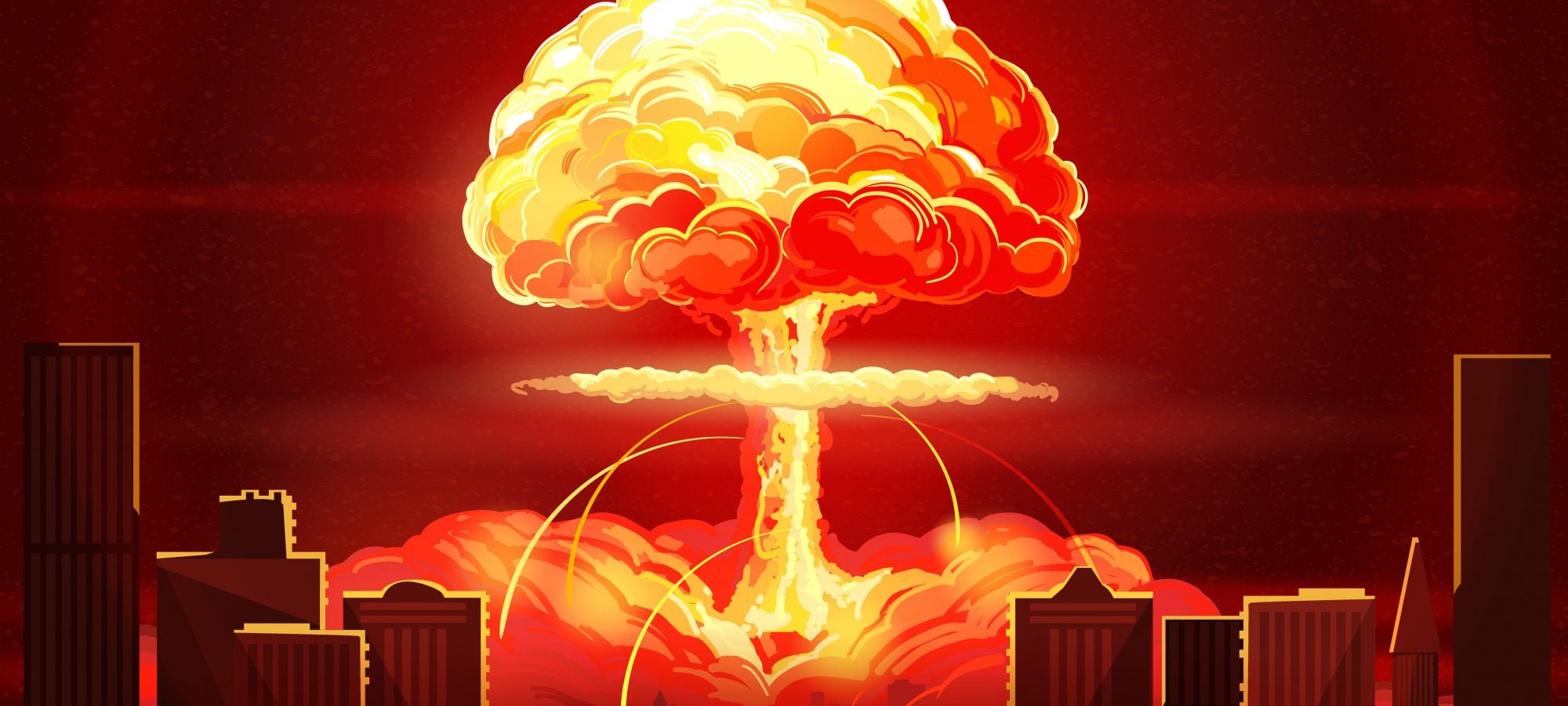
Edward Curtin July 19, 2023 Social psychosis is widespread. In the words of the British psychiatrist, RD Laing, “The condition of alienation, of being asleep, of being unconscious, of being out of one’s mind, is the condition of the normal man.” He was not referring to raving, drooling, hitting-your-head-against-the-wall lunacy but a taken-for-granted acceptance of a world long teetering on the edge of nuclear extinction, to take the most extreme example, but surely only one of many.  Originally published at Off Guardian on July 9, 2023 The insouciant acceptance and support of psychotic rulers who promote first-strike nuclear war is very common. First strike nuclear policy is United States policy. I recently wrote an article about the dangers of the fourteen US Trident submarines. These subs constantly cruise under the oceans carrying 3,360 nuclear warheads equivalent to 134,400 Hiroshima bombs. All are on first strike triggers. And of course these are supplemented by all the land...
Balls-on-ropes-in-the-colors-of-the-national-flags-of-the-United-States-and-China
Alex Lo & Daniel Bell June 24, 2023 “It’s quite clear from recent policies that the US aims to curb China’s economic development and encircle the country with military bases in unfriendly (from China’s viewpoint) countries. Such demonisation only reinforces repressive trends in China and benefits security-obsessed hardliners in China’s political system. That’s why “de-demonisation” can help those in China who favour a more open and humane social and political system. I have yet to meet a single academic, for example, who favours more rather than less censorship and “de-demonisation” can help to strengthen such forces”, says Daniel Bell in a recent interview with Alex Lo. Published at johnmenadue.com on May 11, 2023 On the Confucian Communist Comeback in Contemporary China Once denounced as a fossilised ideology holding back China’s development, an updated Confucianism may be a guide to its future, according to Daniel Bell of the University of Hong Kong in...
photo-1564648351416-3eec9f3e85de
Hein Berdinesen May 10, 2023 A fundamental thesis in Hans Jonas’ The Imperative of Responsibility – In Search of an Ethics for the Technological Age (1984) is that the golden promises of modern technology have turned into a threat, and that technology is inseparably linked with the threat. The thesis is a reminiscence of Heidegger’s diagnosis of the modern in «The Question Concerning Technology» (1977): The «Enframing» (Gestell) is a way to uncover the world where not only nature but also human beings are revealed as part of a «standing reserve» (Bestand). Through technique and technology, nature is just a raw material for manipulation. In this technological «Enframing» of the world, human beings sees everything as orderable, as part of a standing-reserve. Even man is seen as a part of a standing-reserve. This kind of uncovering the world is not in itself a threat amongst other threats, but the threat. In light of the...
quote-civilizations-i-believe-come-to-birth-and-proceed-to-grow-by-successfully-responding-arnold-j-toynbee-75-80-98
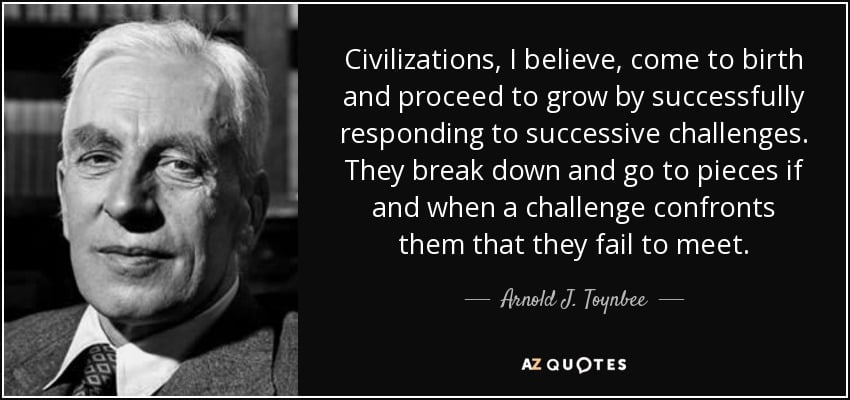
Christopher Quigley April 28, 2023 Very few people today know that between 1934 and 1961 the British historian Arnold Toynbee wrote A Study of History describing the rise and fall of the 23 civilizations he had identified in human history. In contrast to Oswald Spengler, who thought that the rise and fall of civilizations was inevitable, Toynbee maintained that the fate of civilizations is determined by their response to the challenges facing them. In fact the unifying theme throughout the book is challenge and response. One of the ground-breaking discoveries by Toynbee is the fact that there have been so many highly developed civilizations. Understandably in the West, our history lessons focus on our own civilization with its roots in Greek and Roman cultures, but in addition, there have been Chinese, Indian, Mayan, Islamic, Sumerian and Orthodox civilizations, to name but a few. According to Toynbee, civilizations start to decay...
Butten-Coll-5-BIG_2000x100dpi-kopia
© Oberg PhotoGraphics 2022 Hussein Askary April 27, 2023 American political scientist Francis Fukuyama declared in his “End of History and The Last Man,” published in 1992,that the collapse of the Soviet Union and the end of the Cold War era in 1991 marked “not just the passing of a particular period of post-war history, but the end of history as such: That is, the end-point of mankind’s ideological evolution and the universalization of Western liberal democracy as the final form of human government.” Originally posted on the Belt and Road Institute in Sweden’s website on March 23rd, 2023 A utopian, rosy picture of a world living a submissive, silent, and in Fukuyama’s word “boring” life under what turned out to be a sword of the Western liberal democratic military power. The fall of the Berlin Wall in November 1989 was followed by the U.S. invasion of Panama a month...
One-Belt-One-Road-map
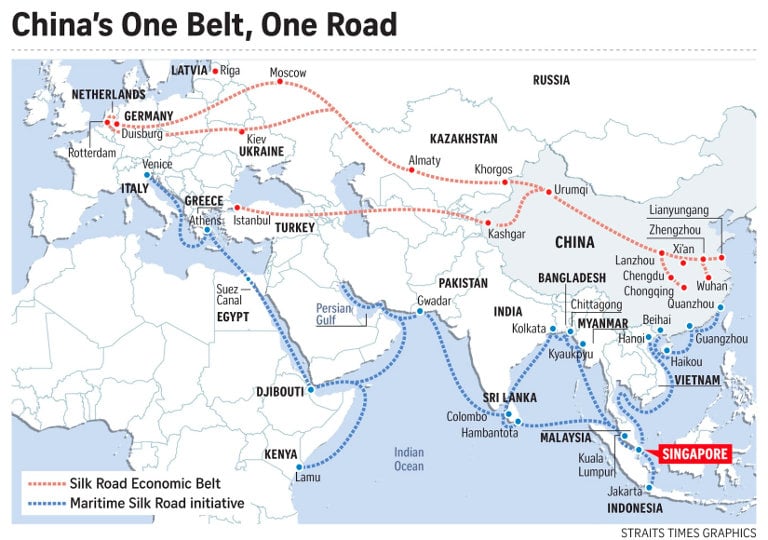
Erni & Ola Friholt TFF Associates March 23, 2023 In 1904, in the run-up to World War I, with the Triple Alliance on one side and the Entente on the other, the Principal of the London School of Economics, Halford Mackinder, gave a lecture to the Royal Geographical Society. The title was ‘The Geographical Axis of History’. Mackinder explained that world power could not, as in the past, be won by controlling the seas, which had been the main route for Portugal, Spain, Holland, France and Britain to their colonial empires, which had lasted some 400 years. Now, he argues, it is about controlling the interior of the Euro-Asian landmass, to which he also counted Africa. This huge land mass he called an island, the World Island. Its heartland lies in the plains and forests of Asia and is so vast that it could only be ruled from its peripheral...

Skaermbillede-2022-12-21-152701
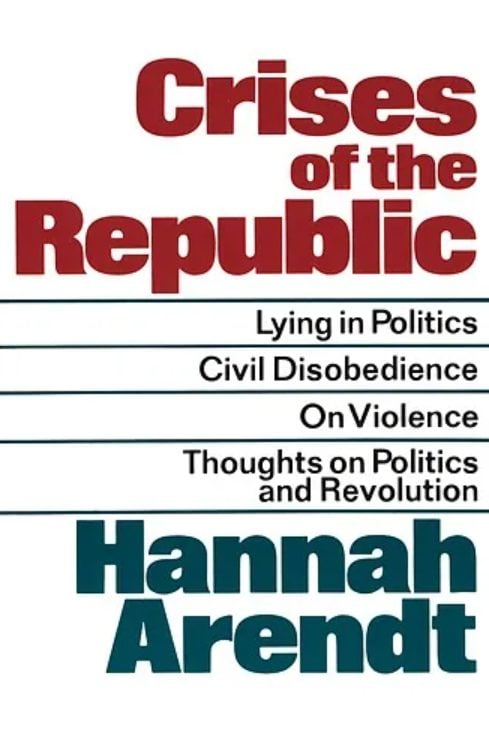
Maria Popova December 20, 2022 “No matter how large the tissue of falsehood that an experienced liar has to offer, it will never be large enough … to cover the immensity of actuality.” The possibilities that exist between two people, or among a group of people,” Adrienne Rich wrote in her beautiful 1975 speech on lying and what truth really means, “are a kind of alchemy. They are the most interesting thing in life. The liar is someone who keeps losing sight of these possibilities.” Nowhere is this liar’s loss of perspective more damaging to public life, human possibility, and our collective progress than in politics, where complex social, cultural, economic, and psychological forces conspire to make the assault on truth traumatic on a towering scale. Those forces are what Hannah Arendt (October 14, 1906–December 4, 1975), one of the most incisive thinkers of the past century, explores in a superb 1971 essay titled “Lying in...
Categories

Year

Author / Contributor

Region