
Neutrality or Non-Alignment? The purposefully forgotten but crucial difference.

J. Natasha Gooneratne*

August 10, 2023

This article explores the discourse of the Ukraine crisis from the perspective of the Non-Aligned Movement (NAM), recalling some of the movement’s focal pillars that find their roots in the cultural and historical makeup of its member states. It looks at recent efforts of NAM members within the context of peace talks and bilateral relations and further presents a reflection on why NAM members are better equipped to create progressive conditions within that space.

Lastly, it explores why such efforts are often misconstrued by Western governments and media.

A few weeks ago, 7 African leaders (heads of state of South Africa, Senegal, Zambia, Comoros and Egypt, alongside top officials from the Republic of Congo and Uganda) travelled to Russia and Ukraine, in what can thus far be described as the largest collective push toward brokering even a semblance of peace talks in over 16 months.

In a comparative perspective, the African peace mission is the opposite of NATO interactions.

Others have done their part, notably Türkiye, brokering the now defunct Black Sea Grain Export deal. This, while juggling tragic natural disasters, a US official’s distasteful hint at possible support toward regime change, a presidential election, its consequential run-off and a worsening economic situation. Although important to note that for now, Türkiye’s balanced stance within NATO appears void in light of investigative journalist Seymour Hersh’s revelation on negotiations between Ankara and Washington.

Other players still have contributed important trajectories in the domain of the last 16 months, that have perhaps re-shaped some of the more cliched POVs of world affairs. China, for instance, has emerged this year as a credible and serious mediator in conflict resolution, not only with Ukraine-Russia but with Iran and Saudi Arabia too. Even the most ascetic of its usual critics conceded to that point, with French President Macron noting that his Chinese counterpart had used ‘important words’ on the Ukraine crisis, and expressed his belief that China could play a major role in finding a path to peace.

This view stands in contrast to German Foreign Minister Annalena Baerbock’s perception of China’s stance, levelling directives that Beijing must take a clearer stance in the war and saying that “neutrality means taking the side of the aggressor, and that is why our guiding principle is to make it clear that we are on the side of the victim”.

In a similar vein, the NY Times reported that President Biden was seeking more allies against, what it called ‘increasingly aggressive governments’ in Moscow and Beijing. Indian Prime Minister Modi’s visit to the US was depicted in the international press as Washington’s ‘pomp-filled’ wooing and pageantry in the possible hopes that India would reconsider its non-aligned stance against Russia, and, perhaps more interestingly, against China. Liberal US media outlets, including the New York Times, are clearly unable to fathom why India, which it described as sharing certain enmity for China, would not subscribe fully to Washington’s strategy and perspective for dealing with the Chinese.

This assessment is important because, since World War II, it has often been the West’s rule, and not its exception, to reduce non-aligned policies of Global South states in their bilateral and multilateral relations with states that the West at varying times considers ‘the aggressors’.

This rule often permeates into diplomatic language, as has perhaps been the case with the United States’ rhetoric on the Indo-Pacific Strategy and more recently with the QUAD. Emphasis is often placed on ‘shared values’ between partners and allies, drawing invisible but palpable lines for non-partners. Lines that justify semantics like that of President Biden’s labelling of President Xi Jing Ping a ‘dictator’ recently, at the end of what had otherwise been seen as a promising visit of Secretary Blinken to China.

Despite the German Foreign Minister, Washington and a smattering of Western press – for Global South states, the familiar writing has always been on the wall: Pick a side – ours or the aggressor’s! It’s a passive-aggressive ultimatum that you’re either with us or against us.

And before we can even begin to deconstruct this coerced polarization of camps that has become part and parcel of the North’s relations with the South, it is perhaps more important to disentangle the purposeful and erred linguistic substitution of ‘neutrality’ with the accurate designation of ‘non-alignment’, and the differentiation of the two.

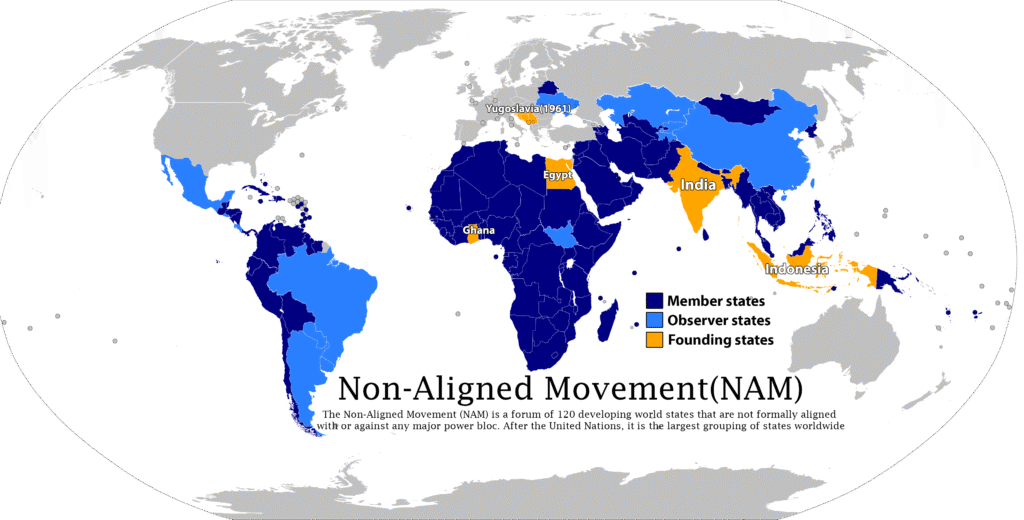
The Non-Aligned Movement (NAM), with its deep roots in the decolonization struggle, understood the implications of them-us narratives, and whose purpose they served. Most NAM member-states fell, of course, within the category of “them” during colonization (and some may argue,they still do).

For NAM members, however, it is the promotion of mutual interests and cooperation that takes precedence over side-picking. It’s friendly relations over cliquey differentiations, and mutual respect over the need to paint international-order positions and policies in easy black or white. For those who followed the struggle of the decolonization movement and founding of the NAM, the current context of world affairs within the discourse of Russia should come as no real surprise: all 7 peace-mission African states are members of the Non-Aligned Movement, as is India.

China, with its observer status within the NAM, has strong links with the movement, with the NAM’s founding pillars being almost identical to the 5 principles of peaceful coexistence (1954) contained in the Panchsheel, a codification of the Chinese government’s foreign relations principles also today.

Even Türkiye, with its historical reservations during the formation of the NAM, has expressed its solidarity with the movement’s work; Türkiye’s foreign minister in 2021 reiterated the validity of the NAM’s work in a multipolar world where he said that challenges were becoming more complex; his words were like a precursor to the reality awaiting the world in 2022 with both the Ukraine crisis and the global economic crisis that would follow.

Among the 10 Principles of the Bandung Founding Conference (1955) was the movement’s pacta sunt servanda pledge toward settlement of international disputes by peaceful means, in conformity with the UN Charter, a pledge that, as illustrated by the African peace mission or via India-China diplomatic relations, members inculcate.

The movement has consistently stressed that it aims to promote peaceful coexistence between nations, regardless of their political, social or economic systems. NAM members have special capacities precisely because of this enshrined principle of friendly relations with all states and not just with those that share similar values.

If third-world approaches to international law liken the West’s hegemony within the international system to an understanding of ‘the white man’s burden’, then the opposite can be true of what the NAM can accomplish. For if the former is based on a perceived moral obligation to civilize, then the states being looked at will always be seen as requiring civilizing; they are “aggressors” or “dictators” always ‘developing’ – yet never arriving to or meeting the invisible measure set for it by that hegemony.

Through the lens of the NAM, states are seen as equals, not greater or lesser, but burdened with their gaps and shortcomings within differing contexts. Contexts that can only be genuinely addressed and understood from within. This is possibly what makes NAM states the most suitable mediators for this present time, with an approach that could allow both Russia and Ukraine to be at the table without consideration of a conflict of interest, or hidden agendas.

Where neutrality takes a back seat and no side, non-alignment actively strives for friendly relations and peace.

During the Cold War, non-aligned policies succeeded in making the world a far less aggressive place than it potentially had the capacity to become, but that story often goes untold, in the face of a narrative of two superpowers with their finger on the MAD trigger.

Perhaps this time around, the viewpoints of the 7 African leaders, or perhaps even the nuances of China-India relations, may be given more amplification – in the media yes, but also in the understanding of the public, alongside the consideration of how multilateral forums such as the NAM differ radically in their diplomatic relations and perception of other nations from those of the Western world.

If a peace mission is genuinely what the international so-called community is seeking, instead of more destruction now and in the future, it is imperative to recognise the radical difference that mediators – in spite of their experience of being labelled, name-called and othered – can make. It’s therefore time to stop twisting their arms and enable their genuinely different but competent mediation as a road toward sustainable conflict resolution and peace.

About the Author

J. Natasha Gooneratne – holds a double Masters in International Law & Human Rights from the United Nations-mandated University for Peace in Costa Rica, and in Political Science with a major in Global Governance from Ateneo de Manila University in the Philippines.

She has worked as a specialist in public diplomacy for Sri Lanka and the US governments and has been responsible for creating initiatives toward building South-South cooperation between Global South states.

She is the Founder and convener of Perspective South an international platform for public accessibility to geopolitics, international law terminology, and perspectives of the Global South.

She works part-time as a post-grad lecturer in International Law.

In the past, she has operated as a fixer and researcher for the NY Times, Swedish Public Media (SVT) and the Finnish Broadcasting Company (YLE). She is currently based in Colombo.

More about Gooneratne and her work on Linkedin and Perspective South on Instagram.

Related Posts

Johan Galtung 1930-2024October 2015 Published here on October 3, 2026 Let us focus on Civilization for conflict analysis and remedies. Major forms of disorder use violence; war is state organized violence. The most belligerent states are the United States of America and Israel, both with civilization roots. National Evangelism, the US Protestant Christian civilization– more national than evangelical–justifies US warfare as exceptionalism of a people chosen by God, with a manifest destiny to run the world. Orthodox Judaism justifies Israeli warfare to conquer and expand from Nile to Euphrates as a religious right and duty to the Eternal One. The third most belligerent country, the UK, no longer believes it is God-chosen but chosen by the USA; not quite the same but something. But the root cause of global disorder lies in the Occident–with Islam–seeing itself as the single, universal civilization valid for all at all times, all others being...
Jan Oberg May 15, 2026 Go to this Fox News page and scroll the whole way down: President Donald Trump tells the world that his meeting with President Xi Jinping yielded a lot of very concrete political and economic results – of course, only where the Chinese side, according to him, agreed with him. He does not mention the Taiwan issue, but Secretary of State, Marco Rubio, says that it did not feature prominently in their talks and that the US policy on Taiwan has not changed. Then go to China Daily – or Global Times – and you will see that for the Chinese it is framework, principles, structure of cooperation etc. that matters – all embedded in the overall idea of “constructive bilateral relationship of strategic stability.” Nowhere is any concrete agreement or deal – all that Trump refers to – mentioned. At the general level, this gives you insights into the very different social...
Lena Petrova of “World Affairs In Context” with more than half a million subscribers on YouTube wanted to explore what a peace researcher like me has to say about, among other things, the First and the Second Cold War and why eethics has disappeared from politics. I am particularly happy about this conversation that also yielded an amazing number of very appreciative comments on YouTube. No doubt, people are longing for alternatives, including peace perspectives.

Recent Articles

Tony Robinson October 4, 2026 Violence is easy to recognise when someone is being beaten, shot or killed. It becomes more difficult when nobody is holding a weapon. Poverty, discrimination, exploitation and repression can restrict a human life just as effectively, although they do so in very different ways and with very different consequences. Simply adding more categories to an ever-growing list of forms of violence does not really solve the problem. The more interesting question is what all these different situations have in common and why it makes sense to describe them using the same word. Human beings do not simply react to what happens around them. They remember the past, imagine things that do not yet exist, make plans and undertake projects. Workers organise because they imagine different working conditions; people migrate because they imagine another life somewhere else; social movements emerge because people refuse to accept the...
It’s a matter of principles, courage, vision and pulling together – while the militarist world is falling apart… Peter Langille October 3, 2026 “Here, then, is the problem which we present to you, stark and dreadful and inescapable: Shall we put an end to the human race; or shall mankind renounce war?”The Bertrand Russell—Albert Einstein Manifesto, July 9, 1955 ⁕ The forecast for what’s ahead is worrisome. The sharp rise in armed conflicts over the past three years is adding to what was already the highest level in over seventy years. Genocides, which should be prevented are supported. A shared climate emergency that jeopardises survival is ignored. Diverse polls now suggest that people are war-weary, worried and interested in a more effective United Nations. And, there are viable policy options for a more secure world! Yet governments are doubling-down, betting on more war and investing heavily. If current trends persist,...
Johan Galtung 1930-2024October 2015 Published here on October 3, 2026 Let us focus on Civilization for conflict analysis and remedies. Major forms of disorder use violence; war is state organized violence. The most belligerent states are the United States of America and Israel, both with civilization roots. National Evangelism, the US Protestant Christian civilization– more national than evangelical–justifies US warfare as exceptionalism of a people chosen by God, with a manifest destiny to run the world. Orthodox Judaism justifies Israeli warfare to conquer and expand from Nile to Euphrates as a religious right and duty to the Eternal One. The third most belligerent country, the UK, no longer believes it is God-chosen but chosen by the USA; not quite the same but something. But the root cause of global disorder lies in the Occident–with Islam–seeing itself as the single, universal civilization valid for all at all times, all others being...

TFF on Substack

Discover and subscribe to more peace materials on TFF Substack

Most Popular

Tony Robinson October 4, 2026 Violence is easy to recognise when someone is being beaten, shot or killed. It becomes more difficult when nobody is holding a weapon. Poverty, discrimination, exploitation and repression can restrict a human life just as effectively, although they do so in very different ways and with very different consequences. Simply adding more categories to an ever-growing list of forms of violence does not really solve the problem. The more interesting question is what all these different situations have in common and why it makes sense to describe them using the same word. Human beings do not simply react to what happens around them. They remember the past, imagine things that do not yet exist, make plans and undertake projects. Workers organise because they imagine different working conditions; people migrate because they imagine another life somewhere else; social movements emerge because people refuse to accept the...
It’s a matter of principles, courage, vision and pulling together – while the militarist world is falling apart… Peter Langille October 3, 2026 “Here, then, is the problem which we present to you, stark and dreadful and inescapable: Shall we put an end to the human race; or shall mankind renounce war?”The Bertrand Russell—Albert Einstein Manifesto, July 9, 1955 ⁕ The forecast for what’s ahead is worrisome. The sharp rise in armed conflicts over the past three years is adding to what was already the highest level in over seventy years. Genocides, which should be prevented are supported. A shared climate emergency that jeopardises survival is ignored. Diverse polls now suggest that people are war-weary, worried and interested in a more effective United Nations. And, there are viable policy options for a more secure world! Yet governments are doubling-down, betting on more war and investing heavily. If current trends persist,...
Johan Galtung 1930-2024October 2015 Published here on October 3, 2026 Let us focus on Civilization for conflict analysis and remedies. Major forms of disorder use violence; war is state organized violence. The most belligerent states are the United States of America and Israel, both with civilization roots. National Evangelism, the US Protestant Christian civilization– more national than evangelical–justifies US warfare as exceptionalism of a people chosen by God, with a manifest destiny to run the world. Orthodox Judaism justifies Israeli warfare to conquer and expand from Nile to Euphrates as a religious right and duty to the Eternal One. The third most belligerent country, the UK, no longer believes it is God-chosen but chosen by the USA; not quite the same but something. But the root cause of global disorder lies in the Occident–with Islam–seeing itself as the single, universal civilization valid for all at all times, all others being...
Read More
Living-Peace-Sign-Budapest-copy
Tony Robinson October 4, 2026 Violence is easy to recognise when someone is being beaten, shot or killed. It becomes more difficult when nobody is holding a weapon. Poverty, discrimination, exploitation and repression can restrict a human life just as effectively, although they do so in very different ways and with very different consequences. Simply adding more categories to an ever-growing list of forms of violence does not really solve the problem. The more interesting question is what all these different situations have in common and why it makes sense to describe them using the same word. Human beings do not simply react to what happens around them. They remember the past, imagine things that do not yet exist, make plans and undertake projects. Workers organise because they imagine different working conditions; people migrate because they imagine another life somewhere else; social movements emerge because people refuse to accept the...
b54a1f10-8c65-4f0b-9dd5-4abc0a7d04cc_2659x2659
It’s a matter of principles, courage, vision and pulling together – while the militarist world is falling apart… Peter Langille October 3, 2026 “Here, then, is the problem which we present to you, stark and dreadful and inescapable: Shall we put an end to the human race; or shall mankind renounce war?”The Bertrand Russell—Albert Einstein Manifesto, July 9, 1955 ⁕ The forecast for what’s ahead is worrisome. The sharp rise in armed conflicts over the past three years is adding to what was already the highest level in over seventy years. Genocides, which should be prevented are supported. A shared climate emergency that jeopardises survival is ignored. Diverse polls now suggest that people are war-weary, worried and interested in a more effective United Nations. And, there are viable policy options for a more secure world! Yet governments are doubling-down, betting on more war and investing heavily. If current trends persist,...
010
Johan Galtung 1930-2024October 2015 Published here on October 3, 2026 Let us focus on Civilization for conflict analysis and remedies. Major forms of disorder use violence; war is state organized violence. The most belligerent states are the United States of America and Israel, both with civilization roots. National Evangelism, the US Protestant Christian civilization– more national than evangelical–justifies US warfare as exceptionalism of a people chosen by God, with a manifest destiny to run the world. Orthodox Judaism justifies Israeli warfare to conquer and expand from Nile to Euphrates as a religious right and duty to the Eternal One. The third most belligerent country, the UK, no longer believes it is God-chosen but chosen by the USA; not quite the same but something. But the root cause of global disorder lies in the Occident–with Islam–seeing itself as the single, universal civilization valid for all at all times, all others being...
Screenshot 2026-10-02 011738
Jan ObergPhD, director, The Transnational Foundation for Peace and Future Research, TFFLund, Sweden October 2, 2026 This is my full original manuscript. The Chinese Academy of Social Science, CASS, makes two publications out if it. 1. China’s Five-year plan emphasized the capabilities of basic research and original innovation. It is regarded as the goal of the future social development, which, as required, should be significantly enhanced. Can you comment on the importance of original innovation in research and academic study? I believe it is easier to define “original innovation” in the natural sciences than in social sciences. The breaking points of what constitutes something new, or innovative, are not quite as sharp in the latter. But in both fields it is about opening up something that was closed, unseen, unexplored before – making manifest what was earlier latent. Innovations come in many forms and shapes – naming something that was not...
arctic-circle-map
The agreement is catastrophic both because of what it says and what it doesn’t mention. It reduces further the major asset of security policies: Freedom of action. Jan Oberg TFF director September 25, 2026 A couple of hours before the agreement was signed on September 22, 2026, I published the following 13 hypotheses about what it would most likely contain on TFF Substack (in English). I was wrong on only the first point. Contrary to what Trump had written on his Truth Social platform, it does not appear to come into force immediately. In fact, it turned out to be worse than even I had anticipated. After these hypotheses now come a number of reflections in light of what the agreement actually contains, and does not contain, as well as the way in which it has generally been presented by major media outlets and by the public-service broadcaster DR. My...
girl-5894831_1280
Below are TFF-related media mentions, comments, videos and social media posts published elsewhere but not on this homepage. We happen to catch and list only a fraction. Regarding video comments and debates, we recommend that you go to the TFF Video Channel on Substack where many of them are reproduced. Jan Oberg is a contributor to China Daily – 52 million daily clicks – and Global Times, CGTN and CCTV (the national television), China Investment, Xinhua News Agency and several others. Articles and videos on these media very often multiply into countless Chinese (and Western media) that re-post them from these main media. Thanks to The China Academy, his analyses, interviews and comments are frequently posted on YouTube channels such as Thinkers Forum and Wave Media. These videos are often re-posted on Bilibili (China’s YouTube), the China Content Center on TikTok, and on the Chinese edition of TikTok, Douyin.com. This means reaching hundreds of millions of viewers worldwide over a year. While there are too many to catch on all these...




