
TFF Associates
March 23, 2023
In 1904, in the run-up to World War I, with the Triple Alliance on one side and the Entente on the other, the Principal of the London School of Economics, Halford Mackinder, gave a lecture to the Royal Geographical Society. The title was ‘The Geographical Axis of History’.
Mackinder explained that world power could not, as in the past, be won by controlling the seas, which had been the main route for Portugal, Spain, Holland, France and Britain to their colonial empires, which had lasted some 400 years. Now, he argues, it is about controlling the interior of the Euro-Asian landmass, to which he also counted Africa.
This huge land mass he called an island, the World Island. Its heartland lies in the plains and forests of Asia and is so vast that it could only be ruled from its peripheral lands in eastern Europe and the coastal regions of the surrounding seas.

Those who once ruled the heartland were the Mongols under Genghis Khan, who ruled the largest empire in history. This was established in the 13th century and reached Poland and Hungary before the Russians managed to drive them out. This was two hundred years before European expansion began from Portugal and Spain.
The European colonial powers had managed to control part of the southern coastal regions of the World Island via the Cape of Good Hope sea route and their superior ship-based guns. The Arctic Ocean was mostly closed. But colonial empires fell, and today, even more than in Mackinder’s time, the populous states of South and Southeast Asia are a barrier to outside control of the World Island.
Mackinder’s point is that he who masters the heartland masters the World Island. And who is there today? Russia, from the Gulf of Finland to the Bering Strait. Mackinder’s analysis argues that whoever controls the World Island controls the world. He saw an axis of power from the Persian Gulf across the steppes and forests of Russia. The rest of the world he described as distant small islands: Australia, Greenland and America. In that spirit, he drew a new world map, showing the Euro-Asian landmass in all its might and the smaller surrounding islands in all their marginal smallness.
Today, no one talks about Mackinder’s image of the world’s crucial land area, the basis of all power politics. But there is certainly a political awareness of it. The declining superpower, the United States, is certainly guided by such awareness. A map of the most important of America’s eight hundred or so foreign military bases shows that the periphery of the heartland is their primary target.
Russia, of course, is equally aware of this. In this context, it has a relatively small population with a huge area to guard and maintain.
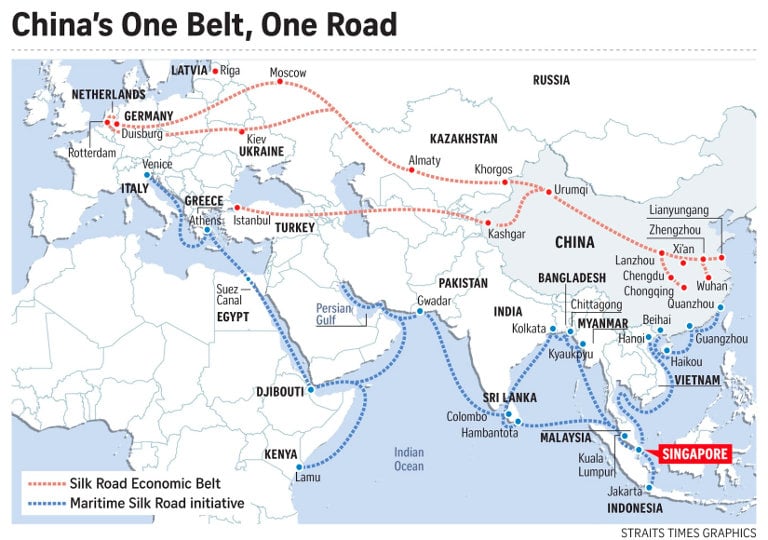
Mackinder argued that while the Suez Canal had greatly increased the importance of shipping over the formerly arduous and vulnerable land transport, railways and other overland communications could ‘work greater wonders on the steppe’. In 1904, he pointed to the importance of the Trans-Siberian Railway from Moscow to Vladivostok. In 2023, one hundred and nineteen years later, his prediction is coming true in a new configuration, namely in China’s massive investment in infrastructure and trade via the new Silk Roads – the Belt & Road Initiative, BRI – centred on the heartland, which is the world’s largest cooperative project, not the least with Russia and several peripheral states as far as southern Europe. And the Dollar and the Euro are no longer obvious means of payment in it.
Mackinder predicted that the enormous resources of the heartland would also allow the building of large navies and future economic world domination from the island’s heartland. This was opposed at the time by the maritime powers of Great Britain and Japan, which he saw as seeking to contain the World Island and prevent its political expansion. To the people of that time, the United States had not yet emerged as a world power with vast air and naval resources.
Mackinder declared: “My purpose is not to predict a brilliant future for this or that country, but to create a geographical formula to suit every political balance.” And here we are today, witnessing one crisis after the other, with the Western democracies’ constantly talking about the right of each state to choose its own defence model and alliance relations. However, it is nothing but a propagandistic semi-truthful formalisation of the underlying quest to gain control of the World Island through NATO’s expansion. It is now 30 members + 42 ”partners”).
The World Island contains most of all the desirable raw materials, organic and mineral. Oil, forest, metals and one-sixth of the world’s fresh water in Lake Baikal. And they ignore the fact that with everybody’s right to choose security arrangements comes the obligation not to increase their own security at the expense of another state.
The years 1989-92 saw the abolition of the Iron Curtain, the independence of the Eastern European states, the dissolution of the Warsaw Pact and the reunification of Germany, ending the GDR, German Democratic Republic. In the run-up to the dissolution of the Warsaw Pact, the Soviet leadership was deeply concerned that the NATO alliance would advance its positions to the Soviet Union’s western border and come so close to Moscow that early warning of possible missile attacks would be impossible.

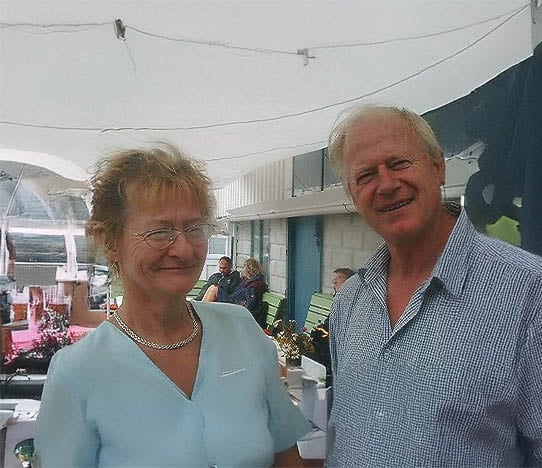
Erni & Ola Friholt in 2021
The Russians are acutely aware of past Western invasions, from the Russian campaigns of the Swedish Empire, Charles XII and Napoleon, to the 1917 revolution and Hitler’s invasion in World War II. The Soviet Union needed a buffer zone.
When Eastern Europe was liberated by Russian troops in 1945, Soviet leaders established the Western buffer zone that Russia had long sought. This was made permanent in 1955 with the creation of the Warsaw Pact, which was also a response to the creation of NATO by Western countries in 1949 and the ”No” from them to the Soviet Union’s wish to join NATO.
In all likelihood, the West believed that the war-torn and impoverished Soviet Union would have the resources to continue its westward march. The Cold War began with an arms race based on growing mutual suspicion.
According to the reasoning of the emerging peace movement at the time, this marked the worst possible development of international relations. Instead, they advocated close economic exchange and good people-to-people relations between East and West in order to build trust and interdependence.
This would also eliminate the habit of suspecting neighbouring states and engaging in arms races as a deterrent. Later, this was partly reflected in the Palme Commission’s proposal on common security: all sides in the conflict would be guaranteed security. Threats would be eliminated. Ultimately, the arms race would end.
Sadly, neither the views of the peace movement nor the Palme Commission’s proposals found a hearing in the West.
With the dissolution of the Warsaw Pact in 1991, the Soviet Union’s weakness was evident. Accelerating arms spending was devastating to the Soviet economy, and the West had a major advantage. In this situation, Soviet leader Gorbachev and US President George Bush the Elder met in Malta in December 1989. There, Bush assured Gorbachev that the US would not take advantage of the upheavals in the East.
On January 31, 1990, German Foreign Minister, Hans Dietrich Genscher , assured in Tutzing (Bavaria), that there would be no NATO expansion to the east beyond the GDR, which was about to be incorporated into (West) Germany. If the fourth victorious power of the Second World War, the Soviets, could be persuaded to say yes. So the promises to Gorbachev were repeated in several memoranda by Genscher, Helmut Kohl, James Baker, Robert Gates, Bush, France’s Francois Mitterrand, Margaret Thatcher, John Major, NATO’s then Secretary-General, Manfred Wörner, and others.
The promises were further repeated in 1990 by Genscher and Douglas Hurd on February 6 and by Kohl to Gorbachev on February 10. Then again, on May 18, by Baker to Gorbachev with the addition of 9 points regarding respect for Soviet security interests. They were further repeated on May 25 and 31. (Details of these promises can be found at many sites but the US National Security Archive at George Washington University is foremost among them).
On the latter date, Bush assured Gorbachev at a meeting in Washington that NATO would never target the Soviet Union. And so it continued six more times until July 1991, when Manfred Wörner assured that NATO was against any further expansion.

Development was rapid, and the Soviet Union dissolved in December 1991. The largest state by far, Russia, took over the Soviet legacy. Just a few years later, it was obvious that NATO’s promises were just empty words.
Today, NATO stands on Russia’s border in northern Norway, Estonia, Latvia and Lithuania and has arrived in Poland, the Czech Republic, Slovakia, Romania and Bulgaria, in addition to former NATO members Greece and Turkey. The advance into Georgia and Ukraine was, for a time, halted by Russia’s red line: “Here but no further”.
But NATO’s continued invitation to Ukraine referred to the right of any state to seek defence cooperation with anyone under the European legal order. But NATO, as mentioned, continues to deny the second leg of the security order: that no state has the right to develop its security at the expense of another state. And NATO denies the publicly documented promises of 1989-91 not to move NATO forces beyond the German border.
Russia’s legitimate concerns are ignored with the claim that Russia only wants to gain power over neighbouring states in a revanchist effort to re-establish the Soviet Union (despite the fact that Russia’s new leadership is rejecting socialism and developing a capitalist market economy).
Another reason for Russian concern is that, in 1999, NATO changed its objective from defending the territory of its member states to being able to intervene militarily throughout the world – ”out of area” operations which go far beyond its own treaty provisions. Subsequently, NATO states under various alliance designations bombed Serbia, Afghanistan, Iraq, Libya and Syria.
Let us now consider the new “Belt & Road Initiative” for interstate trade that China has undertaken over a ten-year period together with many countries, not the least Russia, adding up to a total of no less than 140 countries now connected by land and sea.
Of interest is the development of the new ‘Silk Roads’, roads and railways through the heartland of Asia from South East Asia to the Middle East and Southern Europe, involving 34 states in Europe and Central Asia, 17 in the Middle East and North Africa, 6 in South Asia, 25 in East Asia and the Pacific and a few in South America.
The 140 states cover about 63% of the world’s population and 40% of the world’s GDP.
The means of payment are, as mentioned, no longer necessarily Dollars and Euros. This development continues to the detriment of the old world rulers, Western Europe and the USA. Their great power interests and actions regarding the resources and positions of the heartland are very clearly focused on control of the peripheral states of Ukraine, Syria, Iraq, the rest of the Middle East, Iran, Pakistan, Afghanistan, South Korea, the South China Sea and Japan, with the support of Australia and New Zealand. Japan is in the process of abolishing its peaceful constitutional obligations.
And from February 24, 2022, Ukraine will be the scene of another act in this play. The stakes are high, but the degree of wisdom is not so.
The EU, the US and other NATO states developed increasingly tough sanctions against Russia’s intervention in the civil war that started in Ukraine in 2014. The intervention was initially to protect its embattled Russian minority, which among other things, opposed the country’s integration into NATO. The intention of the NATO states is considered by insiders to expand the war with military help to put Russia in crisis and, according to the Pentagon-affiliated Rand Corporation, to divide the country into half a dozen smaller states.
It is trumpeted that the entire “international community” has joined the sanctions. But the former colonies and other states that have learned that democracies are mostly concerned with war and economic and cultural domination have not joined at all. This means that tacit support for two of the world’s major powers, Russia and China, is given by 2/3 of the world’s population.
But in the Swedish media, only the hateful NATO version of the implied ongoing tug-of-war for the resources of the World Island is reported. The war in Ukraine is as terrible as the other ongoing wars. We are in the middle of a risky great power adventure. The social ideals and processes of consensus and equal cooperation advocated by non-violence and pacifism are being dismissed out of hand. NATO chief Jens Stoltenberg declares: “Weapons are in fact the way to peace.”
But the World Island remains where it is. War has taken a new direction, and great powers are destroying Ukraine – or destroying us all.
It is interesting to see that the new Silk Roads, the Belt & Road Initiative, aims at economic and cultural cooperation but not at cultural and economic domination by the largest states. It is explicitly about multicultural coexistence.
The opposite has so far been the case with the Western colonial powers, which, through a Western-educated ruling class in the former colonies, have created a Western mindset that leads to the acceptance of a Western development model.
The deepening indebtedness contributes strongly to the compulsion to accept Western ideology. The neo-liberal market should rule. Its outcome is inequality and conflict. And its centre of power is the West.
But for how much longer?
About Erni & Ola Friholt
Erni and Ola Friholt are world citizens on the small island of Orust, northwest of Gothenburg, Sweden. They are both in their mid-80es and have devoted their lives to teaching and research in numerous fields such as peace, nonviolence, India’s development, Gandhian thinking, world order change, the environment, gender issues and the struggle against nuclear weapons as well as against Sweden becoming a member of NATO.
They have pioneered the most innovative peace movement in the Nordic countries – The Orust Peace Movement – since 1983, i.e. 40 years this year. For years, they also operated a famous peace café during the summer months there at the coast, which is where the video below starts out.
They have also initiated the ‘real’ peace prize in contrast to that of the Nobel Committee in Oslo, called “The People’s Peace Prize in Accordance with Alfred Nobel’s Will,” written a series of books and pamphlets and have served as editors at “Haga Book Publishers,” a leading publishing house on peace and global affairs operating well into the 1990s.
Here is the first of two one-hour portrait videos – all in Swedish – about the Friholt couple, who have also been Associates of TFF since it was established in 1986.






3 Responses
It is a great experience to get acquainted with Erni & Ole Friholt. Their rationale and historic insight is clear and multifaceted. Yet another time this calls for the intelligent perception that resources, economy and geopolitics are at the heart of the matter. They shall be at the root of how we analyze and understand our world and where it is heading. Without that understanding, we will blindly and powerlessly be navigating dangerous waters. Thank you!
To be blindly navigating dangerous waters, is to the peril of all of us common men, while we are being robbed of Humanity, our most important possession.
One more comment, or actually more of a request. Towards the end of part 1, Jan asks Erni and Ola a question about the development in Sweden during the last decade or so. Why has not only the Government but also most Swedes’ view on peace, military conflict, neutrality changed so much. What happened. I don’t think Erni and Ola really told us what their take is on that exact question. In my view this discussion is actually very important, so it might give Jan and/or Erni and Ola as Swedish occasion to get back to us, your audience, in writing or yet another lovely interview. Would be appreciated very much, at least by me.