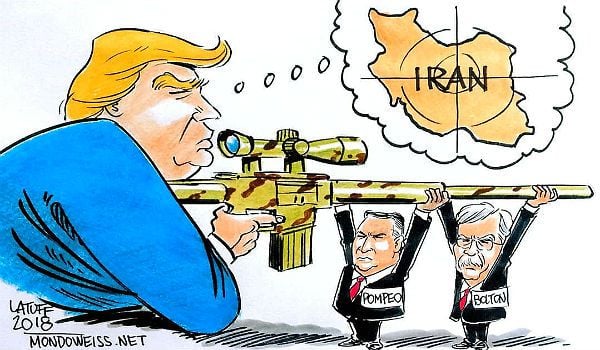
In his State of Union, President Trump focused his comments about the Middle East on Iran, the fight against the Islamic State (ISIS or IS), and the U.S. troop withdrawal from Syria. Despite his negative rhetoric about Iran, Trump did identify some potential common ground with the government in Tehran.
The challenge for the next two years is to focus on that common ground, avoid a war between the United States and Iran, and prepare for an eventual U.S. return to the nuclear agreement with Tehran.
While Iraqi President Barham Salih hailed Iran for supporting the Iraqi nation in the fight against IS, Donald Trump singled out Iran as the world’s leading state sponsor of terror.
Moreover the Iraqi president rejected a plan floated by President Trump that calls for keeping U.S. forces in Iraq to “watch” neighboring Iran, saying that the United States should not burden Iraq with its own “policy priorities.” He reiterated that Iraq and Iran play an important role in upholding peace and stability in the region.
Israeli Prime Minister Benjamin Netanyahu spoke with Trump once and Pompeo twice before Trump’s December 19 announcement of a U.S. troop withdrawal from Syria. Netanyahu lobbied very hard to keep America’s military presence in Syria to support an Israeli campaign of airstrikes aimed at threatening war with Iran.
“We struck thousands of targets (in Syria) without claiming responsibility,”said Gadi Eisenkot, chief of staff of the Israel Defense Forces about Israel’s undeclared military campaign against Iran. The deputy commander of the Islamic Revolution Guards Corps (IRGC), Hossein Salami, declared that Israel will be eliminated and the entire occupied Palestinian territories will be retaken if it embarks on a new war. “The U.S. aircraft carriers would be destroyed, its air bases in the region burned, and the skies set ablaze…we have built our strength for the purpose of long, extended wars”, he said.
According to a Brown University study, U.S. wars in Afghanistan, Iraq, Yemen, Syria, and Libya have cost the U.S. $8 trillion. In addition, 480,000 people have died due to direct war violence, 244,000 civilians were killed in direct violence by other parties, and many times more have died indirectly. Over 6,950 U.S. soldiers have died and at least 7,800 US contractors killed. Last but not least, 21 million people became refugees or were displaced within their own countries.
In the State of Union, President Trump criticized long drawn-out wars. “As a candidate for president, I pledged a new approach. Great nations do not fight endless wars,” he said.
Trump’s strategy is to avoid entering new wars coupled with a gradual withdrawal of U.S. forces from the Middle East. This strategy is on par with what Hillary Clinton envisioned in her 2011 Foreign Policy article, where she proposed refocusing on East Asian powers critical to U.S. national interests.
America seems to realized that the current crises in the Middle East cannot be resolved any time soon, instability and terrorism will engulf the region for the years to come, and substantial financial resources, perhaps in the trillions of dollars, are required for long-term peace, stability, and reconstruction of the region.
Meanwhile, Iran since the Islamic Revolution of 1979 has always emphasized the need for U.S. troops to withdraw from the region. In this sense, Iran and the United States now share common views despite different interests.
Nevertheless, this is only feasible through a safe and gradual withdrawal that could take some years to accomplish. Furthermore, it is in the interests of not only Iran and the United States, but also the entire region and the world, that a U.S. withdrawal from the region not lead to further instability and chaos in the region.
This commonality, which is also pivotal to international peace and security, has the potential to break the deadlock in the recurring confrontation between Iran and the United States. In 2001, under General Suleimani’s leadership, Iranian Quds Force played a decisive role defeating the Taliban and al-Qaeda in the war in Afghanistan.
“His shrewd pragmatism has transformed the unit into a major influencer in intelligence, financial, and political spheres beyond Iran’s borders,” said Gen. Stanley McChrystal, former chief of the U.S. Joint Special Operations Command. Today, Tehran can facilitate a face-saving, safe, and reliable exit of U.S. forces from the region. Such cooperation would deescalate tensions between the two countries’ security and military forces, eliminating the possibility of another unnecessary military conflict in the region and setting the stage for a U.S. return to the nuclear deal.
Bring in the United Nations
However, concerns may remain about Iran’s regional influence. Therefore, it would be more prudent if the UN secretary general oversees the vacuum left behind. Moreover, UN Security Council resolution 598 (from 1987) requests the secretary general to examine, in consultation with Iran and Iraq and other Arab States in the Persian Gulf, measures to enhance the security and stability of the region.
Based on this resolution, the UNSC can take practical steps to create a regional security and cooperation system in the Persian Gulf where Iran, Saudi Arabia, Iraq, and five other states around the Persian Gulf would take collective responsibility in the absence of U.S. forces, transforming current regional rivalries into partnerships.
Fortunately, a majority of Congress, U.S. public opinion, and even Trump himself are against a potential war with Iran. In Iran also, the majority of people and Iranian officials are againstany military conflict.
Nevertheless, there are influential players in key decision-making positions who view America’s current domestic turmoil as an opportunity to drag the United States into a war with Iran, and to dismember the country. Some of the heads of states of America’s regional allies, too, are working hard to realize this scenario before Trump leaves office.
The U.S. withdrawal from the Iran nuclear deal, a critical international agreement achieved only after directionnegotiations between Washington and Tehran, has eliminatedany chances of resolving other outstanding issues.
Despite fundamental disagreements, Iran and the United States also have some mutual interests. The art of diplomacy is to find a way to set the stage for a dignified U.S. return to the nuclear deal by paving the way for the U.S.-Iranian cooperation on mutual interests.
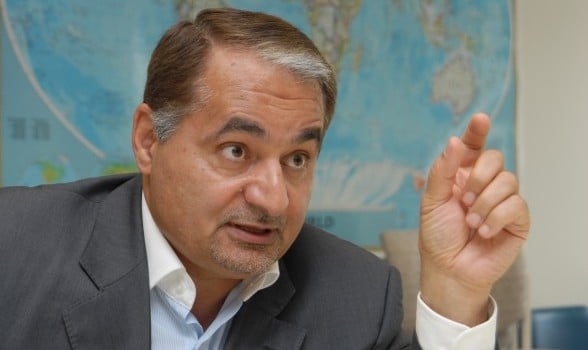
Seyed Hossein Mousavian is
Middle East Security and Nuclear Policy Specialist at Princeton
University and a former Iranian diplomat. His latest book, Iran and the
United States: An Insider’s view on the Failed Past and the Road to
Peace, was released in May 2014.
A friendly quarrel while we agree that the US sanctions are a weapon of mass destruction and kill more people than wars do. And that we must talk much more about sanctions than we have so far. Jan Oberg, TFF director March 16, 2026 John Mearsheimer recently stated that U.S. sanctions murdered around 38 million people between 1971 and 2021 – see the video below. It is a dramatic figure, and it has spread quickly because it captures, in one sentence, the enormous human cost of modern sanctions. I share his concern about the destructive effects of economic coercion. But the specific number he cites — and the way he attributes it — deserves a friendly academic clarification. The figure comes from a 2023 Lancet Global Health article estimating the mortality effects of unilateral U.S. and EU sanctions over the past half‑century. This is the first point where Mearsheimer’s shorthand diverges from the text: the study...
This is not another geopolitical commentary on the Arctic. It is a visionary peace proposal that can save the region from militarised rivalry and ecological ruin. A blueprint for shared security, sustainable development, and human dignity — benefitting Greenland, the Arctic, and the rest of us. Jan Oberg TFF director Lund, Sweden, February 17, 2026 I. Four Principles for a New Arctic Vision The Arctic is often framed as a cold arena of rivalry — a place where great powers test each other’s resolve. But this worldview is outdated, unimaginative, and ultimately self‑defeating. The Arctic is not a vacuum waiting to be militarised; it is a living region, a climate stabiliser, and a cultural homeland whose future will shape the future of humanity. If we begin from that understanding, a far more rational Arctic order becomes possible — one that is peaceful, cooperative, and centred on the people who actually live there. This vision rests...
PART 2 — Diplomacy, Law and Nonviolent Power By Jan ObergTFF co-founder and director January 26, 2026 This is the second of four TFF-created idea portfolios designed to curb the global reach of the United States and, in both the short and long term, help catalyse a worldwide nonviolent resistance to what many observers describe as the Trump administration’s uniquely confrontational, destructive and world-threatening policies. These portfolios outline what governments and citizens across the world can do through dynamic diplomacy, creative initiatives, and strictly nonviolent means. They are typical TFF works in that we do not only tell what the problem is and how bad it will go – as 90+% of all commentators, experts and scholars do – we tell what we think can be done, inviting you to think of what you think you can do. It seems painfully clear to me that the current political dynamics in Washington increasingly resemble the most dangerous...
Photo above: Carl Fredrik Reuterswärd’s Non-Violence outside UN Headquarters in New York. Kirill Levin, CC BY-NC-SA 2. Jan Oberg November 3, 2026 I am happy to be published in Horizons which is produced by the Center for International Relations and Sustainable Development, CIRSD, in Belgrade. My contribution brings out a radical re-thinking of what concepts such as defence, security, deterrence – and peace – may mean if we want to create a more peaceful world. It also summarises a few things I have been working with the last few decades. Please read it here Og her er den på dansk, takket være Johnny Baltzersens lynhurtige oversættelse
UNITE-tillid, DREAM-velstand og andre konstruktive komponenter Normally we publish articles in English here. But this is a translation of a very important TFF document that should reach as many as possible in Denmark since this country’s government has been one of the most hardline in Europe and, up till now at least, has refused to use diplomacy and, instead, spent tremendous sums on arming Ukraine with the express goal of defeating Russia. Thus this – unique – article is in Danish. Vi er Johnny Baltzersen og hans Fælles Sikkerhed – Fælles Fremtid på Substack overmåde taknemmelige for at have oversat og publiceret TFF’s 2025-portfølje for fredsidéer med henblik på Ukraines fremtid. Vi håber den nu kan nå mange flere danskere – som også vil sprede den og skabe debat – nu den danske regerings og folketingspartiernes politik på dette område siden 2022 står nu – forudsigeligt – ved vejs ende....
Jan Oberg TFF director October 28, 2026 Exactly one month has now passed since I published my criticism of the introduction to the special issue on Johan Galtung published by the Journal of Global Security Studies, JoGSS, and of Tor Egil Førland’s chapter about Galtung which serves as a preview to his forthcoming biography of Galtung to be published by PRIO. See the original on The Transnational here and the same article on TFF Substack with many general and critical comments and, in particular, the people who decided to withdraw from the biography project in protest. The special issue itself was extraordinary. It was devoted to the intellectual legacy of one of the founders of peace research and contained a number of strong assessments of his personality, scholarship, intellectual trajectory, and public role. Such assessments are, of course, entirely legitimate. No scholar is beyond criticism, and neither was Johan Galtung....
TFF on Substack
Discover and subscribe to more peace materials on TFF Substack
Photo above: Carl Fredrik Reuterswärd’s Non-Violence outside UN Headquarters in New York. Kirill Levin, CC BY-NC-SA 2. Jan Oberg November 3, 2026 I am happy to be published in Horizons which is produced by the Center for International Relations and Sustainable Development, CIRSD, in Belgrade. My contribution brings out a radical re-thinking of what concepts such as defence, security, deterrence – and peace – may mean if we want to create a more peaceful world. It also summarises a few things I have been working with the last few decades. Please read it here Og her er den på dansk, takket være Johnny Baltzersens lynhurtige oversættelse
UNITE-tillid, DREAM-velstand og andre konstruktive komponenter Normally we publish articles in English here. But this is a translation of a very important TFF document that should reach as many as possible in Denmark since this country’s government has been one of the most hardline in Europe and, up till now at least, has refused to use diplomacy and, instead, spent tremendous sums on arming Ukraine with the express goal of defeating Russia. Thus this – unique – article is in Danish. Vi er Johnny Baltzersen og hans Fælles Sikkerhed – Fælles Fremtid på Substack overmåde taknemmelige for at have oversat og publiceret TFF’s 2025-portfølje for fredsidéer med henblik på Ukraines fremtid. Vi håber den nu kan nå mange flere danskere – som også vil sprede den og skabe debat – nu den danske regerings og folketingspartiernes politik på dette område siden 2022 står nu – forudsigeligt – ved vejs ende....
Jan Oberg TFF director October 28, 2026 Exactly one month has now passed since I published my criticism of the introduction to the special issue on Johan Galtung published by the Journal of Global Security Studies, JoGSS, and of Tor Egil Førland’s chapter about Galtung which serves as a preview to his forthcoming biography of Galtung to be published by PRIO. See the original on The Transnational here and the same article on TFF Substack with many general and critical comments and, in particular, the people who decided to withdraw from the biography project in protest. The special issue itself was extraordinary. It was devoted to the intellectual legacy of one of the founders of peace research and contained a number of strong assessments of his personality, scholarship, intellectual trajectory, and public role. Such assessments are, of course, entirely legitimate. No scholar is beyond criticism, and neither was Johan Galtung....
An aspect of Iran’s culture and civilisation you’ve probably never heard about. Don’t be surprised if the US and Israel also try to bomb them. Jan ObergTFF director October 26, 2026 Today – under the “USraeli” threat of new “annihilating” bombings – opens the 7th International Conference on Peace and Conflict Resolution at Tehran’s University. As far as I can tell, this is the only permanent, advanced peace research institution in West Asia/the Middle East. Perhaps more countries in that region could be inspired? I mean, how many military “security” institutes and military academies do they have? Many peace research institutes and university departments have been established since the 1950s in the West. They are now all under attack; some have closed down, some have gone mainstream, yet others kept the name but do nothing to research peace and disseminate results or advice; instead, they cooperate with militarism’s platforms such...
Let’s discuss using AI to create peace – in contrast to boring geopolitics devoid of creative healing and visions. Jan Oberg TFF director October 15, 2026 I asked VEED to create a short video exemplifying how peace is preferable to war, then chose the lady as a template. Simple as that. In less than a minute, it produced this video, which any peace-loving person would appreciate. The only problem is that human intelligence (HI), at least the one that exists among Western decision-makers, isn’t half as moral or smart as AI. I have used AI to dialogue about peace and peace plans, creative conflict resolution and visions of a better future for humankind. It so happens that I am having more stimulating, intelligent, creative and moral discussions with AI than I could possibly have with any EU or NATO leader today. Yes, AI has very problematic and dangerous aspects; used...
Below are TFF-related media mentions, comments, videos and social media posts published elsewhere but not on this homepage. We happen to catch and list only a fraction. Regarding video comments and debates, we recommend that you go to the TFF Video Channel on Substack where many of them are reproduced. Jan Oberg is a contributor to China Daily – 52 million daily clicks – and Global Times, CGTN and CCTV (the national television), China Investment, Xinhua News Agency and several others. Articles and videos on these media very often multiply into countless Chinese (and Western media) that re-post them from these main media. Thanks to The China Academy, his analyses, interviews and comments are frequently posted on YouTube channels such as Thinkers Forum and Wave Media. These videos are often re-posted on Bilibili (China’s YouTube), the China Content Center on TikTok, and on the Chinese edition of TikTok, Douyin.com. This means reaching hundreds of millions of viewers worldwide over a year. While there are too many to catch on all these...