“The untiring insistence upon freedom and truth, the community of the worker and the intellectual (who are still stupidly warring here, as tyranny aims to keep them doing), and, finally, political democracy as a necessary and indispensable (though surely not sufficient) condition of economic democracy – that is what Budapest was defending.”
Albert Camus
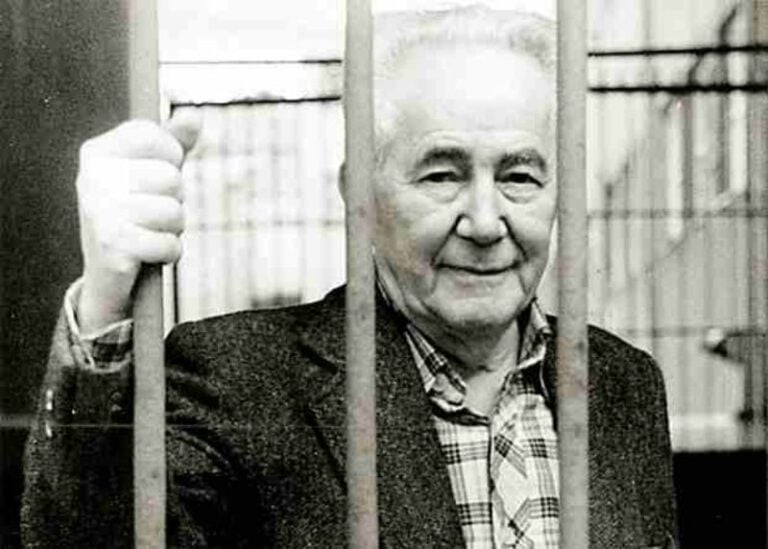
November 19, 2026, marks the 70th anniversary of the arrest of Milovan Djilas (1911-1995, see photo above), one of – if not the – most consequential and historically significant dissidents of Eastern Europe – manifesting his civil courage way before Václav Havel, Adam Michnik, Aleksandr Solzhenitsyn, Andrei Sakharov, and Lech Wałęsa.
Djilas had been a leading Yugoslav Partisan and communist revolutionary, one of Tito’s closest political associates, a senior member of the Yugoslav Communist Party leadership, and Vice-President of Yugoslavia. He was a prolific writer of politics, philsophy and history and a poet who spent years in prison because of his convictions.
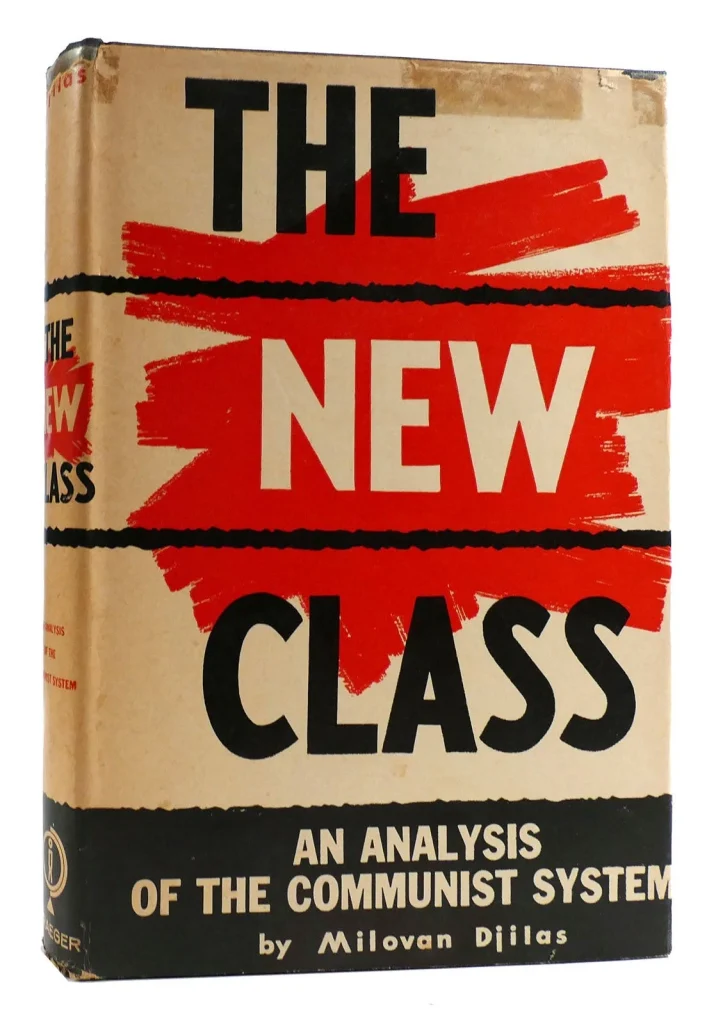
He was the author of the milestone book, “The New Class” (1957) – see about that below. He argued that communist revolutions had not abolished class society but created a new privileged ruling class: the party bureaucracy.
In the early 1990s, I had the honour and joy to of having two long conversations with him in his apartment in Belgrade mentioned below. Among many other things, he told me that Lenin and Gandhi were his main inspirations, and he also said with a smile about the partisan struggle that, “had we known that what we did was impossible, we would never have succeeded.”
We both laughed at this succinct formulation and agreed that that also applied to the struggle for peace today.
And thus, Milovan’s pioneering dissidentship turns 70. Find below the account of his arrest by his son – and my dear friend – Aleksa Djilas. Despite the rampant militarism and deep racism in today’s Europe, dissidents sadly remain few and far between. But I can feel them waiting in the wings.
I recommend that you begin familiarising yourself with the remarkable life of Milovan Djilas and his unique role in Yugoslav and European history on Wikipedia (so much better than Britannica’s entry on him) and then proceed to read his classical books. But first, his son’s personal history.
Jan Oberg
TFF director
◙
Published in Serbian in NIN, Belgrade, 12 November 2026 under the title “Why Tito Feared the Hungarian Revolution.”
Aleksa Đilas *

On Monday, 19 November 1956, the State Security and the police sealed off part of Palmotićeva Street around number 8, where I lived with my father, Milovan Đilas, my mother, Štefanija, and my grandmother, Vasilija. I was three and a half years old. Only after this “securing of the area” did the UDBA officers come to our flat to arrest Đido (Milovan).
He was charged over a statement to Agence France-Presse (AFP) in which he criticised the Yugoslav government’s position on the Soviet military intervention in Hungary – among other things, our representative at the United Nations (UN) had abstained from voting. In an article entitled “Storm in Eastern Europe”, published in The New Leader, Đido had also supported the uprising and concluded that the wound the Hungarian Revolution had inflicted on communism would never fully heal. That New York journal of politics and culture brought together leading figures of the international democratic left.
Đido accused Tito’s regime of abandoning, through its tacit acceptance of the Soviet invasion, the principles that every nation has the right to pursue its own independent development and that interference in the internal affairs of other countries is impermissible. Yet it was precisely on these principles that Yugoslavia had based and built its successful resistance to Stalin. Power in Yugoslavia, Đido concluded, lay with a bureaucratic class whose chief concern was to protect its own interests and which was the principal obstacle to the development of democracy.
In the demands of the Hungarian insurgents, Đido recognised, in a more developed and more combative form, precisely what he himself advocated. They called for the release of political prisoners and the disbanding of the secret police, freedom of the press and free elections. Of particular importance was the fact that, alongside economic reform and the introduction of professional management, they also demanded workers’ councils. At the same time, they rejected free-market capitalism and opposed the return of factories to their former owners and land to the great landowners.
What distinguished Đido’s trial was that both the prosecution and the defence relied on the same body of evidence – his writings and published articles. What one side saw as hostile propaganda harmful to the country, the other regarded as justified criticism that would benefit it. Throughout the proceedings, the two sides were sharply critical of each other and entirely uncompromising. Veljko Kovačević, for example, the most active and eloquent of Đido’s three lawyers, emphasised Đido’s patriotic effort to persuade our government to remain true to its own foreign-policy principles and act in accordance with international law.
Veljko had been a socialist before the war and was a committed democrat. He summed up his lengthy defence speech, and the essence of the entire trial, in these words:
“For, comrade judges, no one who loves this country and its people, no reasonable person, can wish for a return to the past. But we must find a way to add political freedom to the achievements of the revolution, which we all accept, precisely because only in that way can those achievements be most securely preserved.”
Throughout his defence, Veljko stood firmly by Đido, supporting both his ideas and him as a person. One might say that he courageously placed himself in the dock beside his client. This was the second of Đido’s four trials under Tito’s regime. As all of them were closed to the public – in other words, held in secret – and the press carried only brief official statements, none of the courageous and lucid defence speeches made by Đido and his lawyers reached the public. It is worth adding that, at the time, neither the defendant nor his counsel was even allowed to attend a hearing before the panel of the appellate court. Most importantly, not one defence argument or appeal resulted in an acquittal.
At this trial, “over Hungary”, Đido would receive a three-year prison sentence under a strict regime and spend a total of 22 months in solitary confinement. Although much has been written about these proceedings, both at home and abroad, the arrest itself attracted little particular interest. Đido and Štefica would only occasionally recall some interesting details, and that was all. Yet as time passed and new facts came to light, I became convinced that the manner and course of the arrest were only the tip of the iceberg.
The police search of our flat was thorough and painstaking. In his memoir Rise and Fall, Đido records that they found a small pair of scissors that had gone missing and several pistol cartridges. I got hold of one of the cartridges and tried to put it into my cowboy Colt, a plastic children’s toy, presumably to drive the policemen away. I can still picture that failed attempt, though I am not sure whether it is truly my own memory or an image formed while listening to my parents’ stories.
As the policemen rummaged through our belongings, my grandmother Vaja raised her hands above her head, clasped them together and began breathing slowly and deeply. Who knows where she had learnt this way of calming herself, or from what distant times and far-off lands it had come. The UDBA officers were Montenegrins, and they seemed uneasy about arresting Đido. One said that “Mother” was unwell and should be brought a glass of water. Vaja replied: “Never mind, never mind. This isn’t the first time the gendarmes have come to my house!” She was referring to the searches and arrests of her sons and daughters in the pre-war kingdom because of their revolutionary activities. Many years later, we heard that her remark had deeply stung the UDBA officer, who had been a Partisan during the war and saw himself as a fighter against dangerous enemies of the revolution.
Đido had come into conflict with his comrades in the leadership of the League of Communists of Yugoslavia chiefly over a series of theoretical and political articles in Borba. He criticised the Party bureaucracy for its privileges and excessive power and advocated, among other things, freedom of thought and democratic dialogue in society. He won considerable public support, especially among intellectuals and young people.
In January 1954, at a plenum of the Central Committee, Đido was removed from all his leadership positions, chiefly at Tito’s instigation. The Yugoslav leaders suspected that some organised group within the Party, perhaps even outside it, lay behind Đido’s public interventions. Ranković, who oversaw the security services, assured them that there was neither a faction nor a conspiracy – Đido had acted alone. Soon after the plenum, Tito began telling foreign diplomats and journalists that Đido was politically dead. Ranković, for his part, explained that Đido represented no one. And so it seemed. Until the Hungarian Revolution broke out in October 1956.
Tito and the leadership were worried that a similar uprising might take place in Yugoslavia. For even when they declared Đido politically insignificant, they often fiercely attacked democratic and reformist currents both within and outside the Party. They even issued open threats. So, in the autumn of 1956, it seemed to them that dramatic events might bring Đido onto the Yugoslav political stage. If heresy had risen from the dead, was this not an opportunity for the chief heretic?
During their painstaking search of our flat, the UDBA officers also found a copy of the manuscript of The New Class, but had no idea what sort of work it was. This study, in which Đido analyses the communist system and ideology, would be published in the United States the very next year, soon translated into more than forty languages and printed in a total of over three million copies.
Failing to seize The New Class when they had the chance was an enormous professional embarrassment for experienced UDBA operatives. The oversight is understandable to some extent if one assumes that they were not looking for Đido’s theoretical reflections at all, but for his concrete plans for political action – above all, the names of associates and lists of potential members.
In reality, Đido could count on the help of only a handful of close friends if he found himself in any kind of trouble. The heavy police presence in our street therefore made sense only if Tito and the leadership believed that, on hearing of Đido’s arrest, huge numbers of citizens would come out to protest and obstruct his being taken away.
And why, for that matter, such lengthy and thorough isolation in prison – to the point where even the guards were strictly forbidden to speak to Đido? He interpreted almost two years in solitary confinement as pressure to renounce his ideas. True enough, without a doubt. But was the regime not also determined, at any cost, to prevent him from communicating with those who shared his views beyond the prison walls?
Finally, and by no means least, the sentence itself was exceptionally harsh – three years in prison for a short interview and a single article. This can be understood, though not justified, only if one assumes that the regime feared Đido’s words might become the trigger for an uprising, the spark of a revolution.
Aleksa Đilas was born in Belgrade in 1953. He studied philosophy in Belgrade, Vienna and Graz, earned a master’s degree in political science and sociology from Birkbeck College, University of London, and a PhD in sociology from the London School of Economics and Political Science. Together with Vane Ivanović, he edited two collections: Democratic Reforms (London, 1982) and A Collection of Essays on Human Rights (London, 1983). He is the author of The Contested Country: Yugoslavism and Revolution, published by Književne novine in Belgrade in 1990. The book was subsequently published in the United States by Harvard University Press in 1991, with a paperback edition appearing in 1995. As a result of his writings, the books he edited, and his support for dissidents and political prisoners in Yugoslavia, he was unable to return to the country between 1980 and 1990. He was granted political asylum in the United Kingdom. He has published more than 100 articles and essays on Yugoslav politics, history and culture in Yugoslav, European and American newspapers and journals. He has lectured at dozens of universities across Europe and the United States. From 1986 to 1992, he co-edited the German quarterly Kontinent (East-West Forum) with Cornelia Gerstenmaier, focusing on the politics and culture of Eastern Europe. He was a visiting research fellow at the University of Cologne in 1984–1985, a research fellow at Harvard University from 1987 to 1993, and a visiting fellow at the Woodrow Wilson International Center for Scholars in Washington, D.C., in autumn 2000. In addition to his scholarly work, he writes prose and poetry. His story-essay Exile and Return was published by Nova in Belgrade in 1995. He also edited and wrote the forewords to two volumes by Milovan Đilas: Letters from Prison (Vukotić Media, Belgrade, 2016) and Disintegration and War: Diary, 1989–1995 (Vukotić Media, Belgrade, 2022).