
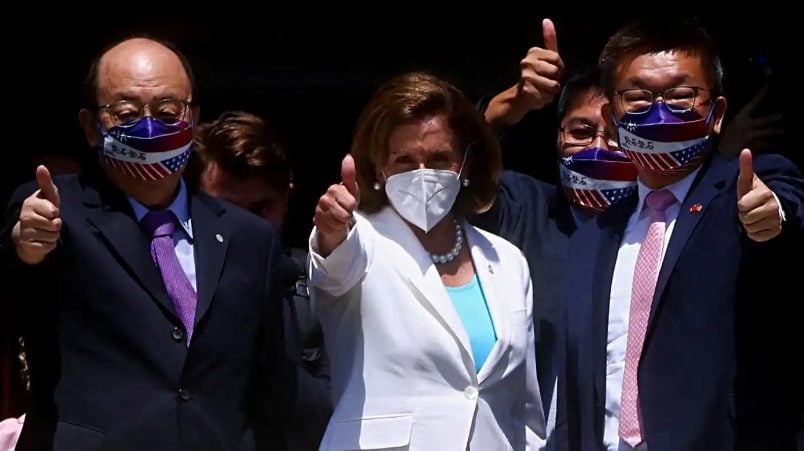
Nancy Pelosi, then U.S. House speaker, center, gestures as she leaves parliament in Taipei on Aug. 3, 2022. © Reuters

Kishore Mahbubani

June 8, 2023

Outspoken Western leaders are putting region’s peace at risk

A war over Taiwan would be disastrous for Asia. By contrast, it would have only a marginal impact on Europe.

The total population of the 53 countries that make up the U.N.’s Asia and the Pacific Group comes to about 4.5 billion. By contrast, the total population of the 27 countries that make up the European Union comes to around 446 million, less than 10% as much.

So whose voices are making the most noise about Taiwan?

Originally published at NIKKEI ASIA on May 12, 2023

Asian leaders have generally had little to say about Taiwan, notwithstanding some recent statements made jointly with their U.S. counterparts.

European leaders have been much more outspoken about the island. European Commission President Ursula Von der Leyen recently commented, “We stand strongly against any unilateral change in the status quo, in particular by the use of force.” German Foreign Minister Annalena Baerbock meanwhile declared, “A military escalation in the Taiwan Strait … would be a horror scenario for the entire world.”

French President Emmanuel Macron tried to balance such provocative statements by stating the obvious: “The question we need to answer as Europeans is … is it in our interest to accelerate [a crisis] on Taiwan? No. The worst thing would be to think that we Europeans must become followers on this topic and take our cue from the U.S. agenda and a Chinese overreaction.” But he then was predictably crucified by other Western leaders and media.

Why have Asians been comparatively quiet? The simple answer is that Asians understand that Taiwan is a dangerous and complex issue. They are also aware that the status quo has kept the peace for the decades since then-U.S. National Security adviser Henry Kissinger’s pathbreaking visit to Beijing in 1971. Asians know that it is not wise to rock the status quo.

So who is trying to change the status quo? European politicians suggest that China is trying to do so, but they are being intellectually dishonest. They lack the courage to say openly that it is reckless American politicians like former House Speaker Nancy Pelosi who are trying to do so.

Mike Pompeo, another former U.S. policymaker who may be preparing to run for president, has been particularly inflammatory, saying in Taipei, “The United States government should immediately take necessary and long overdue steps to do the right and obvious thing: that is, to offer the Republic of China (Taiwan) America’s diplomatic recognition as a free and sovereign country.”

This is extremely dangerous talk. Any seasoned observer of the Taiwan issue knows that if the island declares independence, China will declare war. There are no ifs or buts here.

Since Taiwan remains the last living symbol of China’s “century of humiliation” between 1842 and 1949, no leader in Beijing can allow the independence of Taiwan or they would be crucified by the Chinese people.

This is why it is wise to let sleeping dogs lie on the Taiwan issue. To be fair, the administration of U.S. President Joe Biden has tried to do this. I heard both Vice President Kamala Harris and Secretary of Defense Lloyd Austin say in Singapore last year that Washington remains “firmly committed to our long-standing ‘One China’ policy.”

Under the policy, “The United States acknowledges that all Chinese on either side of the Taiwan Strait maintain there is but one China and that Taiwan is a part of China. The United States government does not challenge that position. It reaffirms its interest in a peaceful settlement of the Taiwan question by the Chinese themselves.”

A Beijing newspaper reports on the Chinese military operation launched after Nancy Pelosi’s 2022 visit to Taiwan: China’s move reminded islanders of a point they clearly know.    © Reuters

Fortunately, the Taiwanese people are aware that it would be sheer folly for the island to declare independence. According to a survey conducted by National Chengchi University in Taipei last year, only 4.6% of the public supports independence “as soon as possible,” while 28% favors maintaining the status quo “indefinitely.”

While President Tsai Ing-wen and some of her predecessors may have flirted with the idea of independence, they knew that the Taiwanese people were not ready for it. This explains why Tsai decided to meet U.S. House Speaker Kevin McCarthy in California last month rather than on Taiwanese soil. The massive military operation that China launched after Pelosi’s visit to Taiwan last August had a salutary effect, reminding islanders of a point they clearly know: War will come if they declare independence.

Many Western politicians claim to be speaking out in support of the Taiwanese. To justify her visit, Pelosi expressed “solidarity” with the 23 million people of Taiwan.

But such friends are putting the Taiwanese people in danger and risk inadvertently upsetting the status quo and starting a war. If war starts, the Taiwanese people will have to fight on their own, just as the Ukrainian people are doing. Just as no NATO soldiers are coming to the rescue of Ukraine, none will come to the rescue of the Taiwanese.

All this explains the relative silence of Asian policymakers on the Taiwan issue. The best thing for the Taiwanese people and for the rest of Asia is to preserve the status quo.

In this status quo, the government in Taipei does not claim to represent an independent state of Taiwan. Instead, it claims to represent the Republic of China.

This is a fiction, but one that is necessary to preserve the notion that both mainland China and Taiwan are part of one country. In this regard, it is good that 13 countries continue to recognize the Republic of China. Paradoxically, it is in China’s national interest for this recognition to continue.

Since the quiet status quo has preserved peace across the Taiwan Strait for over 50 years, we Asians should unite and send any visiting European policymaker a simple message: By doing nothing, we have preserved peace in Asia. Why don’t you stay home and fix Ukraine?

With our careful silence, we have preserved the status quo. Please do not disrupt our silence with your loud, interfering voice.

Originally published at NIKKEI ASIA on May 12, 2023

About the author
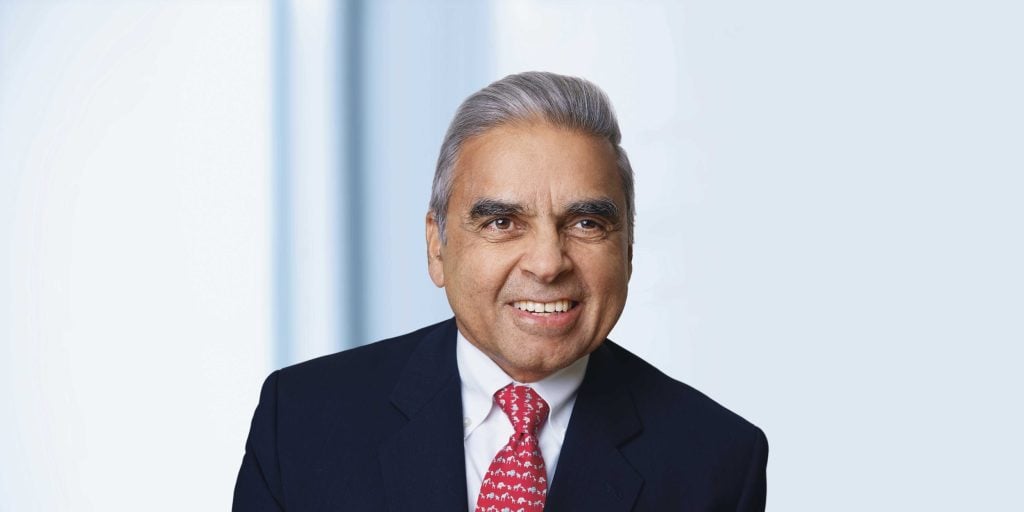
Kishore Mahbubani is Distinguished Fellow at the Asia Research Institute of the National University of Singapore and author of “The Asian 21st Century” and “Has China Won?: The Chinese Challenge to American Primacy.” He previously served as Singapore’s ambassador to the United Nations.


Please help TFF remain truly independent if you liked this article

Click here now!

Related Posts

PART 2 — Diplomacy, Law and Nonviolent Power By Jan ObergTFF co-founder and director January 26, 2026 This is the second of four TFF-created idea portfolios designed to curb the global reach of the United States and, in both the short and long term, help catalyse a worldwide nonviolent resistance to what many observers describe as the Trump administration’s uniquely confrontational, destructive and world-threatening policies. These portfolios outline what governments and citizens across the world can do through dynamic diplomacy, creative initiatives, and strictly nonviolent means. They are typical TFF works in that we do not only tell what the problem is and how bad it will go – as 90+% of all commentators, experts and scholars do – we tell what we think can be done, inviting you to think of what you think you can do. It seems painfully clear to me that the current political dynamics in Washington increasingly resemble the most dangerous...
PART 1 — Media, Culture and Information Sovereignty By Jan ObergTFF co-founder and director January 20, 2026 This is the first of four TFF-created idea portfolios designed to curb the global reach of the United States and, in both the short and long term, help catalyse a worldwide nonviolent resistance to what many observers describe as the Trump administration’s uniquely confrontational, destructive and world-threatening policies. These portfolios outline what governments and citizens across the world can do through dynamic diplomacy, creative initiatives, and strictly nonviolent means. They are typical TFF works in that we do not only tell what the problem is and how bad it will go – as 90+% of all commentators, experts and scholars do – we tell what we think can be done, inviting you to think of what you think you can do. It seems painfully clear to me that the current political dynamics in Washington increasingly resemble the most...
Introduction to TFF’s forthcoming four Idea Portfolios of Diplomatic and Nonviolent Resistance By TFF’s Board & FoundersPascal Lottaz, Biljana Vankovska, Annette Schiffmann, Christina Spannar & Jan Oberg January 19, 2026 “America, you are too arrogant.” — Martin Luther King Jr. Over the course of Trump’s first term and now a year into his second, the world has witnessed a consistent pattern of actions that challenge the basic long-standing norms of international cooperation, weaken multilateral institutions, and ignore the global norms and legal frameworks established by the UN Charter. During these years, we have witnessed military operations in Iran, Syria and Ukraine without UN authorisation; the killing of Iranian General Qassem Soleimani; repeated strikes across the Middle East; and the launch of tariff wars against allies and competitors alike. We have seen a renewed emphasis on nuclearism and zero interest in arms control and disarmament negotiations. Pentagon is now The Department...

Recent Articles

Tony Robinson October 4, 2026 Violence is easy to recognise when someone is being beaten, shot or killed. It becomes more difficult when nobody is holding a weapon. Poverty, discrimination, exploitation and repression can restrict a human life just as effectively, although they do so in very different ways and with very different consequences. Simply adding more categories to an ever-growing list of forms of violence does not really solve the problem. The more interesting question is what all these different situations have in common and why it makes sense to describe them using the same word. Human beings do not simply react to what happens around them. They remember the past, imagine things that do not yet exist, make plans and undertake projects. Workers organise because they imagine different working conditions; people migrate because they imagine another life somewhere else; social movements emerge because people refuse to accept the...
It’s a matter of principles, courage, vision and pulling together – while the militarist world is falling apart… Peter Langille October 3, 2026 “Here, then, is the problem which we present to you, stark and dreadful and inescapable: Shall we put an end to the human race; or shall mankind renounce war?”The Bertrand Russell—Albert Einstein Manifesto, July 9, 1955 ⁕ The forecast for what’s ahead is worrisome. The sharp rise in armed conflicts over the past three years is adding to what was already the highest level in over seventy years. Genocides, which should be prevented are supported. A shared climate emergency that jeopardises survival is ignored. Diverse polls now suggest that people are war-weary, worried and interested in a more effective United Nations. And, there are viable policy options for a more secure world! Yet governments are doubling-down, betting on more war and investing heavily. If current trends persist,...
Johan Galtung 1930-2024October 2015 Published here on October 3, 2026 Let us focus on Civilization for conflict analysis and remedies. Major forms of disorder use violence; war is state organized violence. The most belligerent states are the United States of America and Israel, both with civilization roots. National Evangelism, the US Protestant Christian civilization– more national than evangelical–justifies US warfare as exceptionalism of a people chosen by God, with a manifest destiny to run the world. Orthodox Judaism justifies Israeli warfare to conquer and expand from Nile to Euphrates as a religious right and duty to the Eternal One. The third most belligerent country, the UK, no longer believes it is God-chosen but chosen by the USA; not quite the same but something. But the root cause of global disorder lies in the Occident–with Islam–seeing itself as the single, universal civilization valid for all at all times, all others being...

TFF on Substack

Discover and subscribe to more peace materials on TFF Substack

Most Popular

Tony Robinson October 4, 2026 Violence is easy to recognise when someone is being beaten, shot or killed. It becomes more difficult when nobody is holding a weapon. Poverty, discrimination, exploitation and repression can restrict a human life just as effectively, although they do so in very different ways and with very different consequences. Simply adding more categories to an ever-growing list of forms of violence does not really solve the problem. The more interesting question is what all these different situations have in common and why it makes sense to describe them using the same word. Human beings do not simply react to what happens around them. They remember the past, imagine things that do not yet exist, make plans and undertake projects. Workers organise because they imagine different working conditions; people migrate because they imagine another life somewhere else; social movements emerge because people refuse to accept the...
It’s a matter of principles, courage, vision and pulling together – while the militarist world is falling apart… Peter Langille October 3, 2026 “Here, then, is the problem which we present to you, stark and dreadful and inescapable: Shall we put an end to the human race; or shall mankind renounce war?”The Bertrand Russell—Albert Einstein Manifesto, July 9, 1955 ⁕ The forecast for what’s ahead is worrisome. The sharp rise in armed conflicts over the past three years is adding to what was already the highest level in over seventy years. Genocides, which should be prevented are supported. A shared climate emergency that jeopardises survival is ignored. Diverse polls now suggest that people are war-weary, worried and interested in a more effective United Nations. And, there are viable policy options for a more secure world! Yet governments are doubling-down, betting on more war and investing heavily. If current trends persist,...
Johan Galtung 1930-2024October 2015 Published here on October 3, 2026 Let us focus on Civilization for conflict analysis and remedies. Major forms of disorder use violence; war is state organized violence. The most belligerent states are the United States of America and Israel, both with civilization roots. National Evangelism, the US Protestant Christian civilization– more national than evangelical–justifies US warfare as exceptionalism of a people chosen by God, with a manifest destiny to run the world. Orthodox Judaism justifies Israeli warfare to conquer and expand from Nile to Euphrates as a religious right and duty to the Eternal One. The third most belligerent country, the UK, no longer believes it is God-chosen but chosen by the USA; not quite the same but something. But the root cause of global disorder lies in the Occident–with Islam–seeing itself as the single, universal civilization valid for all at all times, all others being...
Read More
Living-Peace-Sign-Budapest-copy
Tony Robinson October 4, 2026 Violence is easy to recognise when someone is being beaten, shot or killed. It becomes more difficult when nobody is holding a weapon. Poverty, discrimination, exploitation and repression can restrict a human life just as effectively, although they do so in very different ways and with very different consequences. Simply adding more categories to an ever-growing list of forms of violence does not really solve the problem. The more interesting question is what all these different situations have in common and why it makes sense to describe them using the same word. Human beings do not simply react to what happens around them. They remember the past, imagine things that do not yet exist, make plans and undertake projects. Workers organise because they imagine different working conditions; people migrate because they imagine another life somewhere else; social movements emerge because people refuse to accept the...
b54a1f10-8c65-4f0b-9dd5-4abc0a7d04cc_2659x2659
It’s a matter of principles, courage, vision and pulling together – while the militarist world is falling apart… Peter Langille October 3, 2026 “Here, then, is the problem which we present to you, stark and dreadful and inescapable: Shall we put an end to the human race; or shall mankind renounce war?”The Bertrand Russell—Albert Einstein Manifesto, July 9, 1955 ⁕ The forecast for what’s ahead is worrisome. The sharp rise in armed conflicts over the past three years is adding to what was already the highest level in over seventy years. Genocides, which should be prevented are supported. A shared climate emergency that jeopardises survival is ignored. Diverse polls now suggest that people are war-weary, worried and interested in a more effective United Nations. And, there are viable policy options for a more secure world! Yet governments are doubling-down, betting on more war and investing heavily. If current trends persist,...
010
Johan Galtung 1930-2024October 2015 Published here on October 3, 2026 Let us focus on Civilization for conflict analysis and remedies. Major forms of disorder use violence; war is state organized violence. The most belligerent states are the United States of America and Israel, both with civilization roots. National Evangelism, the US Protestant Christian civilization– more national than evangelical–justifies US warfare as exceptionalism of a people chosen by God, with a manifest destiny to run the world. Orthodox Judaism justifies Israeli warfare to conquer and expand from Nile to Euphrates as a religious right and duty to the Eternal One. The third most belligerent country, the UK, no longer believes it is God-chosen but chosen by the USA; not quite the same but something. But the root cause of global disorder lies in the Occident–with Islam–seeing itself as the single, universal civilization valid for all at all times, all others being...
Screenshot 2026-10-02 011738
Jan ObergPhD, director, The Transnational Foundation for Peace and Future Research, TFFLund, Sweden October 2, 2026 This is my full original manuscript. The Chinese Academy of Social Science, CASS, makes two publications out if it. 1. China’s Five-year plan emphasized the capabilities of basic research and original innovation. It is regarded as the goal of the future social development, which, as required, should be significantly enhanced. Can you comment on the importance of original innovation in research and academic study? I believe it is easier to define “original innovation” in the natural sciences than in social sciences. The breaking points of what constitutes something new, or innovative, are not quite as sharp in the latter. But in both fields it is about opening up something that was closed, unseen, unexplored before – making manifest what was earlier latent. Innovations come in many forms and shapes – naming something that was not...
arctic-circle-map
The agreement is catastrophic both because of what it says and what it doesn’t mention. It reduces further the major asset of security policies: Freedom of action. Jan Oberg TFF director September 25, 2026 A couple of hours before the agreement was signed on September 22, 2026, I published the following 13 hypotheses about what it would most likely contain on TFF Substack (in English). I was wrong on only the first point. Contrary to what Trump had written on his Truth Social platform, it does not appear to come into force immediately. In fact, it turned out to be worse than even I had anticipated. After these hypotheses now come a number of reflections in light of what the agreement actually contains, and does not contain, as well as the way in which it has generally been presented by major media outlets and by the public-service broadcaster DR. My...
girl-5894831_1280
Below are TFF-related media mentions, comments, videos and social media posts published elsewhere but not on this homepage. We happen to catch and list only a fraction. Regarding video comments and debates, we recommend that you go to the TFF Video Channel on Substack where many of them are reproduced. Jan Oberg is a contributor to China Daily – 52 million daily clicks – and Global Times, CGTN and CCTV (the national television), China Investment, Xinhua News Agency and several others. Articles and videos on these media very often multiply into countless Chinese (and Western media) that re-post them from these main media. Thanks to The China Academy, his analyses, interviews and comments are frequently posted on YouTube channels such as Thinkers Forum and Wave Media. These videos are often re-posted on Bilibili (China’s YouTube), the China Content Center on TikTok, and on the Chinese edition of TikTok, Douyin.com. This means reaching hundreds of millions of viewers worldwide over a year. While there are too many to catch on all these...




