
Dan Kovalik: Eastern Ukraine had good reason to join Russia after Kyiv’s aggression

Dan Kovalik

December 16, 2022

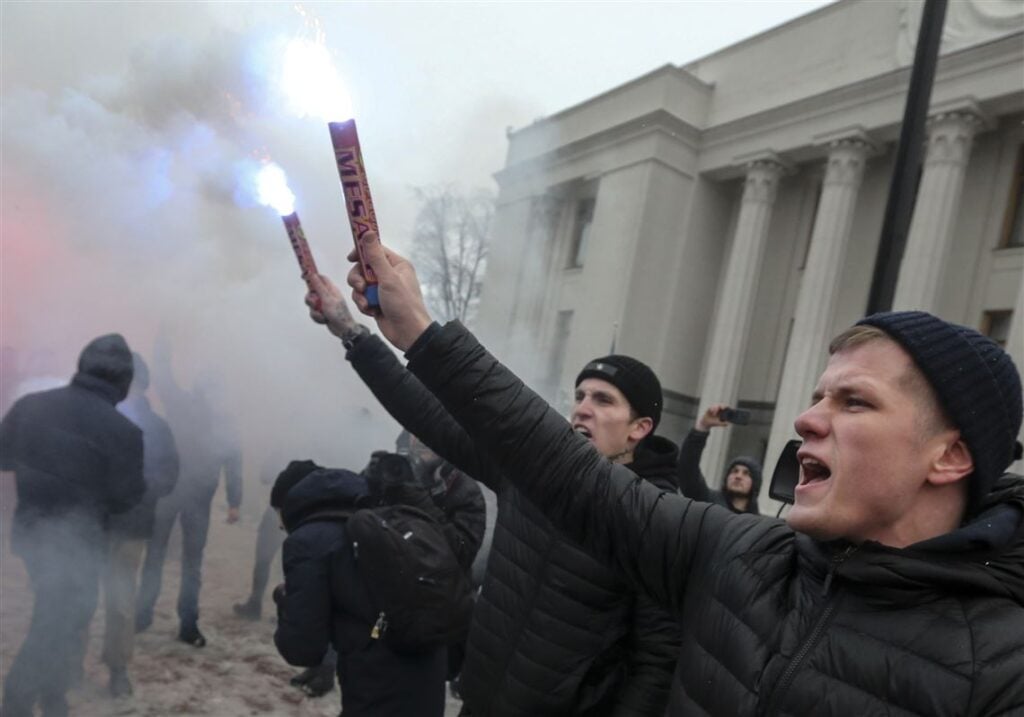
Once a Pittsburgh sister city also known for its steel industry, Donetsk, and the greater Donbas region in which it is located, has been at war since 2014. According to the U.N. High Commissioner for Human Rights, 14,000 people died in this conflict, even before Russia began its military operations in February. I’ve just returned from there.

Before Russia’s intervention, the conflict had been between the people of that region and the government in Kiev, after an unconstitutional coup took 2014. This coup, known as “Maidan,” was — as then US Ambassador to Ukraine Victoria Nuland explained in a recorded telephone conversation — managed by the United States.

Originally published by the Pittsburgh Post Gazette on November 30, 2022

The coup brought to power a pro-Western, anti-Russian, government, which contained elements which were far-right and even Nazi. The best-known element, as the Nation Magazine reported in 2019, is the neo-Nazi Azov Battalion, which has been part of Ukraine’s National Guard since 2014. Its commander Andriy Biletsky once wrote that Ukraine’s mission is to “lead the White Races of the world in a final crusade…against the Semite-led Untermenschen.”

As The Nation explained, the Azov Battalion is not merely Nazi in theory, but also in practice. In present-day Ukraine, “there are neo-Nazi pogroms against the Roma, rampant attacks on feminists and LGBT groups, book bans, and state-sponsored glorification of Nazi collaborators.”

The American press wrote about this sporadically before this year. Now the press does backflips to obscure and deny this reality.

However, the people of Donetsk, who have lived this reality now for almost nine years, are very clear that all of this is real. Indeed, I met people in Donetsk (some quite elderly) who volunteered back in 2014 to defend their land and their people from the Kiev government’s aggression.

Much of the government views the predominantly ethnic Russian people of the Donbas as inferior beings whose language and culture, including the Russian Orthodox Church, should be eradicated. I actually traveled to Donestk in a vehicle laden with clothes destined for a Russian Orthodox monastery in Donetsk that is constantly being shelled by the Kiev government. These monks now live in underground rooms beneath the increasingly-destroyed monastery.

The people I met in Donetsk view their struggle as a fight against fascism. As one told me, there is a saying in Donetsk which goes, “First Stalingrad, now Stalino.” (Stalino was the former name of Donetsk.) Stalingrad, was where the Nazis were finally forced to retreat from Russia. The people of Donetsk are now dedicated to doing the same to the neo-Nazis in Ukraine.

And yes, despite how inconvenient to Americans it may be to accept this, they see Russia as their ally in this struggle.

While I was in Donetsk, the Kiev forces regularly shelled the area, firing over the frontlines to hit civilian targets in the city. Such targets included a school, the soccer arena and a building where residents come to gather fresh water, water being in short supply as the government in destroyed Donetsk’s water treatment facility some time ago.

Such shelling has been an integral part of life in Donetsk since 2014. You would not know this from the mainstream press coverage — the very worst and most dishonest coverage I have ever witnessed.

While the worst of the conflict came in the years 2014 and 2015, witnesses in Donetsk told me that the shelling from Kiev increased greatly in the days preceding the Russian intervention. On Feb. 22, 2022, just two days before the Russian intervention, the Organization for Security and Cooperation in Europe reported 528 ceasefire violations, including 345 explosions, in Donetsk, and 1,182 ceasefire violations, including 1,075 explosions, in neighboring Luhansk.

Now, after the Russian intervention and after the referendum in September in which Donetsk residents voted to join the Russian Federation, the situation in Donetsk has actually improved. The streets are filled with cars, and people are going about their daily lives, including shopping and patronizing cafes and restaurants.

As I witnessed in Donetsk City and Mariupol, the Russian Federation helps with reconstruction. It has helped build huge housing projects and hospitals and restored damaged buildings.

With all of this said, I am not trying to convince the reader that the Russian intervention was justified, or that Russia’s own misdeeds should be excused. I am trying to push back against the cartoonish, Manichean view of the conflict being peddled by the US government and its compliant media — a view which is pushing us ever closer towards a cataclysmic war with Russia in which there will be no winners.

Another side of the story is not being told — a story about the forgotten people who have suffered under a regime backed to the hilt by the U.S., which acted in terrible ways and provoked the crisis. It is my hope that if this reality is taken into account, our leaders will work towards a negotiated settlement of the conflict rather than spending more billions of dollars on the hopes of a total victory which is neither possible nor desirable.

About Daniel Kovalik

Daniel Kovalik teaches international human rights at the University of Pittsburgh School of Law and is the author of “The Plot to Scapegoat Russia.”

Editor’s note: The author has chosen to spell Ukraine’s capital city as Kiev instead of Kyiv, the Associated Press style normally used in the Post-Gazette.

First Published November 30, 2022, 11:24pm
Related Posts

PART 2 — Diplomacy, Law and Nonviolent Power By Jan ObergTFF co-founder and director January 26, 2026 This is the second of four TFF-created idea portfolios designed to curb the global reach of the United States and, in both the short and long term, help catalyse a worldwide nonviolent resistance to what many observers describe as the Trump administration’s uniquely confrontational, destructive and world-threatening policies. These portfolios outline what governments and citizens across the world can do through dynamic diplomacy, creative initiatives, and strictly nonviolent means. They are typical TFF works in that we do not only tell what the problem is and how bad it will go – as 90+% of all commentators, experts and scholars do – we tell what we think can be done, inviting you to think of what you think you can do. It seems painfully clear to me that the current political dynamics in Washington increasingly resemble the most dangerous...
PART 1 — Media, Culture and Information Sovereignty By Jan ObergTFF co-founder and director January 20, 2026 This is the first of four TFF-created idea portfolios designed to curb the global reach of the United States and, in both the short and long term, help catalyse a worldwide nonviolent resistance to what many observers describe as the Trump administration’s uniquely confrontational, destructive and world-threatening policies. These portfolios outline what governments and citizens across the world can do through dynamic diplomacy, creative initiatives, and strictly nonviolent means. They are typical TFF works in that we do not only tell what the problem is and how bad it will go – as 90+% of all commentators, experts and scholars do – we tell what we think can be done, inviting you to think of what you think you can do. It seems painfully clear to me that the current political dynamics in Washington increasingly resemble the most...
Officially, the drones were not identified. By simply thinking critically – which journalists and selected experts no longer do – there may be a good reason for that. And this article will never be mentioned in Denmark… Jan Oberg October 3, 2025 Drones over Denmark. No damage. No trace. No answers. Yet the headlines scream “Russian threat,” and Prime Minister Mette Frederiksen speaks with a certainty that defies logic: “We don’t know they were Russian—but we know Russia is the biggest threat to Europe.” It could be nobody else – unless you make an interest analysis which I did two days ago. This is not security policy. It’s theatre. And the audience is being played. Let’s rewind. These drones—unphotographed, untracked, unclaimed—appear and vanish like ghosts. Airports shut down. Panic spreads. Military budgets swell. And the narrative hardens: Russia is behind it. But what if that’s not just wrong but deliberately...

Recent Articles

Serious but also a lot of laughs and positive energy. Because peace is also about conviviality and enchantment… Jan Oberg, TFF director November 16, 2026 This is a long (129 minutes) conversation with me. We cover very many, also personal, issues that makes a somewhat unusual media event. I am very grateful to Flemming Blicher for giving me this opportunity. I can’t remember any channel or editor who spent as much time as he did preparing it – including also asking me to answer a series of pre-interview questions, which are now posted under the conversation. If you sympathise with its content, please share it. Watch it here
A Message from Jan Oberg November 6, 2026 Over the past fifty years, I have devoted roughly 175,000 hours to research and public education for a more peaceful world: thinking, researching, writing, organising, publishing, debating, maintaining websites, corresponding, reaching out, leading a foundation, work in conflict and war zones, professorships, teaching courses and giving public lectures and doing media work. In short, ten hours a day, seven days a week, for half a century. The focus was on international political peace – analysing and trying to stop wars, address underlying conflicts and making alternative peace plans – at the desk and on the ground. Important as that has been and remains, it is only one kind of peace and it is now in a tragic militarist state compared with what it could have been.  Lately, however, I have found myself thinking about a concept from economics as well as everyday...
Photo above: Carl Fredrik Reuterswärd’s Non-Violence outside UN Headquarters in New York. Kirill Levin, CC BY-NC-SA 2. Jan Oberg November 3, 2026 I am happy to be published in Horizons which is produced by the Center for International Relations and Sustainable Development, CIRSD, in Belgrade. My contribution brings out a radical re-thinking of what concepts such as defence, security, deterrence – and peace – may mean if we want to create a more peaceful world. It also summarises a few things I have been working with the last few decades. Please read it here Og her er den på dansk, takket være Johnny Baltzersens lynhurtige oversættelse

TFF on Substack

Discover and subscribe to more peace materials on TFF Substack

Most Popular

Serious but also a lot of laughs and positive energy. Because peace is also about conviviality and enchantment… Jan Oberg, TFF director November 16, 2026 This is a long (129 minutes) conversation with me. We cover very many, also personal, issues that makes a somewhat unusual media event. I am very grateful to Flemming Blicher for giving me this opportunity. I can’t remember any channel or editor who spent as much time as he did preparing it – including also asking me to answer a series of pre-interview questions, which are now posted under the conversation. If you sympathise with its content, please share it. Watch it here
A Message from Jan Oberg November 6, 2026 Over the past fifty years, I have devoted roughly 175,000 hours to research and public education for a more peaceful world: thinking, researching, writing, organising, publishing, debating, maintaining websites, corresponding, reaching out, leading a foundation, work in conflict and war zones, professorships, teaching courses and giving public lectures and doing media work. In short, ten hours a day, seven days a week, for half a century. The focus was on international political peace – analysing and trying to stop wars, address underlying conflicts and making alternative peace plans – at the desk and on the ground. Important as that has been and remains, it is only one kind of peace and it is now in a tragic militarist state compared with what it could have been.  Lately, however, I have found myself thinking about a concept from economics as well as everyday...
Photo above: Carl Fredrik Reuterswärd’s Non-Violence outside UN Headquarters in New York. Kirill Levin, CC BY-NC-SA 2. Jan Oberg November 3, 2026 I am happy to be published in Horizons which is produced by the Center for International Relations and Sustainable Development, CIRSD, in Belgrade. My contribution brings out a radical re-thinking of what concepts such as defence, security, deterrence – and peace – may mean if we want to create a more peaceful world. It also summarises a few things I have been working with the last few decades. Please read it here Og her er den på dansk, takket være Johnny Baltzersens lynhurtige oversættelse
Read More
Screenshot 2026-11-10 174455
Serious but also a lot of laughs and positive energy. Because peace is also about conviviality and enchantment… Jan Oberg, TFF director November 16, 2026 This is a long (129 minutes) conversation with me. We cover very many, also personal, issues that makes a somewhat unusual media event. I am very grateful to Flemming Blicher for giving me this opportunity. I can’t remember any channel or editor who spent as much time as he did preparing it – including also asking me to answer a series of pre-interview questions, which are now posted under the conversation. If you sympathise with its content, please share it. Watch it here
AbstractVision_2017_#1_800 (kopia)
A Message from Jan Oberg November 6, 2026 Over the past fifty years, I have devoted roughly 175,000 hours to research and public education for a more peaceful world: thinking, researching, writing, organising, publishing, debating, maintaining websites, corresponding, reaching out, leading a foundation, work in conflict and war zones, professorships, teaching courses and giving public lectures and doing media work. In short, ten hours a day, seven days a week, for half a century. The focus was on international political peace – analysing and trying to stop wars, address underlying conflicts and making alternative peace plans – at the desk and on the ground. Important as that has been and remains, it is only one kind of peace and it is now in a tragic militarist state compared with what it could have been.  Lately, however, I have found myself thinking about a concept from economics as well as everyday...
knotted gun
Photo above: Carl Fredrik Reuterswärd’s Non-Violence outside UN Headquarters in New York. Kirill Levin, CC BY-NC-SA 2. Jan Oberg November 3, 2026 I am happy to be published in Horizons which is produced by the Center for International Relations and Sustainable Development, CIRSD, in Belgrade. My contribution brings out a radical re-thinking of what concepts such as defence, security, deterrence – and peace – may mean if we want to create a more peaceful world. It also summarises a few things I have been working with the last few decades. Please read it here Og her er den på dansk, takket være Johnny Baltzersens lynhurtige oversættelse
TFFPortfolioVign
UNITE-tillid, DREAM-velstand og andre konstruktive komponenter Normally we publish articles in English here. But this is a translation of a very important TFF document that should reach as many as possible in Denmark since this country’s government has been one of the most hardline in Europe and, up till now at least, has refused to use diplomacy and, instead, spent tremendous sums on arming Ukraine with the express goal of defeating Russia. Thus this – unique – article is in Danish. Vi er Johnny Baltzersen og hans Fælles Sikkerhed – Fælles Fremtid på Substack overmåde taknemmelige for at have oversat og publiceret TFF’s 2025-portfølje for fredsidéer med henblik på Ukraines fremtid. Vi håber den nu kan nå mange flere danskere – som også vil sprede den og skabe debat – nu den danske regerings og folketingspartiernes politik på dette område siden 2022 står nu – forudsigeligt – ved vejs ende....
JoGSS-Silent
Jan Oberg TFF director October 28, 2026 Exactly one month has now passed since I published my criticism of the introduction to the special issue on Johan Galtung published by the Journal of Global Security Studies, JoGSS, and of Tor Egil Førland’s chapter about Galtung which serves as a preview to his forthcoming biography of Galtung to be published by PRIO. See the original on The Transnational here and the same article on TFF Substack with many general and critical comments and, in particular, the people who decided to withdraw from the biography project in protest. The special issue itself was extraordinary. It was devoted to the intellectual legacy of one of the founders of peace research and contained a number of strong assessments of his personality, scholarship, intellectual trajectory, and public role. Such assessments are, of course, entirely legitimate. No scholar is beyond criticism, and neither was Johan Galtung....
Screenshot 2026-10-26 115647
An aspect of Iran’s culture and civilisation you’ve probably never heard about. Don’t be surprised if the US and Israel also try to bomb them. Jan ObergTFF director October 26, 2026 Today – under the “USraeli” threat of new “annihilating” bombings – opens the 7th International Conference on Peace and Conflict Resolution at Tehran’s University. As far as I can tell, this is the only permanent, advanced peace research institution in West Asia/the Middle East. Perhaps more countries in that region could be inspired? I mean, how many military “security” institutes and military academies do they have? Many peace research institutes and university departments have been established since the 1950s in the West. They are now all under attack; some have closed down, some have gone mainstream, yet others kept the name but do nothing to research peace and disseminate results or advice; instead, they cooperate with militarism’s platforms such...




