
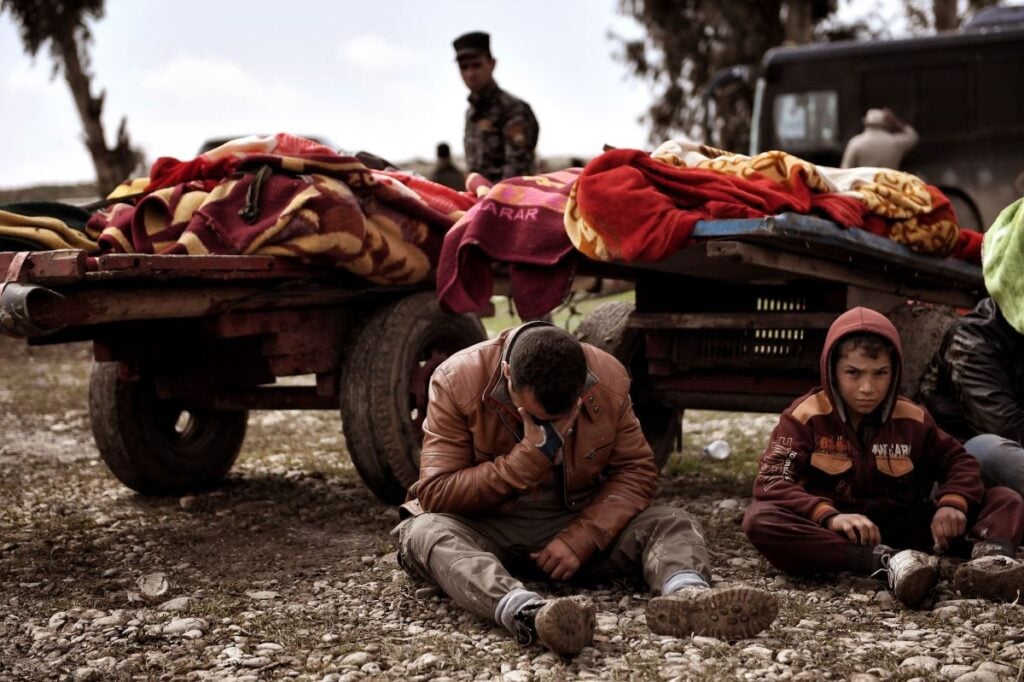
Relatives mourn as bodies of Iraqi residents of west Mosul killed in an airstrike are placed and covered with
blankets on carts on March 17th, 2017. Photo: Aris Messinis/AFP/Getty Images

Imogen Piper & Joe Dyke
October 31, 2021
Airwars tally offers assessment of the direct civilian impact of 20 years of US strikes
Originally posted on Airwars homepage on September 6, 2021
You often find a similar refrain in US media reporting of the cost of two decades of the so-called ‘War on Terror.’ The trope goes something like this: “more than 7,000 US service people have died in wars since 9/11,” an article or news report will say. In the next line it will usually, though not always, try to reflect the civilian toll – but almost exclusively in generalities. Tens, or even hundreds, of thousands.
Ahead of the 20th anniversary of the 9/11 terrorist atrocities, and the subsequent launch of the War on Terror, Airwars has been seeking the answer to one important question – how many civilians have US strikes likely killed in the ‘Forever Wars’?
We found that the US has declared at least 91,340 strikes across seven major conflict zones.
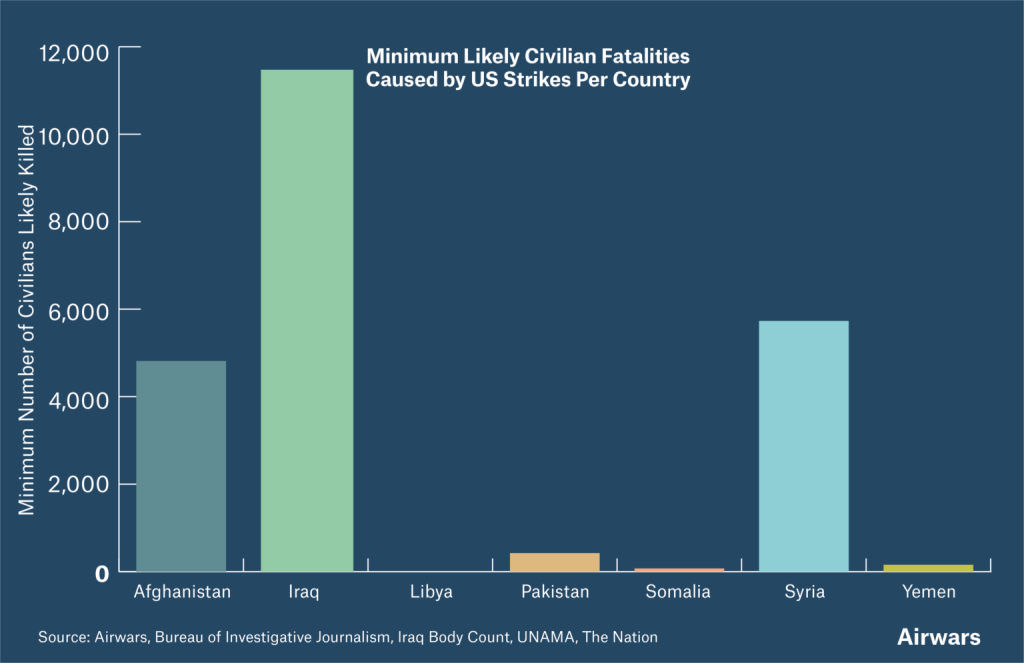
Our research has concluded that at least 22,679, and potentially as many as 48,308 civilians, have been likely killed by US strikes.
The gap between these two figures reflects the many unknowns when it comes to civilian harm in war. Belligerents rarely track the effects of their own actions – and even then do so poorly. It is left to local communities, civil society and international agencies to count the costs. Multiple sources can however suggest different numbers of fatalities, meaning that monitoring organisations like Airwars will record both minimum and maximum estimates.
Our key findings of civilian harm from US actions since 9/11 can be seen in this video and the full dataset is available here.
This accompanying article explains the conflicts we covered and our key findings in a little more detail, before outlining our methodology and data sources.
What are the ‘Forever Wars’?
In the days after the terrorist atrocities of September 11, 2001, in which 2,977 people were killed by Al Qaeda in New York, Pennsylvania and Virginia, US President George W. Bush announced the start of a new type of war, one without defined borders, boundaries, or timescales.
“Our war on terror begins with Al Qaeda, but it does not end there,” he told Americans. “It will not end until every terrorist group of global reach has been found, stopped and defeated.”
“Americans should not expect one battle, but a lengthy campaign unlike any other we have ever seen. It may include dramatic strikes visible on TV and covert operations secret even in success.”
“Every nation in every region now has a decision to make: either you are with us or you are with the terrorists,” he concluded.
So it came to pass. The War on Terror has been a near global endeavour. By 2017 for example, the US Department of Defense said it had around 8,000 “special operators” in 80 countries across the globe.
Dubbed the ‘Forever Wars,’ this conflict has not had clear territorial boundaries, though we have included in our dataset the seven most intensive US military campaigns. The types of conflict vary significantly but broadly fall into three categories:
- Full invasions and occupations of countries – Afghanistan 2001-2021, and Iraq 2003-2009.
- Major bombing campaigns against the Islamic State terror group – Iraq 2014-2021, Syria 2014-2021, and Libya 2016.
- More targeted US drone and airstrike campaigns against militant and terror groups – Somalia 2007-2021, Yemen 2002-2021, Pakistan 2004-2018, and Libya 2014-2019.
Key findings
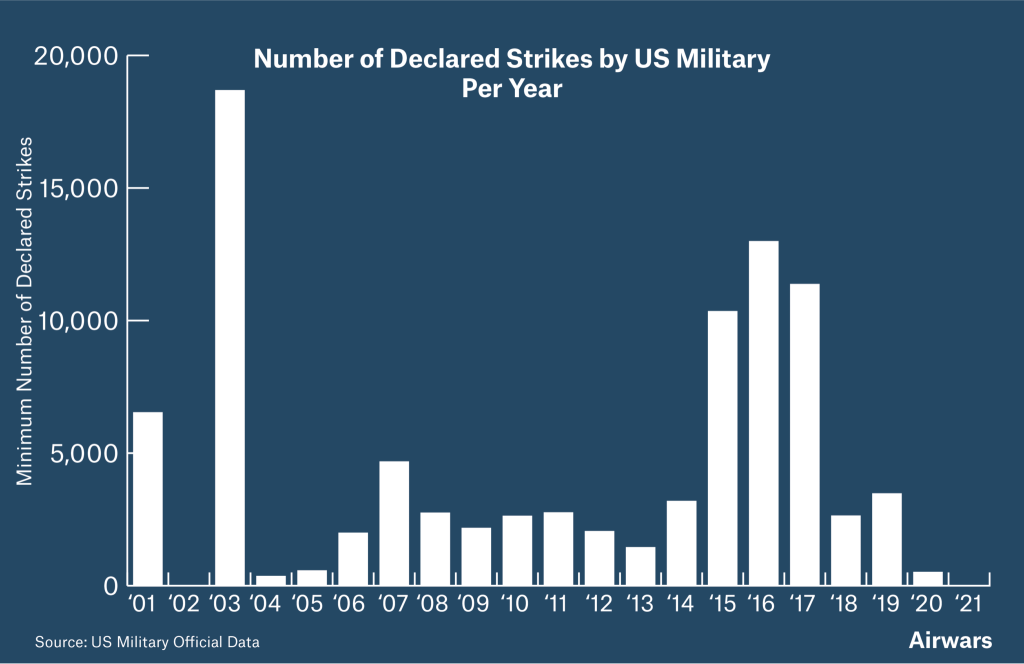
Based on official US military data, we have concluded that the US has carried out a minimum of 91,340 airstrikes throughout the 20 years of the War on Terror.
Particular peaks were seen during the invasion of Iraq in 2003, when the US declared 18,695 strike sorties. The campaign against the so-called Islamic State also saw a sustained peak, with more than 9,000 strikes a year from 2015-2017.
We then gathered together every reliable estimate of civilian harm as a result of US strikes.
Wherever possible we sought to measure civilian harm just from US airstrikes but in some cases, such as the first years of the Iraq invasion, it was impossible to disaggregate airstrikes from artillery fire and other heavy munitions, which were therefore included.
Likewise in some US-led Coalitions it was impossible to determine whether each individual strike was American, though US airpower has dominated all such campaigns.
Based on our comprehensive review of credible sources, we found at least 22,679 civilians were likely directly killed by US strikes since 9/11, with that number potentially as high as 48,308.
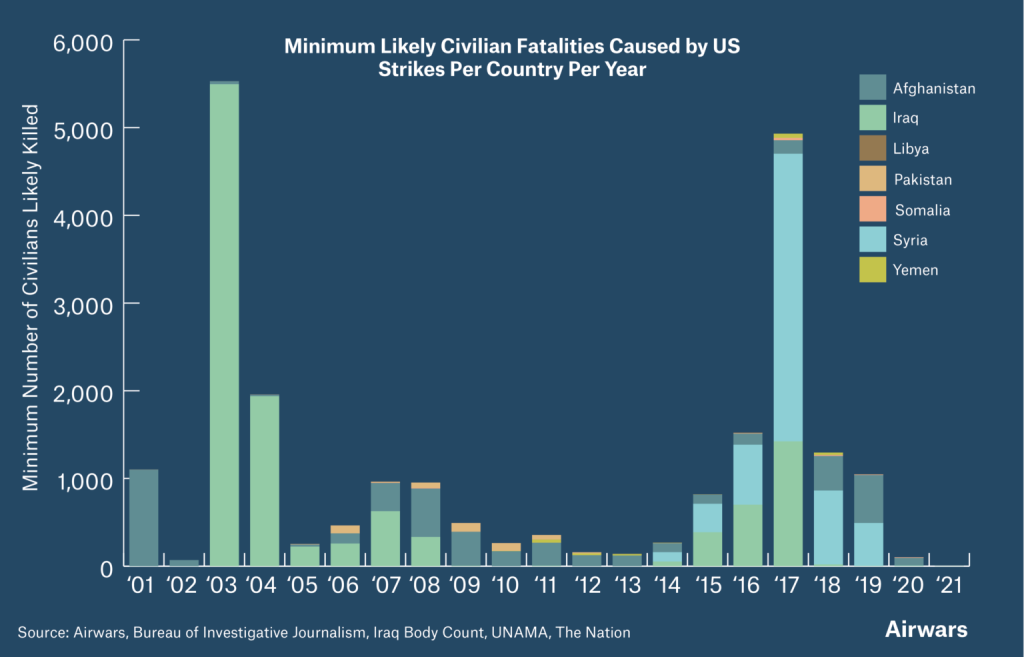
The deadliest year came in 2003, when a minimum of 5,529 civilians were reported to have been killed by US actions according to the monitoring organisation Iraq Body Count, almost all during the invasion of Iraq that year. The next deadliest year was 2017, when at least 4,931 civilians were likely killed, the vast majority in alleged Coalition bombing of Iraq and Syria. However, if we include maximum estimates of civilian harm then 2017 was in fact the worst year for civilian casualties, with up to 19,623 killed.
Almost all of the reported civilian deaths from US wars since 9/11 (97 percent) occurred in the two occupations (Iraq 2003-20119, and Afghanistan 2001-2021); as well as in the campaign against the Islamic State in Iraq and Syria (2014-2021).
In 2011, at the peak of its 20-year occupation, the US had more than 100,000 troops in Afghanistan. That conflict came to an end last month when the final US troops left after a chaotic withdrawal. During the Iraq occupation, troops numbers peaked at 166,000 in 2007, though forces withdrew by 2011.
Just three years later and following the rise of so-called Islamic State, the US and its international partners began an aerial bombing campaign against ISIS in support of allies on the ground. Campaigns to force ISIS from the Iraqi city of Mosul and the Syrian city of Raqqa in 2016-2017 saw some of the most intense urban fighting since the Second World War. In Raqqa alone, Coalition strikes reportedly killed at least 1,600 civilians. While the Islamists lost their last territorial stronghold in April 2019, the war continues at a low intensity.
As part of our research, we also sought official US military estimates for the numbers of civilians killed by its own actions since 9/11. Neither CENTCOM nor the Department of Defense have published such findings.
In the Iraq and Syria campaign against ISIS, the US-led Coalition has accepted killing 1,417 civilians – far lower than Airwars’ own estimate of at least 8,300 civilian deaths for that war.
Additionally, in 2016 the US admitted killing between 64 and 116 civilians in Libya, Pakistan, Somalia and Yemen in counter terrorism operations in the years between 2009 and 2015. But it provided no further details, dates or specifics – making assessment of those claims near impossible.
More publicly, the United States has admitted to killing two civilians in Pakistan; thirteen in Yemen; and five in Somalia in recent years. At least 394 and as many as 570 civilians have in fact been killed by US actions in those countries, according to monitoring organisation New America.
Airwars approached CENTCOM, the part of the US military responsible for most of these conflicts, directly for this project. It said data on officially recognised civilian harm was not readily available. “The information you request is not immediately on hand in our office as it spans between multiple operations/campaigns within a span of between 18 and 20 years,” CENTCOM said in an email, requesting instead that we file a Freedom of Information request. Such requests can take several years to get a response, with no guarantee of the information being released.
It’s important to note that Airwars has examined only direct harm from US strikes since 9/11 – with many of our sources providing conservative casualty estimates. We are therefore looking at a fraction of the overall civilian harm in these countries.
Between 363,939 and 370,072 civilians have been killed by all parties to these conflicts since 2001, according to the well respected Brown University Cost of War programme.
Even so, we believe this research represents the most comprehensive public assessment available of minimum civilian harm by direct US strikes and actions in the 20 years of the War on Terror.
Methodology
Parts or all of the data presented here were peer reviewed by multiple experts in the field, and our full dataset has also been published, to enable scrutiny.
That said, we acknowledge that civilian harm monitoring mechanisms have varied and evolved extensively over the past 20 years, and are rarely consistent across organisations and campaigns.
Airwars itself was formed in 2014, and has collated data on many of the US’s conflicts since then, using our all-source monitoring in local languages to gather allegations of civilian harm. However, for much of the data in the years before 2014 and for the entirety of the Afghanistan campaign – which Airwars does not monitor – we are reliant upon other organisations. This section will explain where the data was gathered from.
Afghanistan
In Afghanistan the United Nations Assistance Mission in Afghanistan (UNAMA) has released civilian harm data since 2006. This includes likely civilian harm from airstrikes carried out by foreign powers. While the War on Terror was launched by the US, some allies initially joined – including European nations that sent significant contingents to Afghanistan. It was not possible to definitively conclude if all of these strikes were conducted by the US as opposed to allied nations, although the US provided the overwhelming majority of airpower throughout the war.
In the early years of the conflict, for the period 2001-05 before UNAMA was fully operational, we have relied upon an investigative dataset compiled by The Nation, which though well researched did not claim to be definitive.
Iraq 2003-11
The US and UK invaded Iraq in 2003 to overthrow President Saddam Hussein, and then maintained an occupation with the support of other nations until withdrawing all forces in 2011. In the vacuum after Hussein was unseated, multiple militant groups, including Al Qaeda in Iraq, a predecessor of the Islamic State, thrived. Hundreds of thousands of Iraqis were killed in ensuing conflict-related violence.
The NGO Iraq Body Count has been collating tolls of civilian harm since the 2003 invasion. It kindly agreed to provide Airwars with all data related to allegations of civilian harm caused by US actions between 2003 and 2013. According to IBC, in many cases such as the initial invasion, and the assaults on the city of Fallujah in 2004, it was near impossible to disaggregate civilian harm caused by airstrikes with artillery and other munitions. As such, the data from Iraq Body Count presented here relates to deaths caused by airstrikes and explosive weapons. Incidents where only small arms fire was involved have been excluded. As with Afghanistan, it is impossible to know for certain whether each strike was carried out by the US or partner nations, though the US provided the overwhelming majority of airpower throughout the war.
Iraq and Syria 2014-2021
In the years after the Arab Spring rippled through the Middle East and North Africa in 2011, the Islamic State militant group seized a swathe of territory spanning northern Iraq and Syria which was roughly the size of the United Kingdom. From 2014 onwards, the US led an international coalition in a bombing campaign against the group, eventually forcing it to cede its last area of territorial control along the Iraqi-Syrian border in April 2019.
Airwars has monitored civilian harm related to the ongoing seven-year war against the Islamic State since the beginning of the campaign, using a standardised methodology and approach for all our civilian harm monitoring projects. Our researchers conduct daily monitoring of local Arabic-language media and social media in Iraq and Syria, documenting and archiving all claims of civilian harm including those claims reported by the local communities themselves. Each event has a unique assessment online, where an archived version of all sources used is also available. Events are considered ‘live’ – constantly updated as new information is found.
Libya
Al Qaeda had a limited presence in Libya following the defeat of dictator Muammar Gaddafi in 2011, and was the target of a small number of US strikes. Then from 2014, an Islamic State affiliate emerged in the country – seizing control of several cities and towns a year later.
Airwars researchers have actively monitored all civilian harm caused by all parties in Libya for many years. Based on hyperlocal media monitoring, and reflecting the same methodology and approach as our Iraq-Syria assessments, we have aggregated the number of alleged civilian deaths related to US strikes against both Al Qaeda and so-called Islamic State in Libya since 2012.
Pakistan, Somalia, and Yemen
In the years after 9/11 the United States launched an initially secret drone campaign targeting militant organisations in Pakistan, Somalia and Yemen. These campaigns led to often significant allegations of civilian harm.
In Pakistan, the data was originally collected by The Bureau of Investigative Journalism, with those archives transferred to Airwars in 2019. There have been no reported US strikes since July 2018.
In Somalia, Airwars has published a comprehensive review of all civilian harm allegations from both suspected and declared US strikes and actions since the conflict began in 2007.
In Yemen, the data from 2002-2016 was originally collected by The Bureau of Investigative Journalism. Airwars has actively monitored the US counter terrorism campaign in Yemen since 2017, and all associated allegations of civilian harm.
Differing methodological approaches
In every conflict, those organisations monitoring civilian harm have applied different methodologies. Airwars, TBIJ and Iraq Body Count are for example remote monitors – meaning that they gather all information publicly available and reflect any uncertainties in their findings – for example by using high and low casualty ranges, rather than definitive figures.
UNAMA employs a different methodology for Afghanistan. Based until recently in Kabul, it deployed field researchers in each province to physically investigate where possible sites of alleged civilian harm, and to interview witnesses. While this approach can lead to more certainty about circumstances and casualty numbers in an individual event, it may also mean that some locally reported cases can be missed. UNAMA also does not provide casualty range estimates – publishing just one number of confirmed civilians killed per year.
More information on conflict casualty standards and methodologies can be found at Every Casualty Counts, which publishes global standards on casualty monitoring, based on the expert work of more than 50 specialist member organisations.
Additional links:
The Guardian Article: “US airstrikes killed at least 22,000 civilians since 9/11, analysis finds”
Please think of supporting TFF so we can bring you more genuine materials – like the above – on problems and on peace as well as remain 100% people-financed and therefore independent and politically non-correct…

Airwars is a collaborative, not-for-profit transparency organisation aimed at tracking, assessing and archiving military actions and related civilian harm claims in conflict zones such as Iraq, Syria and Libya. They also work with militaries, where practicable, to help improve understanding of civilian harm allegations – with the aim of reducing battlefield casualties.






2 Responses
While it is good that American scholars bother to collect the data about the casualties of US’s many wars in different continents, especially in the Middle East, we owe it to the casualties of those wars to be clear about the real number of dead and injured. As the authors point out: “It’s important to note that Airwars has examined only direct harm from US strikes since 9/11 – with many of our sources providing conservative casualty estimates. We are therefore looking at a fraction of the overall civilian harm in these countries.” The article points out: “Our research has concluded that at least 22,679, and potentially as many as 48,308 civilians, have been likely killed by US strikes.” This of course would be a great insult to the memory of hundreds of thousands of innocent Iraqis who died as the result of US war of aggression against that country, because not all the dead and injured come forward to inform us that what they suffered was due to “direct harm from US strikes”. Fortunately, they go on to say: “Between 363,939 and 370,072 civilians have been killed by all parties to these conflicts since 2001, according to the well respected Brown University Cost of War programme.” But these figures are also huge under estimates. As the article says: “In the vacuum after Hussein was unseated, multiple militant groups, including Al Qaeda in Iraq, a predecessor of the Islamic State, thrived. Hundreds of thousands of Iraqis were killed in ensuing conflict-related violence.” But it should be added that there were no Al Qaeda or ISIS forces in Iraq before US invasion. The atrocities committed by those groups and thousands who died indirectly as the result of the wars are all due to the invasion, destruction and destabilisation of the country. After the US’s massive bombing of Mosul which was Iraq’s third largest city and which was turned to rubble, a former Iraqi official friendly to the United States claimed that more than 50,000 were killed in that city alone. While even the death of a single innocent person is wrong and must be condemned, we have at least a moral duty to record the true number of people who have been killed and injured as the result of these illegal wars. This might – just might – encourage some future US leader to think twice before unleashing US’s formidable military against another hapless nation.
Just for proportions, it has been claimed that the western embargo to raq in the 90´íes, has taken the lives of more than ½ million Iraqies, mostly children under 5. Really sad. A crime that should never be forgotten…