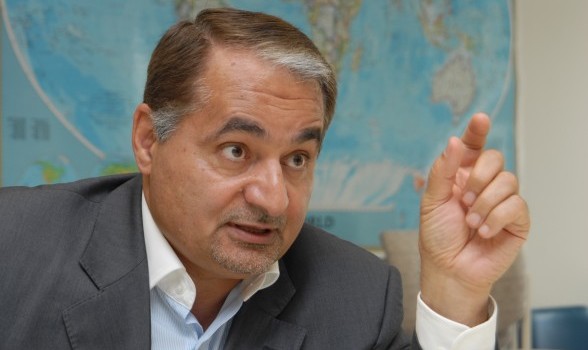
Unprecedented Anti-Iran Tendencies Gain Momentum in White House

By Seyyed Hossein Mousavian
A former Iranian diplomat and a senior analyst at Princeton University has weighed in on seven factors that show anti-Iran tendencies have increased more than ever in the White House. 

Here is the full text of his Farsi article published in the Shargh daily newspaper on Wednesday, November 29:

There have been a few unprecedented changes in the American decision-making system that have a direct or indirect impact on Iran-related decisions in Washington:

1. Over the past few decades, in no US administration as much as the current one, so many high-ranking military officials have occupied key positions. General Mattis is the Pentagon Chief, General McMaster is US National Security Advisor and John Kelley is the White House Chief of Staff. In the past, these three key posts have often been occupied by non-military persons. General Alexander Haig was the White House Chief of Staff more than 40 years ago at the time of President Nixon. After that, non-military persons were always at the post. Joel Rayburn is a senior military officer at the US National Security Council. After Iran’s revolution, all these generals have had command posts in Iraq, Afghanistan, and Lebanon, and generally shared bitter experience regarding Iran. Two or three years ago during Obama administration, Colonel Joel Rayburn was isolated and engaged in academic work at Brown University. For the first time, I saw him at a seminar in which he was describing his experience in Iraq for the audience and was promoting Iranophobia. I had an answer for him and it turned to a one-on-one debate. Suddenly, with a quivering voice, he said, “Mr Mousavian! What do you know about the crisis in Iraq? I have been involved in the operation. My companions have been killed in front of my eye by the elements supported by your Quds Force, and I’ve seen them dying… .” I told him that my brother and three of my cousins were also martyred in Iraq war, a war that the United States was supporting Saddam. I told him that “your claims regarding the Quds Force has not been proved, but the Americans have confessed about my claim on the US support for Iraq’s aggression against Iran.” The chair of the session stopped the debate, and said “we must admit that the hostility of the United States and Iran has had many victims on both sides.” However, that angry colonel is responsible for Iran, Iraq, Syria and Lebanon issues at the NSC today, and his role in policies made against Iran is even greater than that of US State Department diplomats.

2. The US State Department and its senior diplomats have been marginalized and isolated in an unprecedented way. Therefore, experienced diplomats have a “minimal” role and influence in the current US decision-making system.

Via Iran Home Page

3. The combination of Trump’s daughter, Ivanka, and her husband, Jared Kushner, at the White House, and their key role in making decisions with no political and diplomatic experience, is an unprecedented phenomenon that has angered the generals at the White House and the Pentagon as well as the US diplomats, causing friction in the American decision-making system. It is also important to note that Kushner is from a famous Zionist American family, with whom Netanyahu has had a close family relationships since his studies in the US. For Netanyahu, Kushner is the shortest, fastest and most efficient way of influencing the White House decisions. Kushner’s special ties with Saudi Crown Prince Mohammed bin Salman were also organized in this way.

4. The three developments mentioned have led to a strange confusion regarding the national security of America and the critical process of decision-making for foreign policies. This situation has created a golden opportunity for lobbies. Over the past few decades, Tel Aviv’s lobby in Washington has always had extraordinary influence over US decisions, but ultimately, Tel Aviv has followed Washington’s decisions. But the developments in the Trump administration have changed everything. This is an important point that may be difficult for many to accept.

5. The Saudis and the other Arab allies of the United States have had an active and influential lobby in Washington for many years. However, in the past, the main objective of this lobby was to maintain a balance regarding Washington’s policies on the Arabs-Tel Aviv relationship, and boosting anti-Iranian policies was the secondary objective of the Arabs lobby. With the onset of the Iranian nuclear crisis, these two lobbies came together. During the Obama administration and with the change of US policies on Iran, the lobbies of Zionists and Takfiri Arabs united, but failed to change Obama’s policy on Iran. However, during the Trump administration and with taking this opportunity, the unified Tel Aviv-Riyadh-Abu Dhabi lobby has fully succeeded in imposing its demands on the decision-making system in Washington against Iran, and they are not facing serious obstacles. Two, three weeks ago, a group of former senior US Democrat and Republican officials travelled to Tel Aviv; people who held positions like Vice President, Secretary of Defence, Secretary of State, National Security Advisor and Ambassador in previous cabinets. They had extensive discussions with their former Israeli counterparts about Iran and the region. The whole efforts of the American team was to convince the other side about the policy of “carrot and stick” on Iran. But those in Tel Aviv have insisted on the policy of a “carrot-free stick” against Iran. This type of meeting between politicians on the two sides is not unprecedented, but what surprised the US side was the presence of Director General of the Saudi General Intelligence Directorate Turki al-Faisal at the meeting in Tel Aviv. Israelis had invited him to present the views of the Saudi Crown Prince in an extremely hostile speech against Iran, and to make it clear to Americans that Washington’s Arab allies are now on Tel Aviv’s side.

6. In the past, the United States was carrying out military operations directly to the countries of the region, such as Afghanistan and Iraq. But Washington’s new strategy is that the military strike be carried out by its allies with the US supports. The US money must not be spent on wars. No American’s blood must be spilt and the multiplied costs of the supports have to be paid. We see this in the war against Yemen. Tel Aviv also tries not to enter the conflict directly. Therefore, Riyadh and its Arab allies must assume responsibility for any military action to benefit from US and Zionist supports. Meanwhile, the cost of these supports must be paid. So, the Muslim countries should pay for every war which is waged.

7. Trump is an unprecedented phenomenon in the history of US presidents. A totally unpredictable person whose decision-making almost overwhelmingly confused both US parties. Senate Foreign Relations Committee Chairman Bob Corker said that Trump policies could put America at risk of pushing for World War III. Trump’s popularity rating is at the lowest level throughout the 70-years of presidential race. Senior Republican figures have come to this conclusion that Trump will lead them to their historic defeat in the upcoming US congressional elections and also the presidential elections. At the same time, it is important to note that until now, the majority of Trump’s decisions on domestic and foreign policy have been controversial, with the exception of the sanctions imposed on Iran! In such situation, the propaganda war, lobbying, and public diplomacy stirred up Washington’s anti-Iran policies and accelerated the process of decision-making against Iran in an unbelievable way. These seven developments besides what I described in my article entitled “The need to pay attention to the threat of the triangle,” in Donya-ye Eqtesad daily on November 8, have a special meaning. Hope the Islamic Republic’s decision-makers could manage the situation prudently.


Originally published by Iran Front Page on December 1, 2017
Related Posts

PART 2 — Diplomacy, Law and Nonviolent Power By Jan ObergTFF co-founder and director January 26, 2026 This is the second of four TFF-created idea portfolios designed to curb the global reach of the United States and, in both the short and long term, help catalyse a worldwide nonviolent resistance to what many observers describe as the Trump administration’s uniquely confrontational, destructive and world-threatening policies. These portfolios outline what governments and citizens across the world can do through dynamic diplomacy, creative initiatives, and strictly nonviolent means. They are typical TFF works in that we do not only tell what the problem is and how bad it will go – as 90+% of all commentators, experts and scholars do – we tell what we think can be done, inviting you to think of what you think you can do. It seems painfully clear to me that the current political dynamics in Washington increasingly resemble the most dangerous...
PART 1 — Media, Culture and Information Sovereignty By Jan ObergTFF co-founder and director January 20, 2026 This is the first of four TFF-created idea portfolios designed to curb the global reach of the United States and, in both the short and long term, help catalyse a worldwide nonviolent resistance to what many observers describe as the Trump administration’s uniquely confrontational, destructive and world-threatening policies. These portfolios outline what governments and citizens across the world can do through dynamic diplomacy, creative initiatives, and strictly nonviolent means. They are typical TFF works in that we do not only tell what the problem is and how bad it will go – as 90+% of all commentators, experts and scholars do – we tell what we think can be done, inviting you to think of what you think you can do. It seems painfully clear to me that the current political dynamics in Washington increasingly resemble the most...
Introduction to TFF’s forthcoming four Idea Portfolios of Diplomatic and Nonviolent Resistance By TFF’s Board & FoundersPascal Lottaz, Biljana Vankovska, Annette Schiffmann, Christina Spannar & Jan Oberg January 19, 2026 “America, you are too arrogant.” — Martin Luther King Jr. Over the course of Trump’s first term and now a year into his second, the world has witnessed a consistent pattern of actions that challenge the basic long-standing norms of international cooperation, weaken multilateral institutions, and ignore the global norms and legal frameworks established by the UN Charter. During these years, we have witnessed military operations in Iran, Syria and Ukraine without UN authorisation; the killing of Iranian General Qassem Soleimani; repeated strikes across the Middle East; and the launch of tariff wars against allies and competitors alike. We have seen a renewed emphasis on nuclearism and zero interest in arms control and disarmament negotiations. Pentagon is now The Department...

Recent Articles

Serious but also a lot of laughs and positive energy. Because peace is also about conviviality and enchantment… Jan Oberg, TFF director November 16, 2026 This is a long (129 minutes) conversation with me. We cover very many, also personal, issues that makes a somewhat unusual media event. I am very grateful to Flemming Blicher for giving me this opportunity. I can’t remember any channel or editor who spent as much time as he did preparing it – including also asking me to answer a series of pre-interview questions, which are now posted under the conversation. If you sympathise with its content, please share it. Watch it here
A Message from Jan Oberg November 6, 2026 Over the past fifty years, I have devoted roughly 175,000 hours to research and public education for a more peaceful world: thinking, researching, writing, organising, publishing, debating, maintaining websites, corresponding, reaching out, leading a foundation, work in conflict and war zones, professorships, teaching courses and giving public lectures and doing media work. In short, ten hours a day, seven days a week, for half a century. The focus was on international political peace – analysing and trying to stop wars, address underlying conflicts and making alternative peace plans – at the desk and on the ground. Important as that has been and remains, it is only one kind of peace and it is now in a tragic militarist state compared with what it could have been.  Lately, however, I have found myself thinking about a concept from economics as well as everyday...
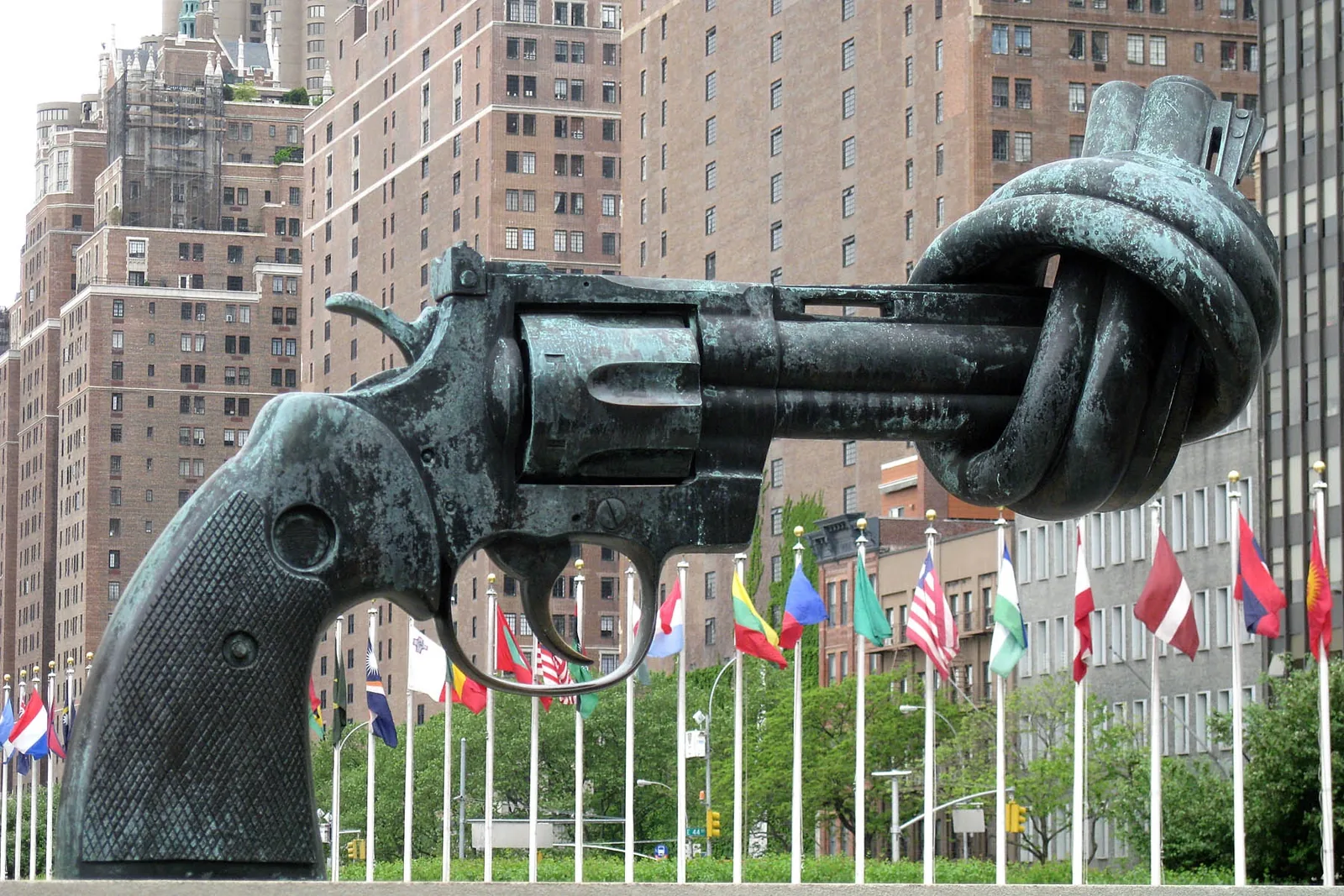
Photo above: Carl Fredrik Reuterswärd’s Non-Violence outside UN Headquarters in New York. Kirill Levin, CC BY-NC-SA 2. Jan Oberg November 3, 2026 I am happy to be published in Horizons which is produced by the Center for International Relations and Sustainable Development, CIRSD, in Belgrade. My contribution brings out a radical re-thinking of what concepts such as defence, security, deterrence – and peace – may mean if we want to create a more peaceful world. It also summarises a few things I have been working with the last few decades. Please read it here Og her er den på dansk, takket være Johnny Baltzersens lynhurtige oversættelse

TFF on Substack

Discover and subscribe to more peace materials on TFF Substack

Most Popular

Serious but also a lot of laughs and positive energy. Because peace is also about conviviality and enchantment… Jan Oberg, TFF director November 16, 2026 This is a long (129 minutes) conversation with me. We cover very many, also personal, issues that makes a somewhat unusual media event. I am very grateful to Flemming Blicher for giving me this opportunity. I can’t remember any channel or editor who spent as much time as he did preparing it – including also asking me to answer a series of pre-interview questions, which are now posted under the conversation. If you sympathise with its content, please share it. Watch it here
A Message from Jan Oberg November 6, 2026 Over the past fifty years, I have devoted roughly 175,000 hours to research and public education for a more peaceful world: thinking, researching, writing, organising, publishing, debating, maintaining websites, corresponding, reaching out, leading a foundation, work in conflict and war zones, professorships, teaching courses and giving public lectures and doing media work. In short, ten hours a day, seven days a week, for half a century. The focus was on international political peace – analysing and trying to stop wars, address underlying conflicts and making alternative peace plans – at the desk and on the ground. Important as that has been and remains, it is only one kind of peace and it is now in a tragic militarist state compared with what it could have been.  Lately, however, I have found myself thinking about a concept from economics as well as everyday...
Photo above: Carl Fredrik Reuterswärd’s Non-Violence outside UN Headquarters in New York. Kirill Levin, CC BY-NC-SA 2. Jan Oberg November 3, 2026 I am happy to be published in Horizons which is produced by the Center for International Relations and Sustainable Development, CIRSD, in Belgrade. My contribution brings out a radical re-thinking of what concepts such as defence, security, deterrence – and peace – may mean if we want to create a more peaceful world. It also summarises a few things I have been working with the last few decades. Please read it here Og her er den på dansk, takket være Johnny Baltzersens lynhurtige oversættelse
Read More
Screenshot 2026-11-10 174455
Serious but also a lot of laughs and positive energy. Because peace is also about conviviality and enchantment… Jan Oberg, TFF director November 16, 2026 This is a long (129 minutes) conversation with me. We cover very many, also personal, issues that makes a somewhat unusual media event. I am very grateful to Flemming Blicher for giving me this opportunity. I can’t remember any channel or editor who spent as much time as he did preparing it – including also asking me to answer a series of pre-interview questions, which are now posted under the conversation. If you sympathise with its content, please share it. Watch it here
AbstractVision_2017_#1_800 (kopia)
A Message from Jan Oberg November 6, 2026 Over the past fifty years, I have devoted roughly 175,000 hours to research and public education for a more peaceful world: thinking, researching, writing, organising, publishing, debating, maintaining websites, corresponding, reaching out, leading a foundation, work in conflict and war zones, professorships, teaching courses and giving public lectures and doing media work. In short, ten hours a day, seven days a week, for half a century. The focus was on international political peace – analysing and trying to stop wars, address underlying conflicts and making alternative peace plans – at the desk and on the ground. Important as that has been and remains, it is only one kind of peace and it is now in a tragic militarist state compared with what it could have been.  Lately, however, I have found myself thinking about a concept from economics as well as everyday...
knotted gun
Photo above: Carl Fredrik Reuterswärd’s Non-Violence outside UN Headquarters in New York. Kirill Levin, CC BY-NC-SA 2. Jan Oberg November 3, 2026 I am happy to be published in Horizons which is produced by the Center for International Relations and Sustainable Development, CIRSD, in Belgrade. My contribution brings out a radical re-thinking of what concepts such as defence, security, deterrence – and peace – may mean if we want to create a more peaceful world. It also summarises a few things I have been working with the last few decades. Please read it here Og her er den på dansk, takket være Johnny Baltzersens lynhurtige oversættelse
TFFPortfolioVign
UNITE-tillid, DREAM-velstand og andre konstruktive komponenter Normally we publish articles in English here. But this is a translation of a very important TFF document that should reach as many as possible in Denmark since this country’s government has been one of the most hardline in Europe and, up till now at least, has refused to use diplomacy and, instead, spent tremendous sums on arming Ukraine with the express goal of defeating Russia. Thus this – unique – article is in Danish. Vi er Johnny Baltzersen og hans Fælles Sikkerhed – Fælles Fremtid på Substack overmåde taknemmelige for at have oversat og publiceret TFF’s 2025-portfølje for fredsidéer med henblik på Ukraines fremtid. Vi håber den nu kan nå mange flere danskere – som også vil sprede den og skabe debat – nu den danske regerings og folketingspartiernes politik på dette område siden 2022 står nu – forudsigeligt – ved vejs ende....
JoGSS-Silent
Jan Oberg TFF director October 28, 2026 Exactly one month has now passed since I published my criticism of the introduction to the special issue on Johan Galtung published by the Journal of Global Security Studies, JoGSS, and of Tor Egil Førland’s chapter about Galtung which serves as a preview to his forthcoming biography of Galtung to be published by PRIO. See the original on The Transnational here and the same article on TFF Substack with many general and critical comments and, in particular, the people who decided to withdraw from the biography project in protest. The special issue itself was extraordinary. It was devoted to the intellectual legacy of one of the founders of peace research and contained a number of strong assessments of his personality, scholarship, intellectual trajectory, and public role. Such assessments are, of course, entirely legitimate. No scholar is beyond criticism, and neither was Johan Galtung....
Screenshot 2026-10-26 115647
An aspect of Iran’s culture and civilisation you’ve probably never heard about. Don’t be surprised if the US and Israel also try to bomb them. Jan ObergTFF director October 26, 2026 Today – under the “USraeli” threat of new “annihilating” bombings – opens the 7th International Conference on Peace and Conflict Resolution at Tehran’s University. As far as I can tell, this is the only permanent, advanced peace research institution in West Asia/the Middle East. Perhaps more countries in that region could be inspired? I mean, how many military “security” institutes and military academies do they have? Many peace research institutes and university departments have been established since the 1950s in the West. They are now all under attack; some have closed down, some have gone mainstream, yet others kept the name but do nothing to research peace and disseminate results or advice; instead, they cooperate with militarism’s platforms such...