
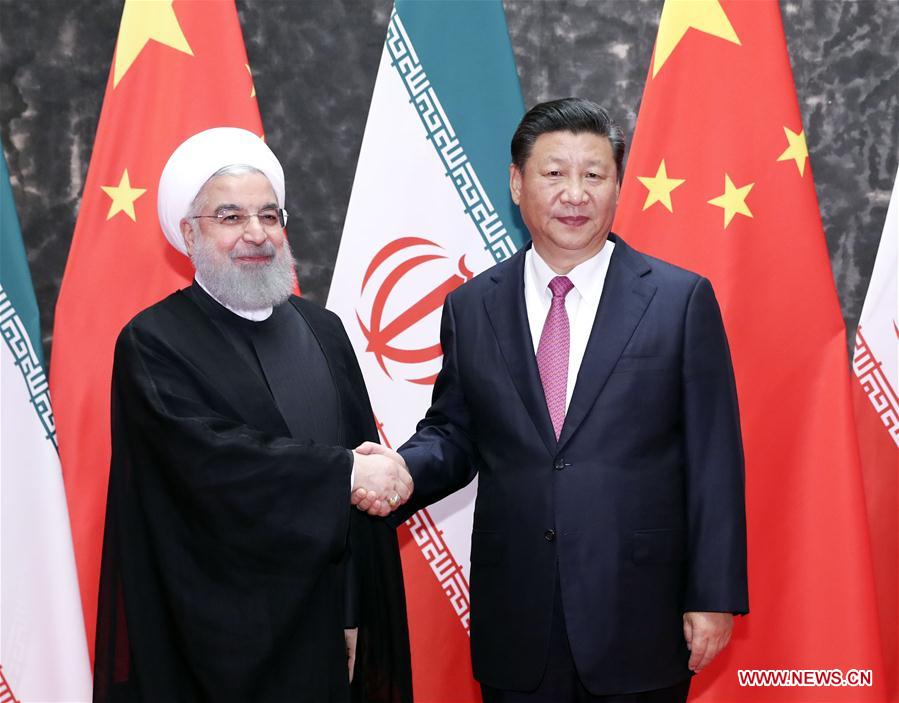
Will China’s bruited $400 bn. investment in Iran make Beijing an oil Gulf power?

Chinese President Xi Jinping (R) holds talks with his Iranian counterpart Hassan Rouhani in Qingdao, east China’s Shandong Province, June 10, 2018. (Xinhua/Ding Lin)

August 31, 2020

By Niranjan Jose

The relationship between China and Iran has been in the spotlight recently. A huge, 25-year deal is reportedly being considered that would see $400 billion of Chinese investment in Iranian energy and transport infrastructure. The deal is the latest effort by Beijing to expand from a regional hegemon into a global power through the Belt and Road Initiative (BRI) which aims to reshape regional economic topographies in its favour.

Beijing has ostensibly undertaken to make such a massive investment in key sectors of Iran’s economy in return for an assured supply of Iranian fuel for the next 25 years. The proposed investment is the biggest China has ever pledged to any country as a part of the BRI and envisages huge expenditure in building Iran’s oil and gas and infrastructure, at $280bn and $120bn respectively.

Originally published at juancole.com

According to the information available, China is to spend $120bn to develop Iran’s transport network starting with the 2,300 kilometre road that will connect Tehran to Urumqi in Xinjiang Province. This route will be paved with the Urumqi-Gwadar connection built under the “New Silk Road” in the China Pakistan Economic Corridor.

When completed, the road link will have an ambitious plan to connect with Kazakhstan, Kyrgyzstan, Uzbekistan and Turkmenistan, and thereafter via Turkey into Europe.

Beijing also plans to deploy over 5,000 Chinese security personnel to protect its investments in Iran. It is among the top three arms suppliers to the Iranians, according to SIPRI data, exporting weapons worth about $270 million to Tehran between 2008 and 2018.

The first trilateral naval exercise between China, Russia and Iran was held in the Gulf of Oman in December last year. Strategically, all three nations are empowered by the common perception of an enemy in Washington and fears of US military interventionism.

Iran seeks to expand its military influence in the region by obtaining Chinese weapons and expertise, while China seeks to develop Iran as a lucrative arms market and a strategic bulwark against US forces in Asia.

The top economic advisor to Iran’s Supreme Leader Ayatollah Ali Khamenei is Ali Agha Mohammadi who appeared recently on state television to address the need for a financial helping hand.

He said that to remain a player in the energy sector, Tehran needs to boost its oil output to at least 8.5 million barrels per day, and for that it needs China. As Iran’s biggest trading partner, China overtook the European Union in 2010, with about one-third of Tehran’s overall international trade being conducted with Beijing.

Iran’s oil industry was more dependent on China as a trading partner, despite sanctions implemented by the US and the UN in 2010. Only 5 percent of Iran’s overall oil exports went to China in 2000; however, by 2011 that had increased to 25 percent.

China has also become a major investor in Iran’s oil and gas industry, as the US and international sanctions have limited Tehran’s access to international finance and the innovations needed to develop its declining energy industry. In 2012, at the height of restrictive economic sanctions, China imported 54 percent of Iran’s oil output by alternative financial structures, including barter.

There are plenty of motives for China and Iran to collaborate as their economies are complementary.

China is the world’s largest oil importer, and Iran wants clients ready to counter US sanctions. Moreover, Iran needs modernized technology in areas such as rail and 5G networks, where Chinese companies have strengths.

Tehran has increasingly turned to Beijing for support in its long-running conflict with the US. China has also been vocal in its support for the 2015 Iran nuclear deal, vowing to uphold it even after Washington withdrew from the pact.

Iran is situated at the crucial nexus of the Middle East, Central Asia and South Asia, as well as the critical trading networks that run through the region. Beijing has identified Iran as a link along the BRI, connecting Xinjiang with the Middle East.

Relations between Beijing and Tehran, which date back to Iranian President Mahmoud Ahmadinejad’s “Pivot to the East“ policy, have blossomed under Chinese President Xi Jinping, who is pushing China’s ambitious initiative.

The alliance developed over four decades across three phases: military cooperation during the 1980/88 Iran-Iraq War; energy cooperation in the 1990s as China developed quickly; and oil deals which defied sanctions. The “maximum pressure” policy and sanctions imposed on Iran by the Donald Trump administration has failed.

Far from isolating Tehran, as intended, the exertion of significant economic pressure on the Iranian regime has pushed it further into the arms of Beijing. China is criticized by Western policy observers for its so-called “debt diplomacy”, the strategy of indebtedness through aggressive investment packages to an economically vulnerable country.

This acts as leverage for important property acquisitions; one of the most prominent examples is the Hambantota Port in Sri Lanka, which the government had to lease to China for 99 years after it struggled to repay Chinese loans.

Beijing is utilizing Tehran’s rising vulnerability intensified by the health and economic crises due to Covid-19. The latest cyber-attacks on its atomic and maritime facilities have also driven Tehran into the arms of China.

After all, the growing superpower provides an insatiable energy demand, military and industrial infrastructure, huge spending and a possible global diplomatic shield, with its veto at the UN Security Council.

All are needed desperately by Iran. The agreement is not only seen by both nations as mutually advantageous, but also as a possible tool to challenge US hegemony in the Middle East.

China sees seamless possibilities in its strategic partnership with Iran, with a low-cost supply of oil, abundant mineral resources and an untapped market. Beijing’s Iran strategy is affected by its increasing footprint in the Persian Gulf, where it cautiously develops a position centred on highly diverse ties with regional powers, along with its global confrontation with the US.

The State Department in Washington has already threatened to target Chinese companies if they make investments in Iran which defy US sanctions.

Nevertheless, China is already in a trade and technological war with the US and seems determined to go ahead with its partnership with Iran. Beijing continued to buy Iranian oil over the past year even after the US sanctions’ waivers expired in May 2019, albeit in smaller volume.

With the US swamped by exhausting wars in the Middle East in recent years, China has steadily increased its political, commercial and even military operations in the region.

Its motives are clear, though varied; it aims to promote its goals, such as a growing need for oil supplies and destinations for surplus labour and capital.

China is mindful that none of the major powers returned unscathed from wars in the Middle East and are confronting a very challenging variety of obstacles.

The broad political fissures in the region render it impossible for outsiders not to take sides in the numerous conflicts. This presents a challenge to China, which seeks to be a partner for everyone, Iran, Israel and Arab states alike, in order to reap the advantages of its global involvement.

Even if just a portion of what is envisaged under the planned Sino-Iranian deal comes to life, it presents a deadly threat to the campaign against Tehran by the Trump administration.

China’s investments in Iran allow it to exert its influence on Iranian foreign policy, and will enable China to do three things: allow China to diversify its energy needs without overly relying on Russian energy; elevate its claim to offer an alternative to the “Washington consensus” by defying US sanctions against Iran and continuing to trade with Tehran; allow China to control India’s access to Central Asia by enhancing Beijing’s relationship with Iran.

Originally published at juancole.com

About the author:

Niranjan Jose is a law student at the National Law University Odisha (NLUO), India.

If you appreciate this type of informative and trustworthy article, please show it here. Thanks!

Related Posts

Jan Oberg May 15, 2026 Go to this Fox News page and scroll the whole way down: President Donald Trump tells the world that his meeting with President Xi Jinping yielded a lot of very concrete political and economic results – of course, only where the Chinese side, according to him, agreed with him. He does not mention the Taiwan issue, but Secretary of State, Marco Rubio, says that it did not feature prominently in their talks and that the US policy on Taiwan has not changed. Then go to China Daily – or Global Times – and you will see that for the Chinese it is framework, principles, structure of cooperation etc. that matters – all embedded in the overall idea of “constructive bilateral relationship of strategic stability.” Nowhere is any concrete agreement or deal – all that Trump refers to – mentioned. At the general level, this gives you insights into the very different social...
Jan Oberg, TFF director April 9, 2026 I was recently invited to have a good, long talk about the world – and, of course, about peace too – with Boris Malagurski on his Weight of Chains Channel on YouTube. It was a real joy and seems to have been greatly appreciated by the viewers too. Mr Malagurski and I shall of course be grateful if you share this conversation in your circles – of course, only if you like what you see and hear 😉☮️ And remember that this one – like hundreds of others with TFF Associates – can be enjoyed at our TFF Video Collection.
This is not another geopolitical commentary on the Arctic. It is a visionary peace proposal that can save the region from militarised rivalry and ecological ruin. A blueprint for shared security, sustainable development, and human dignity — benefitting Greenland, the Arctic, and the rest of us. Jan Oberg TFF director Lund, Sweden, February 17, 2026 I. Four Principles for a New Arctic Vision The Arctic is often framed as a cold arena of rivalry — a place where great powers test each other’s resolve. But this worldview is outdated, unimaginative, and ultimately self‑defeating. The Arctic is not a vacuum waiting to be militarised; it is a living region, a climate stabiliser, and a cultural homeland whose future will shape the future of humanity. If we begin from that understanding, a far more rational Arctic order becomes possible — one that is peaceful, cooperative, and centred on the people who actually live there. This vision rests...

Recent Articles

Below are TFF-related media mentions, comments, videos and social media posts published elsewhere but not on this homepage. We happen to catch and list only a fraction. Regarding video comments and debates, we recommend that you go to the TFF Video Channel on Substack where many of them are reproduced. Jan Oberg is a contributor to China Daily – 52 million daily clicks – and Global Times, CGTN and CCTV (the national television), China Investment, Xinhua News Agency and several others. Articles and videos on these media very often multiply into countless Chinese (and Western media) that re-post them from these main media. Thanks to The China Academy, his analyses, interviews and comments are frequently posted on YouTube channels such as Thinkers Forum and Wave Media. These videos are often re-posted on Bilibili (China’s YouTube), the China Content Center on TikTok, and on the Chinese edition of TikTok, Douyin.com. This means reaching hundreds of millions of viewers worldwide over a year. While there are too many to catch on all these...
Jan Oberg TFF director October 13, 2026 According to Alfred Nobel’s will, the Nobel Peace Prize shall be awarded: ”to the person who has done the most or best to advance fellowship among nations, the abolition or reduction of standing armies, and the establishment and promotion of peace congresses.” Further down, he also expresses how the prize for the “champions of peace” shall be decided: “that for champions of peace by a committee of five persons to be selected by the Norwegian Storting. Alfred Nobel’s will is remarkably short and clear. But few seem to have read it. Nobel did not say that the committee itself should consist of members of parliament. He entrusted the Storting with appointing five persons. In principle, it could have selected diplomats, mediators, peace researchers, conflict-resolution specialists, or other individuals with recognised expertise in matters of peace from around the world. Instead, the Storting gradually...
The Quest for Humane Survival Richard Falk Professor emeritus, Princeton UniversityTFF Associate since 1986October 12, 2026 After decades of teaching and writing about international law in academic frameworks that were not institutionally situated within law school environments—at Princeton and the University of California, Santa Barbara—I found myself most receptive to the TWAIL outlook. It has been especially illuminating in clarifying the extent to which international law evolved as a dialogical critique of Europe’s efforts to legitimize its colonial undertakings. In particular, TWAIL has exposed how international law has functioned to legalize the subjugation of Third World peoples, securing conditions for exploitative investment and trade relations, the coercive enforcement of public debts, and an ideology of cultural superiority. TWAIL’s exposure of these economic legacies of colonialism has influenced my understanding of the history and development of international law, broadly conceived, as an ideological project of the Western sub-system of the world...

TFF on Substack

Discover and subscribe to more peace materials on TFF Substack

Most Popular

Below are TFF-related media mentions, comments, videos and social media posts published elsewhere but not on this homepage. We happen to catch and list only a fraction. Regarding video comments and debates, we recommend that you go to the TFF Video Channel on Substack where many of them are reproduced. Jan Oberg is a contributor to China Daily – 52 million daily clicks – and Global Times, CGTN and CCTV (the national television), China Investment, Xinhua News Agency and several others. Articles and videos on these media very often multiply into countless Chinese (and Western media) that re-post them from these main media. Thanks to The China Academy, his analyses, interviews and comments are frequently posted on YouTube channels such as Thinkers Forum and Wave Media. These videos are often re-posted on Bilibili (China’s YouTube), the China Content Center on TikTok, and on the Chinese edition of TikTok, Douyin.com. This means reaching hundreds of millions of viewers worldwide over a year. While there are too many to catch on all these...
Jan Oberg TFF director October 13, 2026 According to Alfred Nobel’s will, the Nobel Peace Prize shall be awarded: ”to the person who has done the most or best to advance fellowship among nations, the abolition or reduction of standing armies, and the establishment and promotion of peace congresses.” Further down, he also expresses how the prize for the “champions of peace” shall be decided: “that for champions of peace by a committee of five persons to be selected by the Norwegian Storting. Alfred Nobel’s will is remarkably short and clear. But few seem to have read it. Nobel did not say that the committee itself should consist of members of parliament. He entrusted the Storting with appointing five persons. In principle, it could have selected diplomats, mediators, peace researchers, conflict-resolution specialists, or other individuals with recognised expertise in matters of peace from around the world. Instead, the Storting gradually...
The Quest for Humane Survival Richard Falk Professor emeritus, Princeton UniversityTFF Associate since 1986October 12, 2026 After decades of teaching and writing about international law in academic frameworks that were not institutionally situated within law school environments—at Princeton and the University of California, Santa Barbara—I found myself most receptive to the TWAIL outlook. It has been especially illuminating in clarifying the extent to which international law evolved as a dialogical critique of Europe’s efforts to legitimize its colonial undertakings. In particular, TWAIL has exposed how international law has functioned to legalize the subjugation of Third World peoples, securing conditions for exploitative investment and trade relations, the coercive enforcement of public debts, and an ideology of cultural superiority. TWAIL’s exposure of these economic legacies of colonialism has influenced my understanding of the history and development of international law, broadly conceived, as an ideological project of the Western sub-system of the world...
Read More
girl-5894831_1280
Below are TFF-related media mentions, comments, videos and social media posts published elsewhere but not on this homepage. We happen to catch and list only a fraction. Regarding video comments and debates, we recommend that you go to the TFF Video Channel on Substack where many of them are reproduced. Jan Oberg is a contributor to China Daily – 52 million daily clicks – and Global Times, CGTN and CCTV (the national television), China Investment, Xinhua News Agency and several others. Articles and videos on these media very often multiply into countless Chinese (and Western media) that re-post them from these main media. Thanks to The China Academy, his analyses, interviews and comments are frequently posted on YouTube channels such as Thinkers Forum and Wave Media. These videos are often re-posted on Bilibili (China’s YouTube), the China Content Center on TikTok, and on the Chinese edition of TikTok, Douyin.com. This means reaching hundreds of millions of viewers worldwide over a year. While there are too many to catch on all these...
Nobel-Prize-Plaque
Jan Oberg TFF director October 13, 2026 According to Alfred Nobel’s will, the Nobel Peace Prize shall be awarded: ”to the person who has done the most or best to advance fellowship among nations, the abolition or reduction of standing armies, and the establishment and promotion of peace congresses.” Further down, he also expresses how the prize for the “champions of peace” shall be decided: “that for champions of peace by a committee of five persons to be selected by the Norwegian Storting. Alfred Nobel’s will is remarkably short and clear. But few seem to have read it. Nobel did not say that the committee itself should consist of members of parliament. He entrusted the Storting with appointing five persons. In principle, it could have selected diplomats, mediators, peace researchers, conflict-resolution specialists, or other individuals with recognised expertise in matters of peace from around the world. Instead, the Storting gradually...
law-419057_1280
The Quest for Humane Survival Richard Falk Professor emeritus, Princeton UniversityTFF Associate since 1986October 12, 2026 After decades of teaching and writing about international law in academic frameworks that were not institutionally situated within law school environments—at Princeton and the University of California, Santa Barbara—I found myself most receptive to the TWAIL outlook. It has been especially illuminating in clarifying the extent to which international law evolved as a dialogical critique of Europe’s efforts to legitimize its colonial undertakings. In particular, TWAIL has exposed how international law has functioned to legalize the subjugation of Third World peoples, securing conditions for exploitative investment and trade relations, the coercive enforcement of public debts, and an ideology of cultural superiority. TWAIL’s exposure of these economic legacies of colonialism has influenced my understanding of the history and development of international law, broadly conceived, as an ideological project of the Western sub-system of the world...
images-2
Advocates of nuclear disarmament are regularly dismissed by the champions of nuclear deterrence as naïve and unrealistic, utopian or even irresponsible. Yet this ‘doctrine’ of deterrence, regarded by France as the ‘cornerstone’ of its national security, is based on quasi-religious beliefs, a theory that cannot be proven, risky gambles and fragile assumptions. So much so that one might legitimately ask which side the ‘Care Bears’ are on. Marc FinaudVice-President of Initiatives for Nuclear Disarmament (IDN) October 9, 2026 This article was originally published on Pressenza When it comes to these things being treated as religious concepts, look here. Idealists and realists It was Hubert Védrine, François Mitterrand’s former Foreign Minister, who repeatedly coined the phrase: ‘Europeans are a sort of Care Bears who don’t realise they’re living in Jurassic Park’. He applies this reference to the cartoon for well-behaved children not only to what he regards as weakness or idealism...
8824b09f-33a5-43f9-9fd0-550f28cda24d_1536x1024
What the West Borrowed from Asia and What It Left Behind Jan Krikke October 8, 2026 The article was originally published here In the late 1960s, the musical Hair announced that the Age of Aquarius was dawning. Its opening anthem promised a transformation of human consciousness: an era of peace, harmony and understanding. Half a century later, a familiar echo of that promise is a meditation app offered by your employer. You can find it in the same list of benefits as the pension plan and the gym discount. How did a spiritual revolution become an employee benefit? The answer lies in the history of the movement known as New Age: where it came from, what it borrowed from Asia, and why the meaning of what it borrowed changed in the process. Two definitions will help. New Age is a loose label for a wide range of spiritual practices and...
Screenshot 2026-10-04 210142
Small and different + among the 10% most active + 9,000 texts + 150 Associates + 60 000 a day — and a stubborn belief that peace is smarter and must be secured by peaceful means. In 2026, the Transnational Foundation for Peace and Future Research (TFF) turns 40. On Monday, October 5, 2026, a new TFF homepage will go live — a new gateway to more than 9,000 articles, analyses, research papers and other contributions produced over four decades of independent peace research. But this is not simply a new website. For four decades, TFF has worked from a simple conviction: peace is smarter than militarism and can be brought about by peaceful means. This is not merely an aspiration. It is the principle expressed in the UN Charter and the Gandhian tradition that has guided our work from the beginning. TFF is a research-based, independent and people-financed foundation....




