
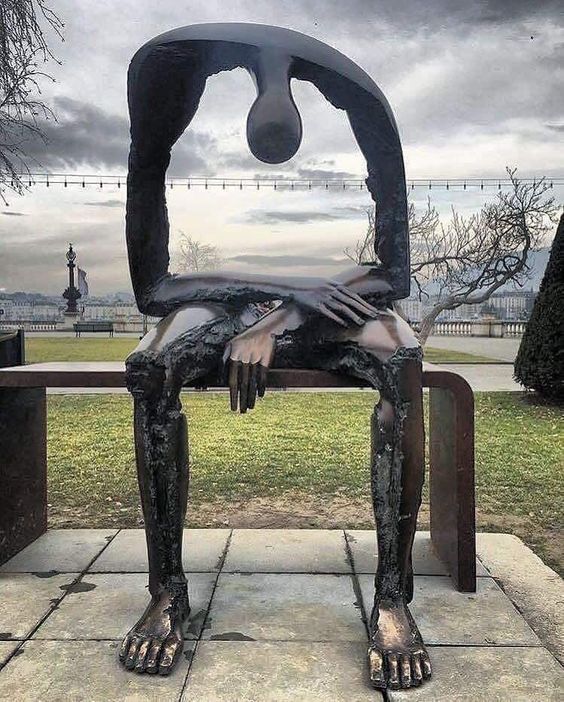
Albert Györgi’s sculpture, “Emptiness,” at Lake Geneva
TFF Associate
In war, there are no unwounded soldiers.
—José Narosky
War is hell, and today more than ever. Although high-tech weapons make it a videogame for some, those same weapons make it unbelievably destructive for everyone else. Whatever valor was once associated with hand-to-hand combat has long since disappeared due to gunpowder, and the massive slaughters of the twentieth century have made it increasingly difficult to romanticize the death and misery war causes. Nonetheless it continues and we have learned, if not to accept it, to take it for granted.
Obviously, not everyone loathes it. The U.S. economy would collapse without the obscene amount spent on the military-industrial complex, now well over $600 billion a year according to some calculations. It’s hard to rationalize such a sum without a war once in a while. That’s why the end of the Cold War with the Soviet Union was so disconcerting. What would we do without an enemy! Fortunately, the war on terror fits the bill perfectly. With a bit of luck it may never end (how would we know?) and the military budget can balloon forever.
But it’s not only those who get rich (or richer) off war who like it. They couldn’t promote war if the rest of us weren’t willing to go along with their manipulations. We support and follow the war-makers because, to tell the truth, there is something in us that finds war agreeable . . . even attractive. Can Buddhism help us understand what that is?
The official excuse for every war is always the same: self-defense. It’s okay to kill other people and destroy their society because that’s what they want to do to us.
As Hermann Goering said, “The people can always be brought to the bidding of the leaders . . . Just tell them they are being attacked, and denounce the peacemakers for lack of patriotism and exposing the country to danger.” They haven’t attacked us yet? Then we need a “preventive war.” That suggests the problem with all “just war” theories. Once there’s such a thing as a just war, every war becomes marketed as a just war.
But that’s not why we like war. That’s just how the propaganda works, how leaders get us to line up behind them. What makes us so gullible? Why are we so willing to sacrifice ourselves, even our children? Why doesn’t exposing the lies of the last war inoculate us against the deceptions that will be used to promote the next one?
Buddhist societies have not been immune from war. The Japanese Buddhist establishment wholeheartedly supported the imperialist ambitions of its fascist government. In Sri Lanka today politicized Buddhist monks oppose a negotiated solution to a civil war that has already cost thousands of lives.
In all the cases that I can think of, however, people who consider themselves Buddhists became belligerent because their Buddhism had become mixed up with a more secular religion: nationalism. Such war-mongering startles us because it so obviously contradicts Buddhist principles – not only incompatible with its emphasis on not harming but also inconsistent with a worldview that emphasizes wisdom over power.
From a Buddhist perspective, the various conflicts in the Middle East look like a family quarrel. That’s because the three Abrahamic faiths – Judaism, Christianity and Islam – share much the same understanding of the world. It’s a feud among brothers who have fallen out, which is, of course, sometimes the most vicious sort. Having been raised by the same father, they have a similar worldview: this world is a battleground where the good must fight against those who are evil.
The most important issue is where each of us stands in this cosmic struggle. Our salvation depends upon it. It’s necessary to choose sides.
It is not surprising, then, that the al-Qaeda understanding of good and evil – the need for a holy war against evil – is also shared by the administration of George W. Bush. Bin Laden would no doubt agree with what Bush has emphasized: “If you’re not with us, you’re against us.” Since there is no room in this grand cosmic struggle for neutrality, neither of them is much concerned about the fate of innocent bystanders. Bystanders are not innocent. Once something has been labelled as evil, the focus must be on fighting it. The most important thing is to do whatever is necessary to destroy it. This implies a preoccupation with power and victory at any cost. Whether one supports small-group terrorism or state terrorism, the issue is the same: Which will be more powerful, the forces of good or the forces of evil?
Buddhism offers a different perspective. In place of this battleground of wills where good contends against evil, the most important struggle is a spiritual one between ignorance and delusion, on the one side, and liberating wisdom on the other. And seeing the world primarily as a war between good and evil is one of our more dangerous delusions.
Looking back over history, we can see that when leaders have tried to destroy evil, they have usually ended up creating more evil. An obvious example is the heresy inquisitions and witch-trials of medieval Europe, but for sheer violence and dukkha nothing can match the persecutions of the twentieth century.
What was Adolf Hitler trying to do with his “final solution” to the “Jewish problem”? The earth could be made pure for the Aryan race only by exterminating the Jews, along with all the other vermin (gypsies, homosexuals, the mentally defective, etc.) who contaminate it. Stalin killed well-to-do Russian peasants because he was trying to create his ideal society of collective farmers. Mao Zedong eliminated Chinese landlords for the same reason. Like Bush and bin Laden, they were trying to perfect the world by eliminating its evil people.
So one of the main causes of evil in our world has been attempts to get rid of evil (or what has been seen as evil). In more Buddhist terms, much of the world’s suffering has resulted from this delusive way of thinking about good and evil.
For Buddhism, however, this simplistic way of understanding conflict keeps us from looking deeper and finding other ways to resolve differences. What we call evil is, like everything else, an effect of causes and conditions, and it’s important to realize what those causes are. Buddhism emphasizes evil itself less than the three roots of evil (also known as the three unwholesome roots, or the three poisons): greed, ill will, and delusion.
The Buddhist solution to suffering does not involve answering violence with violence, any more than it involves responding to greed with greed, or responding to delusion with more delusion. As the most famous verse in the Dhammapada says, hatred (vera) is never appeased by hatred; it is appeased by non-hatred (avera). We must look for ways to break that cycle by transforming those poisons into their positive counterparts: greed into generosity, ill will into loving-kindness, and delusion into wisdom.
The Buddhist path involves understanding how our minds work, and Buddhist teachers warn us about dualistic ways of thinking: not only good and evil, but success and failure, rich and poor, and so forth. We often distinguish between such terms because we want one side rather than the other, yet we cannot have one without the other, because the meaning of each depends upon (negating) the other. They are two sides of the same coin.
If, for example, it is important for me to live a pure life (whatever that may mean to me), that doesn’t mean I escape impurity. On the contrary, I have to think about impurity all the time: I will be preoccupied with (avoiding) impurity. We cannot have one side without the other, and together they distort the world for us. We do not experience the world as it is, but as filtered through such ways of thinking. As Chan master Huihai put it, true purity is a state beyond purity and impurity. By getting caught up in such dualisms, we “bind ourselves without a rope.”
What does this mean for the duality of good versus evil? It’s the same trap. We don’t know what is good until we know what is evil, and we can’t feel that we are good unless we are fighting against that evil. We can feel comfortable and secure in our own goodness inside only by attacking some evil outside us.
There is something quite satisfying about this struggle between good (us) and evil (them), because it makes sense of the world. Think of the plot of every James Bond film, every Star Wars film, every Indiana Jones film, every Harry Potter book and movie, and so forth – you can add your own favourites to this list.
The bad guys are stereotypes because they play a pre-determined role in our collective fantasy. Being ruthless, without remorse, they must be stopped by any means necessary. We are meant to feel that it is okay (and, to tell the truth, it’s quite enjoyable) to see them get beaten up. Because the villains like to hurt people, it’s all right to hurt them. Because they like to kill people, it’s okay to kill them.
While such stories entertain us, they reinforce this worldview. What do they teach us? That if you want to hurt someone, it’s important to demonize them first, to fit them into a good-versus-evil story by labelling them as evil.
Even school bullies usually begin by looking for some petty offence that they can use to justify their own penchant for violence. That is also why the first casualty of war is truth. The media must sell some such story to the people: “In order to defend ourselves, we must . . .”
Does that get at why we like war? Wars cut through the petty problems of daily life, and unite us good guys here against the bad guys there. There is fear in that, of course, yet there’s also something exhilarating about it. The meaning of life becomes simpler and clearer in wartime. As Chris Hedges explains it in his first-hand account of life as a war correspondent, War Is a Force That Gives Us Meaning: “The communal march against an enemy generates a warm, unfamiliar bond with our neighbours, our community, our nation, wiping out unsettling undercurrents of alienation and dislocation. War, in times of malaise and desperation, is a potent distraction.”
The problems with my life, and yours, are not personal anymore but over there – the enemy that is trying to kill us. That makes the solution simple – we must get them first.
Such ways of thinking and feeling are dangerous. Nevertheless, understanding good-versus-evil as a dualism that deludes us is not by itself sufficient for understanding the enduring attraction of war. There is another, perhaps even more basic reason why war is so addictive. Let’s look again at our susceptibility to its “potent distraction.” Something else that Hedges says is quite suggestive:
“The enduring attraction of war is this: even with its destruction and carnage it can give us what we long for in life. It can give us purpose, meaning, a reason for living. Only when we are in the midst of conflict does the shallowness and vapidness of much of our lives become apparent. Trivia dominates our conversations and increasingly our airwaves. . . . [War] allows us to be noble.”
The title of Hedges’ book makes a critically important point: war gives meaning to our lives. This gives us insight into the psychology of terrorism. Why would someone want to crash hijacked aeroplanes into skyscrapers, killing thousands – including oneself – and terrorizing millions? Perhaps only religion can provide the motivation and collective support for such terrible deeds, because religion, ironically, is what usually teaches us the ultimate meaning of life.
Mark Juergensmeyer’s study of religious terrorism, Terror in the Mind of God, clarifies the connection: “A society provides an accepted – even heroic – social role for its citizens who participate in great struggles and have been given moral license to kill. They are soldiers. Understandably, many members of radical religious movements see themselves that way.”
Like many other correspondents, Chris Hedges found it difficult to return to a peaceful environment because he had become addicted to the excitement of war. But what if there is a grand spiritual war that is going on all the time? In that case, everyday life’s “vapidness” may be avoided indefinitely.
According to Juergensmeyer: “Such soldiers have found new battles: the grand spiritual and political struggles in which their movements envision themselves to be engaged. These cosmic wars impart a sense of importance and destiny to men who find the modern world stifling, chaotic, and dangerously out of control. The imagined wars identify the enemy, the imputed source of their personal and political failures; they exonerate these would-be soldiers from any responsibility for failures by casting them as victims; they give them a sense of their own potential for power; and they arm them with the moral justification, the social support, and the military equipment to engage in battle both figuratively and literally.”
Such spiritual struggles can provide a heroic identity that transcends even death, for death is not checkmate when you are an agent of God. What grander destiny is possible than to be part of the cosmic forces of Good fighting against Evil? A heady alternative to languishing in a refugee camp without much hope for the future – or, for that matter, to channel-surfing and shopping at the mall. One’s own death as a martyr (literally, “witness”) becomes a sacrifice (literally, “making holy”) that ennobles one’s victims as well as oneself. All is justified because the meaning of this spiritual struggle transcends this world and its inhabitants.
Juergensmeyer concludes that the modern world as experienced by religious terrorists and their supporters is “a dangerous, chaotic, and violent sea for which religion was an anchor in a harbor of calm. At some deep and almost transcendent level of consciousness, they sensed their lives slipping out of control, and they felt both responsible for the disarray and a victim of it. To be abandoned by religion in such a world would mean a loss of their own individual identity. In fashioning a “traditional religion” of their own, they exposed their concerns not so much with their religious, ethnic or national communities as with their own personal, imperiled selves.”
If the worldview, meaning, and power provided by warfare are addictive for many, what happens when such struggles are elevated into a Cosmic War between Good and Evil? The attraction of warrior-identity becomes even greater. In short, religious terrorism helps us understand that the problem with a good-versus-evil worldview is not merely that it is a simple and comfortable way to understand the world. What did Hedges say about “the shallowness and vapidness of much of our lives”?
Those words point to what is lacking in daily life for many of us. Despite its horrors, war fills the void – the shallowness, loneliness, alienation and malaise – of everyday existence. Is this because it conceals better something that is missing in our everyday identities? Is this lack of meaning a general description of all peacetime life, which suggests a grim prognosis indeed, or does it describe the sense of lack in modern society, which seems to doom our lives to triviality insofar as it provides us with no cosmic role greater than consumerism or (occasionally) patriotism?

In other words, is there something unsatisfactory and ultimately frustrating about the secular alternative that makes religious wars so attractive?
In The Battle for God, Karen Armstrong describes the history of fundamentalism as an attempt to fill the empty core of a society based on scientific rationalism. “Confronted with the genocidal horrors of our century, reason has nothing to say. Hence, there is a void at the heart of modern culture, which Western people experienced at an early stage of their scientific revolution” – or began to experience. The void is still there; we have just gotten used to avoiding or repressing the great anxiety associated with modernity, and not noticing the consequences.
Armstrong reminds us of Nietzsche’s madman, who declared that the death of God has torn humanity from its roots and cast us adrift “as if through an infinite nothingness,” ensuring that “profound terror, a sense of meaningless and annihilation, would be part of the modern experience.”
Today politicians and economists urge us to keep the (secular) faith, keep telling us that we are approaching the promised land of peace and prosperity for all, but “at the end of the twentieth century, the liberal myth that humanity is progressing to an ever more enlightened and tolerant state looks as fantastic as any of the other millennial myths [that Armstrong’s book examines]”.
The nameless dread still haunts us. Fundamentalists and secularists seem to be “trapped in an escalating spiral of hostility and recrimination.” And the stakes, after 9/11, have become much higher.
According to Juergensmeyer, common to all violent religious movements is their rejection of secularism. Although the secularity of modern life is a hard-won historical legacy that has been essential for the freedoms we enjoy today, they have a point. The basic problem that they share – and that we share with them – is not the threat posed by other religions but the ideology that pretends not to be an ideology.
The difficulty with our usual understanding of secularity is that it is an ideology that pretends to be the everyday world we live in. Many of us assume that it is simply the way the world really is, once superstitious beliefs about it have been removed. Yet that is the secular view of secularity, which needs to be questioned in order to realize how unique and peculiar such a worldview is—and ultimately how unsatisfactory.
What we tend to forget is that the distinction between sacred and secular was originally a religious distinction, meant to empower a new type of Protestant spirituality – that is, a more personal way to address our sense of lack. By privatizing an unmediated relationship between more individualized Christians and a more transcendent God, Martin Luther’s emphasis on salvation-by-faith-alone worked to eliminate the spiritual aspects of this world. The medieval understanding of a continuity between the natural and the supernatural was broken by internalizing faith and projecting God’s sacred realm far above this one. The newly liberated space between them created something new: the secular.
As the modern world has evolved, the spiritual aspects of life have become less important while the secular has gradually become more dynamic. As the sacred pole has faded away, or become merely subjective and private, little remains visible except the secular by itself, without any spiritual perspective or moral authority.
What may be misleading about this discussion of a diminished spiritual dimension is that it still seems to suggest superimposing something (for example, some particular religious understanding of the meaning of our lives) onto the secular world (that is, the world “as it really is”).
My point is just the opposite. Our usual understanding of the secular is a deficient worldview (in Buddhist terms, a delusion) distorted by the fact that one half of the original duality has gone missing, although now it has been absent so long that we have largely forgotten about it.
Why is that deficiency a problem? Because the secular world lacks something important: an awareness of our sense of lack, which is the basic spiritual problem. For Buddhism, this sense of lack – the feeling of something missing, that something is wrong with my life – is the shadow side of one’s delusive sense of self. My sense of self, being a psychological and social construct, is by definition ungrounded and therefore intrinsically insecure.
Traditional religions acknowledge this problem by explaining what the problem is (sin, for example) and what to do about it (confession, penance, and so forth). Secular modernity can only explain any sense of lack we may feel as a result of social maladjustment or some form of oppression (class, race, gender, etc.). There are many unjust social arrangements that need to be addressed, to be sure, but resolving them will not fill up the bottomless hole at one’s core.
Obsessed with an emptiness that our rationality cannot understand and does not recognize, we now try to become more real by exploiting the possibilities that the secular world offers. Individually, we have become obsessed with the symbolisms of money, status, and power. Collectively, our lack empowers transnational corporations that are never big or profitable enough, nation-states that are never secure enough, and accelerating technological innovation that is never innovative enough to satisfy us for very long.
To sum up, we cannot understand our secularized world without also acknowledging the sense of lack – and therefore the persistent identity-crisis – which haunts the people who live in that world. That brings us back to what Buddhism has to say about samsara, literally “going round and round.” Samsara is the way this world is experienced due to our greed, ill will, and delusion, which makes it a realm of suffering. Technological development gives us opportunities to reduce many types of suffering, but for Buddhism the deepest and most problematic anxiety is due to the sense of lack that shadows a deluded sense-of-self.
A secularized world can actually be more samsaric and addictive for us than a pre-modern one because it is more haunted by the modern loss of traditional securities. The Buddhist solution is to undo the habitual thought-patterns and behaviour-patterns that cause us to experience the world in such a diminished way, so we can realize the spiritual dimension of everyday life that has always been there even when we have been unable to see it.
In a way, I am arguing that religious fundamentalists are right, after all. The modern world can keep many of us alive longer and sometimes makes death less physically painful, but it has no answer to the groundlessness that plagues us individually and collectively, for nothing in the world can fill up the bottomless hole at our core. Without understanding what motivates us, we end up clinging – not only to physical objects but also to symbols and ideologies, which tend to be the most troublesome.
That brings us back to war. If our modern, secularized world is plagued by an unacknowledged and therefore misunderstood sense of lack, it is not surprising that war too continues to be so attractive, even addictive. War can give us the meaning we crave, because it provides a reassuring way to understand what is wrong with our lives.
War offers a simple way to bind together our individual lacks and project them outside, onto the enemy. They are evil because they want to hurt us. Since we are merely defending ourselves, we can feel good about what we do to them. The karma that results is not difficult to understand: the cause of each war is usually the previous one, at least in part.
If war is a collective response to our collective problem with lack, we cannot expect war to cease until we find better ways to address that basic spiritual problem.
Please help TFF remain truly independent and highly productive by contributing if you benefited from this article

David R. Loy has been professor in the Faculty of International Studies, Bunkyo University, Chigasaki, Japan. Previously, he taught in the philosophy department of National University of Singapore (1978-1984).
His main research is in comparative (East-West) philosophy, especially bringing Buddhist perspectives to bear on contemporary social issues such as terrorism and violence, restorative justice, economics and globalization, biotechnology, environmental crises, and “the clash of civilizations.”
David has been a TFF Associate since 2003.






One Response
The author does not touch on two relevant topics: 1. The development of personal ethical values regarding conflicts in general. 2. The duty of an individual regarding the society, in which s/he lives, when the latter goes to war.